
How this page has changed
July 26, 2026
Sources, internal links and safety or product context reviewed.
In this guide
- 01The six best yoga books at a glance
- 021. Yoga for Everyone — best yoga book for beginners
- 032. Every Body Yoga — best for an inclusive personal perspective
- 043. Science of Yoga — best visual anatomy and science guide
- 054. Yoga Anatomy, Third Edition — best deep anatomy reference
- 065. The Heart of Yoga — best bridge between practice and philosophy
- 076. The Yoga Sutras of Patanjali, Edwin Bryant — best for serious philosophy study
- 08What about Light on Yoga?
- 09How to choose one book instead of six
- 10A book is a companion, not a spotter
- 11The verdict
- 12Frequently asked questions
The best first yoga book is not the biggest classic or the one with the most poses. It is the book that answers the question you actually have. For a welcoming visual start, choose Yoga for Everyone by Dianne Bondy. For modern illustrated anatomy, choose Science of Yoga by Ann Swanson. For practice and philosophy in one humane volume, choose The Heart of Yoga by T. K. V. Desikachar.
The other three picks go deeper: Every Body Yoga for voice and representation, Yoga Anatomy, Third Edition for serious anatomical study, and Edwin Bryant's The Yoga Sutras of Patanjali for scholarly philosophy.
This is a source-checked reading guide, not a claim that I have read every edition cover to cover. Selection is based on publisher metadata and previews, scope, author background, current edition details, long-term presence on training lists and the specific job each book does. There are no affiliate links on this page and no invented star ratings.
The six best yoga books at a glance
| Book | Best for | Format and depth | Main limitation |
|---|---|---|---|
| Yoga for Everyone — Dianne Bondy | Best first visual guide | 256 pages; 50 poses with adaptations | Still a pose book, not personal feedback |
| Every Body Yoga — Jessamyn Stanley | Best inclusive personal voice | Memoir, practice and body acceptance | Less encyclopedic as a reference |
| Science of Yoga — Ann Swanson | Best visual science guide | 2025 paperback; 240 illustrated pages | Simplifies complex evidence for a broad reader |
| Yoga Anatomy, 3rd ed. — Kaminoff & Matthews | Best deep anatomy reference | 2022; 344 pages; movement and breath anatomy | Dense for someone wanting a casual first read |
| The Heart of Yoga — T. K. V. Desikachar | Best bridge to philosophy | Revised edition; practice, breath and Yoga Sutras | Reflects one teaching lineage and framework |
| The Yoga Sutras of Patanjali — Edwin Bryant | Best serious philosophy study | Translation, Sanskrit, context and extensive commentary | Nearly 600 pages; not a quick introduction |
Prices change, and used copies are often sensible. Check the ISBN or edition rather than buying the first cover image a marketplace returns—especially for anatomy books, where an older edition may omit substantial revisions.
1. Yoga for Everyone — best yoga book for beginners
Dianne Bondy's Yoga for Everyone: 50 Poses for Every Type of Body is the clearest first recommendation because its premise fixes a common beginner-book problem. Instead of presenting one thin, highly flexible body as the default, it shows variations and props as part of ordinary practice.
Penguin Random House lists the paperback at 256 pages, published in 2019. It is visual enough to browse and structured enough to return to when a pose name appears in class. The value is not simply the number of poses; plenty of books have more. It is the early message that the practice should adapt to the person.
Choose it if: you want an approachable first reference, clear photographs and visible adaptations.
Skip it if: you already know the common poses and primarily want history, philosophy or detailed biomechanics.
Publisher: Yoga for Everyone by Dianne Bondy.
2. Every Body Yoga — best for an inclusive personal perspective
Jessamyn Stanley's Every Body Yoga is a different kind of beginner book. It combines practice guidance with personal writing about fear, body image, race and the gap between yoga's public image and who can actually belong in the room.
That makes it especially useful for someone who does not need another pristine pose encyclopedia. Stanley's voice is the point. The book addresses the emotional friction before practice—the feeling that you need to look, dress or move a certain way before you qualify.
It is not the strongest pick for looking up anatomical detail or tracing classical philosophy. It belongs here because a beginner's biggest barrier is sometimes not information. It is permission to begin without becoming somebody else first.
Choose it if: mainstream yoga imagery has made the practice feel exclusionary, or you prefer narrative and candid voice to textbook tone.
Skip it if: you want a neutral, systematic reference with diagrams and exhaustive definitions.
Publisher: Every Body Yoga by Jessamyn Stanley.
3. Science of Yoga — best visual anatomy and science guide
Ann Swanson's Science of Yoga is the book for a visually curious reader asking what muscles, joints and body systems are doing. The current Penguin Random House listing is a 2025 paperback of 240 pages. Its signature is layered anatomical artwork that reveals structures beneath familiar poses.
It is more approachable than a conventional anatomy textbook. You can open it at a spread, understand the main idea and leave with better questions for a teacher or clinician. Swanson's background—an MS in yoga therapy alongside senior yoga-teaching credentials—is relevant, though credentials do not turn every broad wellness statement into settled science.
Treat the book as an illustrated explainer, not a personalised assessment. Anatomical drawings show an organised model; real bodies vary, and a picture cannot tell you why your knee or shoulder hurts.
Choose it if: visual explanation helps you learn and you want anatomy without beginning with a dense professional reference.
Skip it if: you want detailed scholarly citations, movement analysis or a purely philosophical book.
Publisher: Science of Yoga by Ann Swanson.
4. Yoga Anatomy, Third Edition — best deep anatomy reference
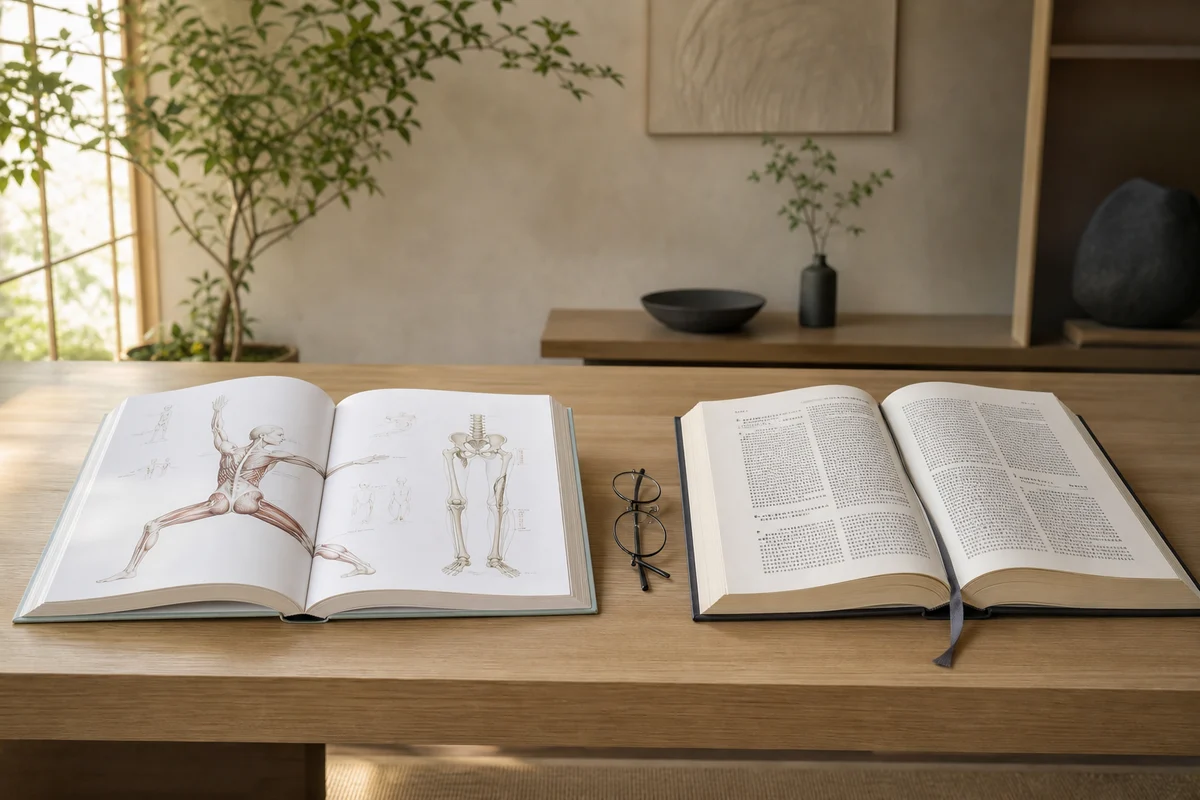
Yoga Anatomy by Leslie Kaminoff and Amy Matthews is the deeper sibling to Swanson's visual introduction. Human Kinetics lists the third edition at 344 pages, copyright 2022, ISBN 9781492596479. That edition matters: it adds context around anatomical language and expands the treatment of breathing, the spine and movement.
The book is organised around principles and pose families rather than simply labelling muscles on photographs. Its enduring value is as a desk reference for practitioners and teachers who expect to revisit chapters, not race from page one to the end.
It is also the easiest book here to buy in the wrong edition. A cheap second-hand copy of an earlier edition can still be useful, but it is not the same product. Check “third edition,” the authors and ISBN when the revision is what you want.
Choose it if: you genuinely want to study anatomy and breath mechanics, take notes and return to a reference over time.
Skip it if: you want your first friendly yoga overview or a book you can absorb in one weekend.
Publisher: Yoga Anatomy, Third Edition.
5. The Heart of Yoga — best bridge between practice and philosophy
T. K. V. Desikachar's The Heart of Yoga: Developing a Personal Practice is the strongest single book here for connecting physical practice, breath, adaptation and philosophy. The current English publisher page describes a revised 1999 edition from Inner Traditions, including Desikachar's commentary on the Yoga Sutras and additional material by his teacher and father, T. Krishnamacharya.
Its central strength is that yoga should be adapted to the individual rather than forcing every individual into one fixed system. That makes it feel surprisingly current beside books that treat a pose photograph as a universal blueprint.
It is not neutral history. It comes from a specific teacher-student lineage, vocabulary and approach. Read it as an influential, coherent perspective—not the only legitimate account of yoga.
Choose it if: you want one thoughtful volume that moves beyond poses without dropping you straight into a 600-page philosophical commentary.
Skip it if: you only want large photographs, quick pose lookup or contemporary exercise science.
Publisher: The Heart of Yoga by T. K. V. Desikachar.
6. The Yoga Sutras of Patanjali, Edwin Bryant — best for serious philosophy study
There is no neutral “the” English Yoga Sutras. Every edition chooses a translation and a commentary, and those choices shape what the short Sanskrit aphorisms appear to mean. Edwin F. Bryant's edition is the pick here because it does not hide that interpretive work.
Macmillan describes a volume that presents each sutra in Sanskrit, transliteration and English, followed by commentary grounded in classical traditions. At close to 600 pages, it provides historical and philosophical context rather than turning isolated sutras into social-media quotations.
That depth is the reason to buy it and the reason not to start here. If you are only beginning to wonder whether yoga extends beyond postures, The Heart of Yoga is the gentler entry. Bryant is for the reader ready to sit with terms, competing interpretations and extensive notes.
Choose it if: primary-text study, translation detail and traditional commentary are the actual goal.
Skip it if: you want a casual first introduction, pose guidance or a book to skim.
Publisher: The Yoga Sutras of Patanjali translated by Edwin F. Bryant.
What about Light on Yoga?
B. K. S. Iyengar's Light on Yoga deserves a place in any serious conversation about influential modern yoga books. First published in the 1960s, it combines philosophy, detailed pose descriptions, photographs and sequences and helped shape how asana was presented internationally.
It is not one of the six task-specific winners because “important” and “best first purchase” are different claims. The book's prescriptive photographs and sequences come from a particular lineage and era. A modern beginner may get more usable adaptation from Bondy, clearer contemporary illustration from Swanson and a gentler practice-philosophy bridge from Desikachar.
Read Light on Yoga for historical influence and depth, not because every body should reproduce every pictured shape. The official Penguin Random House listing remains available for checking the current edition.
How to choose one book instead of six
Start with the sentence you want the book to complete:
- “I want a welcoming visual reference” → Yoga for Everyone.
- “I want a voice that challenges who yoga is shown to be for” → Every Body Yoga.
- “I want to see what is happening inside a pose” → Science of Yoga.
- “I want to study anatomy seriously” → Yoga Anatomy, Third Edition.
- “I want practice and philosophy to make sense together” → The Heart of Yoga.
- “I want a deep, contextual Yoga Sutras commentary” → Edwin Bryant.
Buying several respected books at once often produces a respected unread stack. One clear reading job is better. Use a library or publisher preview to check layout, type size and tone before committing; the “best” text is useless if its format makes you avoid opening it.
A book is a companion, not a spotter
Books are excellent for language, context, reflection and slow study. They cannot watch your balance shift, notice that you are holding your breath or distinguish ordinary effort from a warning sign. Pose photographs also freeze one body at one moment; they are examples, not compulsory geometry.
Use books alongside appropriate teaching, especially for inversions, advanced breathing practices, injury return, pregnancy or health conditions. The yoga for beginners guide explains what to expect from a first class, and Hatha vs Vinyasa helps choose a suitable class format. If a book introduces a sequence such as Sun Salutation, learn its context before treating the page as a performance target.
The verdict
For most complete beginners, start with Yoga for Everyone. It is visual, approachable and built around adaptation rather than a single ideal body. Choose Science of Yoga when curiosity is anatomical, and The Heart of Yoga when the question is what practice means beyond the shapes.
The deeper references—Yoga Anatomy and Bryant's Yoga Sutras—are excellent precisely because they do not pretend to be quick. Buy them when study is the intention, not because a “serious yoga bookshelf” apparently requires them.
Frequently asked questions
What is the best yoga book for a complete beginner?
Yoga for Everyone by Dianne Bondy is the most approachable first pick in this list because it is visual, practical and explicitly designed for different bodies and abilities. Pair any pose book with a beginner-level teacher or class; a page cannot observe your movement or adapt to an injury.
What is the best yoga anatomy book?
Science of Yoga by Ann Swanson is the easier visual introduction, while the third edition of Yoga Anatomy by Leslie Kaminoff and Amy Matthews is the deeper reference. Choose Swanson if you want accessible illustrated explanations; choose Kaminoff and Matthews if you expect to study anatomy rather than browse it.
Which yoga philosophy book should a beginner read first?
The Heart of Yoga by T. K. V. Desikachar is a gentler bridge between practice and philosophy than a dense primary-text commentary. For a much deeper study of the Yoga Sutras, Edwin Bryant's translation and traditional commentary is the stronger reference but not the easiest first yoga book.
Is Light on Yoga still worth reading?
Yes, as an influential historical reference, but not necessarily as the best first or only modern instruction manual. Its photographs, sequencing and prescriptive presentation come from a particular lineage and era. Read it for context and depth, then compare it with current body-inclusive and anatomy-aware sources.
Can you learn yoga safely from a book?
A book can teach vocabulary, history, anatomy concepts and reflection, but it cannot see how you move or respond to pain. Use books to support rather than replace appropriate instruction, especially for inversions, strong breathing practices, injuries, pregnancy or health conditions.
Frequently asked questions
What is the best yoga book for a complete beginner?
Yoga for Everyone by Dianne Bondy is the most approachable first pick in this list because it is visual, practical and explicitly designed for different bodies and abilities. Pair any pose book with a beginner-level teacher or class; a page cannot observe your movement or adapt to an injury.
What is the best yoga anatomy book?
Science of Yoga by Ann Swanson is the easier visual introduction, while the third edition of Yoga Anatomy by Leslie Kaminoff and Amy Matthews is the deeper reference. Choose Swanson if you want accessible illustrated explanations; choose Kaminoff and Matthews if you expect to study anatomy rather than browse it.
Which yoga philosophy book should a beginner read first?
The Heart of Yoga by T. K. V. Desikachar is a gentler bridge between practice and philosophy than a dense primary-text commentary. For a much deeper study of the Yoga Sutras, Edwin Bryant's translation and traditional commentary is the stronger reference but not the easiest first yoga book.
Is Light on Yoga still worth reading?
Yes, as an influential historical reference, but not necessarily as the best first or only modern instruction manual. Its photographs, sequencing and prescriptive presentation come from a particular lineage and era. Read it for context and depth, then compare it with current body-inclusive and anatomy-aware sources.
Can you learn yoga safely from a book?
A book can teach vocabulary, history, anatomy concepts and reflection, but it cannot see how you move or respond to pain. Use books to support rather than replace appropriate instruction, especially for inversions, strong breathing practices, injuries, pregnancy or health conditions.