

Who it is for
People who want a gradual chair-yoga calendar
Duration
Short sessions across 28 days
Experience
Beginner · progressive
You need
Stable chair and a way to track completed sessions
Safety
Repeat or skip days as needed; a calendar is not a reason to practise through symptoms.
How this page has changed
July 26, 2026
Sources, internal links and safety or product context reviewed.
In this guide
This is a free 28-day chair yoga plan for seniors. It runs four weeks, starts at about six minutes a day, and builds to a full seated round of roughly fifteen. Everything is on this page — no sign-up, no email, no PDF to download. Print it if that helps, and tick the days off as you go.
The plan uses the twelve poses from our chair yoga for seniors guide, sequenced so that nothing arrives before you have practised the pieces it is built from. That is the whole design: it is our own ordering of moves we already teach, not a clinical programme.
This is educational movement guidance, not medical advice. Check with your doctor first if you have a health condition, a recent surgery, or balance problems, and stop anything that hurts.
By Marvin Smit · Long-time practitioner, not a certified instructor.
Before you start
You need one thing: a sturdy dining chair with four legs and no wheels, low enough that your feet rest flat on the floor. Not an armchair, not an office chair.
A few habits that make the month easier:
- Pick a time and keep it. Same chair, same part of the day. The plan is short enough to attach to something you already do, like after breakfast.
- Sit forward, not back. Perch toward the front of the seat with a hand's width behind you, unless a pose says otherwise.
- Water within reach, and stop if you feel dizzy or short of breath.
- A lighter day is a real day. Day 7 of each week is deliberately easy, and it counts.
Week 1 — Settling in (about 6 minutes)
Four moves. The point of this week is not exercise, it is turning up.
| Day | What you do |
|---|---|
| 1 | Seated Mountain · Shoulder Rolls · Ankle Circles · Rest and Breathing |
| 2 | Same four, one extra round of Shoulder Rolls |
| 3 | Same four, hold Seated Mountain for five slow breaths |
| 4 | Same four |
| 5 | Same four, add a second set of Ankle Circles |
| 6 | Same four, unhurried |
| 7 | Lighter day: Seated Mountain and Rest and Breathing only |
If any of these are new, read the how-to for each in the main guide before you start — it covers the breath and the safety cue for every pose.
Week 2 — Waking up the spine (about 9 minutes)
Three new moves join: Seated Cat-Cow, Seated Side Bend, and Heel and Toe Raises.
| Day | What you do |
|---|---|
| 8 | Week 1 four, then add Cat-Cow |
| 9 | Add Side Bend, both sides |
| 10 | All six, in order |
| 11 | All six, one extra round of Cat-Cow |
| 12 | Add Heel and Toe Raises |
| 13 | All seven, slowly |
| 14 | Lighter day: Mountain · Cat-Cow · Rest |
Week 3 — Rotation and reach (about 12 minutes)
Three more: Seated Spinal Twist, Seated Eagle Arms, Seated Warrior Arms. This is the week where the everyday benefits usually start to show — turning to look behind you, reaching a shelf.
| Day | What you do |
|---|---|
| 15 | Week 2 seven, then add Spinal Twist, both sides |
| 16 | All eight, keeping the twist small |
| 17 | Add Eagle Arms |
| 18 | All nine, in order |
| 19 | Add Warrior Arms, holding a few breaths |
| 20 | All ten, unhurried |
| 21 | Lighter day: Mountain · Shoulder Rolls · Spinal Twist · Rest |
Week 4 — The full round (about 15 minutes)
The last two arrive: Seated Forward Fold and the Seated Figure-Four Stretch. Skip the Figure-Four if you have a hip or knee replacement unless your professional has cleared it, and come up slowly from the Forward Fold.
| Day | What you do |
|---|---|
| 22 | Week 3 ten, then add Forward Fold |
| 23 | All eleven, coming up slowly |
| 24 | Add Figure-Four, both sides — or skip it and repeat Ankle Circles |
| 25 | The full twelve, in order |
| 26 | The full twelve, holding each a breath longer |
| 27 | The full twelve, as slowly as you can |
| 28 | Your round: the twelve, or only the ones you have come to like |
What to do on day 29
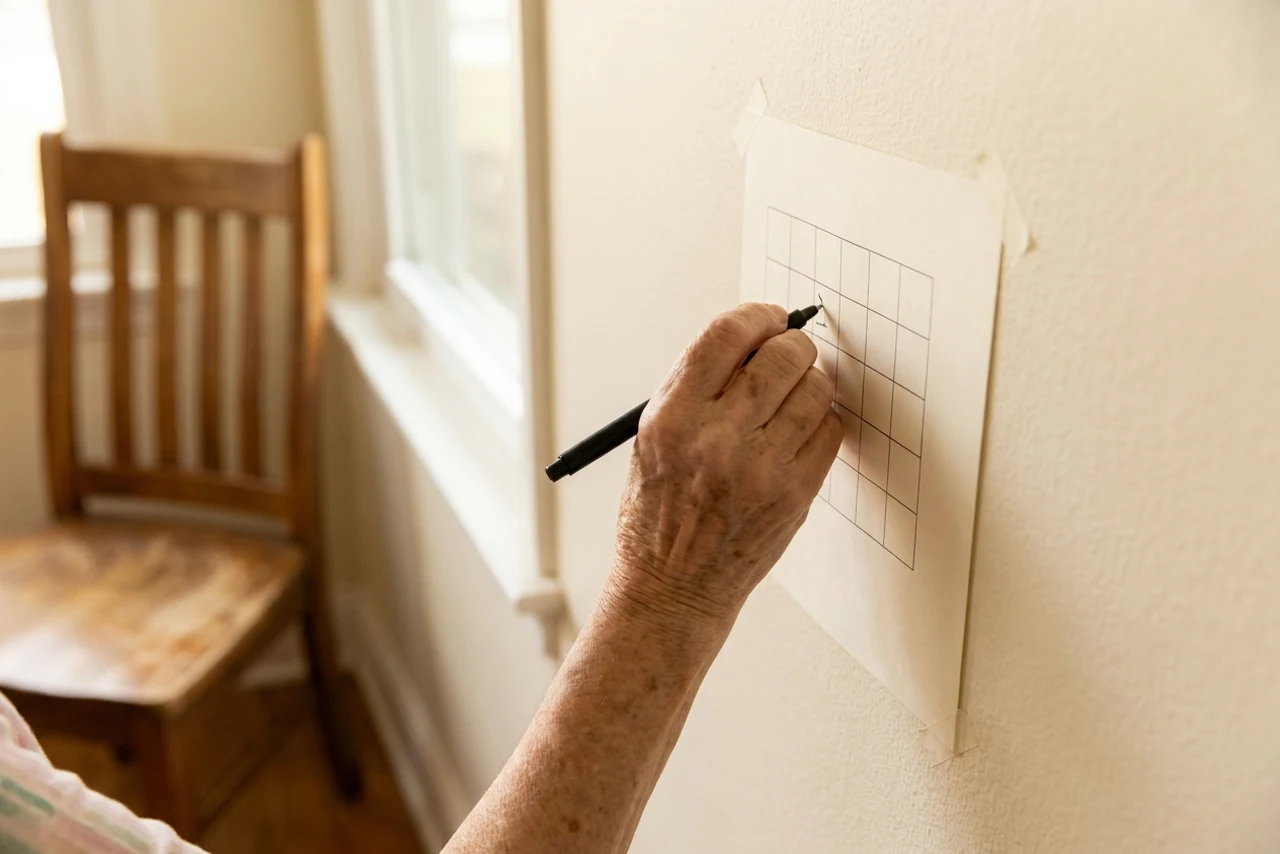
Start again at Week 1, or go straight to the full round from Week 4 and treat it as your daily routine. Both work. The printable chart is the version to tape near the chair once you no longer need the day-by-day structure.
If you would rather follow along with someone on screen, our guide to free chair yoga videos covers what to look for in a good one — and the pause button that makes home practice easier than a class.
How to print this plan
Use your browser's print command — Ctrl+P on Windows, Cmd+P on a Mac. The four week tables print cleanly on paper. Tape the page somewhere you will see it in the morning, and use a pen: ticking a box is a surprisingly reliable way to keep a habit alive.
Related reading
- Chair yoga for seniors — the full how-to for all twelve poses, with the safety cue for each
- Printable chair yoga chart — the one-page routine for after the 28 days
- Free chair yoga for seniors — following along with free videos at home
- Chair yoga for beginners — if you are new to this and not a senior
Frequently asked questions
Is 28 days of chair yoga enough to see a difference?
Many people notice small, practical changes within a few weeks — reaching a top shelf more easily, turning further to check behind them, feeling steadier standing up. Research on older adults links regular gentle movement to better mobility and daily function. What 28 days really buys you is the habit; the plan is built so you can simply start again at Week 1.
Do I need to do chair yoga every single day?
No. This plan has a lighter day at the end of each week, and skipping a day does not undo anything. If you miss several days, pick up where you left off rather than trying to catch up. Consistency over a month matters far more than any single session.
How long does each day take?
Week 1 is about six minutes, Week 2 around nine, Week 3 about twelve, and Week 4 roughly fifteen. If that is too much on a given day, do half. A short session you actually do beats a long one you skip.
What chair should I use?
A sturdy dining chair with four legs and no wheels, low enough that your feet rest flat on the floor. Avoid armchairs, office chairs and anything that swivels or rolls. The full setup is in our chair yoga guide.
Is chair yoga safe if I have arthritis, osteoporosis or a joint replacement?
Many people with these conditions do chair yoga, but this is general educational guidance and not medical advice. Check with your doctor or physiotherapist first, especially with a recent joint replacement, osteoporosis, uncontrolled blood pressure, or any balance or dizziness problem. Stop any movement that causes pain.