How this page has changed
July 26, 2026
Sources, internal links and safety or product context reviewed.
In this guide
- 01The best yoga apps at a glance
- 02First choose: generated sequence or visible teacher
- 031. Down Dog — best for a practice tailored to your time
- 042. Glo — best for a serious teacher-led yoga library
- 053. WHO mYoga — best completely free yoga app
- 064. Apple Fitness+ — best for an Apple household
- 075. Alo Moves — best for yoga, strength and skill programs together
- 08A 15-minute trial test that reveals more than star ratings
- 09What a yoga app cannot do
- 10The verdict
- 11Frequently asked questions
If you need timing rather than a class or content library, use the meditation timer guide to compare browser, app and physical chime formats by screen-lock reliability, offline use, privacy, audio routing and power.
The best yoga app is Down Dog if you want a session built around your available time, level, pace and focus. Choose Glo instead when seeing a specific teacher and browsing a deep class library matters more than generating a different sequence. For a genuinely free, account-free start, WHO mYoga is the clearest choice.
Apple Fitness+ is the convenient all-fitness option for an Apple household, while Alo Moves suits people who want yoga alongside polished strength, mobility and skill programs. Those are different jobs. Ranking them with one universal score would hide the decision that matters most: how do you want to be taught?
This is a source-checked feature comparison, updated July 26, 2026. It is not a claim that The Yoga Sensei completed months of hands-on testing in every app. Features, prices and trials were checked against provider and app-store pages; exact checkout prices can vary by country, platform, tax and promotion. There are no affiliate links or paid placements on this page.
The best yoga apps at a glance
| App | Best for | Teaching format | Cost signal checked July 2026 | Main trade-off |
|---|---|---|---|---|
| Down Dog | Personalized home sessions | Generated practice with selectable variables | Free download; paid access offered in-app | Less connection to a named teacher |
| Glo | A deep yoga-first library | Recorded teachers, live classes and programs | Premium subscription after a 7-day trial | Highest listed price here |
| WHO mYoga | A genuinely free, private start | Fixed learning and practice videos/audio | Free; no account required | Smaller, simpler library |
| Apple Fitness+ | Apple users who want more than yoga | Studio-style video across 12 workout types | Lower-cost subscription after a trial | Yoga is one category in a broad fitness service |
| Alo Moves | Yoga plus strength and skill work | Instructor-led classes and multi-class series | Mid-priced subscription after a 14-day trial | Broader wellness aesthetic may be more than you need |
Prices above are snapshots, not promises. Open the final checkout screen and note the renewal date before starting any trial.
| Your non-negotiable | Start with | Why |
|---|---|---|
| Session length and pace must change every day | Down Dog | Those variables shape each generated practice |
| You want to follow a named teacher over time | Glo | Teachers, programs and live classes organize the library |
| No fee, account or personal-data collection | WHO mYoga | WHO explicitly documents all three |
| One service should cover family fitness | Apple Fitness+ | Yoga shares the subscription with eleven other workout types |
| Yoga should connect to strength and skills | Alo Moves | Its catalog deliberately crosses those categories |
First choose: generated sequence or visible teacher
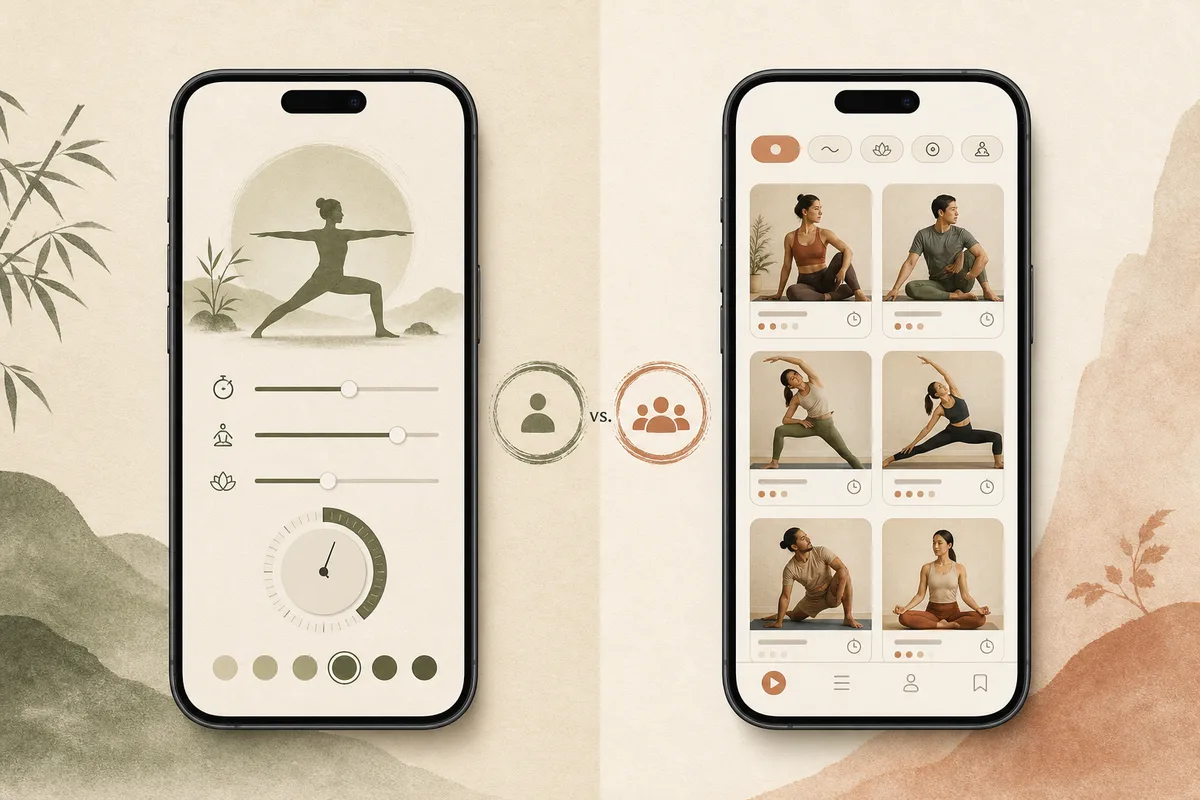
Yoga apps mostly split into two experiences. Down Dog asks for variables and assembles a session: useful when you have 18 minutes, prefer a particular pace or want variety without browsing. Glo, Apple Fitness+ and Alo Moves ask you to choose a class or program led by a visible instructor: useful when voice, personality, sequencing style and continuity matter.
Neither model is automatically more authentic or safer. A generated sequence can be efficient but may feel impersonal. A teacher-led video can explain context more naturally but still cannot see you. WHO mYoga sits between the two: fixed expert-developed material without the commercial library or personalization layer.
1. Down Dog — best for a practice tailored to your time
Down Dog is the clearest overall pick because it solves the most common home-practice problem: finding something appropriate without spending ten minutes scrolling. Its official page lets users select time, level, focus, voice and music. The current Google Play listing also describes more than ten yoga styles, a Beginner 1 level and focus controls for specific areas.
The experience is not the same as following one teacher's carefully filmed course. Down Dog builds a new configuration from your settings. That provides variety and makes a ten-minute session as deliberate as a longer one, but people who learn through a teacher's recurring cues and personality may prefer Glo.
Choose it if: time changes daily, you dislike library paralysis, or you want granular control over pace and focus.
Skip it if: instructor identity, live community or a coherent multi-week course is central to your motivation.
Check the current options at Down Dog. Its store listing says the app is free to download with in-app purchases; confirm the subscription offered on your device rather than relying on a price quoted in an old roundup.
2. Glo — best for a serious teacher-led yoga library
Glo is the strongest yoga-first library in this shortlist. Its official yoga page currently advertises 8,000 yoga videos across twelve styles, plus downloads, live classes and beginner programming. The broader service also includes Pilates, meditation, fitness, walking and education.
That depth is valuable when you want to compare teachers, stay with one instructor or move from an introductory program into Hatha, Vinyasa, Yin or Restorative work without changing platforms. It can also be excessive for somebody who only wants a quick prompt each morning.
Glo's US yoga page listed a seven-day trial, $30 monthly and $245 annually when checked. Those figures make the trial a real decision period, not a formality. Test search, filtering, cue clarity and whether you can repeatedly find an appropriate class in under two minutes.
Choose it if: a visible teacher, a broad yoga catalog and structured programs justify a premium subscription.
Skip it if: you mainly want short generated sequences or know that a large catalog makes you browse instead of practise.
Explore the current library and checkout terms on Glo's official yoga page.
3. WHO mYoga — best completely free yoga app
WHO mYoga is the honest free recommendation. The World Health Organization says the app is available for Android and iOS, requires no account and collects no user data. It contains video and audio learning and practice sessions of varying durations and is available in English, French, Spanish and Hindi.
This is not a freemium catalog designed to convert a trial into a recurring subscription. That makes it especially useful when privacy, cost or a low-friction first experiment matters. The compromise is a smaller and less frequently refreshed experience than the commercial apps above.
WHO also states that mYoga is not a diagnostic or medical tool and makes no promise of health outcomes. That is an appropriate limit for every app in this list, whether or not its marketing says so prominently.
Choose it if: you want a free starting point, avoid account creation or prefer a public-health source over a subscription funnel.
Skip it if: personalized sequencing, a very large library, music choices or continuous new programming keep you engaged.
Download it through the official WHO mYoga page, which links to both stores.
4. Apple Fitness+ — best for an Apple household
Apple Fitness+ makes sense when yoga is one part of a wider routine. Apple currently lists twelve workout types plus meditation, sessions from 5 to 45 minutes, weekly additions and filters for trainer, duration and music. Yoga sits alongside strength, Pilates, cycling, dance and other categories.
The advantage is consolidation: one subscription, familiar Apple devices and a broad family-fitness library. The disadvantage is the same breadth. Someone seeking deep exploration of yoga teachers and traditions may find Glo more focused, while an Android-first household should not choose a service around an ecosystem it does not use.
Apple's US page listed a one-month trial followed by $9.99 monthly or $79.99 annually when checked. Availability and pricing vary by country, and eligible device purchases may carry different offers.
Choose it if: your household already uses Apple services and wants yoga inside a varied fitness subscription.
Skip it if: you are outside the supported ecosystem or want yoga to be the organizing center rather than one workout tile.
See the current regional terms on the official Apple Fitness+ page.
5. Alo Moves — best for yoga, strength and skill programs together
Alo Moves combines yoga with fitness, mobility, mindfulness and skill-focused series. Its official catalog shows instructor-led bundles for beginner yoga strength, flexibility, balance, prenatal practice and more technical work. This makes it appealing when your idea of home practice moves between a flow, a strength block and a longer skill progression.
The polished catalog is also why it is not the default beginner winner. A new practitioner who simply wants clear foundational repetition may get more useful constraint from Down Dog's settings or Glo's beginner filters.
The membership information displayed on the catalog page checked offered a 14-day trial followed by $20 per month, with offline downloads through its iOS app. Verify platform support and the actual billing plan offered to you before subscribing.
Choose it if: high-production instructor video and blended yoga, strength and mobility programs match how you train.
Skip it if: you want a yoga-only curriculum, the cheapest option or minimal choice.
Browse current programs and membership wording at Alo Moves.
A 15-minute trial test that reveals more than star ratings
Do not spend a free trial collecting favorites. Complete one genuinely representative beginner session and evaluate the parts that affect repeat use.
| Trial check | What to look for | Warning sign |
|---|---|---|
| Start speed | An appropriate class is easy to find | Browsing takes longer than practising |
| Cue timing | You can follow without staring at the screen | Pose changes arrive before the verbal cue |
| Modification quality | Options are specific and visible | “Listen to your body” replaces usable guidance |
| Audio control | Voice remains clear over music | Music or production distracts from instructions |
| Progression | The next suitable session is obvious | Difficulty jumps without explanation |
| Billing clarity | Renewal date and cancellation path are visible | The trial end or plan length is hard to locate |
Use the same device, room and session length you expect to use normally. A beautiful tablet demo says little if your actual routine involves a phone across the room and ten minutes before work.
What a yoga app cannot do
Video and generated guidance are one-way. An app cannot reliably notice that weight-bearing causes wrist pain, see that you are holding your breath, or distinguish effort from a warning signal. Camera-based feedback can estimate shapes, but it still lacks the context and judgment of a qualified person who can ask questions.
If you are completely new, use the yoga for beginners guide to understand class pace, props and reasonable expectations. Hatha vs Vinyasa helps decode style labels before choosing a filter. For injury return, pregnancy, persistent pain or a medical condition, seek appropriate professional guidance rather than treating personalization settings as a safety assessment.
The verdict
Choose Down Dog when control and convenience matter most. Choose Glo when you want identifiable teachers and a substantial yoga-centered library. Start with WHO mYoga when free access and privacy outrank catalog size.
Apple Fitness+ is the sensible ecosystem choice, and Alo Moves is the polished cross-training choice. The winning app is not the one with the longest feature list. It is the one whose teaching format gets you from “I should practise” to an appropriate session with the least friction.
Frequently asked questions
What is the best yoga app for beginners?
Down Dog is the strongest fit for beginners who want to set a duration, pace and level before every session. Glo is better when you prefer a visible teacher and a structured beginner library. Try the teaching format before paying, because the best interface cannot compensate for guidance you do not enjoy following.
Is there a completely free yoga app?
WHO mYoga is a genuinely free option from the World Health Organization. WHO says it requires no account, collects no user data and provides learning and practice sessions in several languages. Its library is smaller and less personalized than a commercial subscription.
Is Down Dog or Glo better?
Choose Down Dog for generated sessions that adapt to your time, level, pace and focus. Choose Glo for a large on-demand library taught by identifiable teachers, plus live classes and multi-class programs. The distinction is customized sequence versus teacher-led library, not simply cheap versus expensive.
Can a yoga app replace an in-person teacher?
An app can make regular guided practice convenient, but it cannot reliably see your alignment, interpret pain or adapt in real time. A beginner class or qualified teacher remains valuable when you are learning fundamentals, returning from injury, pregnant or managing a health condition.
How should I compare yoga app prices?
Compare the final checkout price in your country, billing period, renewal date, included services and cancellation route. App-store and website prices can differ, taxes and promotions change, and a low annual price is not good value if you dislike the teaching format.
Frequently asked questions
What is the best yoga app for beginners?
Down Dog is the strongest fit for beginners who want to set a duration, pace and level before every session. Glo is better when you prefer a visible teacher and a structured beginner library. Try the teaching format before paying, because the best interface cannot compensate for guidance you do not enjoy following.
Is there a completely free yoga app?
WHO mYoga is a genuinely free option from the World Health Organization. WHO says it requires no account, collects no user data and provides learning and practice sessions in several languages. Its library is smaller and less personalized than a commercial subscription.
Is Down Dog or Glo better?
Choose Down Dog for generated sessions that adapt to your time, level, pace and focus. Choose Glo for a large on-demand library taught by identifiable teachers, plus live classes and multi-class programs. The distinction is customized sequence versus teacher-led library, not simply cheap versus expensive.
Can a yoga app replace an in-person teacher?
An app can make regular guided practice convenient, but it cannot reliably see your alignment, interpret pain or adapt in real time. A beginner class or qualified teacher remains valuable when you are learning fundamentals, returning from injury, pregnant or managing a health condition.
How should I compare yoga app prices?
Compare the final checkout price in your country, billing period, renewal date, included services and cancellation route. App-store and website prices can differ, taxes and promotions change, and a low annual price is not good value if you dislike the teaching format.