

How this page has changed
August 4, 2026
Sources, internal links and safety or product context reviewed.
In this guide
Quick answer. Bedtime yoga is a short, low-intensity practice designed to help you shift out of the day's pace. Ten minutes is enough: choose supported floor poses, keep every stretch mild, and finish with quiet rest. It may support a calmer bedtime routine, but it is not a treatment for insomnia and cannot guarantee that you will fall asleep.
Bedtime yoga works best when it feels almost deliberately uneventful. This is not the time to chase a deeper forward fold, hold a demanding balance, or turn the sequence into a workout. The useful part is the transition: you put the phone down, lower the lights, move slowly, and give the evening a clear stopping point.
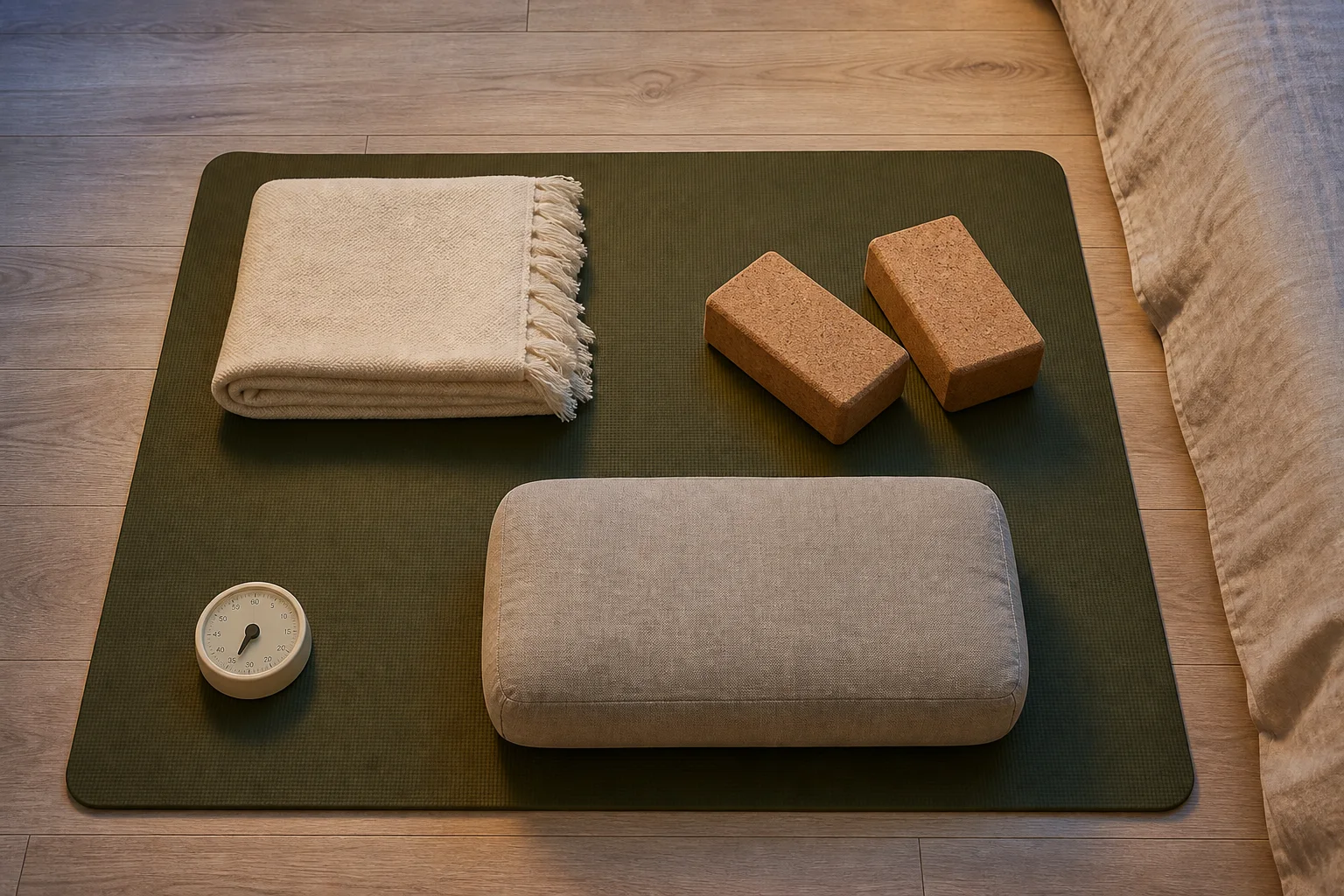
The routine below uses six beginner-friendly stages and takes about ten minutes. You can do it on a yoga mat, a rug that does not slide, or a clear patch of carpet. A blanket and firm cushion are helpful but optional.
This is general educational guidance, not medical care. If you are pregnant, recovering from surgery, managing an injury or balance condition, or have been advised to limit certain movements, ask an appropriate clinician or qualified yoga teacher for individualized guidance.
At a glance
| Time | About 10 minutes |
| Level | Beginner; keep every position easy |
| Intensity | Low, floor-based, no strong flow |
| Useful props | A folded blanket, two blocks, or one firm cushion |
| Main idea | Use gentle movement as a repeatable wind-down cue |
| Skip it when | Movement increases pain, dizziness, breathlessness, or alertness |
Can yoga actually help you sleep?
The most accurate answer is: it may help sleep quality for some people, but the evidence does not turn a short sequence into an insomnia treatment.
The National Center for Complementary and Integrative Health says yoga and tai chi may improve sleep quality, while noting that this does not necessarily mean they treat insomnia. A systematic review of 19 randomized trials in women with sleep problems also found an overall improvement in reported sleep outcomes, but the included groups, yoga programs, durations, and study quality varied. Those studies examined ongoing interventions, not a guarantee from doing six poses tonight.
That distinction matters. Think of bedtime yoga as one possible part of a wind-down routine, alongside a consistent schedule and a bedroom that supports sleep. If sleep trouble is persistent, severe, or affecting daytime functioning, speak with a healthcare professional. Evidence-based care such as cognitive behavioral therapy for insomnia may be more appropriate than adding another wellness routine.
If you prefer guided stillness to physical poses, our Yoga Nidra for sleep guide explains a 15-minute body-awareness practice, recording choices, and supported lying options.
Set up a quieter practice
You do not need dedicated sleep accessories. Make the space safe and simple:
- Lower the light enough to feel calm, but keep the floor visible. You should still see mat edges and props clearly.
- Move the phone out of reach. If you use it as a timer, set one quiet alarm before you begin and place it face down.
- Choose firm support. A tightly folded yoga blanket or firm cushion is easier to position than a very soft bed pillow.
- Keep the room comfortably cool. Do not add heat simply because a pose is labeled restorative.
- Wear ordinary comfortable clothes. Nothing needs to match a studio outfit.
A gentle 10-minute bedtime yoga routine
Move at a pace that lets you breathe normally and change position without rushing. The times are suggestions, not targets. If one setup feels settled, stay there; if it does not, leave it.
1. Arrive in a comfortable seat — 1 minute
Sit cross-legged on a folded blanket, kneel with support, or use a firm chair with both feet on the floor. Let the hands rest. Take several ordinary breaths and notice whether you are holding the jaw or shoulders tense.
Do not force a particular breathing ratio. A quiet, unforced exhale is enough. If focusing on the breath makes you uncomfortable or light-headed, keep your eyes open and simply notice the contact of your feet or sitting bones.
2. Slow Cat-Cow — about 1 minute
Come to hands and knees, placing padding under the knees if useful. On an inhale, make a small comfortable arch. On an exhale, gently round the back. Repeat about six times.
Keep the movement smaller than you might in a daytime class. If bearing weight through the wrists is uncomfortable, place the forearms on the seat of a stable chair and make the same gentle spinal movement while standing.
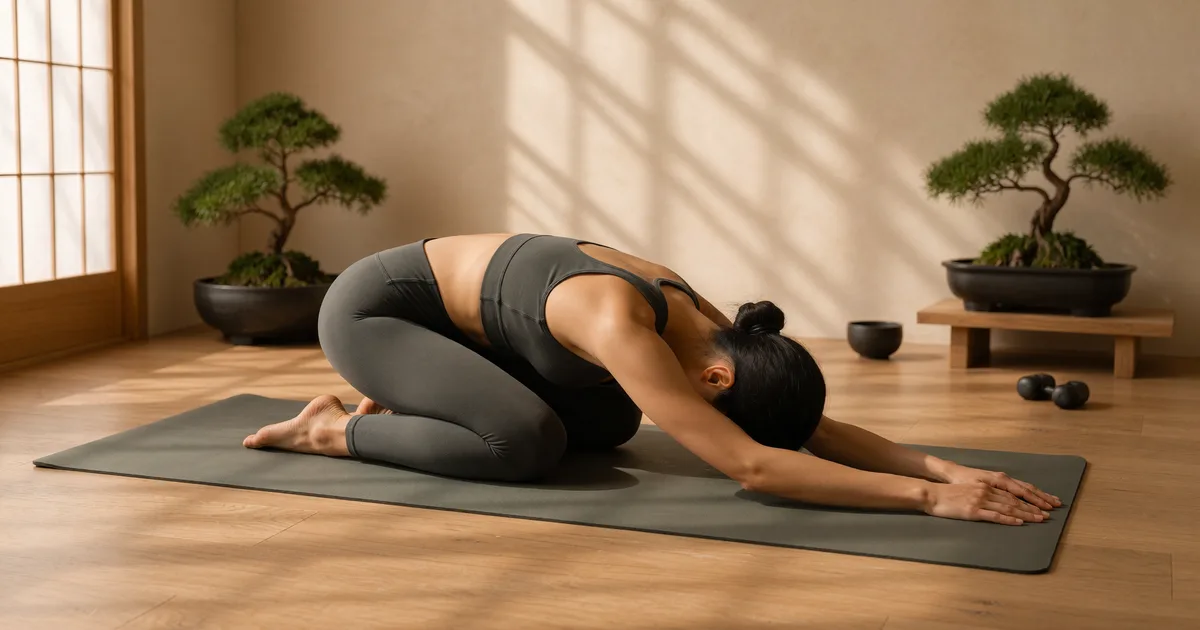
3. Supported Child's Pose — 1 to 2 minutes
Bring the hips toward the heels and separate the knees only as far as comfortable. Rest the torso on a firm cushion or stacked blankets, or keep the hips higher and support the forehead on a block. Turn the head only if the neck feels neutral, and change sides halfway.
Our Child's Pose guide covers knee, hip, shoulder, and chair-supported variations. Skip the kneeling version if it compresses the knees or ankles.
4. Easy seated fold — about 1 minute
Sit on a folded blanket with both legs in front and the knees comfortably bent. Place the hands beside the thighs and hinge forward a small amount from the hips. Stop well before the back or hamstrings feel strained.
This does not need to look like a deep forward fold. You can also sit facing a chair and rest the forearms on its seat. Avoid pulling on the feet to manufacture more range.
5. Supported reclining butterfly — 2 to 3 minutes
Build a gentle slope from firm cushions or folded blankets, then recline so the head and upper back are supported. Bring the soles of the feet together only if that is comfortable. Place a block or cushion under each outer thigh so the knees do not hang in space.
Prefer keeping the knees bent with feet apart if the groin, hips, or lower back feel pulled. To come out, use the hands to help the knees toward each other, roll to one side, and pause before sitting up.
6. Constructive rest — 2 minutes
Lie on your back with the knees bent and feet on the floor, about hip-width apart. Let the knees point toward the ceiling or rest gently against each other. Another option is to place the lower legs on the bed or a chair seat, provided the setup feels stable.
Stay for roughly two minutes without trying to achieve anything. Then roll to one side and come up slowly. The routine ends here; adding a strong final stretch usually defeats the point.
What should bedtime yoga feel like?
Use three practical checks:
- Your breathing stays easy. You should be able to speak a complete sentence.
- The stretch stays mild. A quiet sensation is enough; sharpness, pinching, tingling, or numbness is a reason to stop.
- You feel less activated, not more. If floor work makes you restless, substitute two minutes of comfortable seated breathing or skip yoga entirely.
According to NCCIH's yoga safety guidance, yoga is generally considered safe for healthy people when practiced appropriately, but sprains and strains can occur. Beginners are advised to avoid extreme practices and forceful breathing. That is especially sensible late in the day, when the goal is consistency rather than intensity.
Five-minute and 20-minute versions
If you have five minutes
Do one minute seated, two minutes of supported Child's Pose or a chair-supported alternative, and two minutes of constructive rest. Removing transitions makes the routine easier to start on busy nights.
If you have 20 minutes
Do not make every pose deeper. Instead, add time to the comfortable supported positions: two minutes of Cat-Cow and seated movement, four minutes in supported Child's Pose, four minutes in reclining butterfly, and five minutes of constructive rest.
A longer routine should feel more spacious, not more ambitious.
Common bedtime-yoga mistakes
- Choosing a fast flow because it feels more productive. If it raises your heart rate or leaves you alert, move it earlier in the day.
- Practicing in bed without checking the surface. A soft mattress changes balance and joint support. Use the floor for transitions unless the movement is specifically adapted for bed.
- Forcing a forward fold. Range is not the goal. Bend the knees and use a chair.
- Using props that collapse. Very soft pillows may let the knees or head sink unpredictably; fold a blanket firmly or use stable blocks.
- Treating the routine as a test you can fail. Ten quiet minutes can still be useful even on a night when sleep takes time.
Make it repeatable
Pair the routine with one reliable cue: after brushing your teeth, after setting the alarm, or when the bedroom light changes. Leave the blanket folded where you can reach it. Start with five minutes for a week before deciding whether ten feels better.
If you also practice in the morning, keep the two routines distinct. Our morning yoga routine uses standing work and gentle heat to begin the day; bedtime yoga removes those energizing elements. Beginners who want a broader foundation can start with the complete yoga-for-beginners guide.
The best bedtime routine is not the longest one. It is the one that feels safe, requires almost no negotiation, and leaves the rest of the night alone.
Frequently asked questions
Is it okay to do yoga before you go to bed?
Yes, for most healthy adults, provided the practice is gentle and comfortable. Keep the room calm, choose slow floor-based movements, and stop if you feel pain, dizziness, numbness, or shortness of breath. A vigorous flow may feel energizing, so save that for earlier if it makes you more alert.
What is the best yoga to do before bed?
There is no single best style. A short sequence of slow Cat-Cow, supported Child's Pose, an easy seated fold, supported reclining butterfly, and constructive rest is a practical starting point. Restorative or gentle hatha classes may also fit; intensity matters more than the label.
Is bedtime yoga good for you?
Bedtime yoga can be a useful low-intensity wind-down habit, and research suggests yoga may help sleep quality for some groups. That does not mean one short routine treats insomnia or guarantees sleep. Persistent sleep problems deserve advice from a qualified healthcare professional.
What is bedtime yoga called?
It is commonly called bedtime yoga, evening yoga, or a wind-down practice. Restorative yoga and yin yoga may be used in evening classes, but they are distinct styles rather than alternative names for every bedtime routine.