
How this page has changed
July 26, 2026
Sources, internal links and safety or product context reviewed.
In this guide
- 01Best yoga blankets at a glance
- 02What makes a yoga blanket different?
- 03Five source-checked choices
- 04Fold retention and usable height
- 05Size, weight and portability
- 06Cotton versus blended fibers
- 07Washing, shrinkage and shedding
- 08Yoga blanket versus towel, bolster and meditation cushion
- 09Buying checklist
- 10The verdict
- 11Frequently asked questions
The best yoga blanket is a dense, washable woven blanket that holds an even fold without becoming unnecessarily heavy. For most home users, a large cotton or cotton-rich model with finished edges is the strongest all-purpose choice. A lighter Mexican-style blend is easier to carry; a heavier weave creates a more substantial stack; and a broad brushed cotton blanket favors coverage.
This comparison uses current manufacturer specifications and does not claim hands-on testing. It evaluates the blanket as equipment—fiber, dimensions, mass, weave, edges and care—not as treatment or a substitute for qualified instruction.
Best yoga blankets at a glance
| Best for | Source-checked option | Size | Weight | Material |
|---|---|---|---|---|
| Best overall cotton-rich | Manduka Essential Cotton | 68 × 82 in | 3 lb | 80% recycled cotton, 15% recycled polyester, 5% recycled viscose |
| Best 100% cotton | b, halfmoon Everyday | 60 × 80 in | Not published | 100% cotton |
| Best broad organic cotton | Yogamatters Organic Cotton | 59 × 90.6 in | 2.65 lb | 100% organically grown cotton |
| Best lighter Mexican style | Hugger Mugger Mexican | 48 × 73 in | 2.2 lb | 50% acrylic, 40% polyester, 10% cotton |
| Best heavier Mexican style | Yoga Accessories Deluxe | 54 × 78 in | About 3 lb | 50% acrylic, 40% polyester, 10% cotton |
These are specification-based format picks, not laboratory rankings. Prices, colors and availability change, so verify the maker page and return terms before ordering.
What makes a yoga blanket different?
A useful prop blanket is woven densely enough to create repeatable layers, large enough for multiple folds and finished so its edges do not create unpredictable lumps. A decorative throw may be warm but too stretchy, fluffy or loosely knitted for a compact stack. A quilt can be broad but its batting and stitched channels may produce uneven thickness.
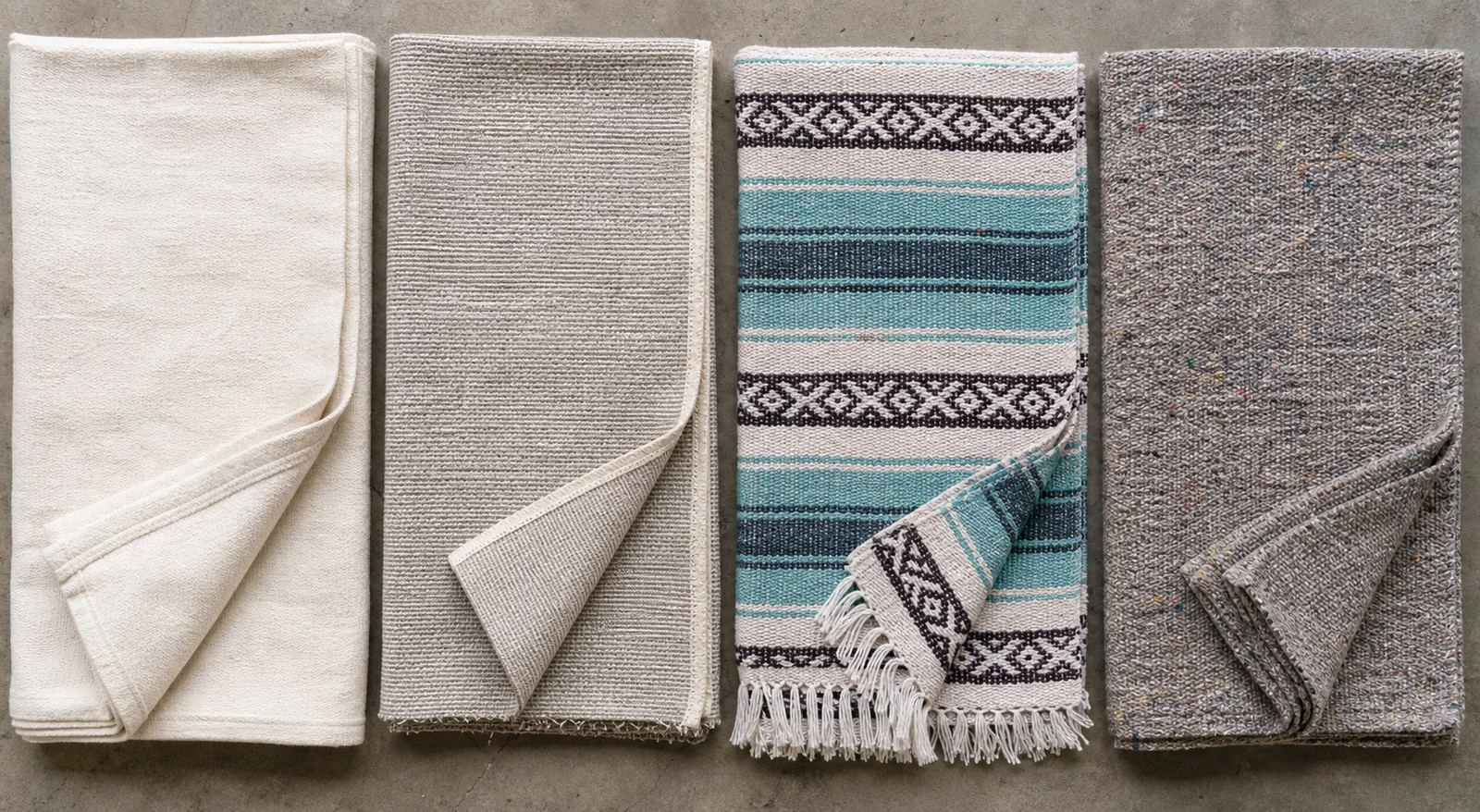
Four details matter more than pattern:
- weave density influences how firmly a folded layer resists spreading;
- surface finish changes softness, shedding and friction against other layers;
- edge construction affects bulk and fraying;
- mass per area helps distinguish a substantial textile from one that is merely large.
No current manufacturer in this shortlist publishes standardized fold-compression data. Therefore, “supportive,” “firm” and “dense” remain qualitative claims. Dimensions and weight offer a more auditable comparison.
Five source-checked choices
Best overall cotton-rich: Manduka Essential Cotton Yoga Blanket
Manduka’s current Essential measures 68 × 82 inches, weighs 3 pounds and uses 80% recycled cotton, 15% recycled polyester and 5% recycled viscose. It is hand-loomed in India, and Manduka warns that handmade dimensions can vary.
That specification balances broad coverage with a moderate three-pound mass. The high cotton share gives buyers a clearer material picture than a generic “recycled blanket” claim, while the polyester and viscose mean it is not a mono-material cotton product.
Care is unusually explicit: machine wash cold separately, do not bleach, hang dry and iron low if needed. Manduka says warm washing or tumble drying can cause shrinkage. Choose this when size, cotton-rich content and air-dry care fit your home routine.
Best 100% cotton: b, halfmoon Everyday Blanket
The b, halfmoon Everyday Blanket measures 60 × 80 inches, uses 100% cotton, has flat selvage edges and is hand-loomed in India. The maker instructs a gentle cold wash and hang drying, noting that new fibers may shed less over time and washing.
Flat selvage edges are relevant because bulky binding or long fringe can interrupt an otherwise even stack. The product page does not publish weight, so it cannot be fairly ranked for travel or density against the measured alternatives. This is the best-defined all-cotton choice, not a proven light or heavy one.
Best broad organic-cotton format: Yogamatters Organic Cotton
Yogamatters lists 230 × 150 centimeters—about 90.6 × 59 inches—and 1.2 kilograms or about 2.65 pounds. It uses 100% organically grown cotton and a thin hem on all four sides. Its long 90.6-inch dimension makes it the broadest coverage format in this shortlist.
The brushed finish creates softness but also a disclosed trade-off: lifted cotton fibers can shed, especially onto dark clothing and cushions. Yogamatters says machine washing may reduce shedding but may not stop it. The care route is a 30°C machine wash, dark colors separated and ample unfolded air-drying time; a slow spin is advised if spinning is necessary.
“Organically grown cotton” describes the stated fiber. Do not expand that into chemical-free, hypoallergenic or a verified finished-product certification unless the seller supplies evidence for those separate claims.
Best lighter Mexican-style blanket: Hugger Mugger Mexican
Hugger Mugger’s Mexican Yoga Blanket is 73 × 48 inches, 2.2 pounds and hand-woven in Mexico from 50% acrylic, 40% polyester and 10% cotton. It can be machine- or hand-washed cold and tumble-dried low; the maker warns that some shrinkage will occur.
This is the smallest and lightest measured option in the group. That makes it the clearest carry candidate, but lower mass and narrower width are not automatically better for a firm multi-layer stack. The striped Mexican appearance also does not imply cotton: nine tenths of this published blend is acrylic and polyester.
Best heavier Mexican-style format: Yoga Accessories Deluxe
The Deluxe Mexican Yoga Blanket from Yoga Accessories measures 78 × 54 inches and weighs about 3 pounds. It uses the same published 50/40/10 acrylic-polyester-cotton ratio as the lighter Hugger Mugger example, but the larger dimensions and higher mass indicate a different physical package.
It is handwoven, so standardization is not guaranteed, and tassel colors may vary. Care is machine wash cold with tumble dry low or hang drying. Pick this format when a more substantial Mexican-style weave is worth roughly 0.8 pound of additional carry weight.
Fold retention and usable height
A blanket has no single thickness. Each fold doubles the number of layers while reducing footprint. Fiber loft, weave and load then determine compressed height.
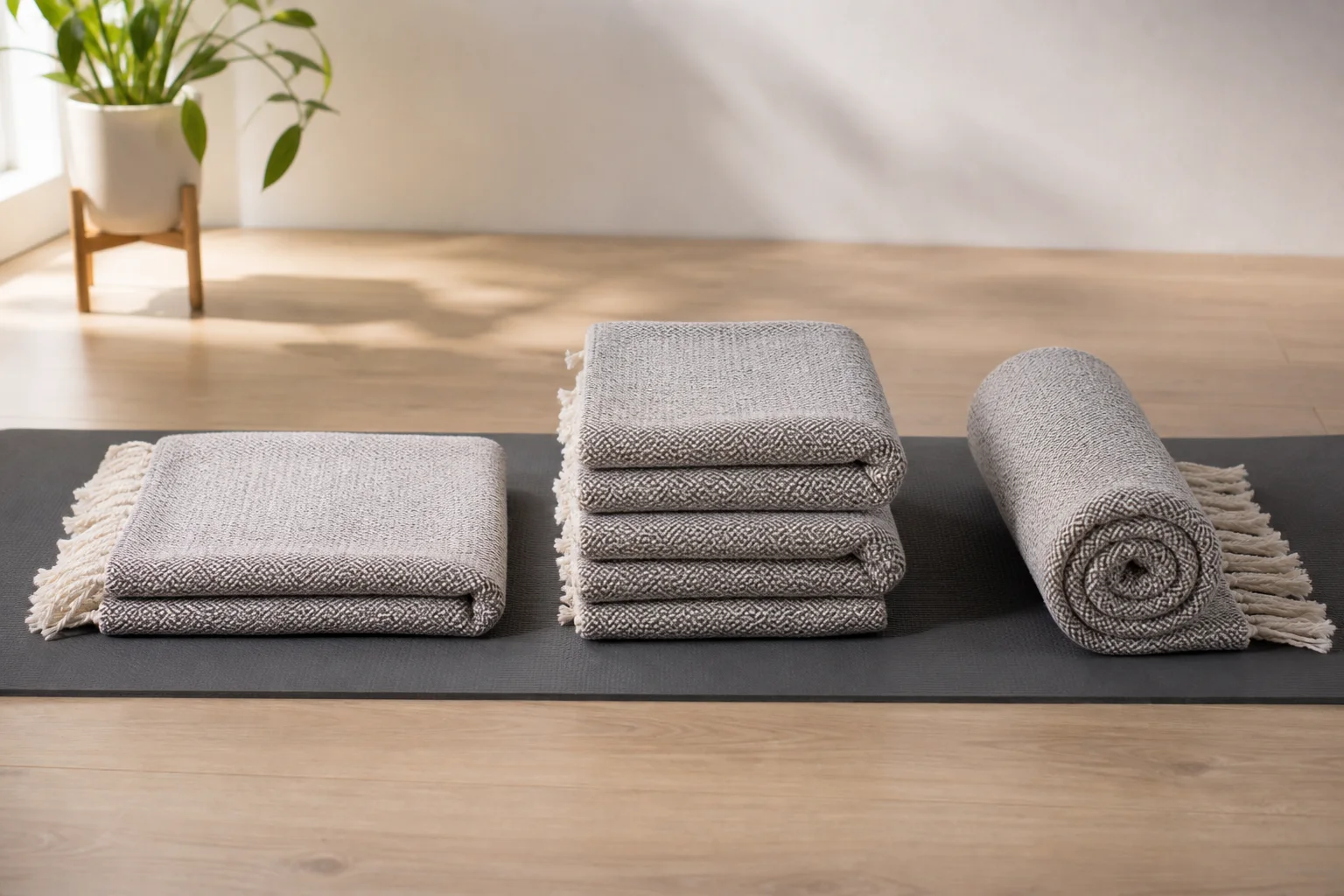
Before using a new blanket as a folded prop, check it without entering a demanding position:
- Fold it into the shape shown by your qualified instructor or trusted program.
- Press the stack with both hands and watch whether layers slide independently.
- Check for fringe, hem or corner lumps inside the contact area.
- Reload the same fold several times and see whether the footprint remains consistent.
- Stop using a configuration that collapses, shifts or creates pressure where it is not intended.
This is an equipment inspection, not a pose tutorial. High-risk inversions and individualized therapeutic setups require competent instruction; a blanket purchase guide cannot determine a safe body position.
Fringe, hems and selvage
Fringe is decorative and common on Mexican-style blankets, but it should be placed outside the loaded fold rather than trapped into a random ridge. A four-sided thin hem is predictable but adds a small amount of thickness around the perimeter. Flat woven selvage can minimize added bulk, while an overlocked edge prioritizes fray resistance.
None is universally superior. Inspect whether the same edge lands repeatedly under a contact point in your intended fold.
Size, weight and portability
Open size tells only half the story. Two blankets with nearly equal area can differ in mass, packed volume and warmth. Normalize the published examples:
| Product | Approximate area | Published weight | Approx. ounces per sq yd* |
|---|---|---|---|
| Hugger Mugger Mexican | 24.3 sq ft | 2.2 lb | 13.0 |
| Yoga Accessories Deluxe | 29.3 sq ft | 3.0 lb | 14.7 |
| Manduka Essential | 38.7 sq ft | 3.0 lb | 11.2 |
| Yogamatters Organic Cotton | 37.8 sq ft | 2.65 lb | 10.1 |
*Calculated from catalog dimensions and weights; handmade variance and rounding apply. This is apparent mass per area, not standardized textile GSM.
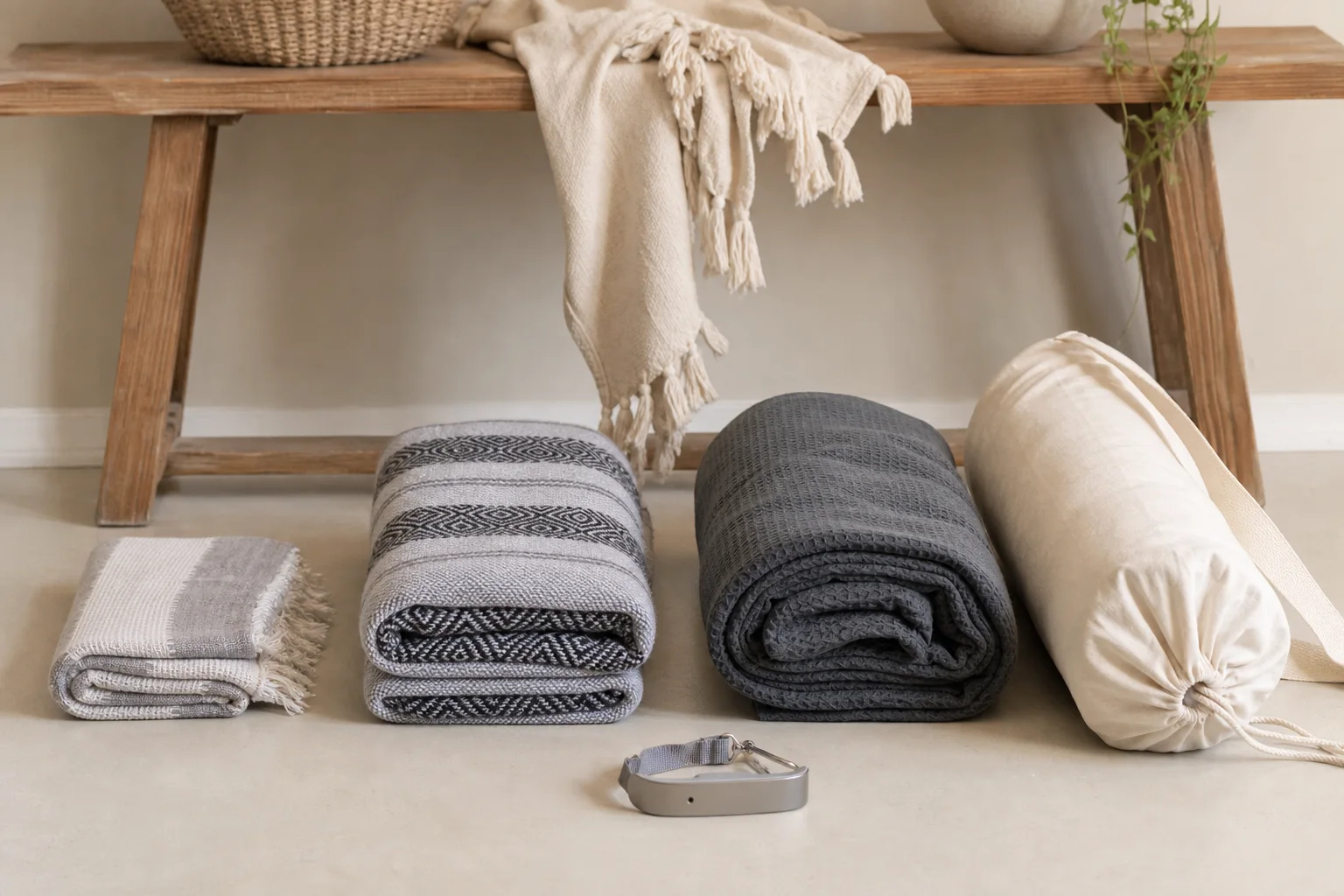
The Manduka and Yogamatters blankets spread much farther for their weight than the Mexican-style examples. That can mean a thinner or more open physical sheet, but catalog data alone cannot prove weave firmness. A buyer who carries props by foot or transit should favor measured weight and a compact test fold. A home studio can prioritize broad coverage and repeatable stacking.
Do not assume a standard yoga-mat bag holds a blanket. Measure the bag’s opening and remaining circumference after the rolled mat is inserted. A separate tote is often more realistic than compressing a damp or freshly washed textile against a mat.
Cotton versus blended fibers
Cotton is absorbent, familiar and available in dense weaves. It can shrink, shed after brushing and take time to dry. Synthetic fibers can reduce cost, change drying behavior and contribute resilience, but “easy care” still depends on the exact weave and label.
| Priority | More suitable starting point | Verify before buying |
|---|---|---|
| Clear plant-fiber content | 100% cotton | Certification scope, shrinkage, shedding |
| Broad coverage | 80–100% cotton large format | Packed size and dry time |
| Lower carry weight | Lighter blended Mexican style | Fold firmness and fringe |
| Substantial compact stack | Heavier dense weave | Actual mass and edge bulk |
| Frequent shared-studio washing | Machine-washable construction | Temperature, drying method, color transfer |
Recycled content needs percentages and material names. “Made from recycled materials” without a fiber breakdown is less useful than Manduka’s explicit 80/15/5 disclosure. It also does not by itself prove durability, low emissions or recyclability after use.
Washing, shrinkage and shedding
Care labels in this category are not interchangeable. One manufacturer permits low tumble drying while another explicitly warns that tumble drying can cause shrinkage.
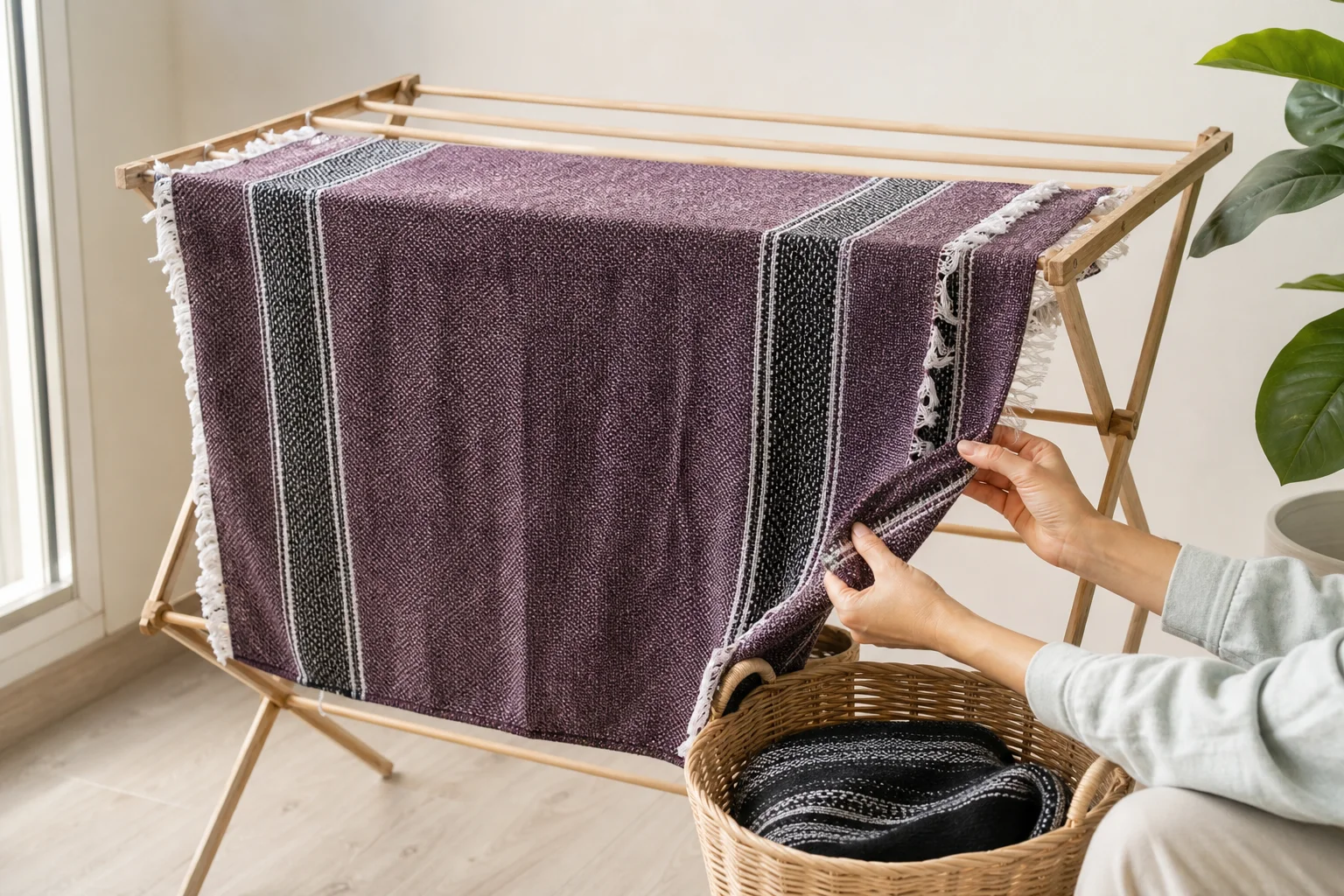
Before the first approved wash:
- measure length and width on a flat surface;
- photograph the weave, hems and fringe;
- test dark dye with a damp white cloth in an inconspicuous area;
- remove loose surface fibers outdoors or with a suitable lint tool;
- wash separately when instructed;
- reshape and dry fully open where the label requires air drying;
- measure again only after the center is completely dry.
Brushed cotton shedding is not necessarily structural failure, but persistent fiber loss, growing holes, pulled hems or loosening fringe deserve inspection. Never hide dampness inside a tight fold or closed prop cabinet.
Yoga blanket versus towel, bolster and meditation cushion
A yoga blanket is flexible and reconfigurable. A yoga bolster has a fixed filled body, while a meditation cushion creates a compact seat with defined loft. A yoga towel is designed around moisture management and mat coverage rather than stable multi-layer folding.
The existing yoga mat alternatives guide explains why a blanket is not a full traction surface: it can bunch, slide and stretch. Use this page to select the blanket itself, not to infer that it replaces a mat.
A regular household blanket can be enough when it forms an even, stable fold and the setup does not demand a specialized prop. Trialing what you own is the best way to learn whether you need greater size, density or washability.
Buying checklist
Confirm these details before ordering:
- exact open dimensions and product weight;
- complete fiber percentages, not “cotton feel”;
- woven, brushed, knitted or quilted construction;
- hem, selvage, overlock or fringe edge;
- likely packed dimensions in your preferred fold;
- cold, 30°C or other stated wash limit;
- hang, line or low-tumble drying permission;
- shrinkage and shedding disclosures;
- handmade size and color variance;
- return restrictions after washing.
If a listing omits weight, you cannot confidently compare portability. If it omits fiber percentages or care, it is not ready for a serious shortlist.
The verdict
The Manduka Essential Cotton Yoga Blanket has the strongest balanced specification: broad 68 × 82-inch coverage, a measured three-pound weight, explicit recycled-fiber percentages and clear cold-wash/hang-dry care. Choose the b, halfmoon Everyday for a documented 100% cotton weave with flat selvage edges, or the broader Yogamatters Organic Cotton when coverage matters and disclosed brushing-related shedding is acceptable.
For travel, the 2.2-pound Hugger Mugger Mexican is the clearest lighter option. The Yoga Accessories Deluxe offers a larger, roughly three-pound version of the same published blend. In every case, judge the real textile: dimensions, mass, weave, edges and wash method are more valuable than color or wellness copy.
Frequently asked questions
What is the best material for a yoga blanket?
Dense cotton or cotton-rich weave is a versatile starting point. Blended Mexican-style blankets can be lighter and easy to wash. Choose by structure, weight and care rather than fiber name alone.
What size should a yoga blanket be?
Current full-size examples span roughly 73 × 48 to 82 × 68 inches, with one broad cotton option reaching about 90.6 inches long. Balance open coverage against packed bulk.
Can I use a regular blanket for yoga?
Yes, if it folds evenly and stays predictable. Avoid loose knit, slippery plush and lumpy quilt construction when a stable stack is required.
Are Mexican yoga blankets cotton?
Not necessarily. Several current examples are 50% acrylic, 40% polyester and only 10% cotton. Check the complete label.
Can yoga blankets go in the washing machine?
Many can, but drying rules differ. Follow the exact product label and expect that heat may cause shrinkage.
Frequently asked questions
What is the best material for a yoga blanket?
Dense cotton or cotton-rich weaves are useful when firm, repeatable folds matter. Acrylic-polyester-cotton Mexican-style blankets are generally lighter and quick to wash, while recycled blends vary by exact composition. The best material depends on whether structure, warmth, portability or easy care leads.
What size should a yoga blanket be?
Current full-size examples range roughly from 73 by 48 inches to 82 by 68 inches. A larger blanket offers more coverage and folding options but creates a bulkier packed item. Compare both open dimensions and product weight.
Can I use a regular blanket for yoga?
Yes, when it folds evenly, stays predictable under load and is suitable for the intended setup. Test a household blanket before buying, but avoid loose knits, slippery plush throws and lumpy quilts when a stable folded prop is required.
Are Mexican yoga blankets cotton?
Not always. Several current Mexican-style blankets use 50% acrylic, 40% polyester and 10% cotton. Read the complete fiber label rather than inferring material from the striped pattern or product name.
Can yoga blankets go in the washing machine?
Many can, but instructions differ. Examples include cold machine washing with hang drying, cold washing with low tumble drying, and 30-degree washing followed by unfolded air drying. Follow the exact label because heat can cause shrinkage.