

This guide contains affiliate links — recommendations aren’t based on commission. Read our full disclosure.
How this page has changed
September 6, 2026
Sources, internal links and safety or product context reviewed.
May 30, 2026
First published.
In this guide
- 01Quick picks
- 02What is a yoga bolster
- 03Rectangular vs round: which shape
- 04Compare size, filling and cleaning before buying
- 05Hugger Mugger Standard — Consider it for a structured bolster
- 06Gaiam Rectangular — Consider it for a washable cover
- 07Match the bolster to your practice
- 08Do you actually need a bolster
- 09How we chose
- 10Sources
- 11Related reading
A yoga bolster is the prop most people buy last and then wish they had bought sooner — but only if they actually do restorative or gentle reclined practice. It is a firm, filled cushion that holds its shape under your body weight, so you can rest in a supported pose without holding yourself up. Like other filled cushions, bolsters compress under load; a bolster is designed as a more structured support cushion.
This guide explains the two decisions that matter — shape and fill — covers what size to buy, and names two honest picks across budgets. I am Marvin Smit, a long-time practitioner and the author of The Yoga Sensei — not a certified instructor. I have not lab-tested these specific bolsters; the picks below are researched from the manufacturer specifications linked below, and I flag any claim that comes from the maker rather than from use.
By Marvin Smit · Long-time practitioner, not a certified instructor.
Quick answer. For most people, a rectangular bolster is a useful starting point to compare. Check its actual height, filling and cleaning instructions before buying. A higher price does not establish firmer support. If you already use folded blankets comfortably, consider whether a dedicated cushion would actually improve your setup.
Quick picks
Two rectangular options with different dimensions, filling and cover care.
| Pick | Fill / shape | Best for | Link |
|---|---|---|---|
| Hugger Mugger Standard Bolster | Foam core + cotton batting · rectangular | Foam-core construction; spot cleaning | Check price |
| Gaiam Yoga Bolster | Cotton batting · rectangular | Lower profile; washable cover | Check price |
Prices and exact stock vary; the links go to current listings. There are no star ratings on this page because we do not have verified first-hand testing data to publish — see how we chose near the end.
What is a yoga bolster
A bolster is a structured support cushion. The job is simple: it holds a firm, stable height so a body part can rest on it without you using any muscle to stay there. That firmness is the entire difference between a bolster and a pillow.
You meet bolsters most in restorative and gentle yoga, where poses are held for minutes rather than breaths and the point is to be completely supported. A bolster under the knees in a reclined position, along the spine in a supported recline, or under the hips in a seated forward shape lets the body settle into the pose instead of working against gravity.
It is a comfort and support prop, not a piece of treatment. A bolster can make a restful pose more comfortable to hold; it does not fix what makes you uncomfortable, and anything sharp or persistent is a reason to see a professional rather than buy a cushion.
Rectangular vs round: which shape
Shape is the first real decision, and it is easier than the marketing makes it look.
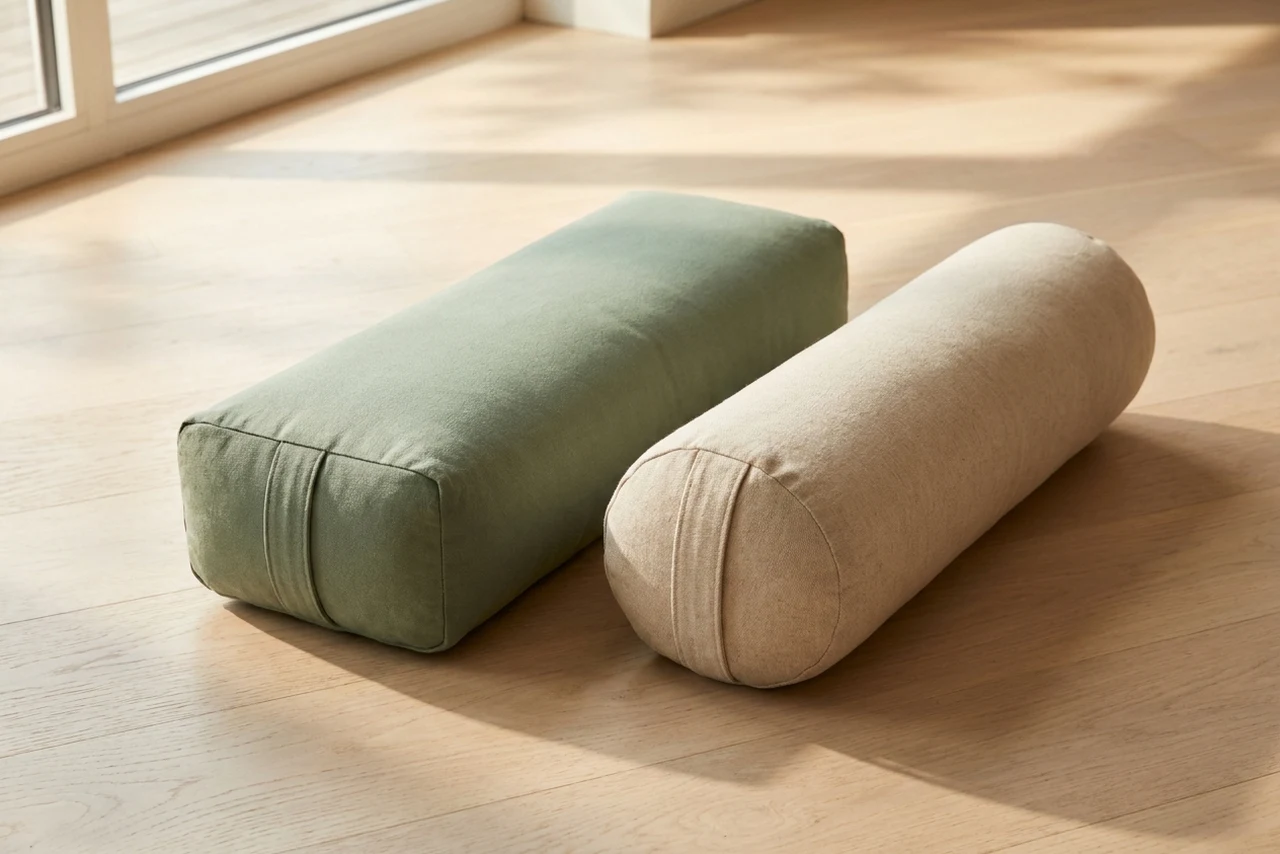
Rectangular bolsters are flatter, wider and more stable. They sit without rolling, spread your weight over a larger surface, and suit supported reclining and most restorative poses. This is the versatile shape and a useful shape to consider for a first bolster.
Round (cylindrical) bolsters provide a curved surface. Check the actual diameter: round does not automatically mean taller. Some people prefer that taller arc under the knees, or for opening the chest in a supported backbend. The trade-off is that a round bolster rolls more and supports a narrower line of the body. It is a preference for specific poses rather than a better all-rounder.
If you are buying one bolster and are not sure, buy rectangular. You can always add a round one later if a pose asks for it.
Compare size, filling and cleaning before buying
| Specification | Hugger Mugger Standard | Gaiam Rectangular |
|---|---|---|
| Length × width × height | 25 × 11 × 6 inches | 25 × 12 × 5 inches |
| Listed weight | 5 lb | 4 lb 4 oz |
| Filling | Foam core and cotton batting | Cotton batting |
| Cover | Cotton on the cited model | Microfiber |
| Cleaning | Spot or dry clean; do not remove cover | Remove cover, machine wash, line dry |
These are manufacturer specifications checked September 6, 2026, not our measurements. A fabric variant can have different care instructions. Check the label on the exact item you order.
Size: neither product is a universal fit. The Gaiam is one inch lower and wider than the Standard. Consider where you will store it and the height you actually need, rather than buying by the word “standard”.
Filling: cotton and foam are not opposing quality grades. The Hugger Mugger uses both. Without a compression test, we cannot rank how quickly either will flatten or promise a lifespan.
Cleaning: a zip does not necessarily mean a cover should be removed. If frequent washing matters, that difference may decide the purchase before price does. Check bolster cover fit and care before buying a replacement cover.
Hugger Mugger Standard — Consider it for a structured bolster
This is the option to compare if you want a foam core wrapped in cotton batting. The maker describes it as firm, but we have not compared its feel with the Gaiam under the same load.
Its main practical limitation is cleaning. Hugger Mugger advises spot cleaning or dry cleaning, and keeping the fitted cover in place. Skip it if removing and machine-washing the cover is essential to you. Check the exact fabric option, because the range includes different covers.
Gaiam Rectangular — Consider it for a washable cover
The Gaiam is the candidate if you want cotton batting and a removable microfiber cover. It is the lower-profile option of these two. Skip it if you specifically need the six-inch height of the Hugger Mugger.
We do not have evidence that this bolster wears out sooner simply because it costs less. Compare the current price alongside dimensions and cleaning, rather than assuming that price measures support or durability.
Match the bolster to your practice
A bolster is equipment, not a pose prescription. Choose its height and position with your teacher if you are unsure. A product photo does not establish that a supported backbend or kneeling position is suitable for you. Stop if a position causes pain.
Before ordering, consider whether you need broad, flat support, a smaller cushion or local padding. A bolster, yoga blocks and knee pads serve different purposes; one does not automatically replace the others.
Do you actually need a bolster
Here is the honest part: a bolster is the most skippable prop on this site for most beginners. If your practice is mostly active — standing poses, flows, balance work — you may never reach for one. The bolster earns its place specifically when you do restorative or gentle reclined practice and want firm support a pillow cannot give.
Until you are sure, two or three tightly folded blankets stacked to bolster height do most of the same job. They are less convenient and they slide, but they are a cheap way to find out whether a bolster will become part of your practice or live in a cupboard. Buy the bolster once you have reached for the blanket stack enough times to know.
If you do buy, one rectangular bolster is plenty. A second or a round one is a later addition for specific poses, not a starting purchase.
How we chose
This is a documentation-led comparison of two existing rectangular picks. We checked dimensions, filling, weight and care instructions. We have not tested compression, comfort or durability, and cannot establish which will fit your body best.
Sources
- Hugger Mugger Standard: specifications and care.
- Gaiam Rectangular: specifications and cover washing.
- Hugger Mugger shape and size comparison.
Sources checked September 6, 2026. Source years indicate the year checked for undated product pages.
Related reading
- Yoga bolster covers — fit, replacement covers and cleaning.
- Best yoga blocks — compare a different type of support prop.
- How to choose a yoga mat — the buying framework these props sit alongside.
- Best yoga mats of 2026 — start with the mat, then add the props.
- Best eco-friendly yoga mats — if natural materials guide your kit.
Frequently asked questions
What is a yoga bolster?
A yoga bolster is a firm, filled cushion used to support the body in seated and reclined poses. It is denser and more structured than a pillow, so it holds its shape and height when you rest your weight on it, which is what makes it useful for long, still, supported positions.
What is a yoga bolster used for?
A bolster props and supports the body so you can stay comfortable in restful poses without muscular effort. Common uses are under the knees in a reclined position, along the spine in a supported reclined pose, and under the chest or hips in gentle seated and forward shapes. It is a comfort and support prop, not a treatment.
What size yoga bolster should I buy?
Compare the actual length, width and height with the support you need. The Hugger Mugger Standard is 25 by 11 by 6 inches; the Gaiam Rectangular is 25 by 12 by 5 inches. Neither is a universal fit. Ask your teacher if you are unsure about height or placement.
Rectangular or round: which yoga bolster is better?
Rectangular bolsters are flatter, wider and more stable, which suits supported reclining and most restorative work. Round (cylindrical) bolsters provide a curved surface; actual height varies by model that some people like under the knees or for chest-opening shapes. Rectangular is the more versatile first buy; round is a preference for specific poses.
What is the best filling for a yoga bolster?
There is no universal best filling. Construction and compression matter as well as material: the Hugger Mugger Standard combines a foam core with cotton batting, while the Gaiam uses cotton batting. We have not tested their comparative firmness or lifespan.
Can I wash a yoga bolster cover?
Check the exact model. Gaiam allows machine washing and line drying of its Rectangular cover. Hugger Mugger advises spot or dry cleaning of its Standard and does not recommend removing the fitted cover.
Do you need a yoga bolster?
Not for general practice. A bolster earns its place if you do restorative or gentle reclined work and want firm, lasting support that a pillow cannot give. For occasional use, firm cushions or tightly folded blankets do much of the same job, so there is no rush to buy one early.
What can I use instead of a yoga bolster?
Two or three tightly folded blankets stacked to the same height give firm, stable support for most reclined and seated poses. A firm couch cushion works for gentler shapes. These substitutes are less convenient than a dedicated bolster but are a sensible way to find out whether you will actually use one.