

This guide contains affiliate links — recommendations aren’t based on commission. Read our full disclosure.
How this page has changed
September 6, 2026
Sources, internal links and safety or product context reviewed.
May 29, 2026
First published.
In this guide
- 01Quick picks: yoga mats for sensitive knees
- 02How thick should a yoga mat be for bad knees?
- 031. Manduka PRO 6mm — Dense cushioning for home practice
- 042. Gaiam Premium 6mm — A budget option to compare
- 053. Liforme Original — Grip before maximum padding
- 06A new mat or a separate knee pad?
- 07What to check before ordering
- 08Related reading
- 09Sources and selection notes
The best yoga mat for bad knees depends on whether you need more padding, a firmer surface or simply a small pad alongside a mat you already like. Our shortlist starts with the Manduka PRO 6mm for dense cushioning, Gaiam Premium 6mm for a simpler budget option, and Liforme Original for people who prioritise grip. None is a treatment for knee pain, and there is no thickness that suits every knee.
Before buying: this is equipment guidance, not medical advice or a rehabilitation programme. Do not continue a painful movement because a mat feels softer. The NHS knee-pain guidance recommends medical advice for pain that does not improve, and urgent help for symptoms such as being unable to move or bear weight on the knee, severe swelling or a hot, red knee with fever.
Quick picks: yoga mats for sensitive knees
| Compare | Consider it for | Main trade-off |
|---|---|---|
| Manduka PRO 6mm | A substantial mat for home practice | Heavy; sweat may call for a towel |
| Gaiam Premium 6mm | A simpler budget option | Check the exact model and dimensions |
| Liforme Original | Grip and alignment reference marks | Thinner at 4.2mm; natural-rubber base |
These are research-based selections, not results from a knee-pain trial or a hands-on comparison by us. The specifications below come from the manufacturers, checked on September 6, 2026. Gaiam sells several different lines: the Premium 6mm here is not the Essentials thick exercise mat.
How thick should a yoga mat be for bad knees?
Thickness tells you how much material is there; it does not tell you how that material feels under load. Two mats marked 6mm can compress differently. A softer mat may feel pleasant on the floor yet less steady under a standing foot. A firmer one may feel more predictable for balance but still need local padding when kneeling.
There is no supported universal “6mm ceiling” for knee comfort. We include two 6mm options because they offer different budgets and constructions, not because an extra millimetre makes a mat unsuitable. If you are comparing a 6mm yoga mat with a 10mm exercise mat, consider your standing practice, floor and ability to return a mat that does not suit you.
For a wider comparison of materials and thicknesses, see how thick a yoga mat should be. If your current mat works everywhere except during kneeling, compare separate yoga knee pads before replacing the whole surface.
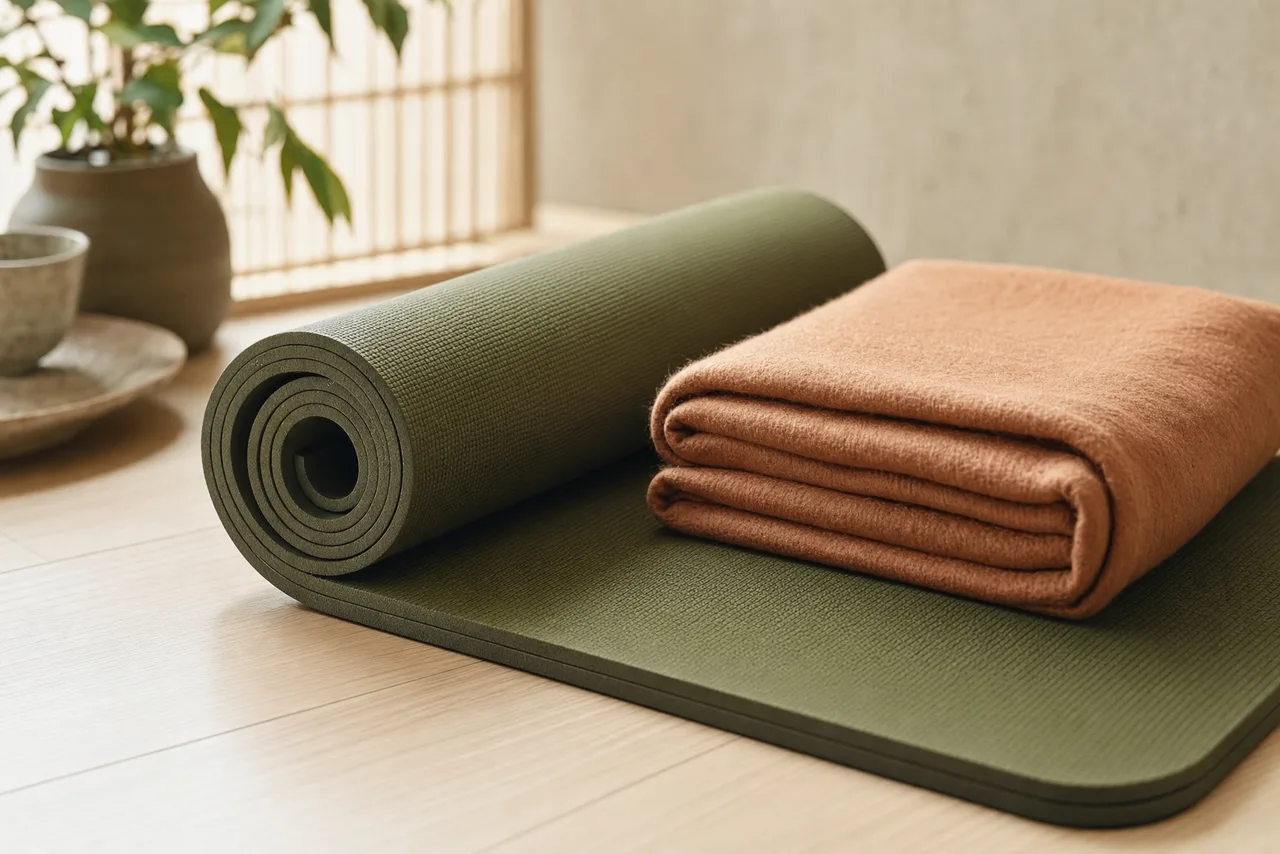
1. Manduka PRO 6mm — Dense cushioning for home practice
Manduka lists a high-density, closed-cell PVC construction, with a standard size of 71 × 26 inches and a weight of 7.5 lb. The extra width may be useful if you find narrow mats restrictive. The weight is the practical drawback: consider whether you will carry it to class regularly.
The surface does not absorb sweat. That makes wiping it down straightforward, but it does not mean it cannot become slippery. Manduka recommends a towel for sweaty practice. Its grip also changes with use, so do not buy it expecting the same surface feel as an absorbent PU mat.
Consider it if: you want a substantial mat that mostly stays at home. Skip it if: low carry weight or towel-free sweaty practice matters more. Our Manduka PRO review explains the care and guarantee details.
2. Gaiam Premium 6mm — A budget option to compare
Gaiam's Premium Celestial Blue model is listed as 68 × 24 inches, 6mm thick and made from latex-free PVC. Check the dimensions of the exact colour or print you buy; “Gaiam mat” alone does not identify the construction or thickness.
This is the budget candidate in our shortlist, but we have not measured its compression against the PRO. The matching 6mm labels are not evidence of identical cushioning. Its shorter, narrower dimensions also deserve attention before you order, particularly if you already find a standard mat cramped.
Consider it if: you want a lower-cost 6mm mat and its dimensions suit you. Skip it if: you need more length or width. The Gaiam review covers model differences and product-label caveats.
3. Liforme Original — Grip before maximum padding
Liforme's Classic/Original mat is listed at 4.2mm, with a natural-rubber base, a grip surface and alignment markings. Those markings are reference points for positioning; they do not establish safe alignment or prevent knee injuries.
This is the thinner option here. Consider it if grip is your main buying criterion and you are open to separate padding where needed. Do not assume the surface will be comfortable for kneeling just because it has good traction. Read our Liforme review for the material and care trade-offs.
Consider it if: you prefer a grip-focused mat with alignment markings. Skip it if: you want maximum thickness from one mat or the natural-rubber base conflicts with your allergy requirements.
A new mat or a separate knee pad?
If you like your existing mat, replacing it may be unnecessary. A folded blanket or dedicated pad lets you change one area instead of changing the entire standing surface. Check that any added layer stays in place, and remove or reposition it before a transition if it gets in the way. If it still hurts, stop rather than adding layers indefinitely.
| Your main concern | What to compare before spending |
|---|---|
| Only occasional kneeling feels uncomfortable | A separate pad or blanket alongside your existing mat |
| The whole mat feels too thin for floor work | A different thickness and construction, with a suitable return policy |
| Standing feels unstable | Firmness and the floor underneath, not just extra thickness |
| Carrying a mat is difficult | Packed size and weight, including any towel or pad |
| You have ongoing knee pain | Professional advice before treating it as a shopping problem |
See the knee pad comparison for portable options. For general equipment choices, use the yoga mat buying guide.
What to check before ordering
- Exact model and size: compare the listed length, width and weight, not just the brand name.
- Floor and stability: assess the mat on the surface where you will use it; a soft floor changes the feel too.
- Materials: check every layer if you have an allergy. A cork or PU top does not rule out rubber underneath.
- Care: use the maker's instructions for that model. Absorbent and closed-cell surfaces need different care.
- Returns: check whether the seller accepts a mat after unrolling or use before relying on a home trial.
For transparency, my own mat is a 5mm Lululemon rubber mat used for hatha and vinyasa. That experience is not a test of these three products or evidence that one thickness treats knee pain. If you already own a comfortable 5mm mat, this guide is not a reason to replace it automatically.
Related reading
- Best thick yoga mats — compare thicker options by intended use.
- How to clean a yoga mat — care by material and brand.
- Manduka vs Lululemon — compare grip, maintenance and ownership trade-offs.
Sources and selection notes
- Manduka PRO: size, weight and materials.
- Gaiam Premium Celestial Blue: dimensions and PVC construction.
- Liforme Classic: thickness and construction.
- NHS: knee pain and when to seek help.
Manufacturer pages establish the listed dimensions and materials, not a clinical benefit. The NHS source supports the distinction between equipment comfort and symptoms that need assessment. We did not test pain outcomes, pressure distribution or comparative mat durability. The source year below is the year checked, not a claim that each undated product page was first published in 2026.
Frequently asked questions
What thickness is best for a yoga mat if you have bad knees?
There is no universal thickness for knee pain. A dense 6mm mat is one option to compare for mixed floor and standing practice, but firmness, your floor and your comfort matter too. Millimetres alone cannot tell you whether a mat will feel comfortable.
Is a thicker yoga mat always better for bad knees?
No. A thicker surface can provide more padding, but a very soft mat may feel less steady when standing. Compare how the material compresses instead of treating 6mm, 8mm or 10mm as a medical threshold.
Can a yoga mat fix knee pain?
No. A mat changes the surface beneath you; it does not diagnose or treat knee pain. If pain persists, seek advice from a healthcare professional. Do not use extra padding as a reason to continue a painful movement.
Do I need a new mat, or can I just pad my knees?
If you otherwise like your mat, a separate knee pad or folded blanket may be worth considering first. Check that it stays in place. Stop if it remains painful; adding padding does not make every movement suitable.
Are natural rubber mats suitable if I have a latex allergy?
Natural rubber can contain latex. Check the complete construction and the manufacturer warning for the exact model, including the base beneath a cork or PU surface. Manduka lists the PRO as latex-free; Liforme uses natural rubber.