

This guide contains affiliate links — recommendations aren’t based on commission. Read our full disclosure.
How this page has changed
July 25, 2026
Sources, internal links and safety or product context reviewed.
In this guide
- 01Where does it hurt? The question that decides everything
- 02When to stop reading buying guides and see someone
- 03The free fix, and why it is not a compromise
- 04The thing the marketing does not tell you about foam
- 05The picks
- 06Who should not buy one
- 07Read the listing sceptically
- 08A note on scale
- 09Related reading
Before anything else, two questions. Where exactly does your knee hurt, and do you own a blanket?
Those two answers decide whether you need to buy anything at all, and no page currently ranking for this product asks either of them. I checked — page one for this term contains no independent editorial roundup at all. Every result that is not Reddit is a brand or a retailer selling its own pad.
Quick answer. Pain on the front of the kneecap when you kneel is a pressure problem, and foam genuinely fixes it. Pain at the sides, underneath, or deep in the joint, or pain that appears when you rotate, is a movement problem — padding hides it rather than fixing it. If it is the first kind, try a blanket folded to about an inch under your shins before you buy anything, because that matches the thickest pads on the market and is better placed than any of them.
By Marvin Smit · Long-time practitioner, not a certified instructor.
I have not tested these pads. This page is built from the manufacturers' own specifications, named yoga teachers and physical therapists, and two peer-reviewed sources — one of which quietly undermines a claim the whole category rests on.
Where does it hurt? The question that decides everything
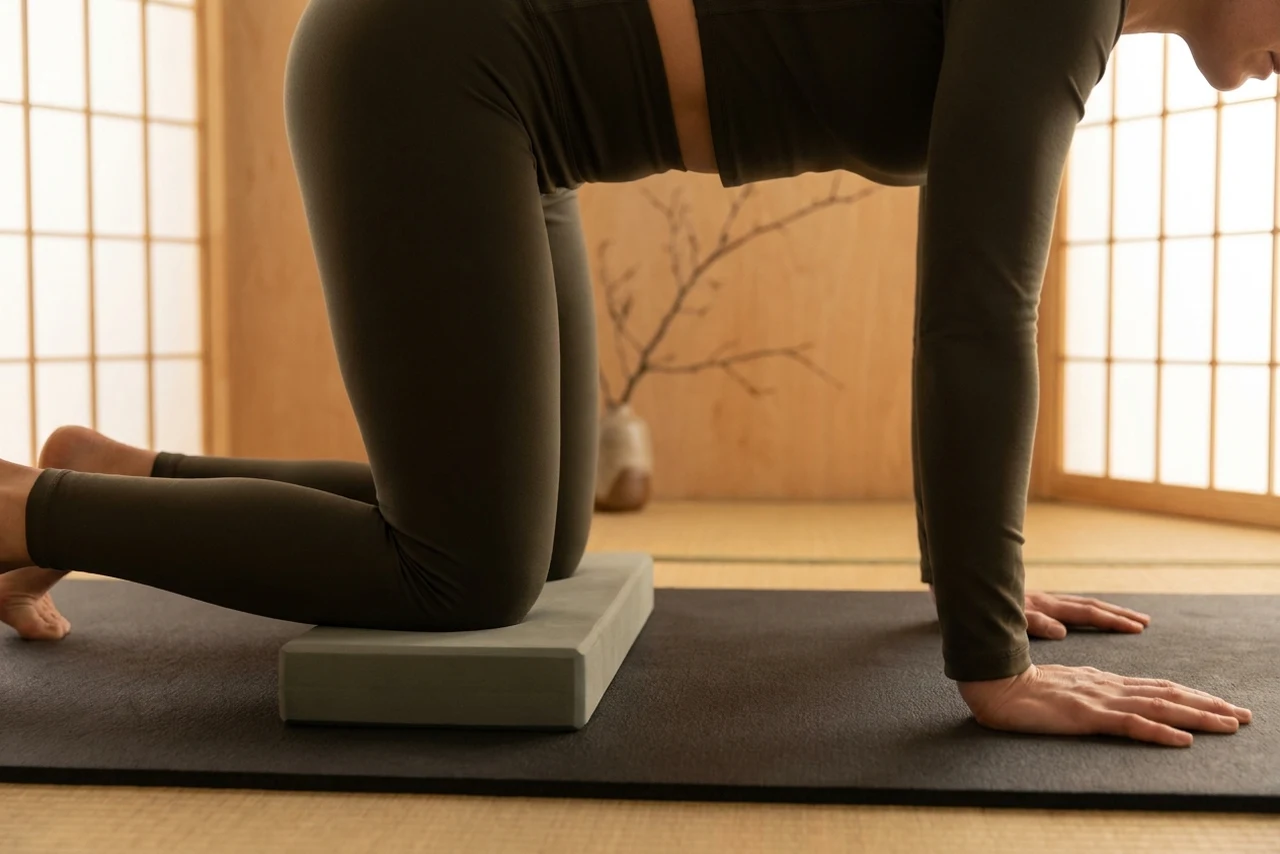
A knee pad protects one specific structure. The prepatellar bursa sits between your kneecap and the skin over it, and per NIH-hosted clinical reference, its thin walls make it vulnerable to inflammation from "repetitive trauma from frequent kneeling". That is exactly what tabletop, cat-cow, low lunge, camel and thunderbolt do to it.
The same source is unusually direct about the fix: use protective equipment, such as bulky knee pads, for those who cannot avoid kneeling. So this is not a product category invented by marketers. For front-of-kneecap pressure, padding addresses the cause.
But that mechanism only reaches the front of the joint. There is nothing a pad under your knee can do about the inside of it.
Yoga therapist Beth Spindler gives the cleanest diagnostic line I found anywhere on this topic: a sensation of pulling at the sides of the knee or under the kneecap "is reason to back away from a movement."
So:
| Where it hurts | What it is | What helps |
|---|---|---|
| Front of the kneecap, under bodyweight | Compression on the bursa | Padding — genuinely |
| Sides of the knee, under the kneecap, deep inside | Alignment or load | Technique, and possibly a professional |
| On rotation, in pigeon or lotus | Torque through the joint | Backing out of the pose |
Yoga instructor Amber Burke names the poses where the knee is most at risk of torquing or hyperextension: pigeon, lotus, triangle, pyramid, dancer and warrior III. Buying a pad for pain in those is buying the wrong thing.
One caution that cuts both ways. Physical therapist Bill Reif points out that pressure pain on the kneecap is often delayed — you may not know during class that you overloaded it. That argues for padding by default in kneeling poses. It also means "it felt fine at the time" is not evidence that you were fine.
When to stop reading buying guides and see someone
Nicholas Sgrignoli, a sports medicine physician at the Hospital for Special Surgery, sets the threshold: see a doctor for persistent knee pain that affects your function or your ability to exercise, pain you cannot manage, or swelling, buckling or collapsing.
And one that is not a padding decision at all. Up to one third of prepatellar bursitis cases present as septic. A kneecap that is hot, red and swollen is a same-day medical question, not a shopping one.
The free fix, and why it is not a compromise
The category leader opens its own product page with the line "Tired of folding your mat or towel for an extra cushion to alleviate knee pain?" — which tells you exactly what its real competitor is.
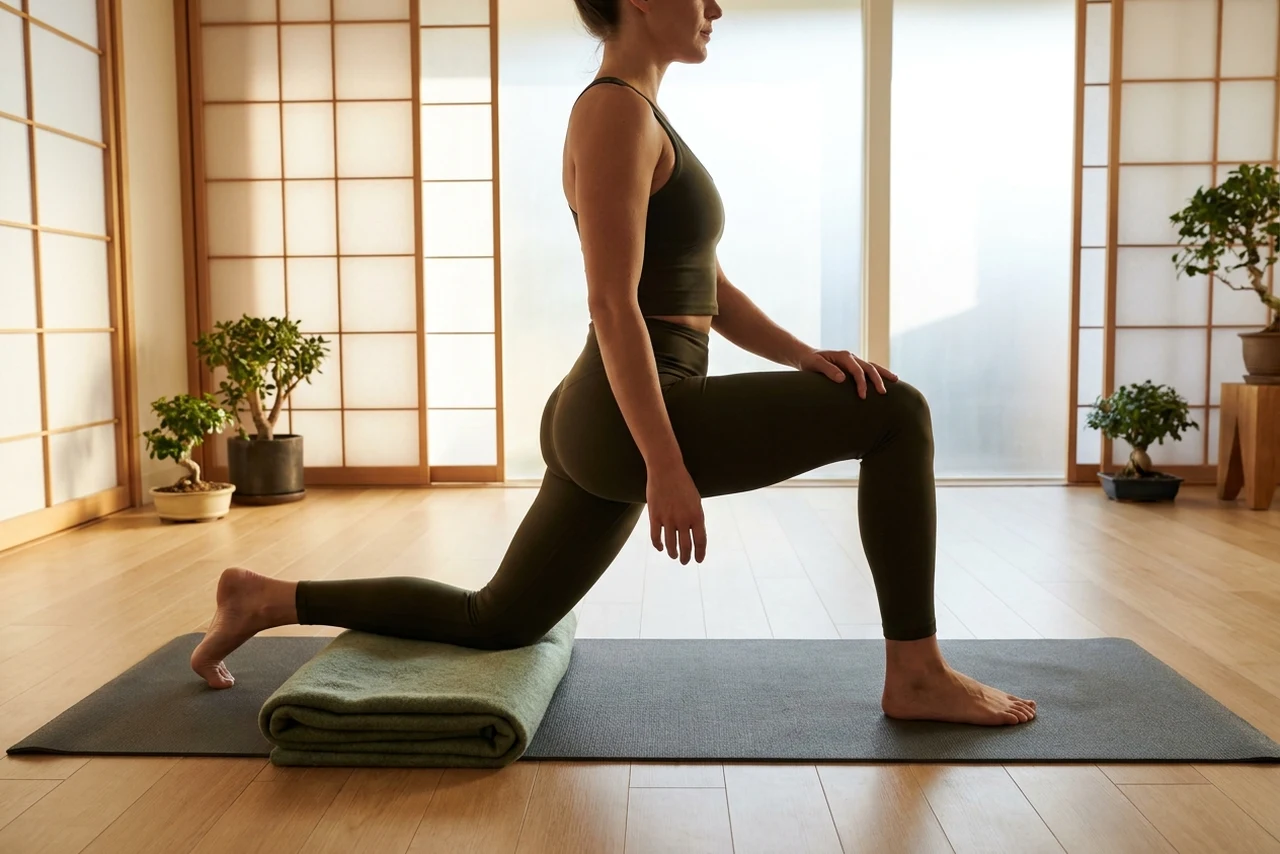
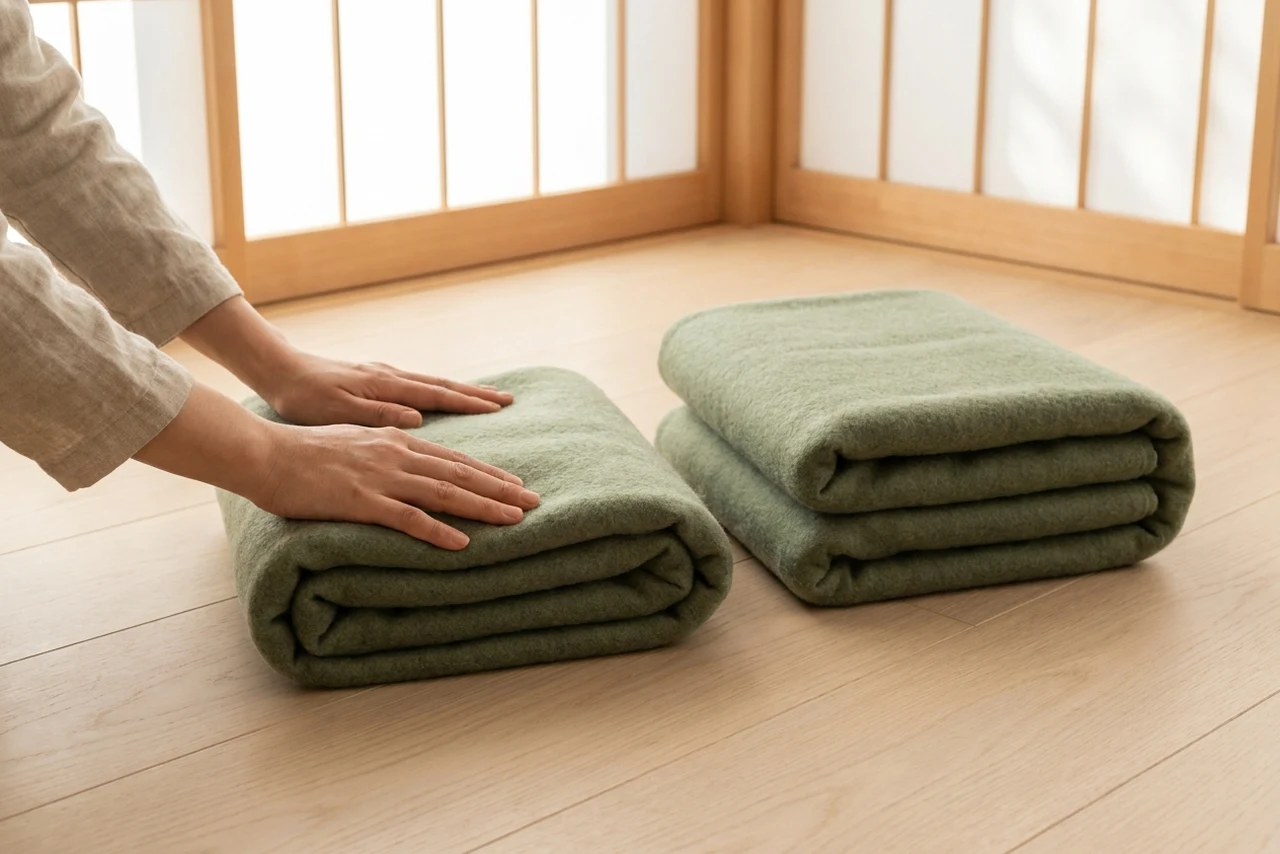
Here is that competitor, specified more precisely than any commercial page manages. Yoga International instructs placing a folded blanket about an inch thick under the shins, with the kneecaps just off the edge of the blanket.
Read that again, because it is doing two things at once:
It matches the thickest pads sold. An inch is 25mm. The Kinesis pad is 25mm. The firm SukhaMat is an inch. Gaiam claims an inch. The blanket is not the budget option — it is the same thickness.
It is better placed. Padding the shins lifts the kneecaps clear of the floor entirely, which is what Reif advises: keep the patellae free from any ground contact. A pad you kneel on still puts weight through the kneecap, just more softly.
Reif's own caveat keeps this honest: for some people, padding only the shins tips more weight forward onto the kneecaps, in which case pad both. It is conditional advice, not a rule.
Two more free options a studio teacher gives: fold your mat over on itself mid-class to double it where you kneel, or change the pose — a high lunge instead of a low one removes the problem entirely.
The fair counterpoint, from a teacher rather than a seller: a purpose-built pad is generally thicker and more consistent than a doubled-over mat, and it holds its shape. A blanket has to be refolded. If yours slides or will not hold an inch, that is when the pad earns its money.
Our own thickness guide already recommends this setup — a stable 4-5mm mat plus a small knee pad or folded blanket — rather than buying a thicker mat. A very thick mat costs you stability in every standing pose to solve a problem that happens in about four.
The thing the marketing does not tell you about foam
This one is worth knowing before you buy the thickest pad you can find.
In balance research, foam pads are placed on force platforms specifically to induce instability — that is their purpose in the experiment. The peer-reviewed posturography work found that the pads of highest stiffness produced the largest change in sway.
You can see the same logic in the catalogue. ProsourceFit sells its NBR foam as a yoga knee pad, and sells a foam balance pad whose own description promises to improve balance and stability through instability. Same material family, opposite marketing.
ProsourceFit is at least explicit about the trade-off on the knee pad, saying its 15mm of high-density NBR foam gives "just the right amount of comfort without being too thick to maintain balance when you're working out on the floor". Kinesis makes the same argument for its 25mm pad — about the thickness of a deck of cards — on the grounds that it cushions without adding bulk to the whole mat.
The practical read: this matters for half-kneeling and lunges where you are balancing, and barely at all for tabletop or child's pose where you are not. Do not buy 25mm for a practice that is mostly standing.
The picks
Five pads, all with specifications I verified against both the manufacturer and the live listing. No scores, because I have not tested them.
The default — ProsourceFit Extra Thick
24 by 10 inches, 15mm of high-density NBR foam, latex-free and phthalate-free per the brand. Big enough to cover both knees or knees and shins, and the brand also positions it for elbows, wrists, sit bones and head support.
It is the pick whose numbers agree across every source, which after auditing this category counts for more than it should. Care is simple: wipe with a damp cloth, air dry fully, not machine washable.
The known complaint, from a named yoga teacher rather than a marketplace: these flatten and indent with heavy use.
Check price on AmazonThe best-known — SukhaMat Yoga Knee Pad
The same format — 24 by 10 inches, 15mm NBR foam — from the brand that holds the number one organic position for this search.
One warning from the audit. SukhaMat's own site prints "Thickness: 3/8″ (15mm)", and those two figures contradict each other: 3/8 inch is 9.5mm. Amazon's structured field says 5/8 inch, which does equal 15mm. Buy it as a 15mm pad and ignore the fraction.
A second one worth knowing: the Amazon listing bullet promises a lifetime guarantee, while SukhaMat's own warranty terms cover manufacturing defects. Read the manufacturer's terms, not the bullet.
Check price on AmazonMost cushion — Kinesis 25mm
A full inch of foam, and it ships with a mesh carry bag, which matters more than it sounds if you take it to a studio. This is the one to pick if your knees are the reason you avoid kneeling poses altogether.
It is also the one where the stability trade-off is real. Kinesis argues the pad cushions without adding bulk to the mat, and that is true of the mat — but an inch of foam under one knee in a half-kneeling balance is still an inch of foam.
Check price on AmazonTwo small pads instead of one long one — Gaiam
A set of two small hexagonal pads rather than a single strip, which suits people who want one under each knee and nothing in between, and packs smaller.
Three honest caveats, all from checking the listing against the brand's own page. Gaiam gives dimensions as 9 by 9 by 1 inch on its site and 7.6 by 7.6 by 0.79 on Amazon. Its marketing copy claims one inch of cushioning while the spec table on the same page says less. And the material is described as gel-like in one place and polyurethane foam in another. I am not printing a weight for it, because the listing gives two different ones.
The small-disc format also draws a specific complaint from a named teacher: it can cause balance problems for beginners, because there is less pad to find with your knee.
Check price on AmazonIf foam bottoms out on you — SukhaMat Firm Support
An inch of TPE rather than foam, positioned by SukhaMat for rigorous floor work — ab wheel, reformer, that kind of thing. Firmer, so it resists bottoming out under a bony kneecap when the softer pads give up.
That firmness is also the reason to skip it. If your knees are tender rather than heavy-loaded, the extra-firm version is the wrong direction and you want the softer NBR.
Check price on AmazonWhat about cork?
Cork knee pads exist and I am not recommending one. The leading cork pad is 6mm thick — roughly a quarter of what the rest of the category uses. Cork's genuine advantage is that it grips more when wet, which is the opposite of most surfaces and genuinely useful. But grip is not the job here. Cushion is.
Who should not buy one
- Anyone whose pain is at the sides, underneath, or deep in the knee. Padding cannot reach it, and buying one delays the fix.
- Anyone who owns a blanket, a bath towel or a spare mat. Test the free version this week. It costs you nothing to find out.
- Anyone practising mostly standing sequences. You are buying a solution for four poses you rarely hold.
- Anyone with bony or tender knees looking at the extra-firm model. That one is built for load, not for sensitivity.
- Anyone with a hot, red, swollen kneecap. That is a doctor, today.
Read the listing sceptically
This category has unusually sloppy product data, and it is worth knowing how to check.
The number one brand contradicts itself on thickness in its own spec line. Gaiam contradicts itself three separate ways — dimensions, weight and material — across its site and its listing. One leading cork pad states a length in its spec table that disagrees with its own description. Two of the five pads here have weights that differ depending on which field you read.
None of that makes them bad pads. It does mean that if a figure matters to your decision, check it against the manufacturer's own page rather than the marketplace bullet.
A note on scale
The research literature on kneeling injury studies floor layers, who spend 40 to 50 percent of the working day on their knees. A yoga class involves a few minutes.
That is worth saying plainly, because it sets the stakes correctly. For most practitioners this is a comfort purchase that lets you stay in a pose long enough to breathe in it — not an injury-prevention necessity. If it makes you practise more often, it has done its job.
Related reading
- Best yoga mats for bad knees — if the whole mat is the problem rather than a few poses.
- How thick should a yoga mat be? — why a thicker mat is usually the wrong answer to this.
- Best yoga blocks — for the poses where height, not padding, is the fix.
- How to choose a yoga mat — the full decision framework.
Frequently asked questions
Can you wear knee pads for yoga?
You can, but strap-on knee pads are not what most yoga practitioners want. The category is dominated by loose foam pads you place on the mat under your knees, which stay put, cover the shins as well, and do not compress the joint the way a wearable pad can. Placement matters more than the product.
How do I protect my knees during yoga?
Pad the shins rather than the kneecaps where you can, keep the knee tracking toward the middle toe, avoid locking or hyperextending it, and back off any movement that pulls at the sides of the knee. A pad handles pressure. It does not handle alignment, and alignment is what causes most yoga knee complaints.
Are foam or gel knee pads better?
Foam, for most people, because thickness matters more than material and the foam pads are far thicker. The NBR foam pads run 15mm to 25mm; the gel-style discs are under an inch and much smaller. Denser foam also resists bottoming out under a kneecap, which is the whole point.
Is a yoga mat good for your knees?
A standard 4-5mm mat is enough for most poses and not enough for sustained kneeling. Rather than buying a thicker mat, the better setup is usually a stable 4-5mm mat plus a small pad or folded blanket where you kneel — a very thick mat costs you stability everywhere to fix a problem that only occurs in a few poses.
Do I actually need a yoga knee pad?
Often not. A blanket folded to about an inch thick, placed under the shins with the kneecaps just off the edge, matches the thickest pads sold and is better positioned than any of them. Try that for a week first. If it works, you have saved the money; if it slides or will not hold its fold, buy the pad.
When should I see a doctor about knee pain from yoga?
See someone for persistent pain that affects how you move or exercise, pain you cannot manage, swelling, buckling or collapsing. And treat a hot, red, swollen kneecap as urgent rather than as a padding decision — up to a third of prepatellar bursitis cases are septic.