

How this page has changed
May 29, 2026
Sources, internal links and safety or product context reviewed.
In this guide
For most practitioners, a yoga mat between 4mm and 5mm thick — about 3/16 inch — gives the best balance of joint cushion and balance feedback. Thinner mats favour travel, floor feel and standing stability. Thicker mats favour knee comfort, restorative work and slow floor-based practice.
That is the simple answer. The better answer is: thickness only makes sense when you connect it to your body, your practice style and the floor underneath you. A 3mm mat on carpet can feel fine. The same 3mm mat on cement can feel brutal. A soft 8mm mat might help your knees in low lunge but make tree pose feel like standing on a mattress.
By Marvin Smit · Long-time practitioner, not a certified instructor.
Quick answer. If you are buying one mat for home practice, start with 4–5mm (about 3/16 inch). Go thinner if you travel often or want firm balance feedback. Go thicker only if your practice is mostly gentle, restorative or floor-based — and consider a knee pad before choosing a very thick mat.
The mm → inches → feel translation
Yoga mat thickness is usually listed in millimetres, but many US shoppers think in inches. The conversion does not need to be perfect; what matters is how the mat feels under hands, knees and feet.
| Thickness | Approx. inches | How it usually feels | Best fit |
|---|---|---|---|
| 1.5–2mm | about 1/16 inch | Very thin, foldable, little cushion | Travel, layering over a studio mat |
| 3mm | about 1/8 inch | Firm, stable, clear floor feedback | Vinyasa, Ashtanga, balance-focused practice |
| 4–5mm | about 3/16 inch | Balanced cushion and stability | Most home practitioners and beginners |
| 6mm | about 1/4 inch | Cushioned but still recognisably yoga-friendly | Sensitive knees, slower practice, hard floors |
| 8–10mm | about 3/8 inch | Plush, soft, less stable for standing poses | Restorative, stretching, floor work, joint relief |
The mistake is reading this table as a ladder where higher is better. It is more like choosing shoes. A trail shoe, a slipper and a barefoot shoe solve different problems.
If you have settled on the cushioned end of the range, compare actual dense and soft-foam options in the best thick yoga mat guide.
Thickness at a glance
Illustrative
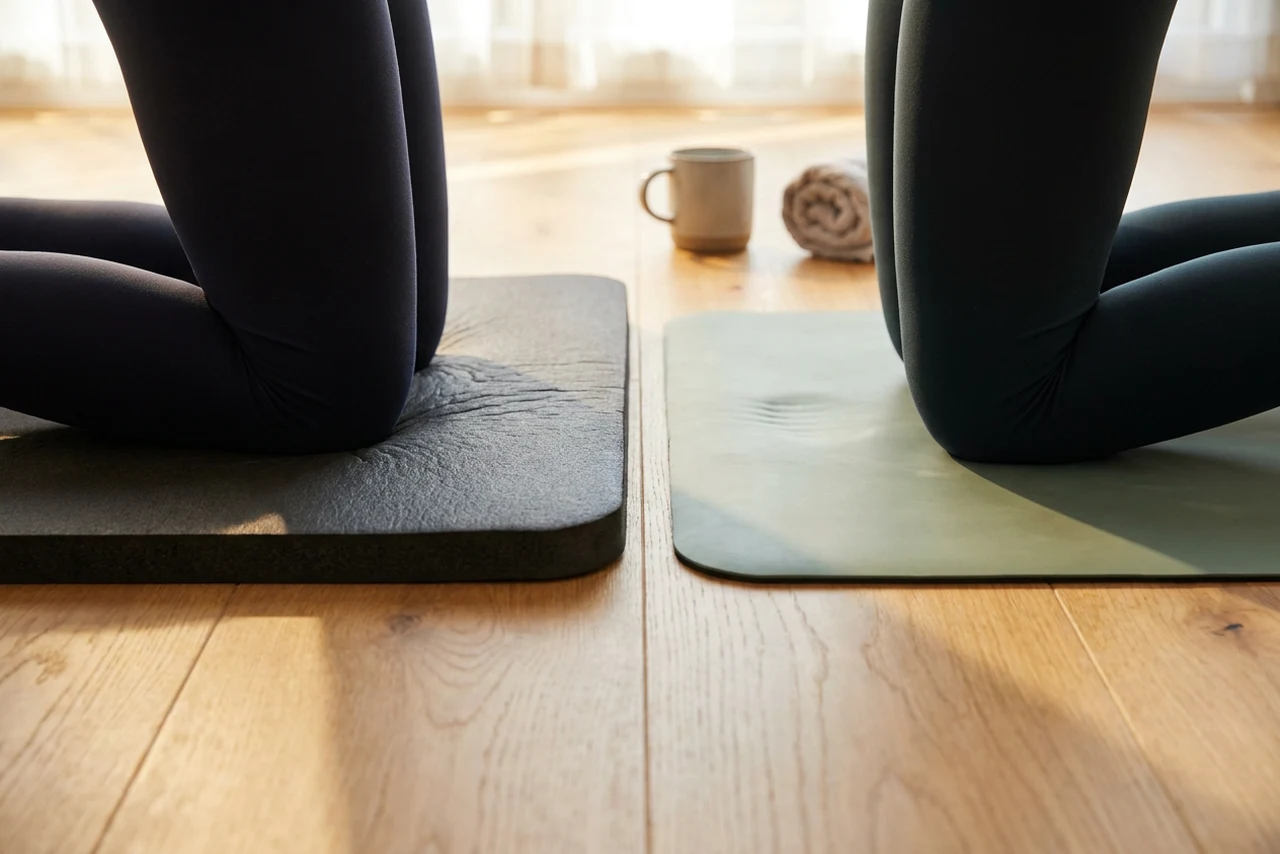
The 5 factors that decide your ideal thickness
Your practice style
Fast vinyasa, Ashtanga and standing balance work reward stability. In those styles, a thinner or denser mat often feels better because your feet can read the floor. A 3–5mm (about 1/8 to 3/16 inch) mat is usually enough.
Hatha, beginner home practice and mixed routines are more forgiving. You still stand, lunge and balance, but you also spend time kneeling and seated. That is why 4–5mm (about 3/16 inch) is the safest general recommendation.
Yin, restorative yoga and long floor holds shift the equation. If you are spending minutes on knees, hips, spine or elbows, comfort matters more than crisp balance feedback. A 6mm (about 1/4 inch) mat, blanket, bolster or knee pad can make more sense than a thin studio-style mat.
Pilates is slightly different. For standing Pilates-inspired work, a firm 3–4mm (about 1/8 inch) mat can feel precise. For floor-heavy Pilates, many people prefer a denser cushioned mat — but that is not always the same tool as a classic yoga mat.
Your body: weight, joint sensitivity and knee history
Thickness changes how pressure spreads. If your knees, wrists, hip bones or ankles feel sharp pressure on the floor, a little more cushion helps. But body weight and mat density change the result. A soft foam mat can compress so much that a 6mm mat effectively feels like 3mm once you kneel on it.
If you have sensitive knees, do not assume you need an 8–10mm mat immediately. Often the better setup is a stable 4–5mm (about 3/16 inch) mat plus a small knee pad or folded blanket for kneeling poses. That keeps your standing practice stable while giving extra support only where you need it.
This is educational guidance, not medical advice. If pain is sharp, persistent or injury-related, get qualified support rather than trying to solve it with gear alone.
Your floor: hardwood, tile, carpet or cement
The floor under the mat changes everything.
Hardwood and laminate floors are usually ideal because they are firm but not brutally hard. A 4–5mm (about 3/16 inch) mat works well for many people here.
Tile and cement are less forgiving. Knees and wrists feel pressure faster, and cold floors can make thin mats feel harsher. On these floors, 5–6mm (about 3/16 to 1/4 inch) or a knee pad is often more comfortable.
Carpet sounds soft, but it can make balance worse. A thick mat on top of soft carpet becomes unstable because both layers compress. On carpet, a thinner, denser mat often works better than a plush one.
Where you practice
If your mat lives at home, weight matters less. You can choose the thickness that supports your practice. If you carry it to class, a dense 6mm mat may become annoying quickly. If you travel, 1.5–2mm (about 1/16 inch) is realistic because it folds or rolls into luggage — but it is a hygienic layer, not a comfort mat.
Outdoor practice adds another variable: uneven ground. A very thin mat on rough decking or stone is uncomfortable, but a very thick soft mat can wobble. For occasional outdoor practice, use a durable mat you can clean gently afterwards. For care by material, see the yoga mat cleaning guide.
Density vs thickness
This is the part most product pages hide. Thickness is the height of the mat. Density is how much it resists compression.
A dense 4mm (about 5/32 inch) mat can feel more supportive than a soft 6mm (about 1/4 inch) mat because it does not collapse under your knee. A cheap plush foam mat — the Retrospec Solana is a classic example — may look comfortable in photos but feel unstable in lunges and compress quickly under repeated use.
When you compare mats, look for language around density, material and compression — not just the thickness number. If the choice is between a dense 4–5mm mat and a soft 8mm foam mat for general yoga, the denser balanced mat is usually the better yoga tool.
Head-to-head thickness comparisons
Is a 5mm or 3mm yoga mat better?
For most home practitioners, 5mm (about 3/16 inch) is better than 3mm (about 1/8 inch) because it gives more cushion without making the mat feel overly soft. It is the safer choice for beginners, mixed home practice and anyone who kneels regularly.
Choose 3mm if you already know you like a firm surface, practise balance-heavy styles, carry your mat often or use it over a forgiving floor. A 3mm mat is not "worse"; it is simply less cushioned and more precise.
Is a 6mm or 10mm yoga mat better?
For yoga, 6mm (about 1/4 inch) is usually better than 10mm (about 3/8 inch). A 6mm mat adds meaningful cushion while still behaving like a yoga mat. A 10mm mat starts to behave more like a fitness or stretching mat.
Choose 10mm only if your practice is mostly floor work, restorative poses, gentle stretching or rehab-style movement where balance feedback is not the priority. For standing poses, transitions and lunges, 10mm can feel too squishy.
Is a 5mm or 8mm yoga mat better?
For most yoga, 5mm (about 3/16 inch) is better than 8mm (about 5/16 inch). It gives enough comfort for normal kneeling and seated work while staying stable in standing poses.
Choose 8mm if your main issue is joint pressure, your practice is gentle, or you rarely do standing balance work. But if the only problem is knee discomfort in a few poses, a knee pad on top of a 5mm mat is often more practical than making the whole mat thicker.
Which thickness is best for most people?
The best thickness for most people is 4–5mm (about 3/16 inch). That range reconciles the conflicting advice you see online: 3mm is standard for people who want floor feedback; 6mm supports people who need cushion; 8–10mm belongs to floor-heavy or joint-relief use cases. The middle is popular because it works for the widest range of real practice.
If you are still choosing your first mat and need help beyond thickness, start with the full yoga mat buying guide.
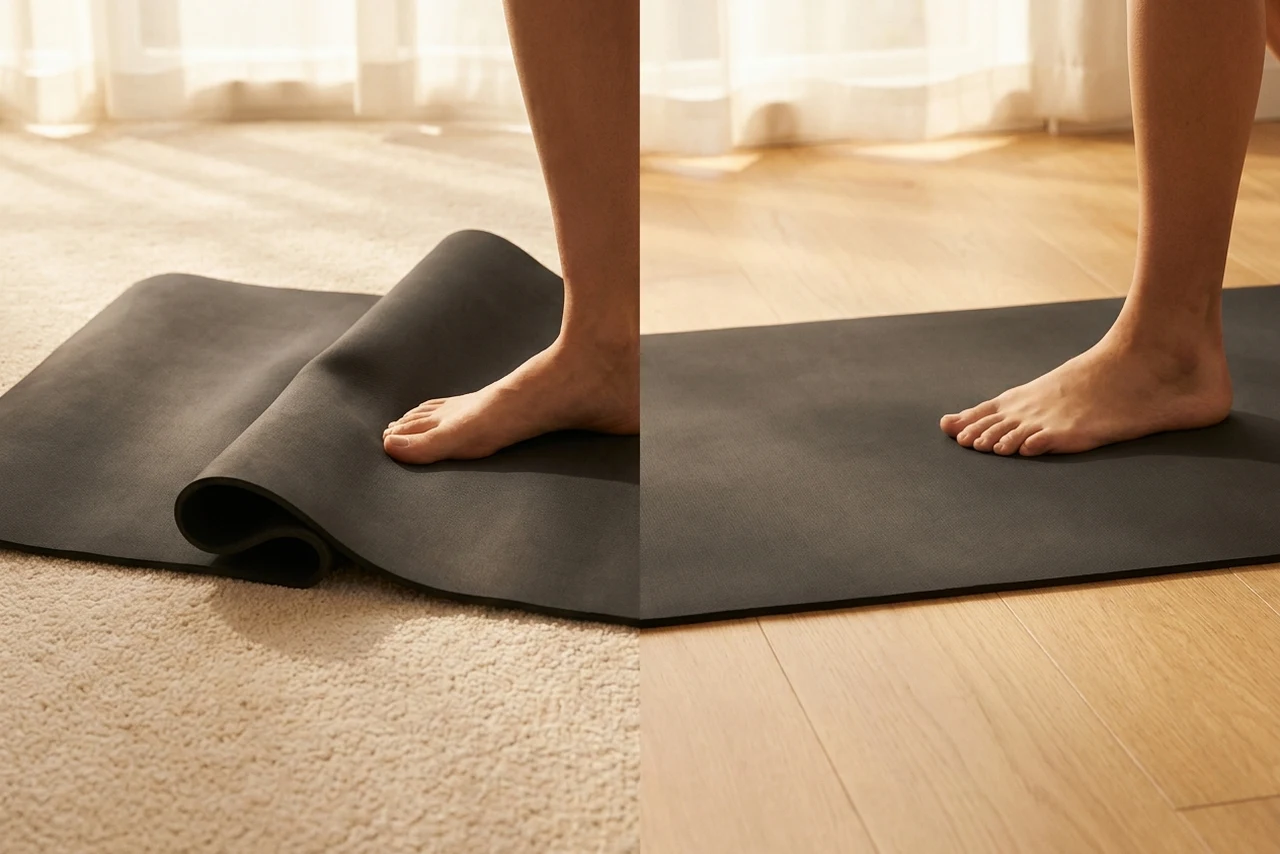
Thickness by practice type
Hot yoga
For hot yoga, thickness is not the main problem. Grip is. Most sweaty practitioners do well with 4–5mm (about 3/16 inch) if the top surface handles moisture well. A thick but slippery mat is still a bad hot-yoga mat.
If you practise heated vinyasa, look for wet-grip performance, towel compatibility, drying time and cleaning routine before chasing extra cushion. The dedicated hot yoga mat guide goes deeper on that decision.
Pilates
For Pilates, ask whether you mean standing/balance work or floor work. Standing Pilates-style movement benefits from a firm surface, often 3–4mm (about 1/8 inch). Floor-heavy Pilates may need more cushion under the spine, hips and knees.
If you do both yoga and Pilates on one mat, a firm 4–5mm (about 3/16 inch) mat is the compromise. If you mostly do Pilates floor work, a dedicated Pilates mat may be more comfortable than trying to make a yoga mat do everything.
Beginners
Beginners usually do best with 4–5mm (about 3/16 inch). It is forgiving enough for knees and wrists but not so thick that every standing pose feels unstable.
The goal for a first mat is not maximum cushion. The goal is a surface that makes you willing to practise consistently. If the mat hurts your knees, you avoid practice. If it is too soft, balance feels harder than it needs to.
Restorative and yin
Restorative and yin practices can use more support because you hold shapes longer and spend more time on the floor. A 6mm (about 1/4 inch) mat, folded blanket, bolster or knee pad can help.
For very long holds, props often matter more than mat thickness. A blanket under knees or hips is easier to adjust than trying to make one thick mat solve every pose.
Travel
Travel mats are usually 1.5–2mm (about 1/16 inch). They fold into a bag and create a clean surface over hotel floors or studio mats. They are not designed for plush comfort.
If you travel often and your joints are sensitive, pack a thin mat plus a small towel or use folded clothing under knees for kneeling poses. That is more realistic than expecting a travel mat to feel like your home mat.
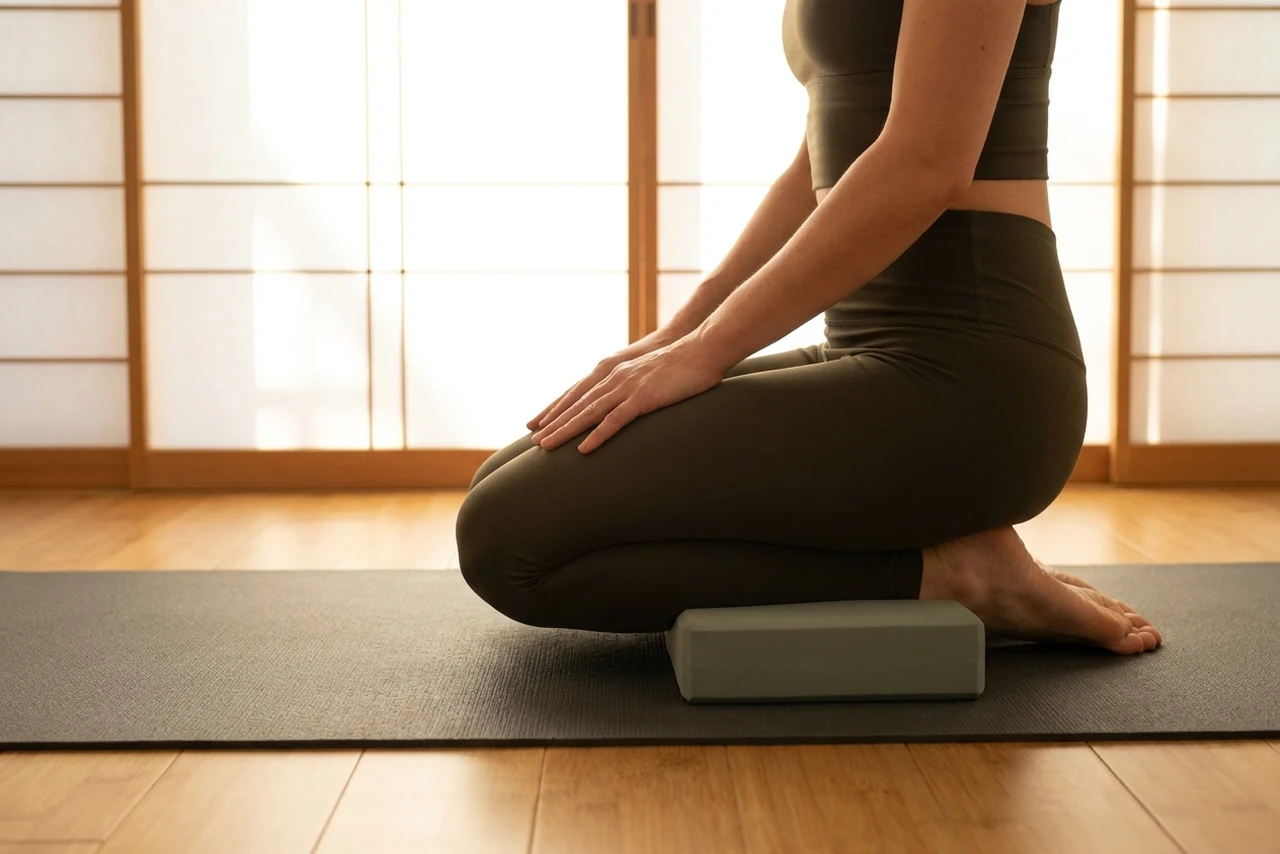
When to use a knee pad instead of a thicker mat
A lot of "I need an 8mm mat" situations are really "I need targeted knee support" situations.
Use a knee pad, folded blanket or folded edge of the mat when pressure only appears in kneeling poses: low lunge, tabletop, camel, gate pose or child's pose. That keeps the main mat stable for standing work and gives extra cushion exactly where the body asks for it.
Choose a thicker mat when your whole practice is floor-based, restorative or consistently uncomfortable on hard surfaces. Choose a knee pad when one or two shapes are the problem.
A pad also costs a fraction of a thicker mat and does not change how every standing pose feels. Our yoga knee pad guide goes through the thicknesses and the free alternatives; if you just want the one that works, this is it.
Check price on AmazonWhen thickness is the wrong question
Thickness is only one part of choosing a yoga mat. Material decides grip, smell, weight, care and durability. Surface texture decides whether hands slide. Size decides whether your whole body fits. Care decides whether the mat still feels good a year from now.
If you are still picking your first serious mat, start with the full guide to choosing a yoga mat. Use thickness as the first filter, not the whole decision.
The quiet answer is usually the right one: choose enough cushion to keep practice comfortable, enough firmness to stay stable, and use props when one specific pose needs extra support.
Frequently asked questions
How thick should a yoga mat be in inches?
For most people, a yoga mat should be about 3/16 inch thick, which is roughly 4–5mm. A 1/8 inch mat, about 3mm, feels firmer and travels better. A 1/4 inch mat, about 6mm, gives more cushion but less floor feedback.
How thick should a yoga mat be for beginners?
Most beginners should start with a 4–5mm mat, about 3/16 inch. That range is forgiving on knees and wrists without feeling too unstable in standing poses. If your joints are sensitive, add a knee pad before jumping straight to an 8–10mm mat.
How thick should a yoga mat be for pilates?
For Pilates-style floor work, firmness matters more than plushness. A firm 3–4mm yoga mat can work for standing and balance work, while floor-heavy Pilates may feel better on a denser 6mm mat or a separate Pilates mat. Avoid very soft foam if you need stable alignment.
How many mm thick should a yoga mat be?
A general-purpose yoga mat should usually be 4–5mm thick. Choose 1.5–2mm for travel, 3mm for a firmer studio feel, 6mm for extra cushion, and 8–10mm only when restorative work or joint relief matters more than balance stability.
Is a thicker yoga mat better?
A thicker yoga mat is not automatically better. More thickness can protect knees, wrists and hips, but it can also make balance poses wobblier because your hands and feet sink into the surface. Density, material and floor type matter as much as the number of millimetres.
Does mat density matter more than thickness?
Often, yes. A dense 4mm mat can feel more supportive than a soft 6mm mat because it resists compression. Thickness tells you how tall the mat is; density tells you how much it collapses under body weight. For standing yoga, density is usually the hidden variable.