

This guide contains affiliate links — recommendations aren’t based on commission. Read our full disclosure.
How this page has changed
May 25, 2026
Sources, internal links and safety or product context reviewed.
In this guide
- 01Why Cleaning Your Yoga Mat Matters
- 02How Often Should You Clean Your Yoga Mat?
- 03What You'll Need
- 04How to Clean Your Yoga Mat: Step-by-Step
- 05Cleaning Different Yoga Mat Materials
- 06DIY Yoga Mat Cleaner: Check Compatibility First
- 07How to Dry Your Yoga Mat After Cleaning
- 08Common Mistakes to Avoid
- 09When to Replace Your Yoga Mat (Beyond Cleaning)
- 10Further Reading
Most yoga mats look fine for months. Then one day you notice the grip is gone, there is a faint smell on every roll-out, and the top layer is starting to flake. How you clean a yoga mat decides whether it lasts you one year or ten.
The wrong cleaner — or letting your mat sit wet — destroys the surface faster than the dirt would. The good news is the right routine takes about thirty seconds a day, plus fifteen minutes once a month. This guide walks through both, plus the per-material differences nobody else covers.
Quick answer. Start with the current care instructions for your exact mat. A damp microfiber cloth is a conservative daily option when the maker permits it; cleaners, soap, vinegar, essential oil, soaking and disinfectants are material- and model-specific. Let the mat dry fully before rolling.
By Marvin Smit · Long-time practitioner, not a certified instructor.
Why Cleaning Your Yoga Mat Matters
Three reasons, in order of how much most people notice them.
Grip. Sweat and body oils sink into the top layer of a mat and leave a fine slick that you cannot see but absolutely feel in downward dog. A clean mat grips like a new one. A neglected mat slides — and you start blaming yourself for "losing flexibility" when really you are losing traction.
Lifespan. Regular care can double or triple how long a mat lasts. Manduka offers a lifetime guarantee on the PRO when cared for properly — see their warranty terms for current conditions. The same mat, never wiped down and rolled up wet, can be unusable inside a year.
Hygiene. Your hands, feet and forehead spend a lot of time on the same surface. Surface bacteria and skin contact are real concerns, especially with shared studio mats — but skip the medical claims. No spray bottle of vinegar "kills 99% of germs", and no honest cleaning routine pretends otherwise. The goal is a clean surface, not a sterile one.
How Often Should You Clean Your Yoga Mat?
Match the rhythm to how much you use it. Most home practitioners can stick to this:
| When | What to do | Time |
|---|---|---|
| After every practice | Quick wipe-down with damp cloth or plain water | 30 seconds |
| Weekly | Maker-approved light clean when needed | 5 minutes |
| Monthly | Model-specific deeper clean when permitted | 15–20 minutes |
After every practice — quick wipe-down (30 seconds)
If you do nothing else, do this. A damp microfiber cloth, two passes top and bottom, hang to dry. It is the single highest-impact habit for mat longevity.
Weekly — light cleaning (5 minutes)
Use only the formula and application method permitted for the exact mat. This may be a maker-approved spray or a carefully controlled damp-cloth method. Our yoga mat cleaner spray guide explains how to assess a commercial product without assuming universal compatibility.
Monthly — deep clean (15–20 minutes)
This is the one where material matters. A natural rubber mat does not get cleaned the same way as a Manduka PRO. See the per-material section below before you start scrubbing.
Extra cleaning after
- Hot yoga or any sweat-heavy session
- Outdoor practice (sand, grass, pollen)
- Borrowing a shared studio mat
- Practising while recovering from a cold or flu
What You'll Need
Nothing exotic. Most of this is probably already in your kitchen or bathroom.
- A microfiber cloth (or two: one damp, one dry)
- A small spray bottle, around 250–500 ml
- Distilled or filtered water — tap water is fine; distilled minimises residue on darker mats
- Any cleaner explicitly approved for the exact mat model
- The mat maker's current care directions
You do not automatically need a branded cleaner, but neither a homemade nor store-bought formula is universally compatible. The mat maker's care label decides. A commercial product is useful when it clearly identifies compatible materials, ingredients, dose, wiping method and drying instructions.
How to Clean Your Yoga Mat: Step-by-Step
There are three routines: daily, weekly, monthly. Same five-step structure, different solution.
The daily wipe-down (after every practice)
- Unroll the mat flat
- Shake or sweep off loose debris
- Lightly dampen a microfiber cloth with plain water
- Wipe both sides in slow sweeping passes, paying attention to hand and foot zones
- Hang or lay flat to air-dry fully before rolling
Total time: under a minute. This is the routine you actually do.
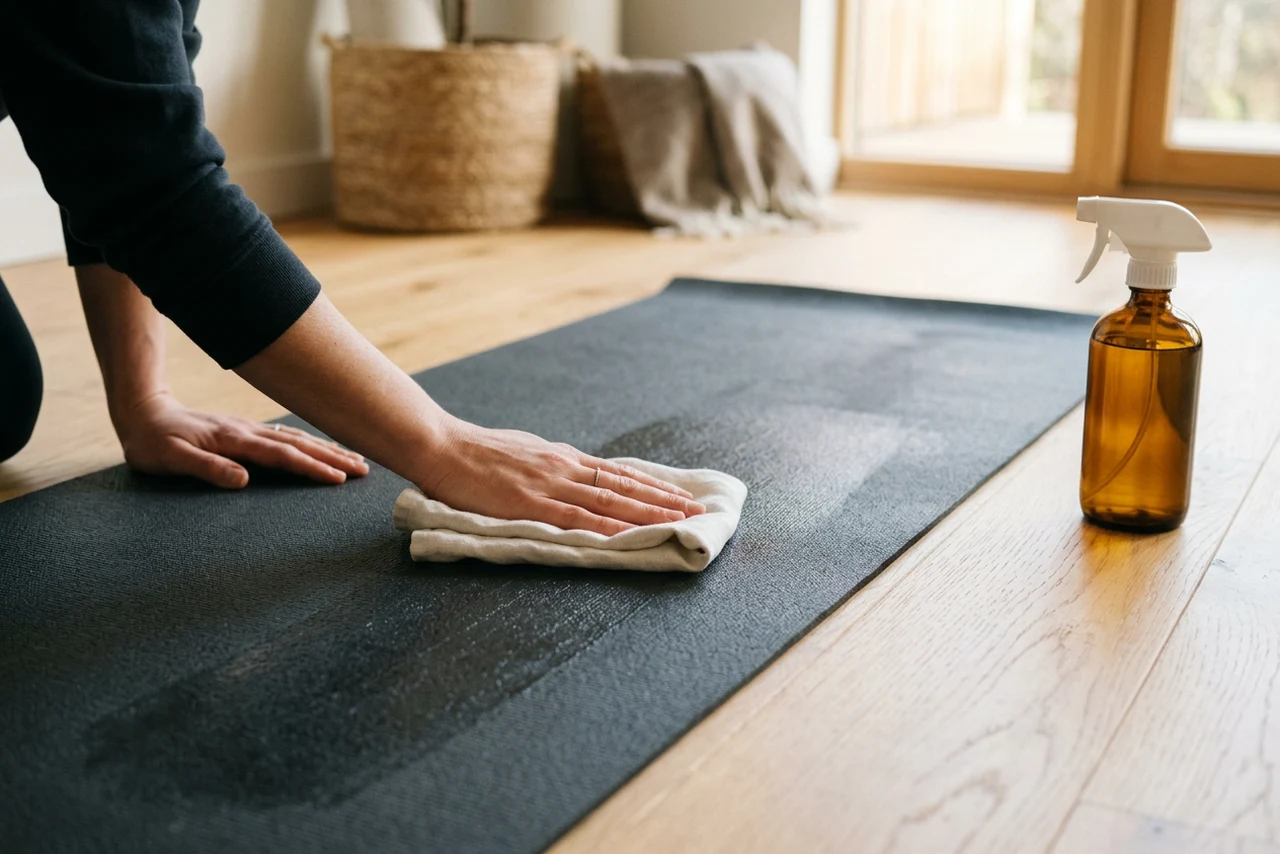
The weekly light clean
Use the same controlled workflow with the cleaner and dose approved by the mat maker. Spend a little longer on high-contact zones, complete any required clean-water wipe, and air-dry completely before rolling.
The monthly deep clean — the closest thing to washing a yoga mat
Briefly: mix a mild soap solution, wipe the top, wipe the back, rinse with a clean damp cloth, then hang to dry for 24 hours. The specifics per material:
- Closed-cell mats (most PVC mats including the Manduka PRO): wipe down with a damp cloth dipped in mild soap solution. Water sits on the surface, so a thorough wipe works well. Do not submerge.
- Open-cell mats (most natural rubber and TPE mats): use the same soap-and-cloth method but be sparing — open-cell surfaces drink water, which is exactly what you do not want. Wring the cloth out properly before each pass.
- The bathtub wash: only for mats the manufacturer explicitly says are bathtub-safe — many natural rubber mats degrade if soaked, so read the label first. If yours qualifies: a few inches of lukewarm water with a small squeeze of mild soap, soak for about five minutes, scrub gently with a soft cloth, rinse until the water runs clear, then roll the mat in a dry towel to press out the excess. This is the method guides like REI's and Wirecutter's describe when people ask how to wash a yoga mat — and never the washing machine (see the FAQ below).
- Drying: after any deep clean, hang the mat for at least 24 hours before rolling — after a full bathtub wash, count on 24 to 48. Trapped moisture is what causes lasting odour and mildew — and once a mat smells musty, it almost never comes back.
For more on how long a properly maintained mat should actually last, see our complete yoga mat buying guide.
Cleaning Different Yoga Mat Materials
Most general "how to clean a yoga mat" articles stop at open-cell versus closed-cell. That misses the point. Here is what actually changes by material.
Natural rubber mats (Jade, Manduka eKO, Liforme)
Natural rubber is open-cell — it absorbs water — so the cardinal rule is damp cloth, not wet cloth. A few specifics:
- Avoid vinegar at high concentration. Diluted is fine for occasional use, but daily strong vinegar will degrade the rubber over months.
- Never dry in direct sunlight. UV breaks down natural rubber fast — you will see fine cracking within a few months of regular sun exposure.
- A new natural rubber mat often comes with a faint rubber smell that fades over a week or two of practice. This is normal and not a defect.
PVC mats (Manduka PRO, Manduka PROlite, classic Gaiam)
PVC is closed-cell, which makes it the easiest material to clean — water sits on the surface and wipes away.
- Manduka has retired its old salt-scrub break-in advice for the PRO: the company now says the initial slickness is the nature of the closed-cell surface and fades with regular practice. Regular cleaning still matters, because sweat and oil buildup add slip. See Manduka's current guidance for details.
- PVC resists most mild cleaners. Still avoid bleach and harsh disinfectants — they will eat through the top finish.
- Closed-cell does not mean indestructible. Over-soaking still causes issues at the seams.
Cork mats
Cork is naturally antimicrobial, which means it actually needs less frequent deep cleaning than other materials. If you are choosing cork mainly for material feel, compare the current options in the eco-friendly yoga mat guide before buying.
- A light damp wipe after practice is usually enough.
- Cork hates over-soaking. Keep cleaning surface-only.
- Avoid soaps with strong dyes or fragrances. Cork is porous and absorbs odours, so what you clean it with stays with it for a while.
Lululemon mats (The Mat 5mm)
The Lululemon top layer is polyurethane bonded to a rubber base. That polyurethane is what makes the mat famously grippy when wet — and what makes it sensitive to harsh cleaners.
- Stick to a light damp cloth with at most a drop of mild soap. As a rule, no soaking and no harsh chemicals on this surface.
- Note that the vinegar spray from the recipe section is NOT for this mat — acid ages the natural rubber base.
- This mat gets its own dedicated routine in how to clean a Lululemon yoga mat, including what should never touch the rubber and the fixes for a slick or smelly surface.
TPE mats (most budget brands and travel mats)
TPE is the most forgiving material in terms of cleaning. Most TPE mats are closed-cell or semi-closed and tolerate mild cleaners well.
- Avoid heavy essential oils. They can leave residue that ends up more slippery, not less.
- Many TPE mats are genuinely safe to rinse in a shower or bath — but always check the brand's label before you commit.
A note on brand pages. Manufacturer care pages move and sometimes disappear. Where this guide references a brand's official instructions, the link goes to their homepage so you can find the current page even if the URL has changed. If a specific instruction here ever contradicts the current label on your mat, follow the label.
DIY Yoga Mat Cleaner: Check Compatibility First
No homemade spray covers every situation. Current manufacturer instructions conflict: some mats permit mild detergent, while others prohibit soap, soaking, solvents, disinfectants or direct essential oil. Follow the exact mat model rather than a universal ratio.
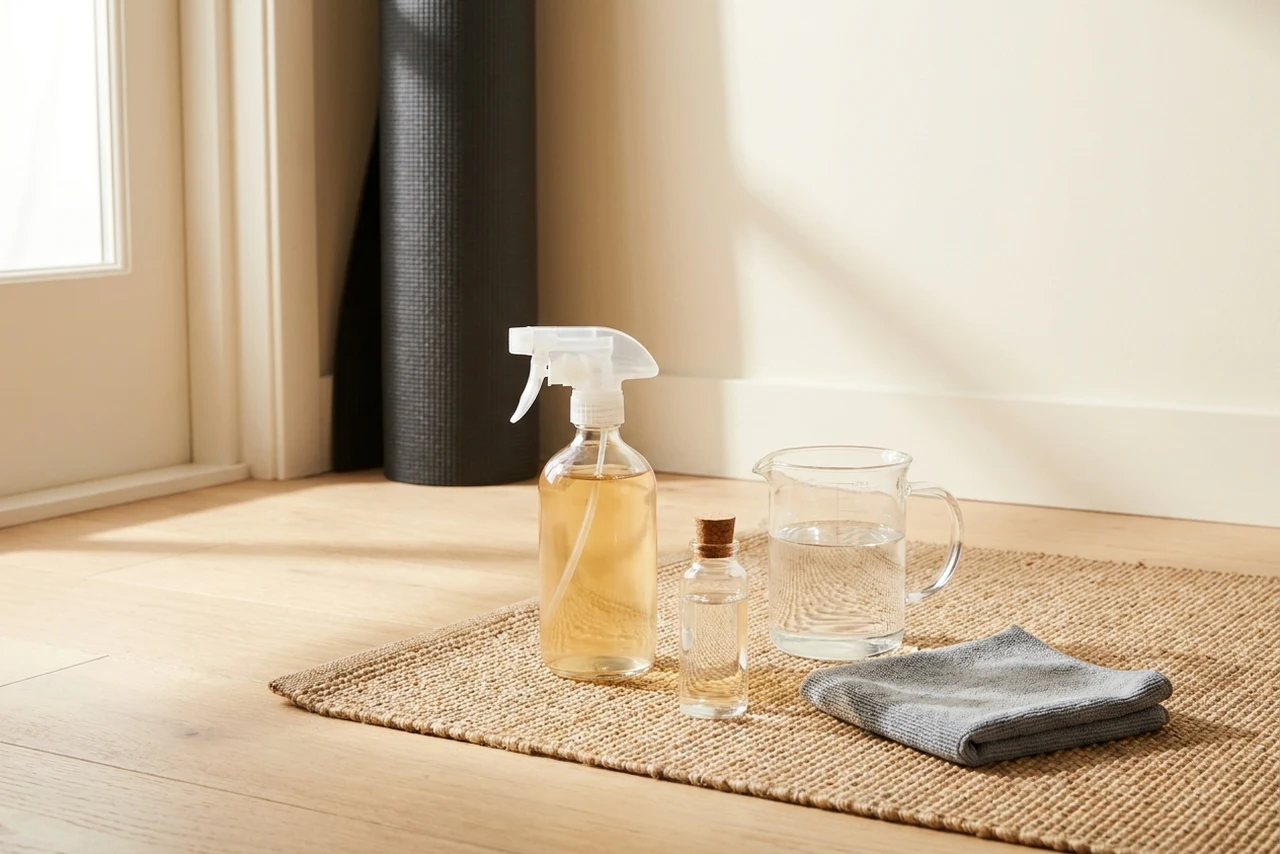
Vinegar + water spray
Frequently suggested online, but not a safe default for every mat.
- Ratio: 1 part white vinegar to 3–4 parts water
- Optional: 3–5 drops of tea tree oil for a fresher smell
- Use for: only models whose current maker instructions permit diluted vinegar
There is no universal vinegar-to-water ratio because mat constructions and care rules differ. Do not adjust by trial and error on a mat whose maker prohibits acid or does not document vinegar compatibility.
Witch hazel + essential oils spray
Not automatically gentler: alcohol content, fragrance, oil concentration and dispersion all matter.
- Ratio: 1 part witch hazel to 3 parts water
- Optional: 5 drops of lavender or tea tree oil
- Use for: only when the exact mat directions permit every ingredient
Castile soap solution
Some mats permit a very mild soap solution; others, including Manduka's current eKO guidance, explicitly prohibit soap.
- Ratio: ½ teaspoon liquid Castile soap to 2 cups of warm water
- Use for: only mats whose maker permits mild soap
- Important: always follow with a clean damp cloth to wipe off any soap residue. Skipping this step is a common mistake — Castile soap residue leaves a film that kills your grip.
What DIY cleaners can and cannot do
- A compatible formula and controlled wiping can remove surface sweat, oil and odour
- They do not sterilise or "disinfect" in a medical sense — please do not treat them like hospital-grade products
- They are not a substitute for replacing a mat that has reached end-of-life (more on that below)
How to Dry Your Yoga Mat After Cleaning
Drying is the step almost everyone gets wrong. Three rules cover it:
- Air-drying flat or hung over a shower rod is the only safe default. A drying rack, the back of a chair, an outdoor railing in indirect light — all fine.
- Twenty-four hours minimum after a deep clean before rolling. Less for a daily wipe-down, but err on the side of longer.
- No direct harsh sunlight on natural rubber. Short indirect sun is fine for most other materials. Tumble drying and hair dryers on full heat will ruin almost any mat.
If you are in a hurry, a small fan moving air across the surface speeds drying without heat. That is the only "shortcut" worth doing.
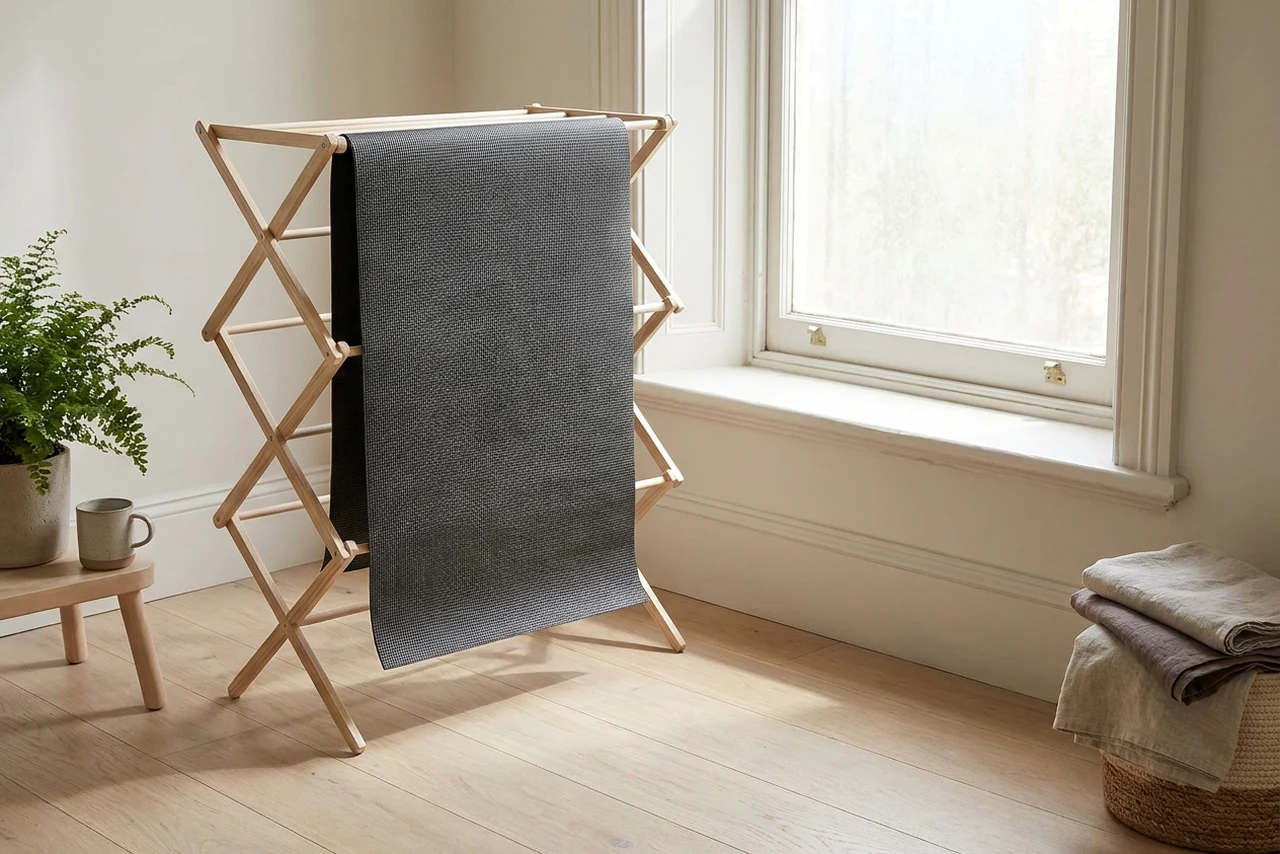
Once it is fully dry, how you put it away matters just as much: here is storing a yoga mat the right way so the clean actually lasts.
Common Mistakes to Avoid
Most mat damage comes from a handful of avoidable mistakes:
- Bleach or hospital-grade disinfectants. They destroy the top layer of nearly every yoga mat material.
- The dryer. Heat melts, warps and delaminates. Never.
- Over-soaking closed-cell mats. Water that gets into the seams stays there.
- Disinfectant wipes with quaternary ammonium ("quats"). Corrosive to rubber and polyurethane surfaces — the chemistry is well-documented and the damage is irreversible.
- Heavy essential oil use. Residue plus skin irritation; less is more.
- Rolling the mat while still even slightly damp. This is how mildew starts and why old mats smell musty.
- Ignoring the brand's care label. Almost every mistake above is printed on the label of the mat you bought.
When to Replace Your Yoga Mat (Beyond Cleaning)
For a proper keep-clean-replace diagnosis, use the four functional tests in how long a yoga mat lasts. Age alone is not a reliable replacement rule.
No amount of cleaning can save a mat past its lifespan. The honest signals:
- The top layer is flaking or peeling
- Grip is gone even on a freshly deep-cleaned mat
- Permanent indentations where your hands and feet land
- A musty smell that will not lift after a proper deep clean and 24-hour dry
When you hit two or more of these, it is time. A new mat that you treat well from day one will outlast a tired mat held together with vinegar.
Further Reading
- Start with our complete yoga mat buying guide if you are choosing a mat from scratch.
- For a focused breakdown, read our yoga mat thickness guide.
- If sweat and grip are the main issue, see our hot yoga mat guide.
- REI Expert Advice publishes a short, well-sourced primer on yoga mat cleaning in their how-to library — worth a read for a second perspective.
- See our affiliate disclosure for how we recommend products.
Have a question about cleaning a specific mat we did not cover? Email hello@theyogasensei.com — corrections and additions are noted in the article.
Frequently asked questions
Is it OK to use a wet wipe to clean my yoga mat?
Standard household wet wipes are not ideal. Most contain quaternary ammonium compounds or harsh fragrances that corrode rubber and polyurethane surfaces over time. If you only have wipes, use fragrance-free baby wipes occasionally — but a damp microfiber cloth with water is gentler and safer for daily use.
Can I wash my rubber yoga mat?
You can clean a natural rubber mat with a damp cloth and a few drops of mild soap, but never submerge or soak it. Natural rubber is open-cell and absorbs water, which leads to mildew and breakdown of the rubber itself. Keep cleaning surface-only and dry it flat or hung.
Does vinegar disinfect yoga mats?
Diluted white vinegar is mildly antibacterial and cuts through sweat, oil and odour very effectively. It is not a medical disinfectant and should not be described as one. For everyday yoga mat care, a one-to-four vinegar-to-water spray works well — strong enough to clean, dilute enough to spare the surface.
Can I wash my yoga mat with dish soap?
A tiny amount of mild dish soap in water is fine for a monthly deep clean on most PVC and TPE mats. Avoid it on natural rubber and on Lululemon-style polyurethane tops, where it can strip the grippy surface. Always wipe down afterwards with a clean damp cloth to remove residue.
Can I put my yoga mat in the washing machine?
Almost no yoga mat is genuinely washing-machine safe. The agitation tears at the surface, water gets trapped between layers, and the heat of a tumble dry destroys most materials. Always check the care label first — and when in doubt, hand-clean instead.
How do I get smells out of my yoga mat?
Most mat odour comes from sweat and body oil buildup, not the mat itself. A monthly deep clean with diluted vinegar or witch hazel usually clears it. If the smell will not lift after a proper clean and a full twenty-four-hour dry, the mat has likely reached end-of-life.