

This guide contains affiliate links — recommendations aren’t based on commission. Read our full disclosure.
How this page has changed
August 2, 2026
Sources, internal links and safety or product context reviewed.
May 26, 2026
First published.
In this guide
- 01Quick picks: the best eco-friendly yoga mats
- 02What “eco-friendly” actually means for a yoga mat
- 03How we chose these picks
- 041. Manduka eKO 5mm — Best Overall Natural Rubber
- 052. Liforme Original — Best Premium Eco-PU + Rubber Pick
- 063. Jade Harmony — Best Open-Cell Rubber Grip
- 074. Manduka eKO Lite 4mm — Best Lighter Eco Mat
- 085. Gaiam Cork Yoga Mat — Best Cork Option
- 09The mat I actually use (not a pick)
- 10Natural rubber vs cork vs PU vs TPE
- 11Greenwashing red flags
- 12Care notes for eco-friendly mats
- 13Who should buy an eco-friendly yoga mat?
- 14Final verdict
An eco-friendly yoga mat should make your practice feel better without turning sustainability into vague marketing fog. The problem is that “eco” can mean at least five different things: natural material, lower-toxic formulation, recycled content, plastic-free packaging, biodegradability, or simply a mat that lasts long enough that you do not replace it every six months.
We did not test these mats in a lab. We cross-referenced manufacturer specifications, material claims, what established yoga and gear publishers report, Amazon availability, and recurring buyer/reviewer themes. The aim is not to crown a morally perfect product. It is to help you choose a mat whose material story, grip, weight, latex risk and care needs actually match your practice.
By Marvin Smit · Long-time practitioner, not a certified instructor.
Quick picks: the best eco-friendly yoga mats
| Pick | Best for | Material story | Thickness | Latex flag |
|---|---|---|---|---|
| Manduka eKO 5mm | Best overall natural rubber | Dense natural rubber, serious all-round feel | 5 mm | Yes |
| Liforme Original | Best premium alignment mat | Eco-PU top over natural rubber base | 4.2 mm | Yes |
| Jade Harmony | Best open-cell rubber grip | Classic natural rubber with tactile grip | ~4.7 mm | Yes |
| Manduka eKO Lite 4mm | Best lighter eco mat | Lighter natural-rubber build for commuters | 4 mm | Yes |
| Gaiam Cork Yoga Mat | Best cork option | Cork top with non-toxic TPE backing | 5 mm | Check maker guidance |
If you already know latex is a concern, remove the natural-rubber picks first. If you want the least maintenance, be careful with open-cell rubber and cork. If you want one deeper all-category comparison, start with the best yoga mats of 2026 hub instead.
What “eco-friendly” actually means for a yoga mat
The cleanest answer would be simple: natural materials good, synthetic materials bad. Real life is messier.
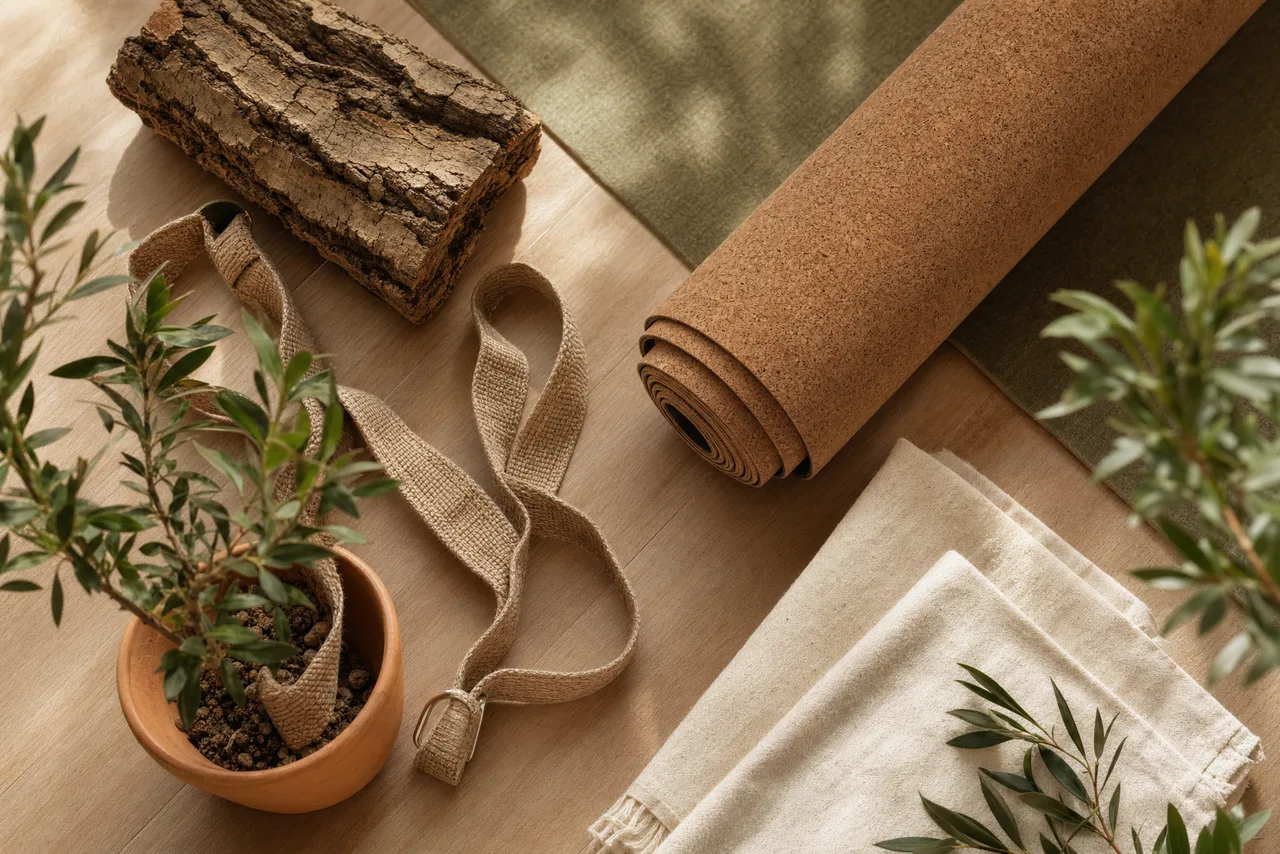
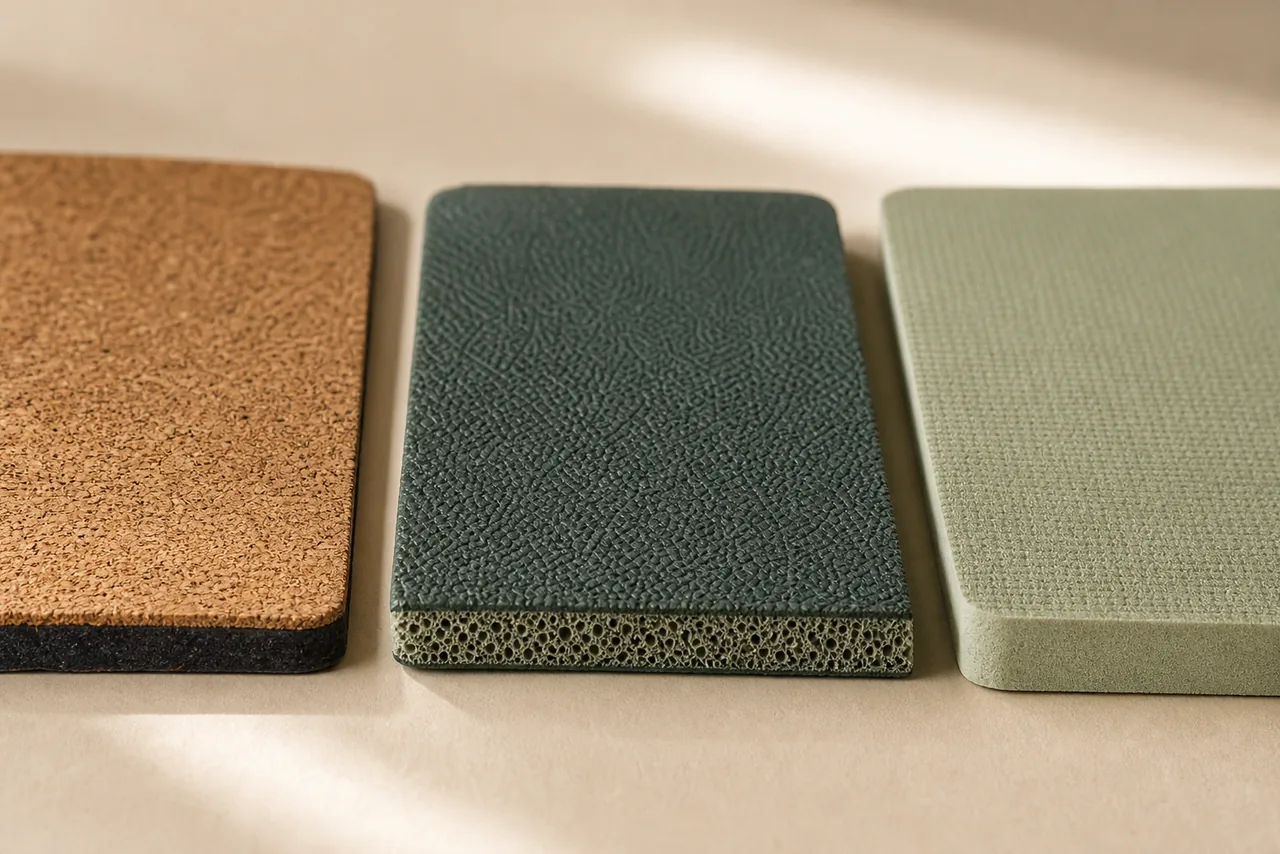
Natural rubber can feel grippy and grounded, but it can smell at first, degrade in direct sun, weigh more than foam, and matter for latex-sensitive practitioners. Cork is attractive because cork bark can be harvested without cutting down the tree, but most cork yoga mats are not pure cork slabs. They usually bond a thin cork layer to rubber or TPE backing, so the backing and adhesive still matter.
PVC has the weakest “eco” story in many shoppers' minds, but a durable PVC mat kept for years may create less waste than a cheap “eco” mat that flakes quickly. TPE is often marketed as a lighter, latex-free, more recyclable alternative, but the word TPE covers a family of materials rather than one universal standard. Polyurethane tops can perform beautifully, but they are still synthetic surfaces and often need careful cleaning.
So this guide uses a practical standard: does the mat reduce obvious material concerns compared with basic foam/PVC, does it have enough durability to stay in use, and are the trade-offs disclosed early? A mat is not truly mindful if it hides allergy risk, care difficulty or a short lifespan behind a green label.
How we chose these picks
We started with mats that already make sense inside the yoga-mat cluster: natural rubber, cork or lower-impact performance constructions with enough buyer visibility to be useful. We also wanted the list to complement the broader yoga mat buying guide, not duplicate it.
The filters were:
- Material relevance: natural rubber, cork or eco-positioned performance construction had to be central to the mat's story.
- Use-case clarity: each pick needed a distinct reason to exist: cushion, alignment, grip, portability or cork texture.
- Stable specs: thickness, material and weight range matter more than live prices or star ratings.
- Honest limitations: latex, smell, moisture absorption and cleaning needs are part of the recommendation, not a hidden footnote.
- Affiliate discipline: product links go through local
/go/redirects and remain gated until Amazon approval is active.
That last point matters. Prices, Amazon badges, review counts and star ratings change constantly. They can inform research, but they should not be frozen into evergreen editorial copy.
1. Manduka eKO 5mm — Best Overall Natural Rubber
The Manduka eKO 5mm is the strongest overall eco-friendly pick because it gives you the serious-mat version of the natural-rubber category. It is dense, substantial and built for people who want one grounded mat for home practice, studio classes and general vinyasa.
At 5mm, it lands in the practical middle: more cushion than thin travel mats, but still stable enough for standing poses. The weight is part of the story. Around 7 lb is not carefree commuter territory, but that density helps the mat feel planted under hands and feet. If the mat mostly lives at home or in a studio corner, that trade-off can be worthwhile.
The eco angle is natural rubber rather than a plastic-first construction. That does not make it perfect. Natural rubber has a real latex caveat, a possible rubber smell during the first weeks, and a care routine that rewards patience. You need to let it dry fully, avoid direct sun unless the brand says otherwise, and clean it more thoughtfully than a basic closed-cell mat.
Best for: people who want one serious natural-rubber mat with enough cushion for a broad practice.
Skip it if: you need a light commuter mat, dislike rubber smell, want a latex-free surface, or mainly need hot-yoga wet grip.
2. Liforme Original — Best Premium Eco-PU + Rubber Pick
The Liforme Original is the premium pick for people who want a more guided practice surface. Its signature alignment system gives you visual reference points for hand placement, foot angle and stance width. That can be especially useful if you practise at home, learn from videos or like small cues that make poses less vague.
Material-wise, it sits in a hybrid space: an eco-PU top over a natural rubber base. That top layer is part of why Liforme often appears in premium mat conversations. It can feel grippy and smooth in a way that differs from classic rubber texture, while the rubber base adds weight and stability.
The sustainability story is not “pure natural material.” It is more nuanced: a performance surface paired with natural rubber, designed for serious use. If you buy it and practise on it for years, that durability and usefulness are part of the eco equation. If you buy it only because the branding feels green, the case is weaker.
The caveats are price-positioning, visual preference and latex. Some people love alignment lines; others find them distracting. And because the base uses natural rubber, latex-sensitive practitioners should not treat this as neutral.
Best for: alignment-focused practice, home learners, premium-mat buyers and people who like visual placement cues.
Skip it if: latex sensitivity is an issue, you dislike markings on the mat, or you want a simple low-maintenance cork/rubber surface.
3. Jade Harmony — Best Open-Cell Rubber Grip
Jade Harmony is the classic natural-rubber grip pick. It feels less like a glossy performance mat and more like a straightforward studio surface: tactile, grippy and connected to the floor. If you dislike the plasticky feel of many beginner mats, Jade is the obvious comparison point.
Its open-cell natural rubber is the reason people like it and the reason it needs care. Open-cell surfaces can give strong grip, but they can also absorb more sweat and odour than closed-cell designs. That means you should not roll it up wet, leave it in a hot car or treat cleaning as optional.
In eco terms, Jade's appeal is simple: natural rubber, a long-standing reputation and a product that many practitioners keep in the conversation year after year. The honest limitation is that natural rubber is not a universal good. For latex-sensitive users, it is the wrong category. For people who hate rubber smell, it may be annoying at first.
Compared with the Manduka eKO 5mm, Jade feels like the more classic grippy rubber mat. Compared with Liforme, it is less about alignment technology and more about surface feel. The dedicated Jade yoga mat review digs into its grip, eco story and the latex nuance.
Best for: practitioners who want tactile natural-rubber grip for vinyasa, home practice and studio classes.
Skip it if: latex sensitivity, odour, or higher-maintenance drying would make you avoid the mat.
4. Manduka eKO Lite 4mm — Best Lighter Eco Mat
The Manduka eKO Lite 4mm is the practical pick for people who like the eKO material story but know they will actually carry the mat. It keeps the natural-rubber feel while reducing bulk and weight compared with the full 5mm eKO.
At 4mm, it is thinner and more portable, but it still has enough substance for many general practices. That makes it a better fit for studio commuters, apartment practice, travel-adjacent use and people who want a rubber mat without committing to a heavy studio slab.
The trade-off is cushion and planted feel. A lighter mat cannot offer the same dense support as the eKO 5mm. If your knees need padding or your practice is mostly slow floor work, the full eKO may be more comfortable. If your main friction is getting the mat to class, the Lite may support consistency better.
The latex caveat remains. This is still a natural-rubber mat, not a workaround for latex sensitivity. Treat portability as the reason to choose it, not as proof that it avoids the normal rubber limitations.
Best for: commuters, lighter studio practice, travel-adjacent routines and people who want natural rubber without carrying a heavy mat.
Skip it if: you want maximum cushion, need a latex-free mat or mostly practise on hard floors with sensitive knees.
5. Gaiam Cork Yoga Mat — Best Cork Option
The Gaiam Cork Yoga Mat adds the cork category this cluster was missing. Search results and retailer listings position it as a 68 × 24 inch, 5mm cork mat with non-toxic TPE backing. That makes it a mainstream, Amazon-friendly way to evaluate whether cork belongs in your practice without jumping straight to a boutique premium brand.
Cork has a different feel from rubber and PU. It is usually drier, firmer and more textured. Many cork mats become more grippy when hands are slightly damp, which is why they often appear in hot-yoga and eco-friendly conversations. If you hate sticky rubber feel, cork can be refreshing.
But cork is not magic. The cork layer itself is thin and firm, so comfort depends heavily on thickness and backing. A cork mat can feel less plush for knees and wrists than a dense rubber mat. It also still needs a backing material, so “cork” does not automatically mean the whole mat is biodegradable or plastic-free.
The Gaiam option makes sense as the accessible cork pick: recognizable brand, mainstream availability and a clear material angle. It is not the most premium cork mat in the world. It is the pick for readers who want to try cork as a practical surface before over-investing.
Best for: people curious about cork, slightly sweaty hands, warm practice and anyone who dislikes rubber's tacky feel.
Skip it if: you need plush cushion, want the most premium cork build, or assume cork means the entire mat has zero synthetic or rubber components.
The mat I actually use (not a pick)
For what it's worth, the mat under my own feet is not on this list. I have been on a 5mm dark green Lululemon natural rubber mat for about a year and a half now — mixed practice, mostly hatha and vinyasa. Grip has been solid, it cleans up well, and honestly I have not found anything to complain about yet.
It is not a pick here on purpose. I wanted this guide to point to mats that are broadly available and easy to compare on the same terms, so I kept my own mat as an honest aside rather than slotting it in above the five options. Read it as context on where I am coming from, not as a sixth recommendation.
Natural rubber vs cork vs PU vs TPE
Natural rubber is the core eco-friendly yoga mat material because it feels grippy, grounded and less plasticky. It is also the category with the clearest caveat: latex. If latex sensitivity is part of your reality, natural rubber should be treated as a risk, not a wellness upgrade.
Cork is appealing because cork bark can be harvested without cutting down the tree. On a mat, it usually appears as a top layer bonded to rubber or TPE. Cork can feel excellent when slightly damp, but it is often firmer than rubber and may not suit people who want plush floor comfort. If you are choosing between the two grippy naturals, how cork and rubber compare directly weighs grip, cushion, weight and care side by side.
PU or eco-PU tops are performance surfaces. They can provide a smooth, grippy feel, especially on premium mats, but they are not “natural” in the same way cork or rubber are. Their eco argument depends more on durability, manufacturing claims and how long the mat stays useful.
TPE is worth knowing even though it is not a main pick here. It is often marketed as lightweight, latex-free and recyclable, which can be useful for beginners or allergy-sensitive buyers. The problem is that TPE is not one single material standard. Some TPE mats are practical; some wear quickly. Treat it as a latex-free alternative to research, not as an automatic sustainability win.
For thickness-specific trade-offs, read how thick should a yoga mat be?. Eco-friendly material still has to work under your body.
Greenwashing red flags
| What you can verify | Useful evidence | What should make you pause |
|---|---|---|
| Top and backing materials | Both layers are named separately | Only the visible top is described |
| Care and expected use | Specific cleaning, drying and heat guidance | A vague “easy care” claim with no instructions |
| Latex relevance | Natural-rubber content is stated clearly | “Natural” language without an allergy note |
| End of life | A real take-back route or locally usable disposal guidance | “Recyclable” with no route, location or material code |
| Durability | Warranty terms and replaceable or repairable parts | Sustainability claims built only around packaging |
Be cautious when a product page says “eco” but never explains the actual material. A mat can be green-coloured, nature-branded and still be ordinary synthetic foam. Look for material, backing, care instructions and durability claims you can understand.
Also be careful with vague end-of-life language. “Recyclable” is only meaningful if the material can realistically be recycled where you live. “Biodegradable” depends on conditions, time and what the whole mat is made from, not just the top layer. “Non-toxic” is reassuring only when the claim is specific enough to mean something.
The most practical anti-greenwashing rule is boring: buy a mat you will use for years, clean it correctly and replace it only when it no longer supports safe practice. Longevity is not sexy marketing, but it is central to lower-waste gear.
Care notes for eco-friendly mats
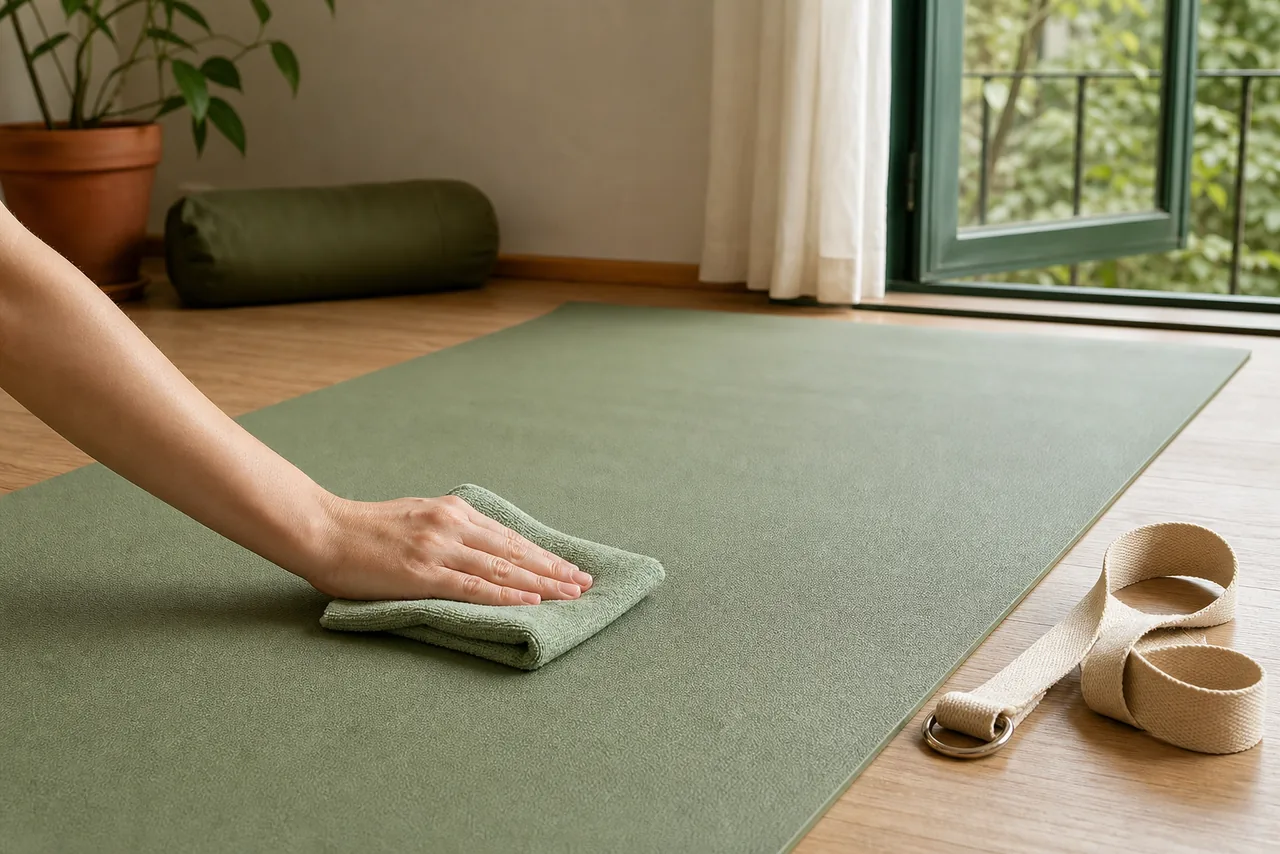
Natural materials usually dislike neglect. Rubber can degrade in harsh sun, cork can stain or dry oddly if treated aggressively, and performance tops can lose grip if coated with oil-heavy sprays. Start with the maker's instructions, not a random cleaning hack.
A safe baseline is simple: wipe after sweaty practice, use minimal moisture, air-dry completely and avoid rolling the mat up damp. Do not soak cork or rubber unless the manufacturer explicitly allows it. Do not leave natural rubber in a hot car. Do not assume vinegar, essential oils or dish soap are safe for every surface.
For the full material-by-material routine — rubber, cork, PU, PVC, TPE and DIY spray cautions — use the full how to clean a yoga mat guide.
Who should buy an eco-friendly yoga mat?
Buy an eco-friendly yoga mat if you care about material feel, want to avoid basic plastic foam, and are willing to maintain the mat properly. Natural rubber and cork can make practice feel more grounded and intentional, but they ask more from you than the cheapest mat in the aisle.
Do not buy one because the label makes you feel guilty. Buy one because it fits your actual practice. If you sweat heavily, look at grip and cleaning. If you commute, look at weight. If your knees are sensitive, look at thickness and density. If allergies matter, filter by latex before you fall in love with the branding.
For a broader comparison across eco and non-eco categories, go back to Best Yoga Mats of 2026. For the full decision tree, start with How to Choose a Yoga Mat.
Final verdict
For most people who want one serious eco-friendly mat, I would start with the Manduka eKO 5mm. It has the clearest all-round natural-rubber case: enough cushion, a grounded practice feel and a material story that matches the eco-friendly intent.
Choose Liforme if alignment lines are genuinely useful to you. Choose Jade Harmony if classic rubber grip is the priority. Choose eKO Lite if carrying the mat matters. Choose Gaiam Cork if you specifically want to try cork's dry, natural-feeling surface.
The calm rule: do not buy the greenest-sounding mat. Buy the mat whose material, weight, grip, allergy profile and care routine you can actually live with. Then practise on it consistently.
Frequently asked questions
What is the most eco-friendly yoga mat material?
There is no single most eco-friendly yoga mat material in every case. Natural rubber and cork are often better stories than basic PVC, but durability, backing material, adhesives, shipping, latex sensitivity and how long you keep the mat all matter.
Are natural rubber yoga mats latex-free?
No. Natural rubber yoga mats should be treated as latex-relevant products. If you have a latex allergy or known rubber sensitivity, do not buy a natural-rubber mat without checking manufacturer guidance and professional advice where needed.
Are cork yoga mats good for sweaty practice?
Cork can work well when hands are slightly damp because the surface often becomes grippier with moisture. The trade-off is that cork can feel firm and less plush than rubber or foam, so thickness and backing material still matter.
Is TPE more eco-friendly than PVC?
TPE is often marketed as a lighter, recyclable or lower-impact alternative to PVC, but the real answer depends on the exact formulation, durability and end-of-life options. It can be useful for latex-free buyers, but it is not automatically the greenest choice.
How do I make an eco-friendly yoga mat last longer?
Clean it gently, dry it fully, keep it out of direct sun unless the maker says otherwise, and avoid harsh sprays or soaking. A mat used for years is usually a more responsible purchase than a theoretically greener mat replaced quickly.