

This guide contains affiliate links — recommendations aren’t based on commission. Read our full disclosure.
Direct answer
Which should you choose?
Choose cork
If you value low weight and grip that increases as the surface becomes damp.
Choose rubber
If you want dependable dry grip, denser cushioning and a grounded feel.
Biggest practical difference: Cork changes more with moisture; rubber usually feels grippier from the first dry pose but is heavier and relevant to latex sensitivity.
- Dry grip
- Firm, less tacky
- Tacky and planted
- Damp grip
- Usually improves
- Product-dependent
- Cushion
- Often firmer
- Usually denser
- Weight
- Often lighter
- Usually heavier
- Care
- Wipe, then dry fully
- Wipe; avoid heat and sun
- Latex relevance
- Depends on the backing
- Yes for natural rubber
- Best for
- Sweaty practice and lighter carry
- Reliable dry grip and grounded feel
How this page has changed
May 29, 2026
Sources, internal links and safety or product context reviewed.
In this guide
Cork vs rubber yoga mat is one of those choices where the honest answer is "it depends" — but the part that decides it for most people is narrower than the marketing suggests. It comes down to how much you sweat, whether your knees need cushion, and whether latex is something you have to avoid. Get those three straight and the rest is preference.
This is a material comparison, not a lab report. I have not lab-tested these two materials myself. What follows is drawn from how the materials behave by design, manufacturer specs, and the recurring themes in practitioner reviews — plus one honest note about the mat under my own feet near the end.
By Marvin Smit · Long-time practitioner, not a certified instructor.
The short version
If you sweat heavily or practise in heat, cork is the easier pick — its surface tends to grip better as it gets damp. If you want maximum tactile grip in a dry room and more give under the knees, natural rubber is usually the better feel. And if latex is a concern, that single fact can settle it: a cork-topped mat with a synthetic base sidesteps natural rubber latex entirely.
Everything below is the reasoning behind that split.
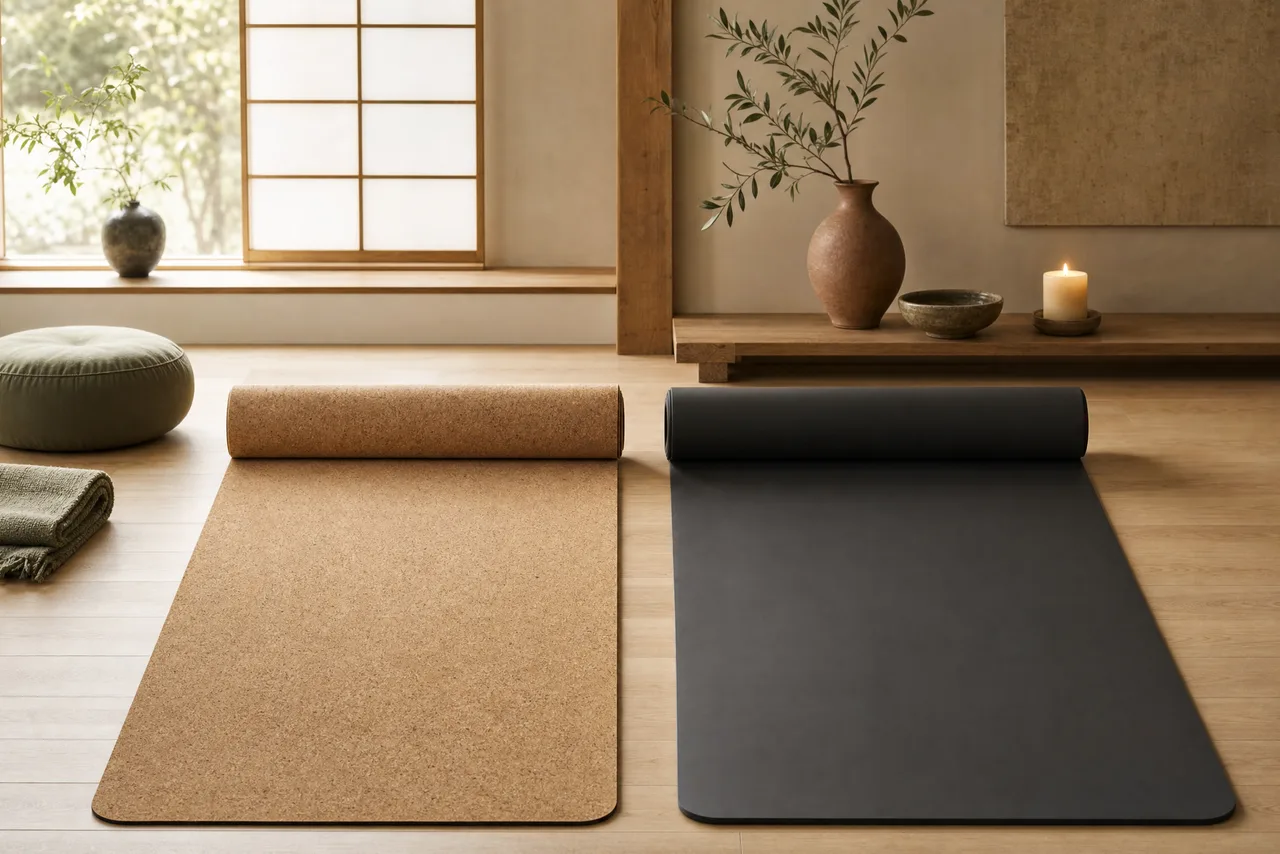
Grip: cork wins wet, rubber wins dry
This is the real dividing line. Cork has an unusual property — the surface generally becomes grippier as moisture appears, which is why cork shows up so often in hot-yoga and sweaty-practice conversations. Cork can feel slightly firm and matte when your palms are dry; as they dampen, the surface tends to lock in.
Natural rubber is the opposite character: tacky and planted from the first pose in a dry room, with a grip many practitioners prefer over any synthetic surface. The trade-off is sweat. Once a rubber mat gets genuinely wet, grip can fade unless you add a towel. For heated rooms, read the dedicated hot-yoga mat guide — wet grip is the whole game there.
So the grip question is really a sweat question. Heavy sweat or heat leans cork. Dry, grip-first practice leans rubber.
Grip vs. moisture
Illustrative
Cushion and joints
Natural rubber generally gives more underfoot. It compresses and springs back, which is kinder during kneeling poses and longer floor sequences. Cork tops sit on a thinner, firmer profile, so a cork mat can feel more "connected to the floor" — good for stability, less forgiving on the knees.
If joint comfort is your main filter, that points toward rubber, or toward pairing a thinner mat with a folded towel under the knees. Thickness matters as much as material here; the thickness guide breaks down where cushion helps and where it costs you stability.
Weight, feel and daily carry
Natural rubber is dense, and dense means heavy. A serious rubber mat is a planted, premium thing to practise on and a genuine consideration to carry across town every day. Cork mats vary, but the cork-plus-synthetic-base builds are often a touch lighter and drier-feeling in the hand.
There is also smell. Natural rubber can carry a noticeable rubbery odour for the first weeks. Cork is close to odourless out of the box. Neither is a dealbreaker; both are worth knowing before the mat arrives.
Durability and care
Both materials reward care and punish neglect, in different ways. Natural rubber dislikes direct sun, harsh sprays and being rolled up damp — dry it fully and keep it out of hot cars. Cork is low-maintenance day to day but can stain or dry oddly if you soak it or hit it with oil-heavy cleaners.
A cork mat is almost never pure cork — it is a cork layer bonded to a backing, usually rubber or a synthetic like TPE. So "cork" does not automatically mean the whole mat is one clean material; the backing decides weight, grip underneath, and the latex answer below. The full routine for each surface lives in how to clean a yoga mat.
The eco question
Both have a real sustainability story, and both have an asterisk. Cork is harvested from the bark of the cork oak without felling the tree, and the bark regrows — genuinely renewable. Natural rubber is tapped from rubber trees and is also a renewable, plant-based material, though its density means more weight to ship.
The honest part is the backing and the whole-mat picture. A cork top over a synthetic base is not 100% biodegradable, and a natural-rubber mat still has a manufacturing and transport footprint. Neither is a moral trump card. For the deeper material-by-material breakdown — including the greenwashing traps — see the eco-friendly yoga mat guide.
Latex: the factor that can rule a mat out
This is the one to check first if it applies to you. Natural rubber is latex-relevant. If you have a latex allergy or a known rubber sensitivity, a natural-rubber mat is not a "see how it goes" — it is a material to avoid, and you should follow manufacturer guidance and professional advice.
Cork helps here, with a caveat about the backing. A cork-topped mat built on a TPE base contains no natural rubber latex, which makes it a sensible route for latex-sensitive practitioners who still want a natural surface feel. A cork mat on a rubber base does not get that pass. Always confirm what the backing is before buying if latex matters.
Cork vs rubber at a glance
| Factor | Cork (cork top + synthetic/TPE base) | Natural rubber |
|---|---|---|
| Grip — dry | firm, matte | tacky, planted |
| Grip — sweaty | improves as it dampens | can slick up without a towel |
| Cushion / joints | firmer, more "floor-connected" | more give, kinder to knees |
| Weight | often lighter | dense, heavier |
| Smell | near-odourless | rubbery at first |
| Care | wipe + dry; don't soak | dry fully; no direct sun |
| Latex | none on a TPE base | latex-relevant — avoid if allergic |
| Eco | renewable bark; backing matters | renewable, but heavier to ship |
Use the table as a filter, not a verdict. The row that matters most is whichever one is non-negotiable for you — usually sweat, knees or latex.
Cork and rubber aren't the only two
The "cork vs rubber" framing quietly hides the two materials that sit right alongside them. PU (polyurethane) tops, common on premium performance mats, grip very well once damp — close to cork's wet-grip strength — but they are a synthetic surface that needs careful, oil-free cleaning. TPE is a lightweight, latex-free synthetic often sold as eco; it can be a practical, allergy-safe option, but "TPE" covers a wide quality range, and a short-lived TPE mat is not a greener buy than a mat you keep for years.
So the real decision is rarely cork-or-rubber in isolation. If grip-under-sweat leads, cork and PU compete. If latex-free is the hard requirement, cork-on-TPE and pure TPE compete. If dry tactile grip plus cushion lead, natural rubber is hard to beat. The full material-by-material rundown — including PVC and the greenwashing traps — is in the eco-friendly yoga mat guide.
So which should you choose?
Choose cork if you sweat a lot, practise in heat, want a near-odourless mat, or need to avoid natural rubber latex (on a TPE base). A mainstream option to evaluate is the Gaiam Cork mat.
Check price on AmazonChoose natural rubber if you practise mostly in a dry room, want the grippiest, most planted tactile feel, and want more cushion under the joints — and latex is not a concern. The Manduka eKO 5mm is a solid representative of the dense natural-rubber category.
Check price on AmazonFor transparency: the mat I actually practise on is neither of these — it is a 5mm dark green Lululemon natural rubber mat, about a year and a half in, mixed hatha and vinyasa. Grip has been solid and it cleans up well. I mention it only as honest context (a rubber mat, with the same latex caveat), not as a pick over the two above.
If you are still deciding between materials more broadly, start with the full how to choose a yoga mat framework, or compare specific mats across categories in the best yoga mats of 2026 shortlist.