

This guide contains affiliate links — recommendations aren’t based on commission. Read our full disclosure.
How this page has changed
September 6, 2026
Sources, internal links and safety or product context reviewed.
May 30, 2026
First published.
In this guide
For hot yoga, start by choosing between an absorbent mat and a closed-cell mat with a towel. The GRP Adapt is our absorbent candidate; the eKO models suit people who prefer natural rubber and accept a towel for heated practice. If your existing mat works well apart from sweat, compare a towel before replacing it.
Hot yoga is not regular yoga with the thermostat turned up. Once heat and sweat enter the room, a mat has two jobs that matter more than almost everything else: it has to stay grippy when damp, and it has to handle sweat without becoming a swampy mess after class. If your slipping happens in a normal, unheated room, that is a different buying decision — the best non-slip yoga mat guide covers that one.
I have practised long enough to know that a beautiful mat can still become useless the moment your palms start sliding in downward dog. This guide is deliberately practical. No invented lab test, no fake scorecard, no fixed Amazon prices. The shortlist uses published specifications and manufacturer guidance, with links to our individual research reviews.
By Marvin Smit · Long-time practitioner, not a certified instructor.
TL;DR: the hot-yoga shortlist
| Pick | Consider it for | One-line verdict |
|---|---|---|
| Manduka GRP Adapt 2.0 | Best overall | The most hot-yoga-specific pick here: a PU-top mat built around sweat handling and wet grip. |
| Jade Harmony | Best natural rubber | A classic open-cell natural rubber mat with strong reviewer consensus and a required latex caveat. |
| Manduka eKO 5mm | Best cushion balance | A dense 5mm natural rubber mat for people who want comfort, grip and an all-round practice feel. |
| Manduka eKO Lite 4mm | Lighter eKO option | A lighter natural rubber option when you actually need to carry the mat to class. |
If you want one serious hot-yoga mat and do not have a latex sensitivity, I would start with the GRP Adapt. If you want a more traditional rubber feel, compare Jade Harmony and the Manduka eKO 5mm. If your mat is already stable but slick when wet, start with a towel before replacing the whole setup.
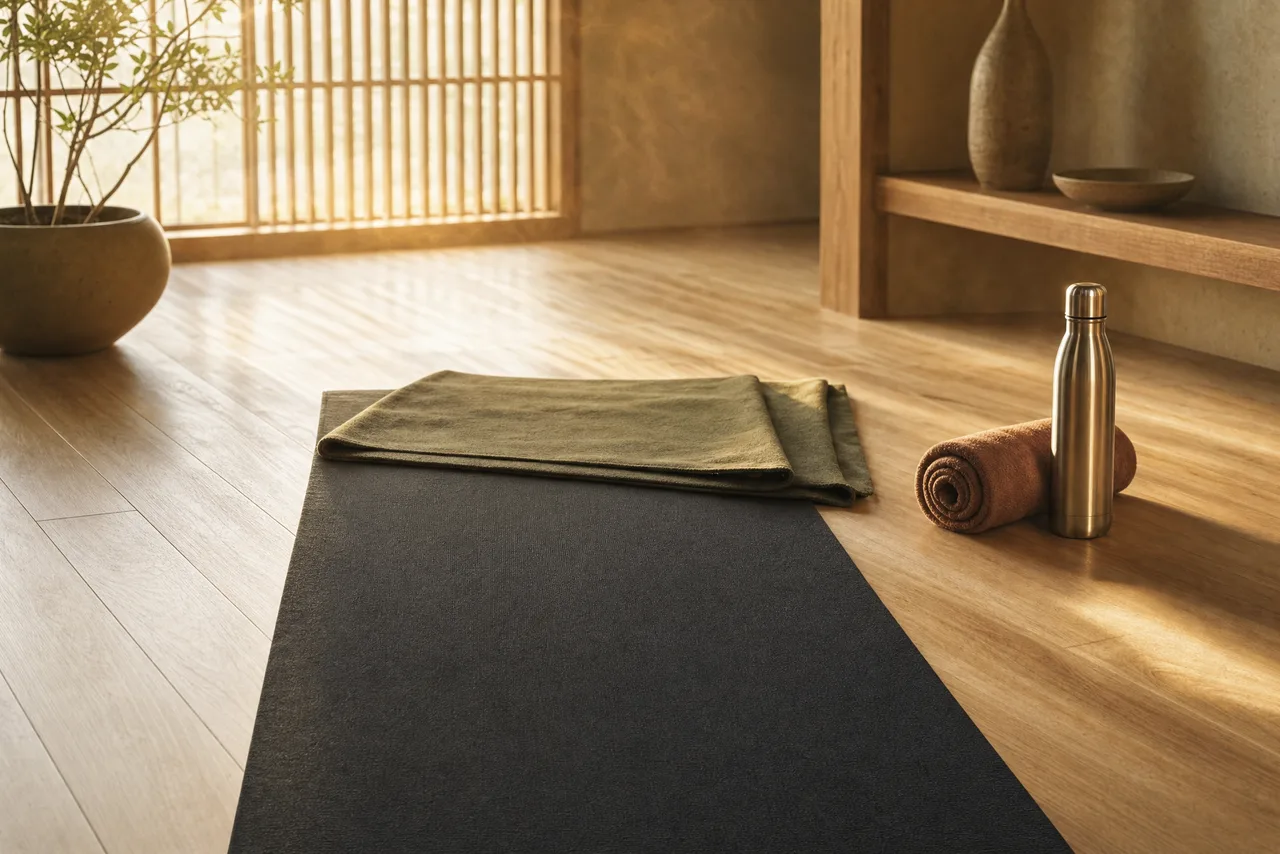
Absorbent or closed-cell: choose the whole setup
Normal mats are judged mostly by dry grip, cushion and price. Hot yoga adds heat, humidity and steady sweat. That changes the physics quickly.
A basic PVC or TPE mat can feel fine at home, then become slippery in a heated studio because sweat sits between your skin and the surface. Extra cushion does not solve that. In fact, a very soft mat can make balancing worse once the room gets hot because your hands and feet sink instead of pressing into a stable base.
Sweat handling is the real separator. Some mats keep sweat on the surface, which can be easier to clean but more slippery mid-class. Some open-cell or absorbent surfaces pull moisture in, which can improve grip but requires more careful drying and cleaning. The GRP Adapt is an example of an absorbent polyurethane top; material labels alone do not tell you how every mat handles sweat. Cork is the other surface that tends to grip more as it dampens, which is why it keeps appearing on hot-room shortlists — the cork-versus-rubber trade-offs are worth a look before you commit.
That is why the best mat for hot yoga is rarely the thickest mat. It is the mat that keeps traction when your palms are damp, lies flat under fast transitions, and can survive being cleaned after every sweaty practice.
Compare your complete setup
| Setup | Consider it when | Ownership trade-off |
|---|---|---|
| GRP Adapt 2.0, used directly | An absorbent PU surface is your priority | Full drying and specific cleaning; contains latex |
| eKO or eKO Lite with towel | You prefer rubber and want a washable sweat layer | Carry and wash the towel as well as care for the mat |
| Existing closed-cell mat with towel | The mat otherwise suits you | Check towel dimensions and whether it stays in place |
Do not compare only the weight or price of the mat when one setup also needs a towel. The mat-and-towel compatibility guide covers matching dimensions. For a closed-cell PVC alternative, compare GRP Adapt versus PRO.
How we chose
We checked the manufacturer specifications and care instructions linked below. This refresh compares construction, listed thickness and weight, towel compatibility, latex warnings and cleaning. The linked individual reviews provide separately attributed review evidence.
We have not measured wet grip, comfort or lifespan across these products. The picks describe use cases rather than a tested performance ranking.
Prices, colours and Amazon availability change too often to freeze into the article. Use the product links to check current price and stock.
The 4 best yoga mats for hot yoga
Manduka GRP Adapt 2.0 — Best Overall
The Manduka GRP Adapt 2.0 is the top pick because it is the most directly hot-yoga-engineered mat in this shortlist. The published specs list a PU top with a rubber base, 5mm thickness and a listed standard weight of 5.8 lb. GearLab also rates it a top hot-yoga pick, which matches the material logic: a polyurethane-style top is designed to handle sweaty contact better than many standard dry-grip surfaces.
Manduka markets this mat around sweat readiness and absorption. Treat that as a manufacturer claim, not as a The Yoga Sensei lab result. Still, it explains why the GRP Adapt sits above the eKO variants for serious hot practice. The eKO line can work in heated rooms, but the GRP Adapt is the mat in this group that is most clearly aimed at the problem hot yoga creates.
Best for: regular hot yoga, hot 26+2, heated sculpt and anyone who leaves class genuinely soaked.
Trade-offs: it is likely the most expensive option in this guide, and absorbent/grippy performance surfaces usually need careful cleaning and full drying. It is also still a rubber-base mat, so people with rubber or latex sensitivities should check the exact manufacturer guidance before buying.
Two things worth knowing before you click. Manduka lists latex in this mat's material stack and advises against it for latex sensitivities, so it is not the hot-yoga answer for everyone. Our earlier listing check identified a previous-generation 5mm Adapt behind the affiliate link. Stock and listings change: check the model before ordering, and use Manduka’s current 2.0 product page if that is the version you want. Our full Manduka GRP Adapt review covers which variant to buy, why it is not on Manduka's lifetime guarantee, and the care rules that come with an absorbent surface.
Jade Harmony — Best Natural Rubber
The Jade Harmony is the classic natural-rubber answer. The published specs list natural rubber, 3/16 inch thickness — about 4.7mm — and weight around 5 lb. Check our Jade review for the attributed review evidence and model differences. We have not measured its wet grip against the other mats here.
Its appeal is simple: open-cell natural rubber gives a tactile, grippy surface that many practitioners trust when practice gets warm. It has less of the slick, glossy feel that some synthetic tops can have. If you like a grounded studio-mat feel and do not want a very heavy mat, Jade Harmony makes sense.
The honest caveat is hygiene and allergy. Open-cell rubber can grip well, but it also absorbs more sweat than a closed-cell surface. That means you need to clean and dry it seriously after hot classes. And because this is natural rubber, the latex-allergy flag matters. If you know latex is a problem for you, do not treat this as a safe pick.
Best for: practitioners who want a traditional rubber feel, strong tactile grip and a lighter mat than the heaviest premium options.
Trade-offs: latex caveat, rubber smell at first, more moisture absorption and narrower dimensions than some Manduka options.
Manduka eKO 5mm — Best Cushion Balance
The Manduka eKO 5mm is the best balance pick if you want natural rubber, enough cushion and a serious all-round mat that can handle heated vinyasa. Published specs list natural rubber, 5mm thickness and weight around 7 lb. That weight is not fun on a long commute, but it helps the mat feel planted once class starts.
This is not Manduka's most hot-yoga-specific mat. That distinction belongs more naturally to the GRP Adapt. The eKO has a closed-cell surface that does not absorb sweat. Manduka recommends pairing it with a towel for heated practice, so include towel weight and washing in the comparison.
The 5mm build is the main reason it earns this spot. It gives more cushion than a thin travel mat without becoming a plush wobble pad. If your practice includes heated vinyasa, slower home sessions and general mat work, the eKO is easier to justify than a mat that only shines in soaked studio rooms.
Latex is the required caveat here too. Natural rubber can be a deal-breaker for latex-sensitive practitioners. The other honest note is smell: rubber mats often have a noticeable scent during the first weeks. Air it out, do not store it in direct sun, and do not roll it up wet after class.
Best for: people who want one substantial natural-rubber mat for hot yoga, home practice and general vinyasa.
Trade-offs: latex flag, heavier carry, rubber smell at first and less sweat-specific than the GRP Adapt.
Manduka eKO Lite 4mm — Lighter eKO Option
The Manduka eKO Lite 4mm is lighter than the eKO 5mm, but it is not a thin, foldable travel mat. It keeps the natural-rubber idea but makes it easier to carry. Published specs list natural rubber, 4mm thickness and a listed standard weight of 5 lb.
At 5 lb, it reduces carry weight by about 2 lb compared with the standard eKO 5mm. Both are listed at 71 × 26 inches, so the Lite does not save floor space. Compare the 4mm thickness with your preferred cushioning, and avoid storing either mat in a hot car.
The same natural-rubber caveat applies. Latex-sensitive practitioners should be careful, and rubber smell can appear at first. Heavy sweaters may still want a towel layer. The eKO Lite solves weight; it does not magically turn into the most sweat-absorbing mat in the room.
Best for: people comparing the two eKO models who prefer a lower listed weight and thinner mat.
Trade-offs: latex flag, less cushion than 5mm mats, less sweat-specific than the GRP Adapt.
When to add a towel — and when to skip it
A towel is an option for moisture left on a closed-cell surface, not an automatic add-on for every mat. If your current mat is stable but becomes slick once sweat pools, a towel may solve the actual problem faster than a full mat upgrade.
GRP exception: Manduka designs the GRP Adapt for practice directly on its absorbent surface. Its current guidance cautions against trapping moisture with a damp covering towel. For the eKO and PRO, the brand recommends a towel for heated practice.
The two towel picks here have different mechanisms. Manduka Yogitoes uses silicone nubs underneath, so it is the more anchored, grippy towel-layer option for heavy sweat or slippery mats. It is the one I would look at first for Bikram-style rooms, shared studio mats or a mat you like but no longer trust when wet.
Manduka eQua is the lighter microfiber alternative. It is simpler, softer and easier to pack, but it relies more on moisture-activated grip than underside anchoring. That makes it useful for moderate sweat, travel and people who want a towel that can also work around the gym or beach.
The decision is not premium versus budget. It is anchoring versus simplicity. If your towel bunches, slides or annoys you, you will stop using it. Choose the grip mechanism that matches how sweaty your practice actually gets.
Before you buy either, it is worth knowing that a mat towel fixes one kind of slipping and can make another kind worse — Manduka says so itself. Our yoga mat towel guide walks through which problem you actually have, who should skip a towel entirely, and why nearly every maker tells you to dampen the towel before class.
Cleaning and drying: follow the exact model
Hot yoga sweat is hard on mats. Moisture, salt, heat and rolled-up storage can create odour, bacteria build-up and surface breakdown faster than gentle home practice. The habit matters more than the product: wipe the mat after class, let it dry fully, and do not leave it baking in a hot car — then store it out of heat and sun so the grip lasts.
For the GRP Adapt, Manduka specifies Mat Wash & Refresh or a clean damp cloth and complete drying. Do not use soap or submerge it. For the eKO models, the current instructions specify Natural Rubber Yoga Mat Restore. One brand does not mean one cleaning method for every material.
For the complete routine — rubber, polyurethane, PVC, cork, DIY sprays and what not to use — read the full how to clean a yoga mat guide.
Final verdict
If I were buying for a serious hot practice, I would grab the Manduka GRP Adapt first because the PU-top construction and reviewer consensus line up with the actual problem: grip when sweat is unavoidable. If I were choosing between the two eKO models for a studio commute, I would look at the eKO Lite instead and accept that a towel may be part of the setup.
For a broader first-mat decision, start with the full how to choose a yoga mat pillar. For hot yoga specifically, keep the decision calm: solve wet grip first, compare thickness and firmness for your practice, clean the mat properly, and do not buy natural rubber if latex sensitivity is part of your reality.
Manufacturer sources
- GRP Adapt 2.0 specifications and care.
- eKO 5mm specifications and care.
- eKO Lite 4mm specifications and care.
- Harmony mat specifications.
Product specifications and care checked September 6, 2026. Source years indicate the year checked. These are manufacturer statements, not our own wet-grip or durability measurements.
Frequently asked questions
Are rubber mats good for hot yoga?
Yes, rubber mats can be good for hot yoga because they usually offer more tactile grip than basic foam or PVC mats. The caveat is latex sensitivity: natural rubber mats such as Jade Harmony, Manduka eKO 5mm and Manduka eKO Lite 4mm are not the right choice for everyone.
How thick should a hot yoga mat be?
Several mats here are 4–5mm, but there is no single thickness that fits everyone. Firmness, floor surface and your comfort matter too. If your knees need more support, use targeted padding or read the full yoga mat thickness guide before buying a plush mat for a heated room.
Do I need a towel for hot yoga?
You may need a towel for hot yoga if your mat is stable but becomes slick once sweat pools on the surface. Check the model instructions: a towel is useful with many closed-cell mats, whereas the GRP Adapt is designed for direct practice on its absorbent surface.