

This guide contains affiliate links — recommendations aren’t based on commission. Read our full disclosure.
How this page has changed
July 25, 2026
Sources, internal links and safety or product context reviewed.
In this guide
- 01First: which slipping problem do you actually have
- 02Who should not buy one
- 03Nubs, coating or nothing: what the makers actually say
- 04Do you have to wet it? Mostly yes, and it is per-product
- 05The picks
- 06Size it to your mat, not to the category
- 07Care: one mistake ruins a towel
- 08Where the sources disagree
- 09How much do you actually sweat?
- 10Related reading
Buying the towel together with a mat is a separate compatibility decision. Our yoga mat and towel set guide verifies exact bundle contents, matching dimensions, attachment construction, separate care and like-for-like value.
Most people buy a yoga mat towel to stop sliding, and a good number of them are buying the wrong fix. A mat towel solves one specific problem very well. It does nothing for a second problem, and for a third it can make things measurably worse.
Quick answer. If your mat goes slick once you sweat, a mat towel is the right purchase, and a budget one with grip dots does the job. If you slip with dry hands at the start of class, a towel is the wrong purchase — Manduka says so itself. If your mat grips fine and only your palms sweat, buy a hand towel instead and save most of the money.
By Marvin Smit · Long-time practitioner, not a certified instructor.
I have not tested these towels. This page is built from what the manufacturers publish, what named testers at Wirecutter and OutdoorGearLab found, and the places those sources contradict each other — which turns out to be the most useful thing about the category, because nobody else prints it.
First: which slipping problem do you actually have
Three different problems get sold the same product. Work out which one is yours before you spend anything.
1. The towel or mat slides on the floor, or the towel slides on the mat. This is a mechanical problem and it is what silicone nubs and silicone coatings are for. A towel with an anchored underside fixes it whether you are sweating or not.
2. Your skin slides on the surface. This is a moisture problem, and it is the one a towel is genuinely built for. Microfibre absorbs sweat that would otherwise sit on top of your mat as a film. Note the implication: it needs moisture to work.
3. Your brand-new mat is slippery. This is neither. New mats ship with a factory release film, and as Hugger Mugger explains, it wears off with normal use — a sea-salt scrub speeds it up. If your slipping started the day the mat arrived, you have a break-in issue, not a towel-shaped hole in your kit.
The reason this matters: buying a mat towel for problem 3 means paying for something that was going to fix itself. And buying one for problem 1 when your hands are dry can backfire, which brings us to the part most buying guides leave out.
Who should not buy one
Two of the best sources on this category recommend against it for a large group of people, and one of them sells the towels.
Manduka's own hot yoga towel guide tells customers who slip with dry hands that a full mat towel is the wrong answer and that it "will only make you slip". Their suggested fixes are mat care, core strength and technique — none of which involve buying anything.
OutdoorGearLab's tester, several hundred hours into the category, is blunter still: for restorative yoga, outdoor practice in cooler temperatures, or any style where you simply do not sweat, a mat towel is "simply overkill".
Add three more cases where the honest answer is not a purchase:
- You already own a grippy natural-rubber mat and only your palms sweat. A hand towel covers it.
- Your towel used to work and stopped. That is almost always fabric softener, and the fix is a wash, not a replacement. See the care section below.
- You are hoping to use a towel instead of a mat. Wirecutter's testers found neither of the towels they tested had enough cushioning to be used alone. A towel is a surface, not a mat.
If you are still here, you sweat and your mat goes slick. A towel will help.
Nubs, coating or nothing: what the makers actually say
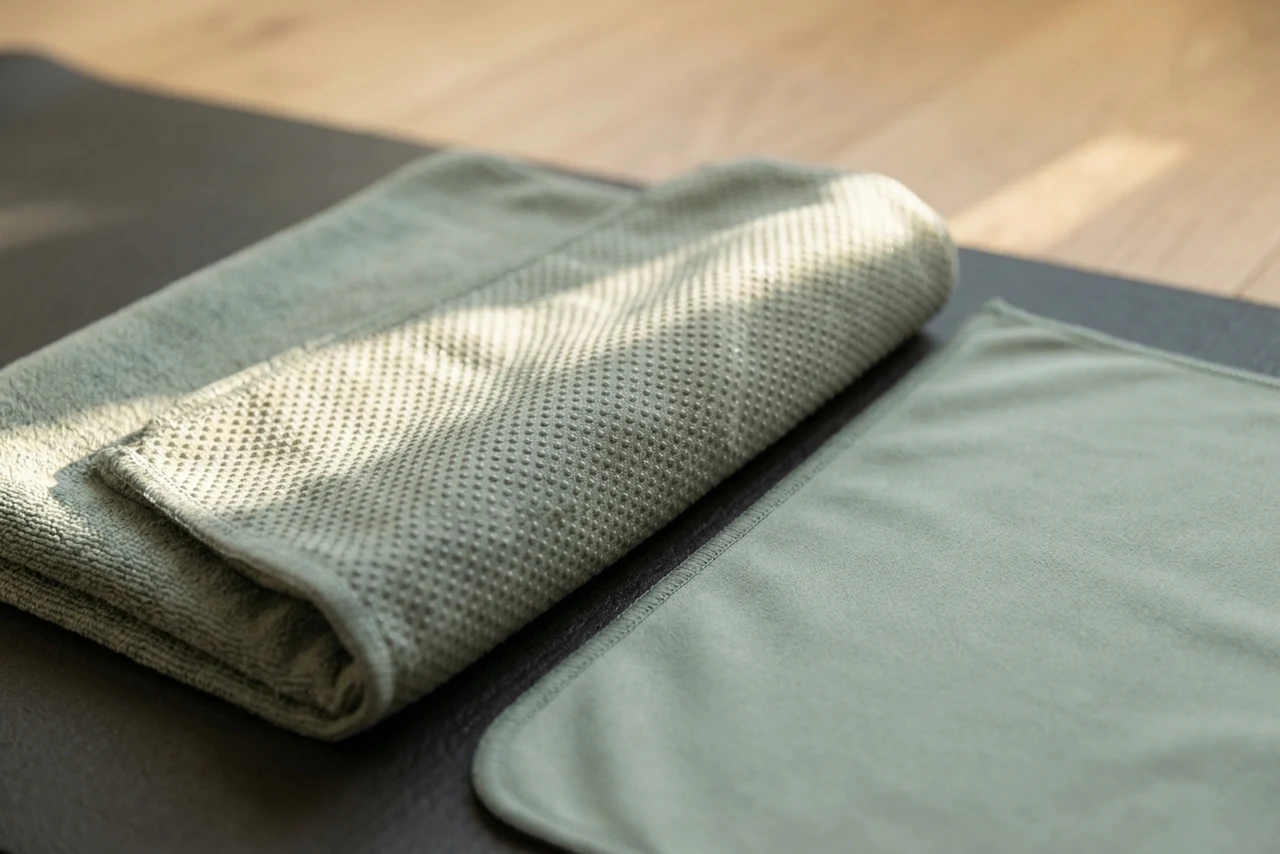
The category divides into three underside treatments, and the marketing blurs them.
Silicone nubs. Small raised dots across the underside that grip the mat. Manduka's Yogitoes uses them and holds a patent on the design. A textiles expert at the Fashion Institute of Technology, speaking to Wirecutter, described the Yogitoes dots as 100% silicone and spaced further apart than a budget rival's.
Silicone coating. A continuous layer rather than discrete dots, used by Heathyoga among others.
Nothing. Manduka's eQua deliberately has no anchor at all — the brand calls it "a smooth, anchor-free design keeps your flow seamless".
Here is the trade-off, framed by the company that makes both. Manduka states that the un-nubbed eQua develops grip faster on first sweat but weakens once it is saturated and can start to move, while the nubbed Yogitoes absorbs more and holds on longer. That is a genuine practice-dependent choice, not a good-better-best ladder.
One caution on the dots. Not all grip dots are silicone. Eunzel publishes a comparison table on its own listings giving the dot material per model, and its mat towels are listed with PVC dots rather than silicone. That is a real, checkable difference nobody on the first page of Google mentions — and it is the kind of thing worth checking on any budget towel before you assume "grip dots" means one thing.
Do you have to wet it? Mostly yes, and it is per-product
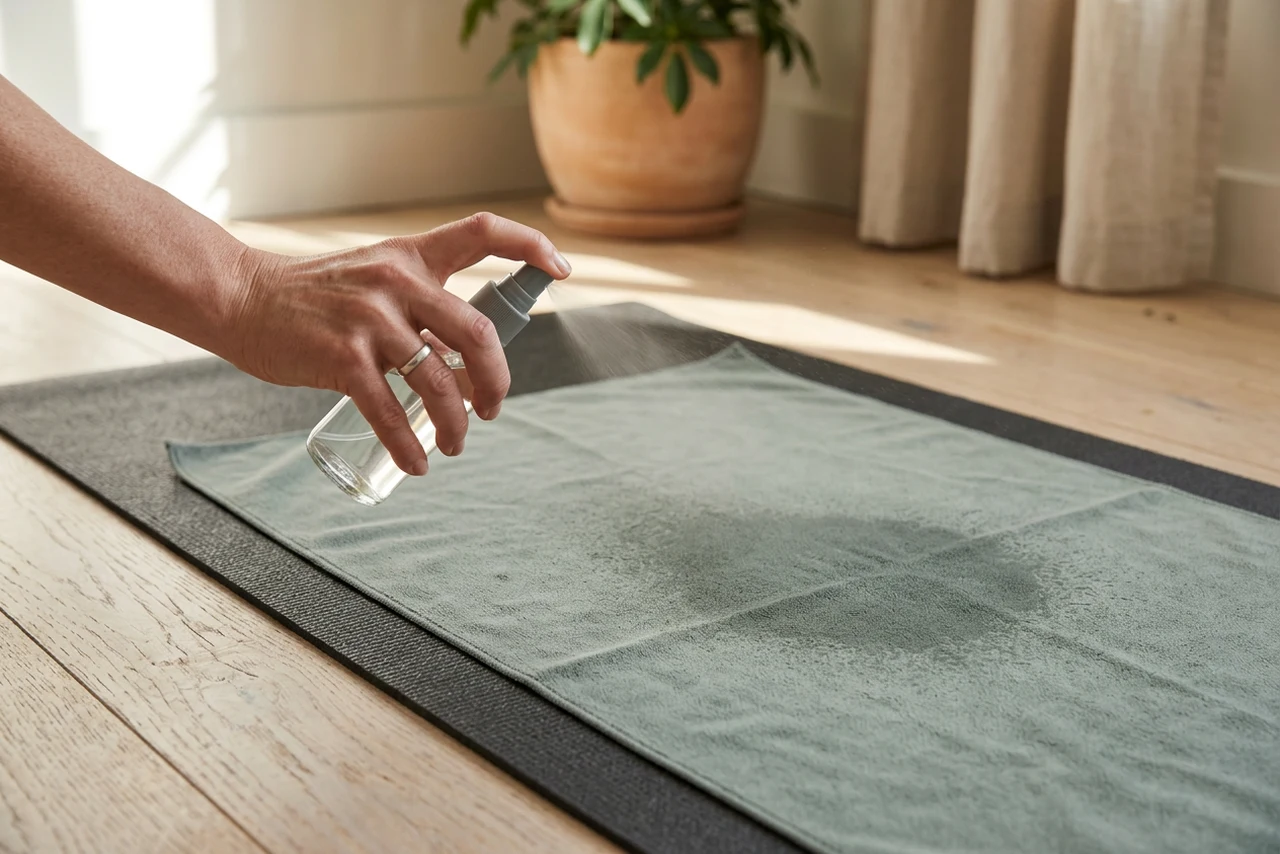
This is the most useful unpublished detail in the category. Three manufacturers say the same thing in different words, and two of them ship a spray bottle in the box to make sure you do it.
- Manduka, nubbed Yogitoes: lightly mist the top side before practice.
- Manduka, smooth eQua: lightly spray or dampen the towel before use — both sides.
- Heathyoga: the silicone coating is paired with "the included spray bottle for lightly misting".
- IUGA: "it is recommended to spray some water on the surface of the towel (A spray bottle is included)".
Hugger Mugger states the consequence plainly: if your hands and feet are dry at the start of class, the towel might actually feel slippery. That is the product working as designed and not yet activated — not a defect, and not something you should return.
Worth knowing that this is contested. Wirecutter tested two nubbed towels across several 90-minute hot classes and never mentions wetting them at all. My reading of the disagreement: the wetter your practice, the less the pre-mist matters, and the first ten minutes are where it matters most.
The picks
Four towels covering four genuinely different cases, plus the hand-towel option most roundups skip. No scores, because I have not tested them; the reasoning is the recommendation.
Best evidenced — Manduka Yogitoes
The patented silicone nubs, the deepest independent coverage, and the one Manduka positions for the sweatiest practice. Its 30/60/10 recycled-polyester blend is the same across the range.
Two honest caveats. OutdoorGearLab's tester reports it bunches underfoot when dry and does not offer the traction you want until moisture flattens it out — while Verywell Fit lists "no bunching" as a pro of the same towel. Those two cannot both be right, and the difference is probably how much you sweat. Manduka also tells you to mist the top before class, so plan on that.
Check price on AmazonBest value — Eunzel Grip Dot Yoga Towel
Wirecutter's headline finding is that a premium nubbed towel and a budget nubbed one were "equally functional", and that the extra money buys neater edge stitching and hand-feel rather than grip. If that is right — and it is the only head-to-head test of exactly this question — the budget nubbed towel is the rational buy.
Eunzel earns the slot for a second reason: it publishes its dot material on its own listing rather than leaving you to guess. Those dots are PVC, not silicone. That is a fair trade at the price, and you now know it before buying rather than after.
Check price on AmazonIf you sweat hard and want a coating — Heathyoga
A continuous silicone grip rather than dots, and it ships with the spray bottle the category quietly depends on. Check the width against your mat before buying: it runs wider than the 24-inch standard, which is useful on a wide mat and awkward on a narrow one.
Check price on AmazonIf you hate the feel of nubs — Manduka eQua Mat Towel
No anchor at all, and Manduka is upfront that this is a deliberate design rather than a cheaper one. It grips faster on first sweat and gives up sooner when saturated. Good for moderate sweat, travel, and anyone who finds dots distracting underfoot.
Buy the mat-sized version deliberately. The eQua also comes as a hand towel, and at least one Amazon listing for it carries a mat-towel title over hand-towel dimensions — check the listed length is around 71 inches before you order.
Check price on AmazonThe one most people should consider first — a hand towel
If your mat already grips and the problem is only your palms, a hand towel is smaller, cheaper and less to wash. It is the answer for a large share of the people who search for a mat towel, and it is the option every roundup skips because it sells less.
Check price on Amazon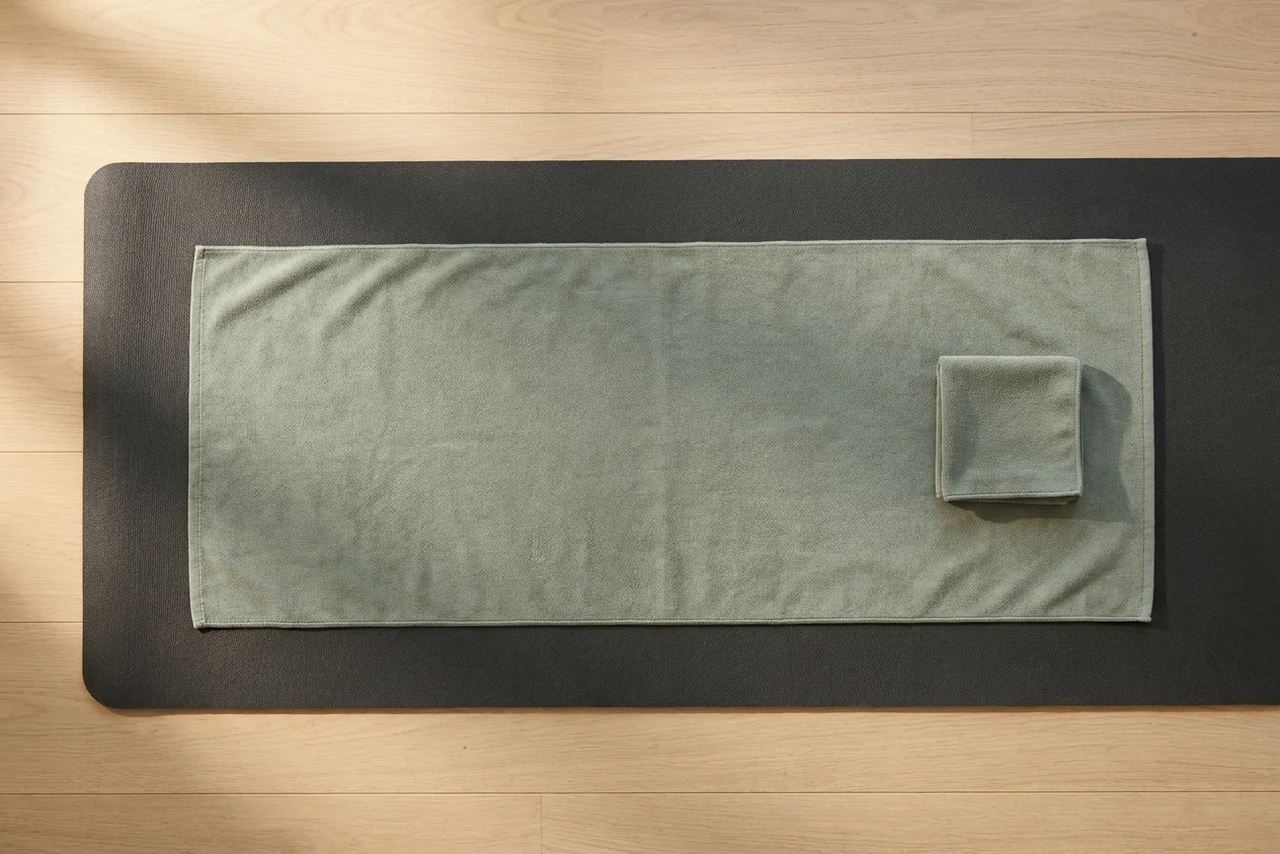
Size it to your mat, not to the category
"Too narrow for my mat" is the most repeated complaint across the published roundups, and it is entirely avoidable.
Most mat towels are 24 inches wide, matching a standard mat: the Yogitoes is 71 by 24, the eQua mat towel 71 by 24. Some run wider — Heathyoga is 26 inches. If you practise on a wide mat, a 24-inch towel will leave rails of exposed mat down both sides. If you practise on a standard mat, a 26-inch towel will fold over the edges.
Measure your mat first. It takes ten seconds and it is the single most common regret in this category.
Care: one mistake ruins a towel
If your towel stopped gripping, this is almost certainly why.
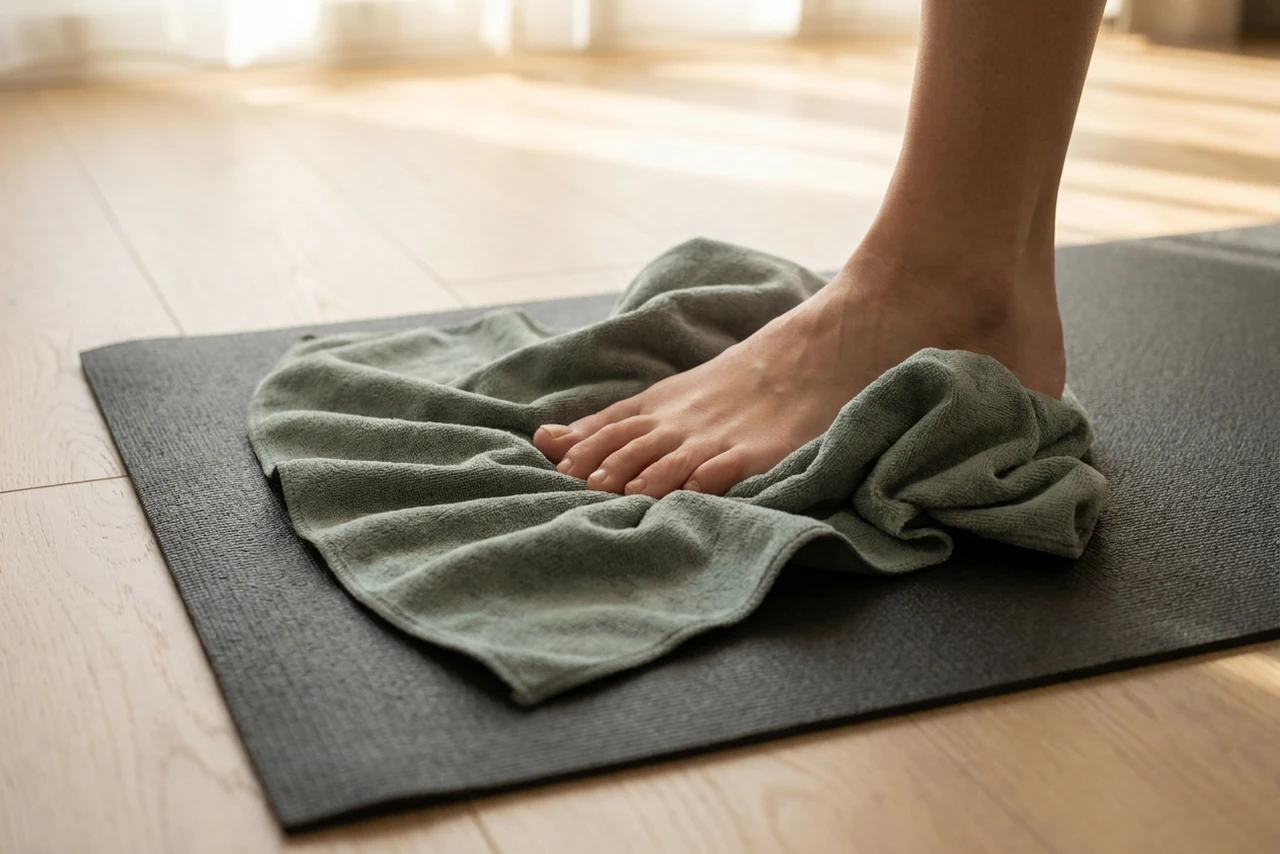
Never use fabric softener or dryer sheets. Manduka states that they "will make the surface of your product slippery". Hugger Mugger says the same independently: softeners leave a coating that makes the fibres slick. Microfibre works by having an enormous amount of surface area, and softener fills it in.
The revival trick. A towel that has stopped absorbing because of detergent or softener buildup can often be brought back with one detergent-free wash plus a cup of white vinegar in the rinse. That distinction — recoverable versus finished — is worth trying before you replace anything.
Wash cold, dry low or hang. Manduka's own routine is cold water, like colours, tumble dry low or hang dry, no bleach. Sources disagree on the dryer: Wirecutter reports both towels survived repeated machine washing and drying with no dots harmed, while microfibre manufacturers outside the yoga industry warn that high heat melts the fibres. Hang-drying costs nothing and sidesteps the argument.
Never roll a damp towel inside your mat. Manduka, Hugger Mugger and Yoga Journal each warn against it separately. It is the fastest route to mildew, and the smell does not wash out.
For mat-side care, our guide to cleaning a yoga mat covers the routines by material — the wrong cleaner shortens the life of a good mat the same way softener shortens the life of a good towel.
Where the sources disagree
Three contradictions I could not resolve, published rather than smoothed over, because knowing they exist tells you how firm the "expert consensus" really is.
- Bunching. OutdoorGearLab says the Yogitoes bunches underfoot when dry. Verywell Fit lists no bunching as one of its strengths. Same towel, two hands-on sources.
- Whether nubs matter. Wirecutter found premium and budget nubbed towels equally functional. Shape, the highest-ranking magazine roundup for this term, never uses the word silicone once and picks un-nubbed towels for both its top slots.
- Wetting. Manduka instructs misting even its nubbed flagship. Wirecutter tested nubbed towels through several hot classes and never raises it.
If a page tells you the category is settled, it has not read the other pages.
How much do you actually sweat?
Worth a number, because the whole decision rests on it. In a study of hot yoga at 38.7°C, twenty-one participants showed a mean sweat rate of 0.9 litres per hour, with a spread of plus or minus 0.6. That is a wide range, and it is the reason two people can practise in the same room and reach opposite conclusions about the same towel.
If you are at the low end of that spread, you are closer to the "you may not need one" group than the marketing suggests.
Related reading
- Best yoga mat for hot yoga — if the mat itself is the problem, start here rather than with a towel.
- How to clean a yoga mat — the mat-side half of the same care routine.
- How to choose a yoga mat — the full decision framework, including grip.
- Best yoga mat bags and carriers — for when the mat and the towel both start travelling.
Frequently asked questions
Do yoga mat towels actually work?
Yes, for the specific problem they solve: keeping a layer between you and a mat that has become slick with sweat. They work by absorbing moisture, and most need some moisture present before they grip well. They do not add cushioning, and they do not fix a mat that is slippery when dry.
Do you need to wet a yoga mat towel?
Usually yes, at least in places, and the makers say so themselves. Manduka tells you to lightly mist the top of its nubbed Yogitoes before practice, and to dampen both sides of its smooth eQua. Heathyoga and IUGA each ship a spray bottle in the box. A completely dry microfibre towel can feel more slippery than the bare mat until your sweat activates it.
What is the difference between a yoga towel and a yoga mat towel?
A yoga mat towel is mat-sized, roughly 71 by 24 inches, and covers the whole surface. A yoga hand towel is around 16 by 24 inches and sits where your hands go. If your mat already grips well and only your palms sweat, the hand towel is the smaller, cheaper and often correct answer.
Can I use a regular bath towel instead?
You can, and people do, but expect two problems: a cotton bath towel is not sized to a mat so it bunches and shifts, and it has no anchoring underside, so it slides. It is a reasonable way to test whether you need a towel at all before buying one. It is a poor long-term solution for a flowing practice.
Why did my yoga mat towel stop gripping?
Almost always fabric softener or dryer sheets. Both Manduka and Hugger Mugger warn that they leave a coating on the fibres that makes the surface slick, and it is the most common reason a towel that worked stops working. Wash with detergent only, and try a detergent-free wash with white vinegar in the rinse to strip existing buildup.
How often should you wash a yoga mat towel?
After every session for hot or heavy-sweat practice. For gentler styles where the towel barely dampens, every two to three sessions is reasonable if you hang it to dry fully in between. The thing to never do is roll a damp towel up inside your mat, which is the fastest route to mildew and a smell that does not wash out.
Are silicone nubs worth it?
For keeping the towel anchored to the mat, yes. For keeping your hands from sliding on the towel, the evidence is weaker than the marketing suggests. Wirecutter tested a premium nubbed towel against a budget nubbed one and found them equally functional, and Shape's roundup picks un-nubbed towels for both its top slots.