

This guide contains affiliate links — recommendations aren’t based on commission. Read our full disclosure.
How this page has changed
May 30, 2026
Sources, internal links and safety or product context reviewed.
In this guide
A yoga mat bag does one useful thing: it makes a rolled mat easy to carry and keeps it clean while it travels. If your mat lives at home, you do not need one. If it leaves the house — to a studio, a gym, the park — a bag or carrier is the difference between a tidy commute and a mat tucked awkwardly under your arm.
This guide covers the real decision, which is bag versus sling versus carrier, explains how to check your mat actually fits, and names two honest picks. I am Marvin Smit, a long-time practitioner and the author of The Yoga Sensei — not a certified instructor. I have not lab-tested these specific carriers; the picks below are researched from manufacturer specifications and aggregated buyer reviews, and I flag any claim that comes from the maker rather than from use.
By Marvin Smit · Long-time practitioner, not a certified instructor.
Quick answer. If you carry gear as well as a mat, a full zip bag with pockets is the better buy. If you only carry the mat and want light and fast, an open sling or carrier wins. Check the bag's stated capacity against your rolled mat's length and diameter first — a thick or long mat can outgrow a snug bag. And if you practise at home, you can skip this entirely.
Quick picks
Two carriers that cover the two real use cases: a minimalist sling and a full bag with storage.
| Pick | Type | Best for | Link |
|---|---|---|---|
| Manduka Breathe Easy Carrier | Open mesh sling | Best overall — light, breathable, fits most mats | Check price |
| Gaiam Cargo Yoga Mat Bag | Full-zip bag | Best value with storage — pockets for your gear | Check price |
Prices and exact stock vary; the links go to current listings. There are no star ratings on this page because we do not have verified first-hand testing data to publish — see how we chose near the end.
Bag vs sling vs carrier: which type
This is the only decision that really matters, and it comes down to whether you carry anything besides the mat.
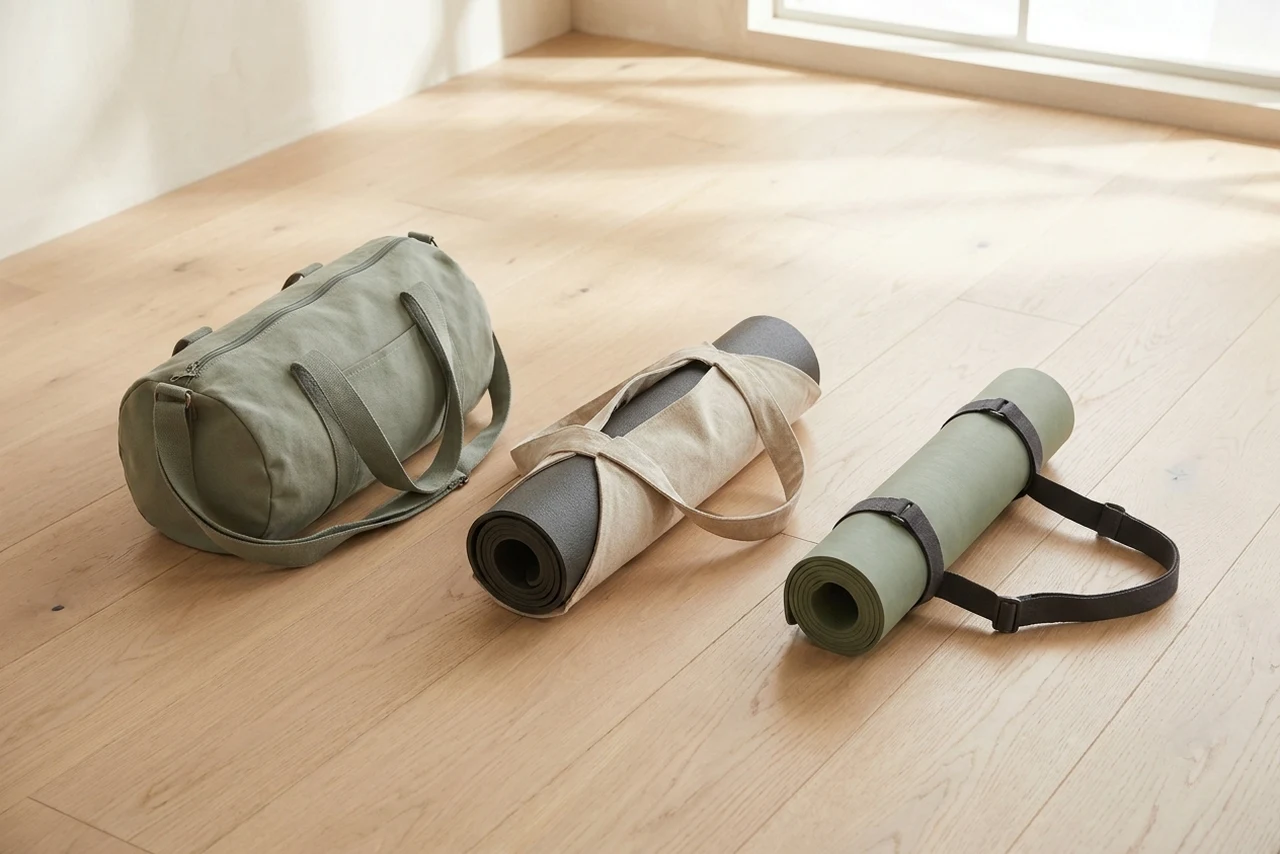
A full bag is an enclosed tube, usually with a zip and one or more pockets. It protects the mat from rain and grime, holds a strap, towel and water bottle, and keeps everything in one place. The trade-off is bulk and a little weight, and a fixed internal diameter that a fat mat can outgrow.
A sling or open carrier is a strap and a cradle — often a mesh or fabric sleeve open at the ends. It holds just the mat, weighs almost nothing, and slips on and off in a second. It gives no storage and no weather protection, but it never fights your mat's thickness because it is not a sealed tube.
A carry strap is the most minimal option of all: a loop of webbing that cinches around the rolled mat with a shoulder sling. It carries nothing but the mat and protects nothing, but it is the cheapest, lightest way to make a mat portable. It is a different, more minimal buy than a bag, so most people choosing a carrier are really deciding between the two options above.
If you carry gear to class, get a bag. If you only carry the mat, get a sling. That single question answers most of this page.
If even a sling is more than you want, the strap is the honest third answer. It costs a fraction of a bag, weighs almost nothing, and does the one job — getting a rolled mat onto your shoulder. Plenty of people who buy a bag end up using one of these instead.
Check price on Amazon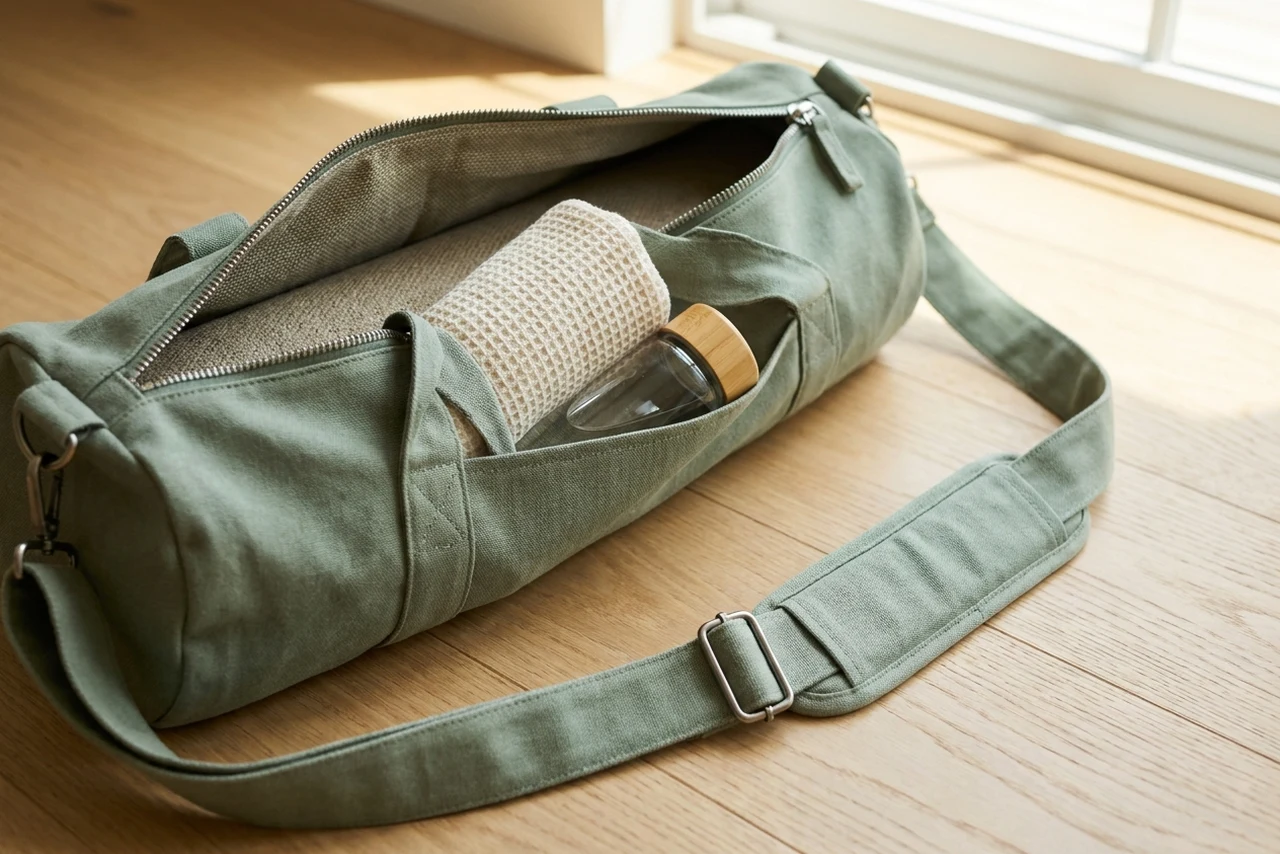
What to look for: fit, pockets, strap and material
Four things separate a bag you use from one that annoys you.
Fit. The most common mistake is buying for the mat's unrolled length and ignoring the rolled diameter. A bag has to swallow the cylinder your mat becomes, not the flat sheet. More on this in the next section, because it is where most returns come from.
Pockets. If the reason you want a bag is to carry a strap, towel and bottle, make sure it actually has a pocket sized for them. A bag with one tiny zip pocket is really a sling with extra fabric.
Strap. An adjustable, padded shoulder strap is the difference between comfortable and digging in, especially with a heavy mat. A fixed, thin strap is fine for a light mat and a short walk, less so for a daily commute.
Material. Cotton and canvas breathe and usually machine wash, which matters because a mat you roll up slightly damp will leave the inside musty. Synthetic shells wipe clean and shrug off rain but trap moisture more. Either works if you let a damp mat dry before it goes in — the same rule as storing a mat.
Will my mat actually fit
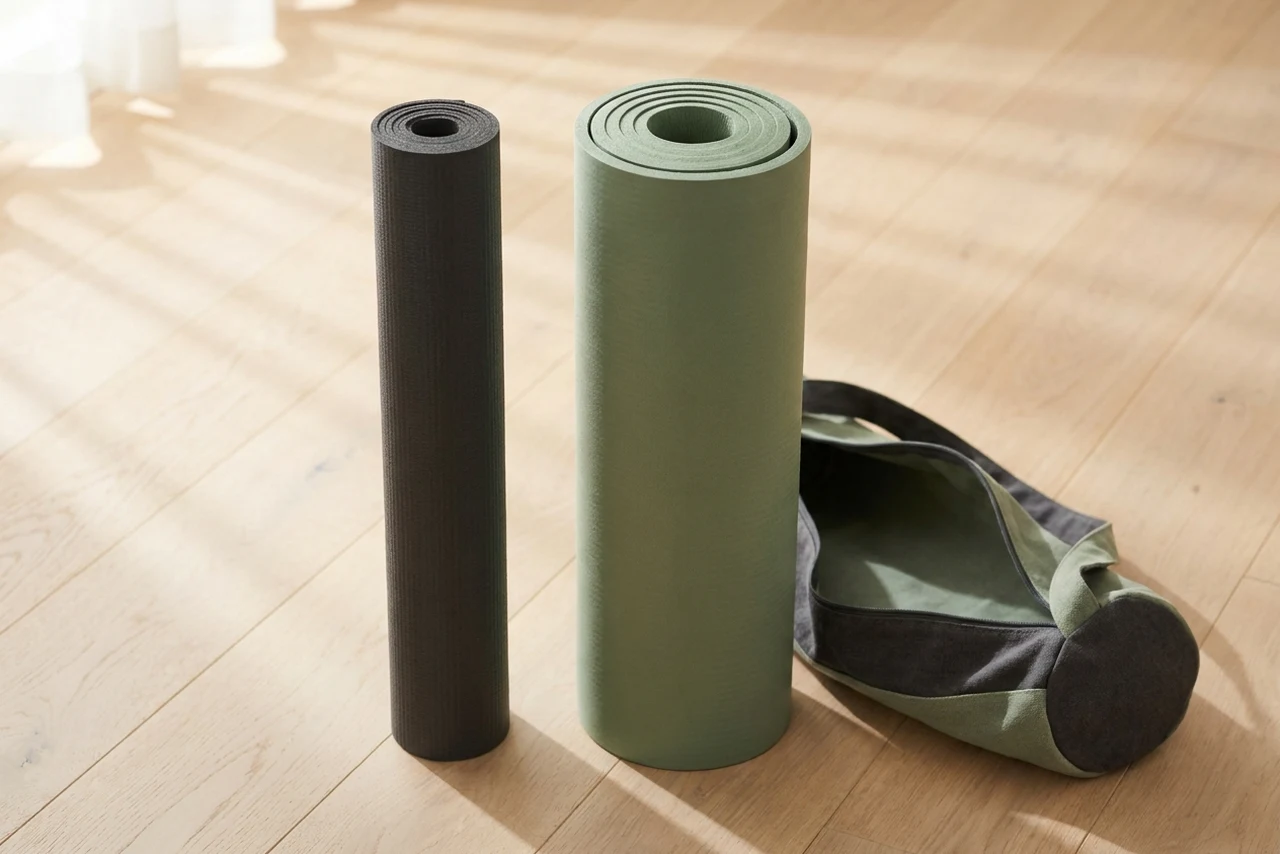
This is the question the product photos never answer, and it is where buyers get caught. A bag is sized for a cylinder, so two numbers decide whether your mat fits: the rolled length and the rolled diameter.
Length is the easy one. A standard mat is around 68 to 71 inches unrolled and rolls to roughly 24 to 28 inches long, which most bags handle. A long mat (74 inches and up) rolls longer and needs a bag that says so.
Diameter is the one that bites. A thin 3 to 4mm mat rolls into a slim cylinder that slides into almost anything. A thick 6mm or 8mm mat rolls into a much fatter roll that can jam in a snug zip bag even when the length is fine. If you have a thick mat — the kind we recommend in the bad-knees guide — measure the rolled diameter and check it against the bag, or choose an open sling that does not have a fixed width at all.
When in doubt, a sling is the safe pick. It cannot be too tight, because it is not a tube.
Best overall — Manduka Breathe Easy Carrier
The Manduka Breathe Easy Carrier is the one I would point most people to, because it solves the fit problem by not being a sealed bag at all. It is a breathable mesh sling with an adjustable strap, so it cradles the mat, lets it air out, and does not care whether your mat is thin or thick.
That open design is the whole case. There is no zip to fight, no fixed diameter to outgrow, and the mesh lets a slightly damp mat breathe instead of sealing moisture in. It is light, it is brand-consistent with the mats we already cover, and it is the carrier to get if all you want is to move the mat from A to B.
The honest limit: it carries the mat and nothing else. No pockets, no protection from rain, no room for a towel or bottle. If you want to carry your gear in one bag, the Gaiam below is the better fit.
Best value with storage — Gaiam Cargo Yoga Mat Bag
The Gaiam Cargo Yoga Mat Bag is the pick if you want to carry your whole kit, not just the mat. It is a full-zip bag with cargo pockets, so a strap, towel, keys and a small bottle all travel with the mat in one thing on your shoulder.
For a studio commute that is genuinely useful. You leave with one bag instead of juggling a mat under one arm and a tote on the other, and the enclosed shell keeps grime and light rain off the mat. It is widely available and costs less than most premium carriers.
The trade-offs are the ones every zip bag has: it is bulkier than a sling, and its fixed internal width means a very thick mat may not fit even if the length does. Check the capacity against your rolled mat before buying, and if your mat is thick, look back at the sling.
Do you need a yoga mat bag
Here is the honest part: if your mat never leaves the house, you do not need a bag or a carrier at all. A wall hook, a strap looped around the roll, or a clean corner keeps the mat tidy and off the floor for nothing. Buying a carrier for a mat that lives in your living room is the most common small overspend in beginner yoga.
The carrier earns its place the moment you start carrying the mat regularly — to a studio, a class, the park. At that point it is genuinely worth it, because a loose mat under your arm gets dropped, dirty and annoying fast. Buy the carrier when the mat starts travelling, not before.
If you do buy, match the type to how you travel: a sling if you carry only the mat, a bag if you carry your gear with it.
How we chose
We did not run a lab test for this guide, and there are no star ratings on this page because we have no verified first-hand testing data to publish. We compared manufacturer specifications, the stated capacities, materials and strap designs, and recurring themes in aggregated buyer reviews — paying particular attention to the fit complaints that dominate negative reviews of mat bags.
What we weighted: a carrier that fits real mats including thick ones, a strap that is comfortable to carry, honest storage that matches the type, and a price that matches the job. Prices and badges change constantly, so they inform research but do not belong frozen into evergreen copy. Affiliate links run through local /go/ redirects, and the picks above stay the same whether or not you buy through them.
Related reading
- How to store a yoga mat — carrying is half the storage question.
- Best yoga mats of 2026 — pick the mat, then the bag that fits it.
- How to choose a yoga mat — the buying framework this sits alongside.
- Best yoga blocks — the other accessory worth owning before a bag.
Frequently asked questions
What are the benefits of a yoga mat bag?
A bag or carrier keeps a rolled mat tidy, keeps dust and floor grime off the surface you press your face into, and makes the mat easy to carry hands-free. A bag with pockets also holds a strap, towel, water bottle and keys, so you can leave for class with one thing on your shoulder.
Why do you need a yoga mat bag?
You only really need one if you carry your mat — to a studio, a gym or the park. For practice that stays at home, a bag is optional and a wall hook or a corner does the job. The bag earns its place the moment your mat leaves the house regularly.
What size yoga mat bag do I need?
Match the bag to your rolled mat's length and diameter, not just its unrolled size. Most bags fit a standard mat around 24 to 28 inches long. A longer mat (71 to 74 inches unrolled) or a thicker mat rolls up bigger, so check the bag's stated capacity against your specific mat before buying.
Bag, sling or carrier: which is better?
A full bag carries the mat plus accessories and protects it most, but it is bulkier. A sling or open carrier holds just the mat with a strap, which is lighter and faster but offers no storage or weather protection. Choose a bag if you carry gear, a sling if you only carry the mat.
Can a yoga mat bag fit a thick mat?
Not always. A thick mat (6mm and up) rolls into a fatter cylinder that can be too wide for a snug zip bag, even if the length is fine. Open slings and carriers handle thick mats more easily because they are not a fixed tube. If you have a thick mat, check the bag's diameter or buy a sling.
Do you need a yoga mat bag if you practise at home?
No. A home practice does not need a carrier at all — a wall hook, a strap, or a tidy corner keeps the mat clean and out of the way for nothing. Buy a bag when you start carrying the mat out of the house, not before.
How do you clean a yoga mat bag?
Check the label first. Most cotton or canvas bags can be machine washed cold on a gentle cycle and air dried; many have a removable strap. Spot-clean any bag with a damp cloth and mild soap between washes, and let it dry fully before you roll a damp mat back inside.