

This guide contains affiliate links — recommendations aren’t based on commission. Read our full disclosure.
How this page has changed
May 30, 2026
Sources, internal links and safety or product context reviewed.
In this guide
Most yoga blocks do the same simple job, which is why the choice comes down to two questions: foam or cork, and one block or two. Foam is light, soft and cheap, and it suits the way most people actually use a block. Cork is firmer, heavier and more grippy, which some practitioners prefer once they are leaning real body weight on it.
This guide compares the two materials, names three honest picks across budgets, and explains what a block is for and how to use it. I am Marvin Smit, a long-time practitioner and the author of The Yoga Sensei — not a certified instructor. I have not lab-tested these specific blocks; the picks below are researched from manufacturer specifications and aggregated buyer reviews, and I say so wherever a claim comes from the maker rather than from use.
For specification-first material research, use the dedicated cork yoga block guide or foam yoga block guide. They cover dimensions, mass, construction disclosure, wear, cleaning and storage without duplicating this roundup's product-ranking intent.
By Marvin Smit · Long-time practitioner, not a certified instructor.
Quick answer. For most beginners, a standard 4 × 6 × 9 inch foam block is the sensible first buy — light, forgiving under the hands, and cheap enough to own two. Step up to cork if you want a firmer, grippier, more planted feel and do not mind the extra weight. And if you are in your first weeks of practice, you may not need a block at all yet.
Quick picks
Three blocks that cover the sensible range: one foam option for most people, and two cork options from premium to budget.
| Pick | Material | Best for | Link |
|---|---|---|---|
| Manduka Yoga Block | Fine-grain cork | Best overall — firm, grippy and built to last | Check price |
| Gaiam Yoga Block | EVA foam | Best value — the cheap, light, do-everything block | Check price |
| Gaiam Cork Yoga Block | Natural cork | Budget cork — the firm feel for less | Check price |
Prices and exact stock vary; the links go to current listings. There are no star ratings on this page because we do not have verified first-hand testing data to publish — see how we chose near the end.
Best overall block — Manduka Yoga Block
The Manduka Yoga Block is the one I would point to if you want the best single block rather than the cheapest. It is fine-grain cork, not foam, which is the reason it makes the top spot: cork stays firm under your full body weight instead of compressing, and its surface grips a wooden floor rather than sliding on it.
That firmness is the whole point of a block. A block that gives way under your weight stops doing its job in standing poses, so a dense cork block holds a steadier height in Trikonasana (Triangle Pose) and supported lunges. Cork is also durable and latex-free, and it is brand-consistent with the mats we already cover, which mainly means the build quality tends to match.
The honest limit: cork is heavier to carry, it costs more than foam, and the firm edge presses harder under a kneecap or wrist bone. For purely gentle, seated use you may never need that firmness — and the foam pick below will feel kinder under bony points.
Best value — Gaiam Yoga Block (foam)
The Gaiam Yoga Block is the one I would buy if I wanted a block to work today and did not want to think about it. It is a standard 4 × 6 × 9 inch EVA foam block, it is one of the most widely bought blocks anywhere, and it costs little enough that owning a pair is easy.
Foam is softer and far lighter than cork, so it compresses a touch more under full body weight. For the most common uses — propping the floor up in a forward fold, sitting on it in a hip opener, sliding it under the sacrum in a supported bridge — that softness is fine and even kinder under bony points. This is the right pick for most beginners.
Skip it only if you specifically want a firm, planted, grippy surface for weight-bearing balance work. For that, the cork picks are worth the extra weight and cost.
Budget cork — Gaiam Cork Yoga Block
The Gaiam Cork Yoga Block is the pick if you want cork's firm, grippy feel without the Manduka price. Cork is a natural material harvested from the bark of the cork oak, and a cork block feels completely different from foam in the hand: firmer, denser, with a surface that does not slide on a wooden floor. If you have decided you want cork but do not need the premium option, this is it.
It pairs naturally with a cork mat, so if you came here from the eco-friendly yoga mat guide, this is the matching prop. Like all cork, it is latex-free, which is worth knowing if you avoid natural rubber for that reason.
The trade-offs are the same as any cork block: heavier than foam, a firmer edge under bony points, and a higher price than the foam pick. Against the Manduka cork block it is the value choice rather than the premium one — close in feel, easier on the wallet.
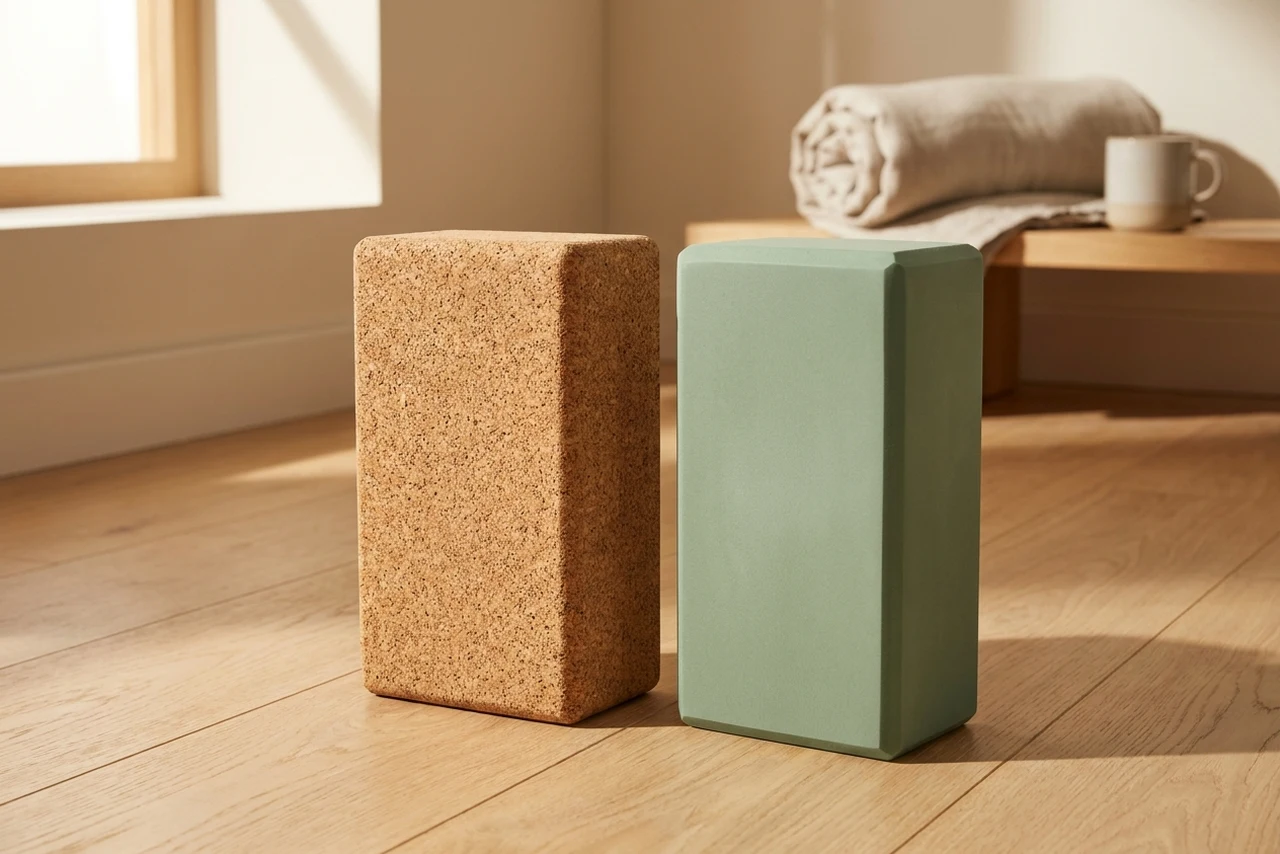
Foam vs cork: which should you choose
If the measurements are the unresolved part of the purchase, use the separate yoga block size guide for 3-inch versus 4-inch formats, metric conversions, mini and oversized blocks, storage volume and manufacturer examples. This page keeps ownership of materials and product picks.
Buying two blocks together with a strap is a different decision. Our yoga block and strap set guide checks exact item count, matched dimensions, strap hardware and like-for-like bundle value without duplicating the product rankings here.
Wood is a separate construction problem rather than a third version of the same shortlist. The wooden yoga block guide compares solid, laminated and hollow bamboo builds, including seams, finish, weight and care.
The foam-versus-cork question sounds bigger than it is. Both materials make a perfectly good block. The difference is feel, weight and price, and you can predict which you will prefer from how you practise.
Choose foam if you want a light block that is soft under bony points, you are buying your first block, or you want two without spending much. Foam is the default for a reason: it is forgiving, cheap and good enough for almost everything.
Choose cork if you dislike how foam compresses, you want a firm and planted surface for standing and weight-bearing poses, or you prefer a natural material. Just budget for the extra weight in your bag and the harder edge under your joints.
One quiet point most roundups skip: a soft foam block and a firm cork block feel like different tools under a kneeling shin, even at the same dimensions. If joint comfort is your main concern, that firmness difference matters more than the material name — the same way mat thickness and density matter more than the headline number.
What are yoga blocks for
A yoga block is a height adjuster. It raises the floor to meet your hands, or it gives a stable surface to sit on, lean into, or rest a body part against. That is the entire job, and understanding it makes every use obvious.
In standing forward folds, a block under each hand lets you keep a long spine instead of rounding to reach the floor. In seated poses, sitting on a block tilts the pelvis forward so the hips can open without the lower back collapsing. In restorative shapes, a block under the sacrum or between the shoulder blades holds a gentle, supported position you can stay in for minutes.
Blocks are also a support aid for sensitive joints. If your knees take a lot of load when you kneel, a block can change the angle and reduce that pressure — the same problem we cover in the yoga mat for bad knees guide. A block is gear, not treatment, so it makes a position more comfortable rather than fixing what causes pain.
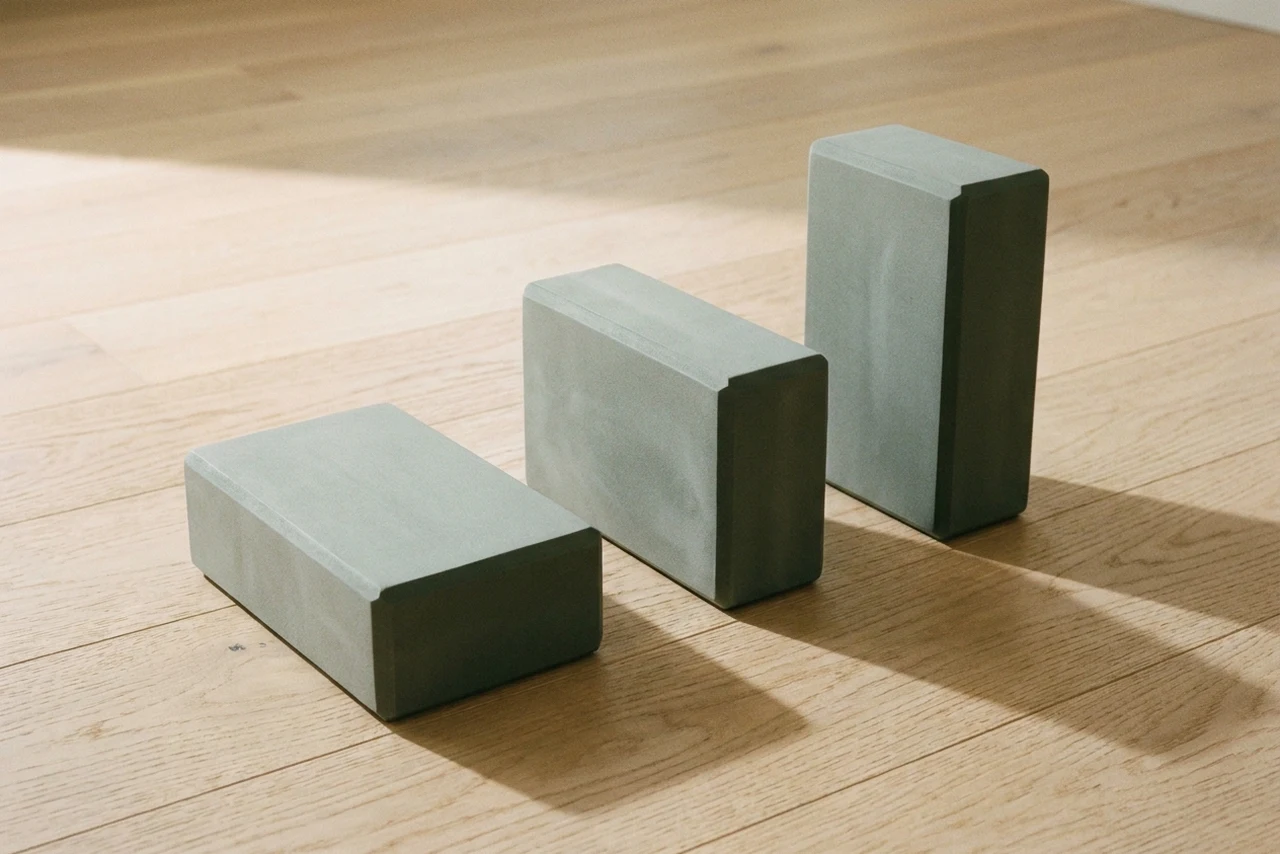
How to use yoga blocks: 5 simple ways
You do not need a routine of yoga block exercises to get value from one. These five uses cover most of what a block does in a normal practice.
- Under the hands in standing forward folds. Set a block on its tallest side under each hand so you can fold with a flat back instead of straining toward the floor.
- Under the front hand in Triangle and Half Moon. A block beside your front foot gives your lower hand somewhere stable to land, so you can open the chest without dumping weight into the wrist.
- As a seat in hip openers. Sitting on a block in a cross-legged or wide-legged pose lifts the hips above the knees and lets the lower back stay long.
- Under the sacrum in a supported bridge. Lie on your back, lift the hips, and slide a block under the bony plate of the sacrum on its lowest or middle height for a passive, restful backbend.
- Between the thighs or hands for engagement. Squeezing a block keeps the legs or arms active and aligned in poses where they tend to splay, which is a quiet way to feel a pose working.
Start on a block's lowest height and only raise it if you still cannot reach comfortably. The goal is support, not maximum height.
Uses three and four — sitting on it, and propping the sacrum — are where a block starts to feel hard under bone. If most of your practice is restorative rather than standing, a bolster does those two jobs far more comfortably, and a block does everything else. They are complements, not alternatives.
Check price on Amazon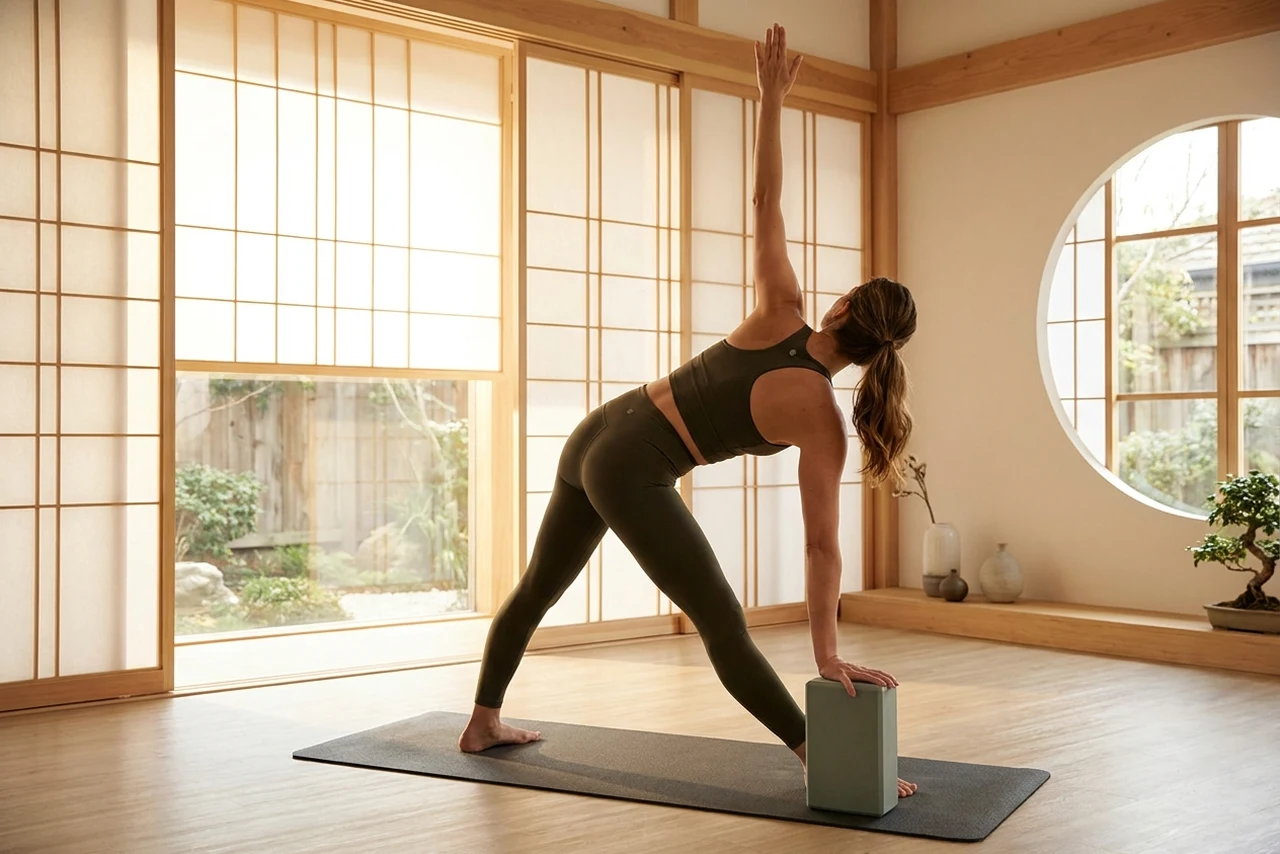
Do you actually need a block yet
Here is the part the product pages will not tell you: in your first weeks of practice, you may not need to buy a block at all. A pair of thick hardcover books, stacked, gives you almost the same height and stability for standing folds and seated poses while you learn what your body actually reaches for.
A block earns its place the first time you meet a pose where your hands genuinely cannot find the floor without rounding your spine — and that moment is different for everyone. When it comes, a block is cheap and worth it. Until then, there is no rush, and buying props you do not use yet is the most common way beginners overspend on yoga.
If you do buy, one block is plenty to start. Add a second only when a class or a restorative pose asks for even height on both sides.
How we chose
We did not run a lab test for this guide, and there are no star ratings on this page because we have no verified first-hand testing data to publish. Instead, we compared manufacturer specifications, the published dimensions and materials, and recurring themes in aggregated buyer reviews, then cross-referenced what established yoga-gear reviewers say about block density and durability.
What we weighted: firmness that holds under body weight, a standard size that suits most people, an honest material trade-off rather than a marketing story, and a price that matches the job. Star ratings, prices and badges change constantly, so they inform research but do not belong frozen into evergreen copy. Affiliate links run through local /go/ redirects, and the picks above stay the same whether or not you buy through them.
Related reading
- How to choose a yoga mat — the buying framework this accessory sits alongside.
- Best yoga mats for bad knees — where a block doubles as joint support.
- Best eco-friendly yoga mats — pair a cork block with a cork mat.
- Best yoga mats of 2026 — start with the mat, then add the props.
Frequently asked questions
What are yoga blocks used for?
Yoga blocks bring the floor closer to your hands and add height and support so a pose stays stable while you build the flexibility for it. They are most useful in standing forward folds, seated poses, and restorative shapes where you would otherwise round or strain to reach the ground.
Are foam or cork yoga blocks better?
Neither is better in every case. Foam is lighter, softer under bony points and cheaper, which suits most beginners. Cork is firmer, heavier and more stable to stand or sit on, which some people prefer for weight-bearing poses. The choice is about feel and budget, not quality.
What are yoga blocks made of?
Most yoga blocks are EVA foam or natural cork; a few are wood or bamboo. Foam is the lightest and cheapest, cork is firmer and grips the floor, and wood is the heaviest and most rigid. Foam and cork cover almost every real-world need, so the choice usually comes down to those two.
How many yoga blocks do I need?
One block covers most home practice. Two blocks become useful for restorative poses, supported backbends and any pose where both hands or both sides of the body need even height. Most people start with one and add a second only when a class or a pose calls for it.
Do beginners need yoga blocks?
Not on day one. A block helps once you meet a pose where your hands cannot reach the floor without rounding your back, which is common in standing forward folds and lunges. Until then, a couple of thick books do the same job, so there is no rush to buy.
What can I use instead of a yoga block?
A pair of thick hardcover books, stacked, gives almost the same height and stability for standing folds and seated poses. A firm cushion or a tightly folded blanket can stand in for restorative support. These work fine while you learn what your body reaches for, so there is no rush to buy a block on day one.
How do you clean a yoga block?
Wipe a foam block with a cloth dampened with water and a little mild soap, then let it dry fully before storing. Clean cork with a barely damp cloth and avoid soaking it, because cork absorbs water. Skip harsh sprays and bleach on either material.