

This guide contains affiliate links — recommendations aren’t based on commission. Read our full disclosure.
How this page has changed
August 30, 2026
Sources, internal links and safety or product context reviewed.
July 25, 2026
First published.
In this guide
The best non-slip yoga mat for most people is a polyurethane-top mat or a natural rubber mat — not the foam mat with "non-slip" printed on the box. Grip comes from the surface material, and only a few materials actually deliver it. This guide compares five mats that do, and explains the free fixes that make the mat you already own less slippery.
One honest note before the list. I have not lab-tested all five of these mats. One of them — the Lululemon — has been my own daily mat for about a year and a half. The rest are ranked from published specs, manufacturer positioning, and what established reviewers like NYT/Wirecutter and GearLab consistently report. No invented scorecards.
By Marvin Smit · Long-time practitioner, not a certified instructor.
TL;DR: the non-slip shortlist
| Pick | Best for | One-line verdict | Details |
|---|---|---|---|
| Jade Harmony | Best all-round pick | The natural rubber classic with years of reviewer consensus behind it. | Full notes below |
| Liforme Original | Best grip out of the box | A PU top that is grippy from day one, no break-in needed. | Full notes below |
| Manduka GRP Adapt | Best for sweaty hands | An absorbent PU surface built to hold on when your palms are damp. | Full notes below |
| Lululemon Reversible 5mm | The one I use daily | Dependable everyday grip from a PU top — my own mat since late 2024. | Full notes below |
| Gaiam Premium 6mm | Best budget | Fine dry grip for the price, with limits you should know first. | Full notes below |
If you want the short answer: pick the Jade Harmony if you want a proven all-rounder, the Liforme if you want strong traction from the very first class, and the GRP Adapt if sweat is your real problem. If your current mat is the problem, try the fixes further down before spending anything.
Why some mats grip and most do not
Mat marketing treats "non-slip" as a feature every mat has. The materials disagree. Three surfaces dominate every serious grip ranking, and they work in different ways.
Polyurethane tops (Liforme, Manduka GRP line) feel almost tacky under a dry palm. The surface bonds with skin, which is why reviewers keep calling PU mats the grippiest out of the box. The trade-off is care: PU absorbs sweat and stains, and it wants regular cleaning with the right products.
Natural rubber (Jade Harmony, Lululemon's base layer) grips through texture and slight give. Wirecutter has recommended the Jade Harmony for years, praising its "octopus-like grip". Rubber is the honest all-rounder — good dry, decent damp, but it fades as sweat pools. One hard caveat: natural rubber and latex allergies do not mix, and even mats labelled latex-free may carry trace latex proteins. Check the manufacturer's guidance if you are sensitive.
Budget foam and TPE (most mats under the price of a studio class card) grip acceptably when dry and new. The surface polishes smooth with use, and sweat defeats it quickly. That is not a scandal — it is just what the material is.
Grip vs. moisture
Illustrative
How we chose
No lab test behind this guide. The shortlist comes from cross-referencing spec sheets, manufacturer claims, the consensus at NYT/Wirecutter and GearLab, and recurring buyer reports. Where I have first-hand experience — the Lululemon — I say so and describe it plainly. Where I do not, I attribute.
The criteria:
- Dry grip: does the surface hold in a normal, unheated practice?
- Damp grip: what happens when your hands start to sweat mid-class?
- Honest trade-offs: every grippy surface costs something — care effort, weight, latex, or money.
- Reviewer consensus: do independent reviewers keep landing on the same strengths?
Prices and stock change too often to freeze into an article, so there are no prices here. Use the links to check current numbers.
The 5 best non-slip yoga mats
Jade Harmony — Best All-Round Pick
The Jade Harmony is the classic answer when the question is simply "which mat grips". It is natural rubber through and through — about 4.7mm thick, made in the US, with a textured open-cell surface that holds a dry or lightly damp palm well. NYT/Wirecutter has kept it in its top recommendations for years on the strength of exactly that grip.
The trade-offs are the rubber trade-offs. Jade labels the Harmony latex-free but notes it may still contain trace latex proteins, so latex-allergic buyers should check with Jade before ordering. Open-cell rubber absorbs sweat, which helps grip but means more cleaning. And it wears faster than a dense PVC mat — grip over longevity is the deal you are making.
Best for: everyday practice, anyone who wants proven grip without a performance-mat price.
Our full Jade Harmony review covers how the open-cell surface ages and who the mat actually suits.
Liforme Original — Best Grip Out of the Box
The Liforme is the mat people buy when slipping has actually scared them. Its polyurethane top is grippy from the very first class — no break-in, no scrubbing — and in our review it is the wet grip, once your hands start sweating, that stands out as its best attribute. The etched alignment guides are a genuine extra for beginners placing hands and feet.
The costs are real. It sits at the premium end of the market. The PU top marks and stains more easily than rubber, and it wants cleaning with gentle products only. And although its grip when sweaty is excellent, heavy sweat wears a PU surface down faster — if you drench a mat every session, read the GRP Adapt notes below and the durability notes in our full review.
Best for: practitioners who want strong traction immediately and will do the care that a PU surface asks.
The full Liforme review goes deeper on the alignment system and how the surface holds up over time.
Manduka GRP Adapt — Best for Sweaty Hands
If your slipping starts when your palms start sweating, the GRP Adapt is the pick built for your problem. Its absorbent PU top is designed to take moisture in rather than let it pool. GearLab rates it a top hot-yoga pick and measured its wet grip at 8.5 — the highest of any mat in its test field, and the only score above 8.0 — though not every reviewer agrees, and our full review covers that split honestly. For unheated practice with sweaty hands, the same physics apply.
Trade-offs: it is a heavier mat, the absorbent surface demands consistent cleaning and full drying, and Manduka lists latex in the material stack. Also worth knowing: at the time of writing, the Amazon listing is the previous 5mm generation rather than the current 2.0 — our review covers which variant to buy.
Best for: people whose hands sweat in any room, and anyone splitting time between regular and heated classes.
The full GRP Adapt review explains the generation differences and the care rules an absorbent surface comes with.
Lululemon Reversible Mat 5mm — The One I Use Daily
This is the only mat in this guide I can speak about first-hand. I have practised on a dark green Reversible Mat 5mm nearly daily since late 2024. The polyurethane top side grips my palms reliably in slow flows and holds up in sweatier sessions better than I expected when I bought it. The rubber underside has never slid on a wooden floor.
Honest notes from ownership rather than marketing: the smooth top shows sweat marks, the mat is not light, and the 5mm cushion is comfortable but makes single-leg balance work slightly softer than a firmer 4mm surface. None of that has made me want to replace it.
There is no affiliate link on this pick — Lululemon does not sell through the programmes we use. It stays in the guide because it is the mat I actually stand on.
Best for: everyday practitioners who want one dependable mat and buy direct from Lululemon.
Read the full Lululemon Reversible Mat review for the long-term ownership notes, or Alo versus Lululemon if that is the cross-shop you are stuck on.
Gaiam Premium 6mm — Best Budget
The Gaiam Premium is the honest budget entry. Dry grip is acceptable for gentle and beginner practice, the 6mm foam is comfortable on knees, and it costs a fraction of the mats above. For a first mat while you find out whether yoga sticks, that is a fair deal.
Know the limits before buying. The surface is the first thing sweat defeats — damp palms slide sooner than on any other pick here. The texture also smooths with regular use. If you already know you practise hard or sweat, spend more once rather than twice.
Best for: beginners testing the waters, gentle practice, and anyone for whom budget is the deciding factor.
Our full Gaiam review covers what the low price does and does not buy you.
The grippy-mat pick I would skip: a new Manduka PRO
This needs saying because the Manduka PRO appears on nearly every "best mat" list: a brand-new PRO is one of the slipperiest mats you can unroll. That slickness is not a residue you can scrub away. After years of the famous salt-scrub tip, Manduka has retired that advice — the company now says the slick feel is simply the nature of the closed-cell surface, and it fades with weeks to months of regular practice. Owners love the mat once it gets there. But if you type "best non-slip yoga mat" into a search bar today, a mat with a multi-week break-in is the wrong answer.
Durability is the PRO's actual argument, and our Manduka PRO review makes that case fairly. Buy it for the decade of use. Do not buy it for day-one grip.
Slipping in a hot room is a different problem
Everything above assumes a normal, unheated class. Once a studio is heated, sweat volume rewrites the rules: surfaces that grip dry palms fail wet, and towels become part of the system. If most of your slipping happens in heated classes, read the best yoga mat for hot yoga guide instead — that is the page built for that problem, including towel pairings.
How to stop slipping on the mat you already own
Before spending on any mat above, try these. They are free or nearly free, and they fix a large share of slipping complaints.
- Wash the factory film off. Many new mats ship with a manufacturing residue that blocks grip. A proper first clean — see how to clean a yoga mat — is the single most common fix.
- Give a dense mat its break-in time. A closed-cell surface like the Manduka PRO starts slick by design, and Manduka has retired the old salt-scrub tip — the surface only opens up with weeks of regular practice. No home trick reliably speeds it up.
- Dry your hands and wrists before class. Lotion applied in the morning is still on your palms at noon. Wash hands right before you practise.
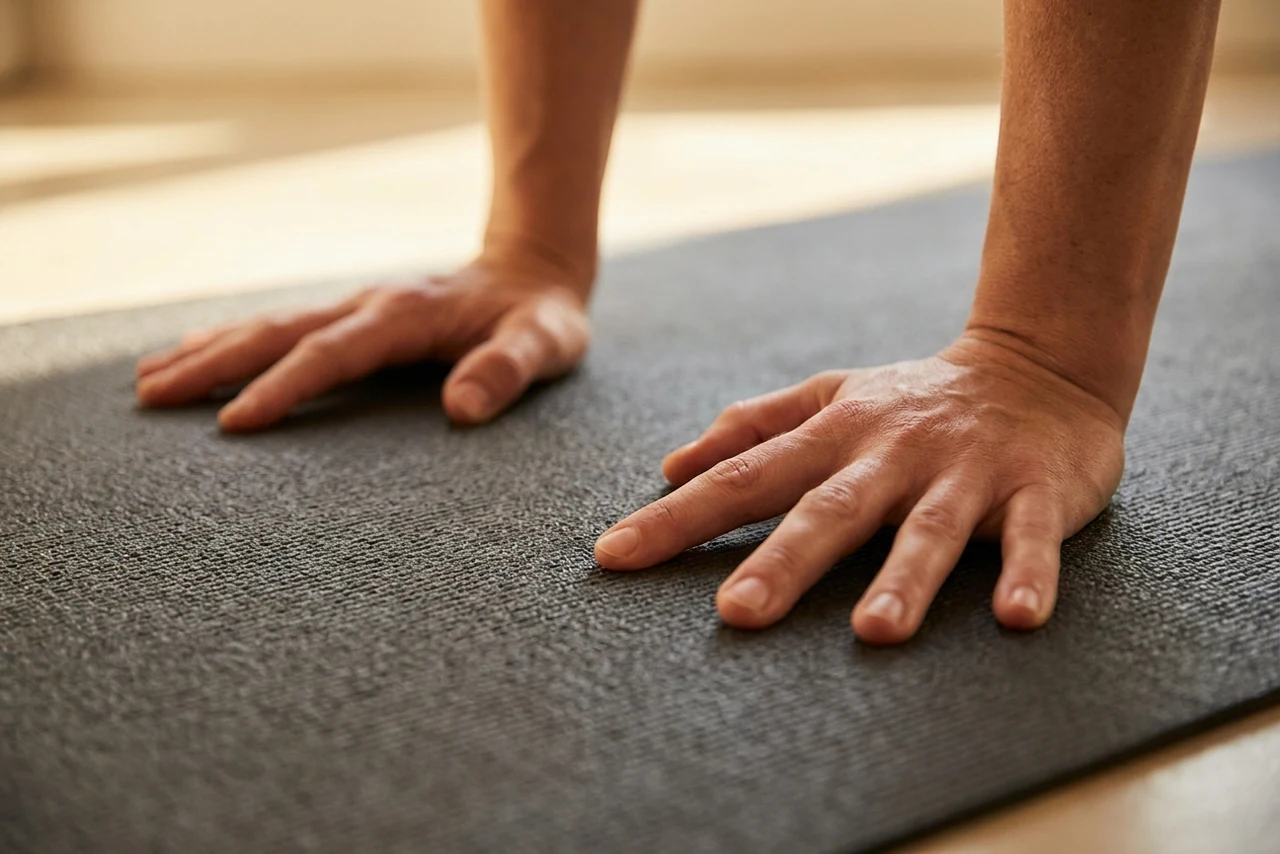
- Use the whole hand. Spread the fingers and press through the knuckles and fingertips, not just the heel of the hand. Half the contact patch means half the grip.
- Add a towel before replacing the mat. If sweat is the trigger, a grip towel on your current mat costs far less than a new PU mat and works immediately.
If you have done all five and still slide during dry, unheated practice, the surface itself is the problem — that is when the shortlist above earns its place.
Related reading
- How to choose a yoga mat — the full buying framework this shortlist plugs into
- Best yoga mat for hot yoga — the heated-room version of this decision
- Cork vs rubber yoga mat — the two grippiest natural materials compared
- How to clean a yoga mat — the maintenance that keeps any of these mats grippy
Frequently asked questions
What is the best non-slippery yoga mat?
For most people it is a polyurethane-top mat like the Liforme or Manduka GRP Adapt, or a natural rubber mat like the Jade Harmony. Reviewers at NYT/Wirecutter have long recommended the Jade Harmony for its grip. If your hands stay dry, natural rubber is enough; if they sweat, look at a PU top.
What is the most grippy yoga mat?
There is no single grippiest mat for every condition — dry grip and wet grip come from different surfaces. In GearLab's measured testing, the Manduka GRP Adapt scored the highest wet grip of the mats in its field at 8.5, which is why its absorbent top is the strongest pick for sweaty palms. On dry grip the order changes: the Manduka eKO leads at 10.0, with the Jade Harmony and the GRP Adapt tied behind it at 9.5. The Liforme is grippy from the first class with no break-in.
How do I stop slipping on my yoga mat?
Start by working out which problem you have. If the mat is new and dense, the slickness is the surface itself rather than a coating — Manduka retired its own salt-scrub advice in March 2026 and now says regular practice is the only thing that resolves it. If the mat is not new, clean it: Manduka notes that sweat and body-oil buildup adds slip over time. Beyond that, dry your hands before class, and spread your fingers and press through the whole hand. If sweat is the cause, a grip towel works faster than a new mat.
Is Liforme or Manduka better?
For grip out of the box, Liforme. Its PU top is grippy from day one, while the Manduka PRO needs a break-in period before it stops feeling slick. For durability, the Manduka PRO is the mat that lasts a decade. They solve different problems, so pick by which problem you actually have.
Do I need a different mat for hot yoga?
Usually, yes. Heated rooms change the picture: you need a surface that grips when wet, which usually means a PU top, cork, or a rubber mat paired with a grip towel. That is a different buying decision from everyday non-slip, so read our hot yoga mat guide if most of your practice is in a heated studio.