

Direct answer
Which should you choose?
Choose Alo Warrior
If a large, plush home-practice surface matters and the mat rarely needs to travel.
Choose Lululemon The Mat
If you want a more versatile mat for standing balance and both dry and sweaty sessions.
Biggest practical difference: Alo emphasizes space and cushioning; Lululemon is the more compact and versatile sweat-aware option.
- Footprint
- Longer and wider
- More conventional size
- Feel
- Plush and substantial
- Balanced and versatile
- Grip
- Strong PU-surface grip
- Strong reversible grip
- Carry
- Heavy and home-oriented
- Heavy, but easier to manage
- Care
- Wipe-only surface care
- Absorbent side needs care
- Best for
- Spacious home practice
- Mixed and sweaty practice
How this page has changed
July 26, 2026
Sources, internal links and safety or product context reviewed.
In this guide
These are the two mats that dominate every "which premium mat should I buy" thread, and they are more different than their matching price tier suggests. One is a single enormous plush surface built to live unrolled in a room. The other is two practice surfaces in one mat, built to handle whatever kind of session you turn up for.
A word on what this comparison is. I own the Lululemon Reversible Mat 5mm — a dark green one, in near-daily use since late 2024 — so what I say about that mat comes from a year and a half of standing on it. I have never practised on an Alo Warrior Mat. Everything about the Alo comes from Alo's published specs and care guidance, T3's tested review, Popsugar, YouTube tester Alexia K Yoga and owner threads. That asymmetry is worth naming up front, because it is exactly the sort of thing comparison articles usually hide. The full detail lives in our Alo Warrior Mat review and our Lululemon Reversible Mat review.
By Marvin Smit · Long-time practitioner, not a certified instructor.
The short answer
Choose the Alo Warrior Mat if you practise at home, the mat stays unrolled, and you want the biggest and plushest surface money buys in this tier. Choose the Lululemon Reversible Mat if you want one mat that copes with both sweaty and dry practice, feels more planted in standing balances, and you would rather not build a room around it. That is the whole decision; the rest is why.
Side by side
| Alo Warrior Mat | Lululemon Reversible Mat 5mm | |
|---|---|---|
| Top surface | Polyurethane leather, coated | Polyurethane, absorbent |
| Underside | Natural rubber, floor grip only | Natural rubber, a second practice surface |
| Reversible | No | Yes |
| Thickness | 5 mm | 5 mm (a 3 mm version exists) |
| Size | ~74 × 26 in (6.2 × 2.2 ft) | ~71 × 26 in (longer and wider versions sold) |
| Weight | ~8 lb, per Alo | ~5.2 lb published; just under 6 lb weighed by OutdoorGearLab |
| Sweat behaviour | Repels — sweat sits on top | Absorbs — grip holds as it dampens |
| Cushion feel | Softer, plusher | Firmer, more planted |
| Care | Wipe-only, roll top-side out | Wipe-only, no vinegar, oils or sun |
| Price tier | $$$ | $$$ |
Neither column wins. The Alo takes size, plushness and looks; the Lululemon takes versatility, stability and the weight of independent testing behind it. On our own scoring the Lululemon finishes a fraction ahead overall, which is a closer result than the internet's enthusiasm for either mat suggests.
Grip: two different ways of handling sweat
Both mats put polyurethane over natural rubber, so on paper they sound identical. They are not, and the difference is what happens when you start to sweat.
Lululemon's top absorbs moisture — that is the company's own description, and it is why the grip on mine holds up in sweatier sessions better than I expected when I bought it. The Alo's top is polyurethane leather: a coated, wipeable skin that repels moisture instead, which is why Alo pairs it with moisture-wicking and anti-odour claims and wipe-clean-only care. Sweat sits on that surface rather than soaking into it.
Practically: the Lululemon manages sweat by drinking it, the Alo by shedding it. Neither is strictly better, but it decides whether a grip towel is optional or close to mandatory. If you sweat heavily, budget for a mat towel on the Alo.
On dry grip the two are close enough that picking a winner over-reads the evidence — our reviews score them within a tenth of each other. The honest asymmetry is in the testing: the Lululemon has been through hands-on testing at OutdoorGearLab and Live Science, with Wirecutter citing it as a top overall pick, while nobody has run the Warrior through a structured grip protocol. Its reputation rests on reviewer consensus — strong, but not the same thing. The closest the Alo gets is T3's tested review, which scores it four stars out of five.
Size and weight: the Alo is a room decision
This is where the two mats stop being comparable products. The Warrior is about three inches longer and a touch wider — enough that tall practitioners stop running their heels off the end, and wide-legged flows stay on the mat.
That extra surface has a price, and it is not only the sticker. Alo publishes the Warrior at approximately 8 lbs. Lululemon publishes about 5.2 lbs for the 5mm, and OutdoorGearLab's scale said just under 6 lbs. So the Lululemon is not light either — its own review calls it "not a daily commuter" — but the Alo is nearly three pounds heavier at effectively the same thickness, and owners describe carrying it accordingly. Rolled up the two look much alike; the difference is in your hand, not your eye.
Reversible versus single-faced
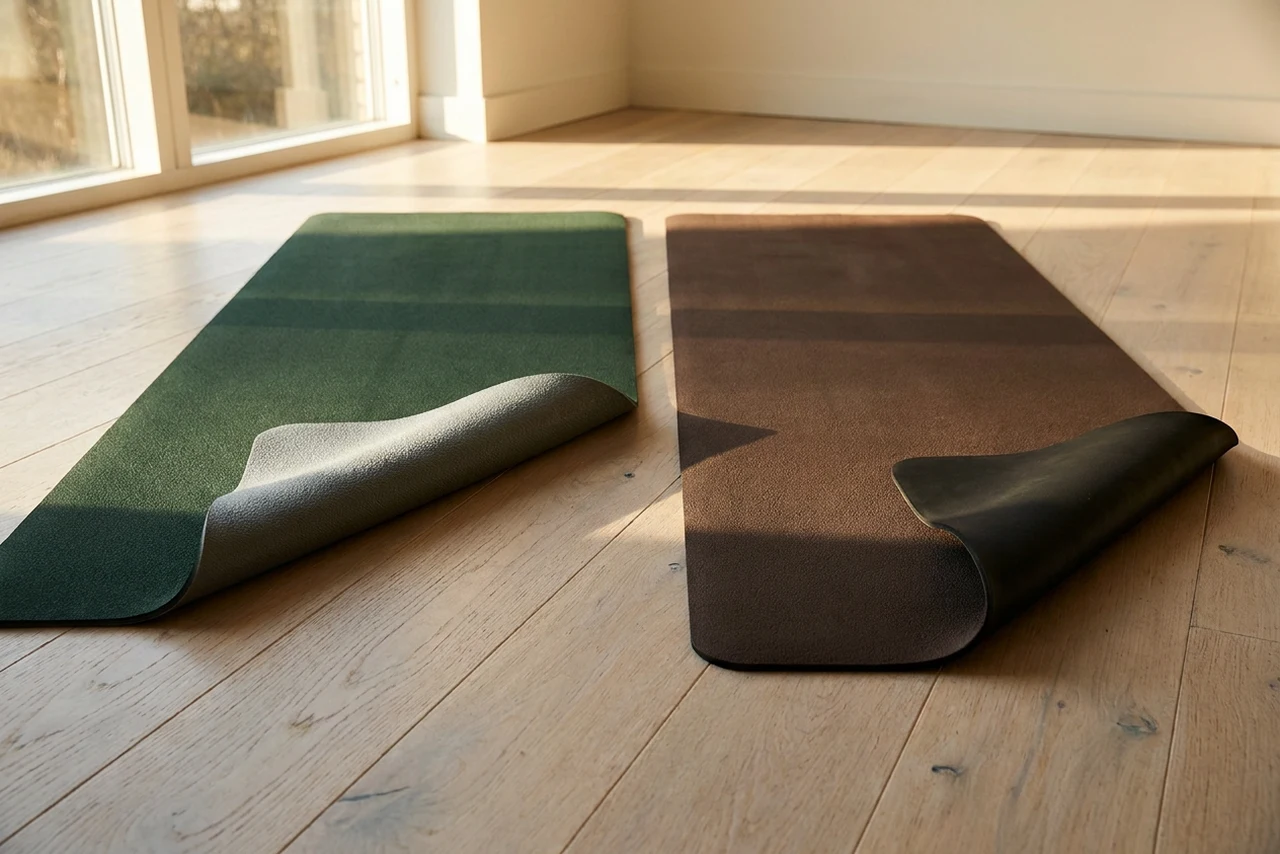
The Lululemon is genuinely two mats. Both faces are designed to be practised on: the smooth polyurethane side, which Lululemon markets as the sweat side because it absorbs moisture, and a textured natural-rubber side that trades absorption for raw friction. There is no single correct face — some reviewers reach for the rubber side precisely when they are sweating hardest. In eighteen months I have flipped mine more than I expected to.
The Alo has one face. Its rubber underside is floor grip, not a practice surface, and Alo's own care instruction — always roll the mat top-side out, or you risk damaging the surface — tells you how directional that single face is.
Comfort and stability: the trade you are actually making
The Alo is the plusher mat — softer underfoot, kinder to knees in low lunges and floor work, and the reason owners describe it as luxurious. Our review scores it clearly ahead of the Lululemon on cushioning and joint support.
The Lululemon trades some of that softness for stability, and that is not a consolation prize: OutdoorGearLab gave it a perfect score for comfort and support, and it stays firmer under a standing balance where a plusher surface lets your foot sink. Our Lululemon review scores stability 4.5; the Alo review scores balance-pose stability 3.8 and concedes that "softness costs a little in standing balance".
So: soft and large, or firm and versatile. If your practice is slow, floor-based and knee-heavy, the Alo's cushion is a genuine daily benefit. If you spend real time in standing balances, the Lululemon gives you a better platform.
Upkeep: both are fussy, differently
Neither mat forgives neglect, so do not choose on maintenance — choose knowing both need it.
The Alo's matte surface shows sweat outlines, oils and scuffs, and Alo asks for a wipe after every session with a 1-to-20 oil-free soap solution applied to the cloth rather than the mat. Owners who let marks sit report they set in.
The Lululemon needs the same after-practice wipe and carries a longer banned list: no vinegar, no essential oils, no soaking, no sun, because the acid and UV age the rubber base. Mine shows every sweat mark too — the dark colour hides staining that pale-mat owners complain about, which is a colour decision more than a mat decision. We wrote the Lululemon care routine up separately because so much general mat advice is wrong for it.
Which should you buy?
Buy the Alo Warrior Mat if:
- Your mat lives unrolled in a home studio and the weight never has to move
- You are tall or broad and keep running off the edges of a standard mat
- Kneeling poses and floor work are where your current mat hurts
- The mat is part of the room, and how it looks genuinely matters to you
Buy the Lululemon Reversible Mat if:
- You want one mat that copes with both sweaty and dry practice
- Standing balances are a real part of your week and you want a firmer platform
- You would rather have the mat with independent testing and long-term owner reports behind it
- You occasionally have to carry it, and "heavy" versus "very heavy" matters
If you sweat hard enough that grip is the whole question, the honest answer is that neither of these is the textbook pick — a mat built around wet grip beats both, and our best non-slip yoga mat guide covers those. And if you are cross-shopping the wider premium tier, the Manduka versus Lululemon comparison takes on the durability argument these two mostly avoid, while Liforme versus Lululemon is the one to read if wet grip is what you are really buying.
Frequently asked questions
Is the Alo or Lululemon yoga mat better?
Neither wins outright. On our own scoring the Lululemon edges it overall, mostly on stability and the weight of independent testing behind it. The Alo wins on size and plushness. If you practise at home and want the biggest, softest surface, take the Alo; if you want one mat that handles both sweaty and dry practice and feels more planted in balance poses, take the Lululemon.
Which is bigger, the Alo or the Lululemon mat?
The standard Alo Warrior Mat, comfortably. Alo publishes 6.2 by 2.2 feet — roughly 74 by 26 inches — against the standard Lululemon at 71 by 26 inches. That is about three extra inches of length, which can be the difference between your heels landing on the mat or the floor. Worth knowing before you decide on size alone: Lululemon also sells longer and wider versions of The Mat, so if length is your only issue, check those first.
Which mat is heavier, Alo or Lululemon?
The Alo, and not marginally. Alo states approximately 8 lbs for the Warrior Mat. Lululemon publishes about 5.2 lbs for the 5mm Reversible Mat, though OutdoorGearLab weighed one at just under 6 lbs. Neither is a commuting mat, but the Alo is the one people describe as a struggle to carry.
Is the Lululemon mat reversible and the Alo not?
Yes, and it is the biggest structural difference between them. Lululemon designs both faces to be practised on — a smooth polyurethane side that absorbs sweat, and a textured natural-rubber side that grips by friction instead. The Alo has one practice surface; its rubber underside is floor grip only, and Alo tells you to always roll the mat top-side out to protect that single face.
Which is better for hot yoga, Alo or Lululemon?
The Lululemon has the edge, because its top absorbs sweat rather than shedding it, which is the behaviour you want when your palms are wet. The Alo's coated polyurethane-leather surface repels moisture instead, so heavy sweaters usually end up putting a towel over it. If hot yoga is most of your practice, neither is really the textbook answer — read our hot yoga mat guide first.
Which mat needs less maintenance?
Both want a wipe after every practice, so neither is low-maintenance. The Alo's matte surface shows sweat outlines and scuffs and Alo asks for a 1-to-20 oil-free soap solution applied to the cloth, never the mat. The Lululemon's absorbent top stains too and has a longer list of banned cleaners — no vinegar, no essential oils, no soaking, no sun.