

How this page has changed
July 26, 2026
Sources, internal links and safety or product context reviewed.
In this guide
- 01Quick verdict by alternative
- 02What a yoga mat actually provides
- 031. Purpose-built yoga rug
- 042. Firm exercise or hybrid mat
- 053. A clean bare floor
- 064. Carpet
- 075. Purpose-built yoga towel
- 086. Bath or beach towel
- 097. Yoga blanket
- 108. Outdoor grass, sand or earth
- 11An empty setup check
- 12Temporary versus permanent alternatives
- 13Common substitution mistakes
- 14Selection checklist
The most credible yoga mat alternatives are a purpose-built yoga rug, a compatible firm exercise mat or—when no extra traction or cushioning is required—a clean, even floor. A bath towel, loose blanket or decorative rug usually replaces only one mat function and can introduce wrinkles, sliding or inconsistent support.
Do not choose a substitute because it is rectangular. First identify what the mat was doing: supplying top grip, resisting movement against the floor, adding firm separation, managing moisture or creating a personal barrier. The alternative must cover the functions that matter in the actual space.
Quick verdict by alternative
| Alternative | What it can replace | Main limitation | Verdict |
|---|---|---|---|
| Purpose-built yoga rug | Dedicated surface, absorption, packing | Minimal cushion; floor guidance varies | Viable when maker approves setup |
| Firm exercise or hybrid mat | Cushion, barrier, defined footprint | Top grip and softness vary | Viable after specification check |
| Clean bare floor | Stable plane and open area | No barrier or added cushion; finish may be slick | Conditional no-mat option |
| Low-pile carpet | Some cushion and personal area | Pile and underlay move | Conditional; inspect full floor system |
| Purpose-built yoga towel | Absorption and removable top layer | Commonly relies on a mat underneath | Accessory, not default replacement |
| Bath or beach towel | Washable textile barrier | Wrinkles, slides, little structure | Temporary top layer only |
| Yoga blanket | Warmth and localized folded support | Bunches; not a traction sheet | Prop, not full replacement |
| Decorative rug | Visual boundary | Unknown backing, pile, dyes and dimensions | Do not assume compatibility |
| Grass, sand or bare earth | Outdoor location | Unevenness, debris, moisture and no controlled surface | Site-dependent, not equipment-equivalent |
No alternative becomes suitable merely because a blog labels it “natural” or “free.” The floor, construction, maintenance and intended use remain part of the decision.
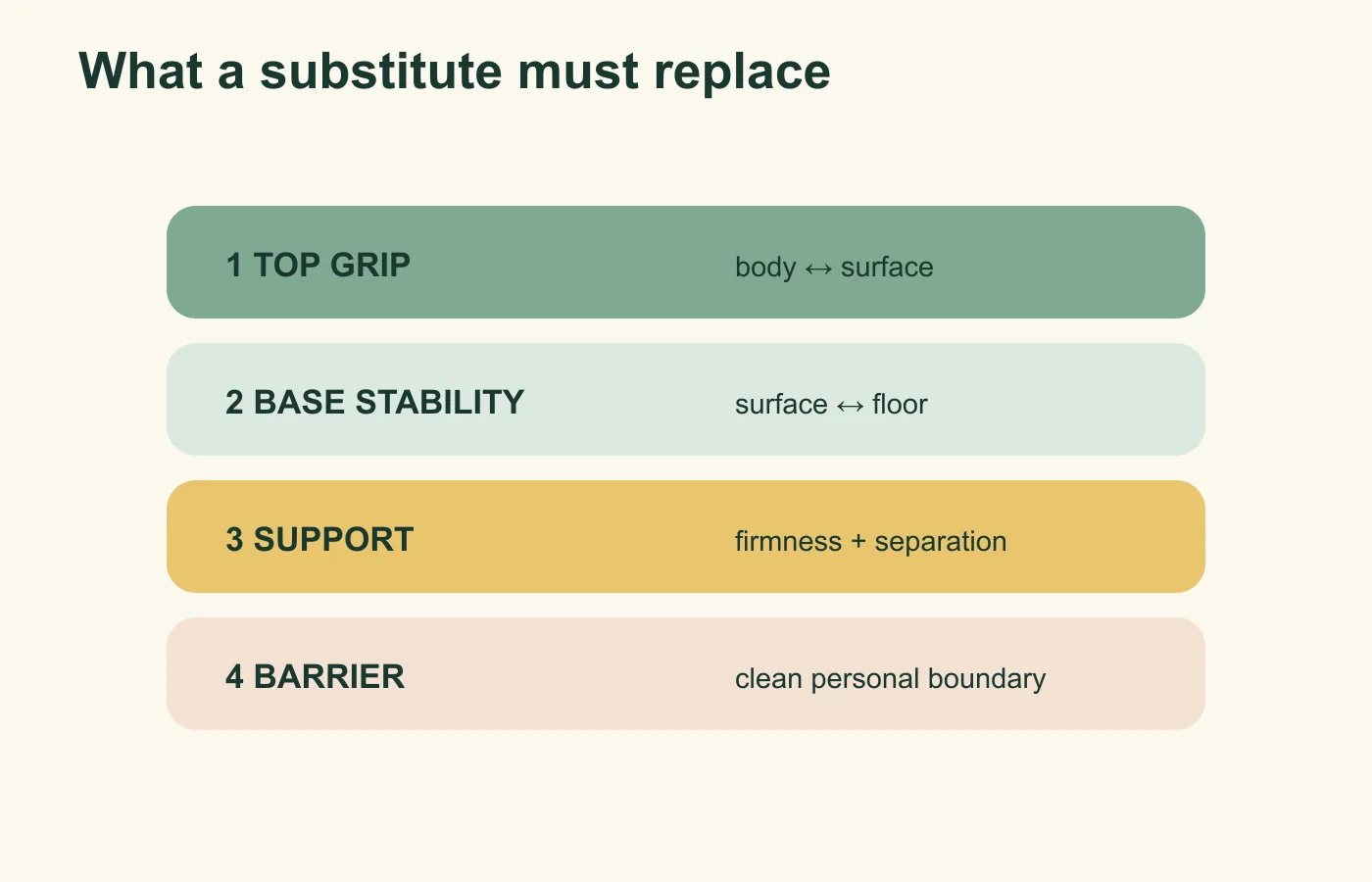
What a yoga mat actually provides
Consumer Reports evaluates yoga mats across drying time, cushioning, grip against the floor and grip against hands and feet. That framework exposes the weakness in most improvised replacements: they solve one metric and ignore the rest.
Top-surface grip
The body-facing surface must suit dry or damp contact without relying on residue or an improvised coating. A cotton textile may absorb moisture but does not automatically provide consistent dry traction.
Base stability
The entire object must remain flat against the floor. This is separate from top grip. A towel can feel textured under a hand while its underside slides across tile.
Firm support and separation
A mat creates distance from the floor and distributes contact through a coherent sheet. Softness alone is not support. A thick loose blanket can fold and compress unevenly, while a thinner dense mat remains dimensionally stable.
A clean boundary
A personal surface separates clothing and skin from a shared or outdoor floor. A substitute must itself be cleanable and dryable. Covering dirt with a porous household textile does not remove the hygiene issue.
A defined footprint
Standard mat dimensions create a visible practice area. An alternative should fit entirely within a clear space without overlapping doorways, furniture legs, floor transitions or walkways.
1. Purpose-built yoga rug
A yoga rug is the strongest non-foam alternative because it is made as practice equipment. Current products use woven cotton-rich construction, practice-size dimensions and explicit care guidance. Some can work alone; others need a mat on smooth floors.
Manduka currently positions its 71 × 26-inch Shala rug for travel, outdoor use and layering. JadeYoga instructs buyers to place its Mysore rug over a Jade mat on hardwood, laminate and tile. These different instructions prove that “rug” is not a universal floor rating.
Choose a rug when woven texture, absorption and folded packing are the goals. Do not expect built-in foam cushioning or assume a decorative rug is interchangeable. The full yoga rug vs mat guide compares current examples and wash rules.
2. Firm exercise or hybrid mat
An exercise mat can replace a yoga mat when its structure is firm enough, its top provides suitable contact grip and its base remains stable. A current 5mm hybrid such as Manduka X occupies the overlap deliberately; a soft 10mm floor-fitness roll may prioritize cushioning instead.
Compare exact thickness, dimensions, weight, material, shoe policy and cleaning instructions. “Fitness mat” can also describe wide training platforms, folding gym panels and equipment flooring that are not intended for the same body contact.
Use our yoga mat vs exercise mat comparison to separate the categories without assuming all thicker surfaces are better substitutes.
3. A clean bare floor
Doing yoga without a mat is physically possible; a mat is equipment, not a rule defining yoga. But a bare floor supplies no added cushioning, absorbency or personal barrier. Its finish determines friction, and seams or surface damage remain exposed.
Inspect the clear area before use:
- dry and free of cleaning residue;
- level, intact and without raised transitions;
- free of dust, grit, splinters, fasteners and objects;
- large enough that contact does not reach furniture or walkways;
- not so smooth that ordinary contact slides unexpectedly.
This is an equipment and floor inspection, not a movement test. Do not validate a surface with jumps, balancing or deliberate skidding. If the intended activity needs cushion or controlled hand-and-foot grip, a bare floor has not replaced those functions.
4. Carpet
Low-pile carpet may supply a clean-enough personal area and some cushion, but pile and underlay can shear or compress. Plush carpet is particularly different from a firm mat because the whole foundation moves beneath the contact surface.
Carpet alone can be a no-mat option only when it is clean, even, stable and appropriate for the intended contact. A loose rug over carpet adds another moving interface. The carpet setup guide explains pile, underlay and rigid-platform trade-offs.
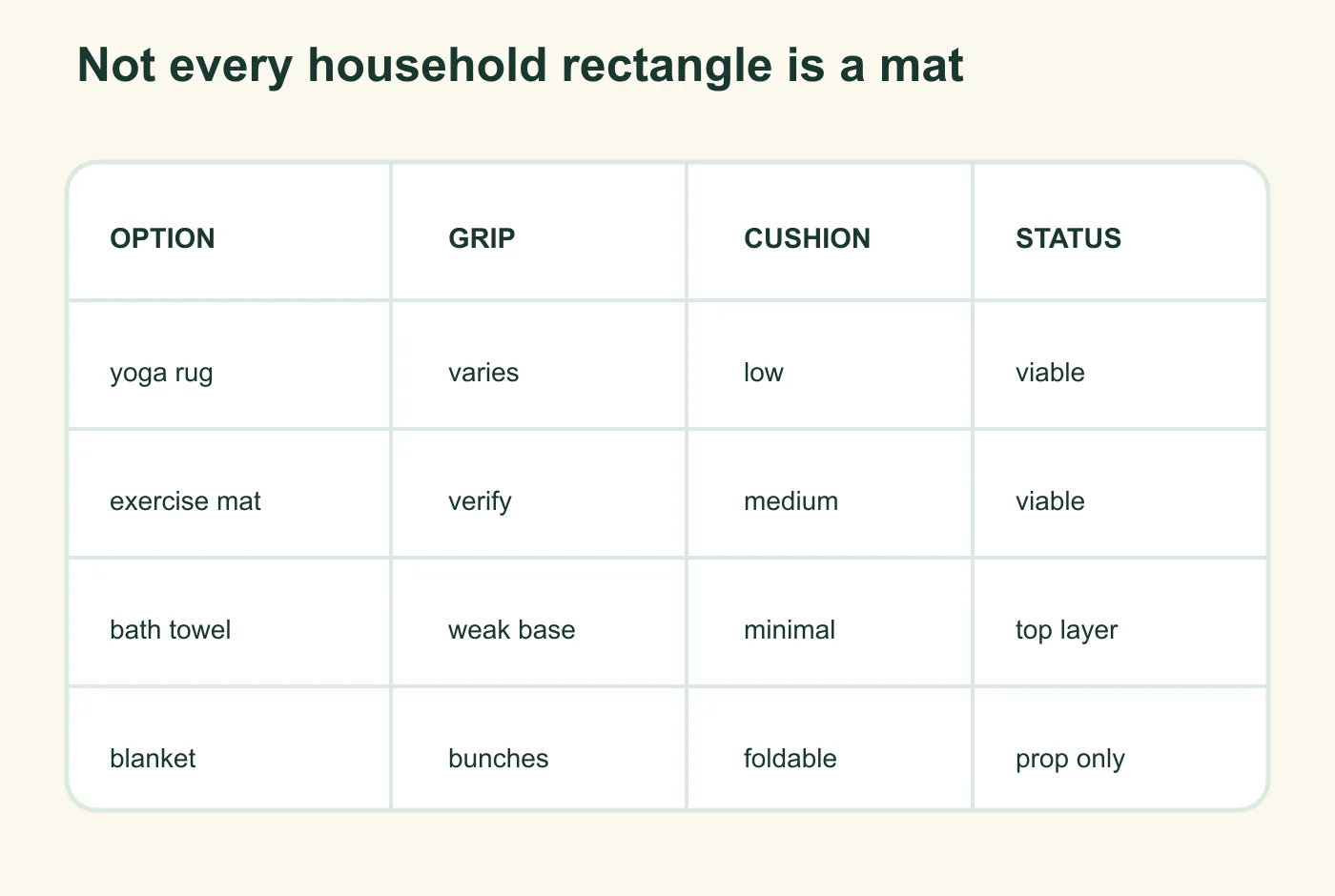
5. Purpose-built yoga towel
A full-length yoga towel manages sweat and creates a washable body-facing layer. Manduka’s current Yogitoes designs use silicone nubs intended to anchor to a mat, and the brand’s product collection repeatedly describes them as mat towels.
Some exact towel instructions may permit direct floor placement, but that does not make every yoga towel or floor compatible. The thin fabric provides little structured cushion and can behave differently when dry. Follow the specific product page.
If moisture—not absence of a mat—is the real problem, a towel can solve the top layer without replacing the base. See the yoga mat towel guide rather than treating a standard bath towel as equivalent equipment.
6. Bath or beach towel
A household towel is washable, portable and absorbent. It can create a temporary textile barrier on top of a suitable stable surface. It is a weak full replacement because terry loops, soft edges and a plain underside do not control bunching or floor migration.
Do not pin a towel with furniture, dumbbells or loose objects. That introduces hard obstacles around the contact area. Do not tape it to the floor without surface-maker approval.
A towel works best as an accessory: drying moisture, covering a compatible existing mat or supplying localized clean contact. If it wrinkles under light empty hand pressure, it has failed the flatness check.
7. Yoga blanket
A blanket is intentionally flexible. Manduka’s current cotton yoga blanket is a 68 × 82-inch, three-pound cotton-rich prop designed to be folded, rolled or layered for support and warmth. Those same qualities make it different from a taut traction sheet.
Use a blanket according to its prop instructions. It can supply local padding or insulation, but spreading one across a smooth floor does not create an integrated stable base. Fringes and folded edges also need to remain outside walk paths.
8. Outdoor grass, sand or earth
Outdoor ground is a location, not a standardized yoga mat alternative. Grass may hide holes, glass, thorns, insects, damp soil or animal waste. Sand shifts and can contain sharp fragments. Hard earth can be uneven and abrasive.
A purpose-built outdoor-approved rug or mat can create a cleanable top surface, but it cannot level the site or make hidden debris disappear. Inspect local conditions, follow access rules and avoid sensitive terrain. Never describe “natural ground” as inherently cleaner, safer or more sustainable.
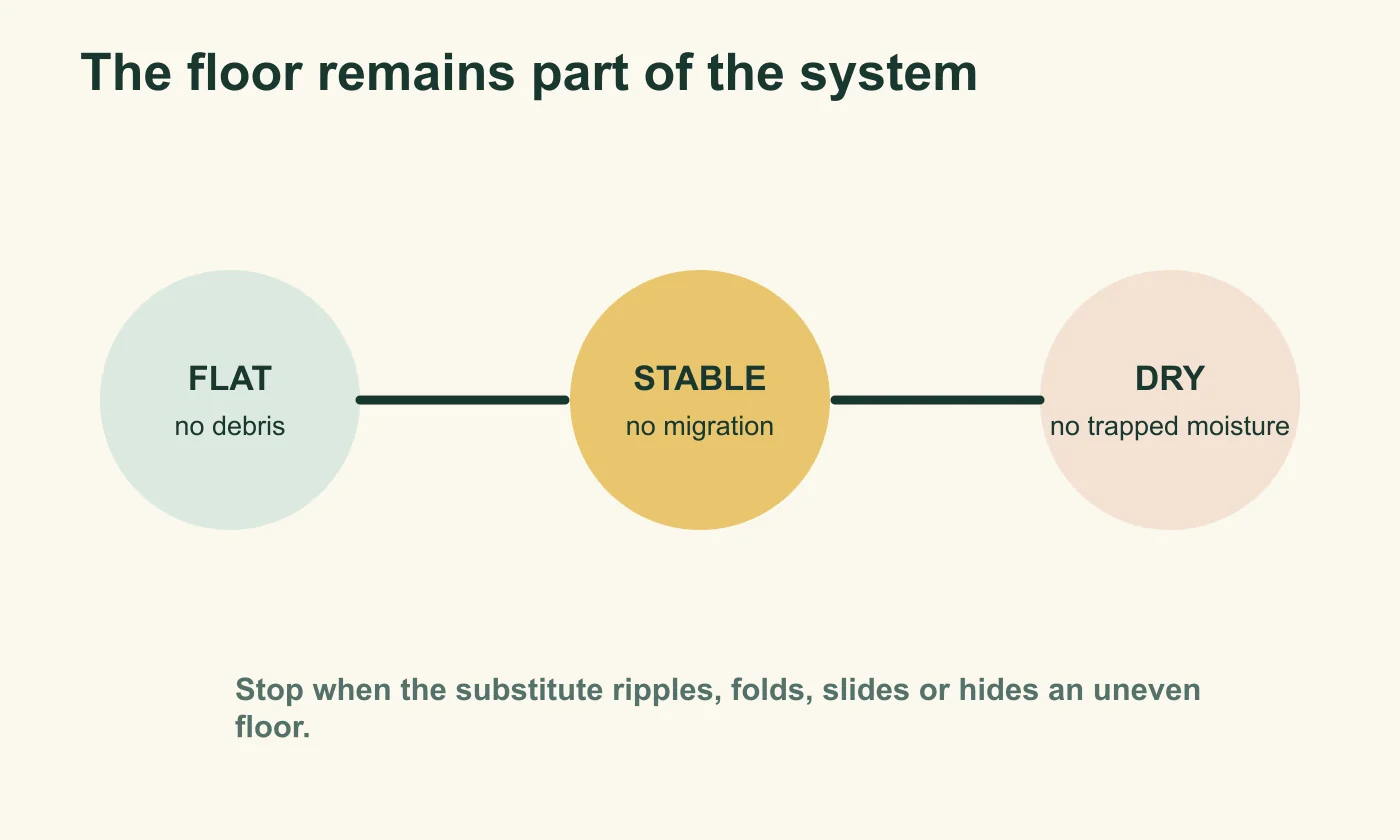
An empty setup check
Before body contact:
- Clear an area larger than the substitute.
- Inspect the floor for residue, moisture, damage and loose debris.
- Place the substitute exactly as its maker directs.
- Smooth it without stretching or pinning the edges.
- Look along every edge for curls, ripples and folds.
- Press and release several empty areas with a hand.
- Confirm the outline does not translate and the surface returns flat.
- Stop if the material bunches, stretches, slides or exposes hazards.
This check cannot certify performance for every movement. It only filters out visibly unsuitable equipment before use.
Temporary versus permanent alternatives
A forgotten mat and a deliberate long-term setup are different buying problems. For one quiet session, a clean appropriate floor may be sufficient. A towel can add a washable contact layer. For recurring use, repeated improvisation deserves a more stable solution.
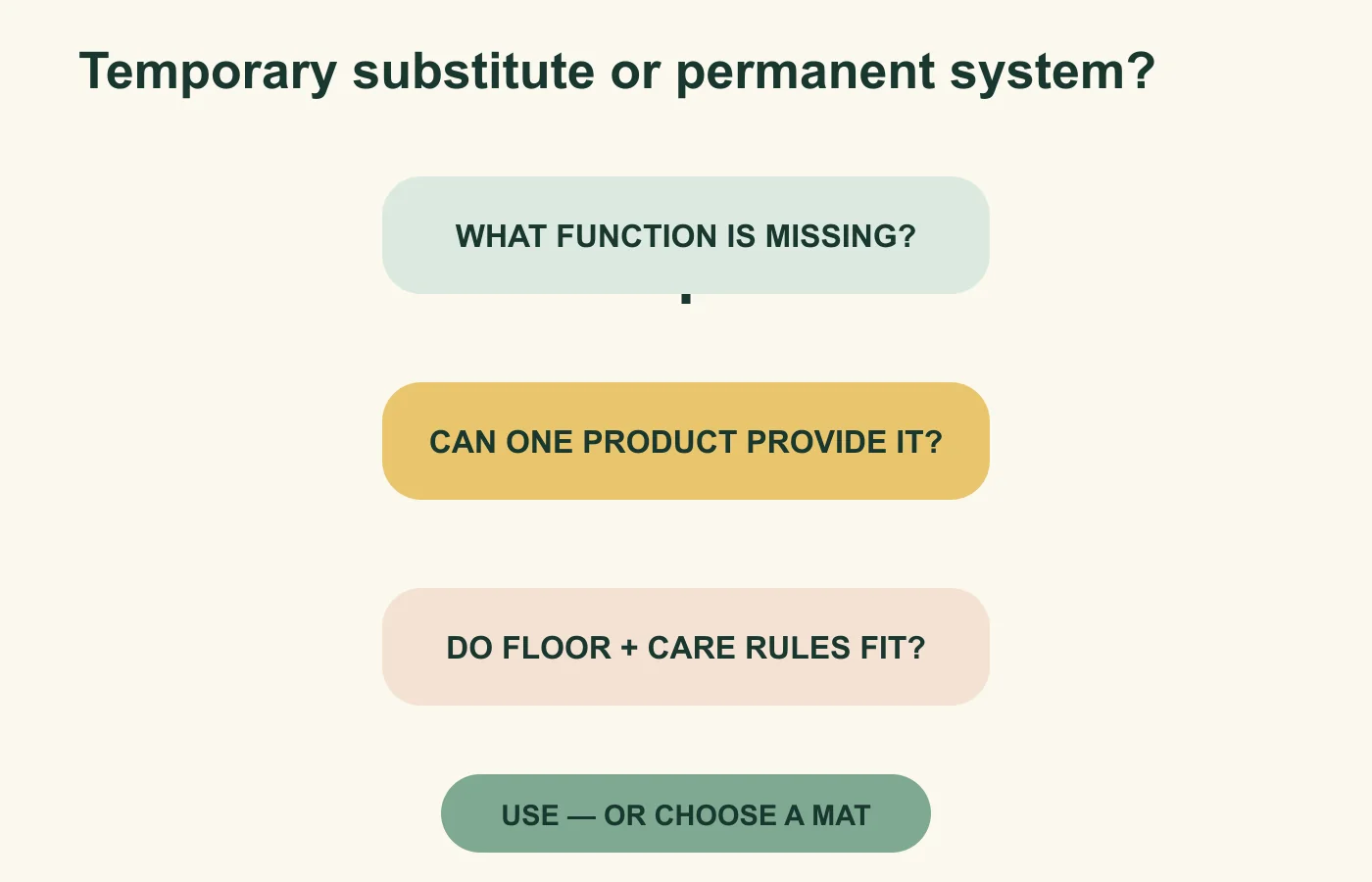
Choose a permanent yoga rug when textile feel and washing are deliberate preferences. Choose a hybrid exercise mat when mixed training matters. Choose a conventional mat when grip, integrated cushion and predictable transport remain the dominant requirements.
Avoid buying multiple accessories to imitate one mat. A towel over a blanket over a decorative rug creates three moving interfaces, complicated care and no verified performance.
Common substitution mistakes
- Assuming every towel is non-slip because it absorbs sweat.
- Using a blanket as a full traction surface because it feels soft.
- Placing loose textiles on polished stairs, transitions or walkways.
- Weighting corners with hard objects.
- Treating thick carpet as a firm base.
- Using interlocking play tiles without checking separation, surface texture and intended contact.
- Practicing over damaged or dirty outdoor ground because grass looks soft.
- Adding adhesive spray or tape to household textiles.
- Calling a decorative rug a yoga rug without manufacturer guidance.
- Assuming natural fiber automatically means non-toxic, biodegradable or low impact.
Selection checklist
- Identify which mat function must be replaced.
- Prefer purpose-built equipment with explicit use instructions.
- Check both body-facing grip and floor-facing stability.
- Compare firmness, not only thickness.
- Confirm dimensions and clear-space requirements.
- Read floor, footwear, outdoor and cleaning rules.
- Inspect the setup empty before every changed location.
- Treat towels and blankets as accessories unless their maker says otherwise.
- Stop using anything that curls, bunches, migrates or remains damp.
- Buy a conventional mat when the alternatives require a complicated stack.
The best alternative to a yoga mat is not the most inventive household object. It is the simplest documented surface system that replaces the grip, stability, support and barrier you actually need.
Frequently asked questions
What can I use instead of a yoga mat?
A purpose-built yoga rug or a firm exercise mat can be a viable substitute when its manufacturer permits the floor and intended use. A clean stable floor may work without a mat when no cushioning or traction layer is needed. Towels and blankets usually replace only absorption or padding, not the mat’s complete function.
Can I do yoga without a mat?
Yes, but the bare floor must be clean, dry, even and appropriate for the intended contact. A mat is not mandatory equipment, yet it provides grip, cushioning, a floor barrier and a defined personal area. This guide evaluates equipment only and does not prescribe mat-free movements.
Can a towel replace a yoga mat?
A regular towel is not a full replacement on most smooth floors because it can wrinkle, slide and provides little structured cushioning. A purpose-built yoga towel is usually designed as a moisture-managing top layer; follow its floor or mat instructions.
Can a blanket replace a yoga mat?
A blanket can provide warmth or localized folded padding, but a loose blanket is generally not engineered as a stable full-length traction surface. Use it as a prop according to its product guidance rather than assuming it replaces a mat.
Is an exercise mat a good alternative to a yoga mat?
It can be when it is firm, lies flat, fits the user and provides suitable top and base grip. Thick soft exercise foam may compress or stretch more than a yoga mat. Compare the exact construction and footwear, floor and cleaning guidance.