

This guide contains affiliate links — recommendations aren’t based on commission. Read our full disclosure.
How this page has changed
August 25, 2026
Sources, internal links and safety or product context reviewed.
July 26, 2026
First published.
In this guide
- 01The picks
- 02Quick answer by carpet type
- 03Why carpet changes mat behavior
- 04Low pile, medium pile and plush carpet
- 05Diagnose the problem before changing equipment
- 06A setup check before use
- 07What makes a mat more carpet-compatible?
- 08Do you need a mat at all on carpet?
- 09Rug pad, underlay or platform?
- 10Common mistakes
- 11Buying checklist for carpet use
You can use a yoga mat on carpet when the mat lies flat and the complete floor system remains stable. Low-pile carpet is usually straightforward. Medium pile can make flexible mats ripple. Plush carpet and soft underlay can let almost any mat sink or shear, so a rigid platform may solve more than another layer of foam.
Do not default to a thicker mat. Carpet already contributes cushioning; combining a soft carpet, compressible underlay and thick foam mat can increase movement. For carpet, prioritize a firm sheet, enough mass to stay flat, a base that does not damage the pile, and dimensions that remain stable under light setup checks.
The results form a distinct carpet-setup and product-selection cluster rather than duplicating general thickness or top-surface grip. This guide is based on documented construction and current specifications; it does not claim that we tested every mat on every carpet. Affiliate links may earn The Yoga Sensei a commission at no extra cost to you.
The picks
For low- and medium-pile carpet, start with the Liforme Classic: it is the only mat here whose manufacturer currently names carpet among the surfaces it can be used on, and its 4.2mm, 5.5-pound sheet is wider than a standard mat. The heavier Manduka PRO is the firmness-first alternative when the mat stays at home. The PROlite keeps the same dense construction in a lighter, narrower format for low pile and smaller rooms.
None of these can turn plush carpet or a soft foam underlay into a rigid floor. If the empty mat waves, sinks or shears, skip the mat upgrade and investigate a purpose-built platform rated for carpet.
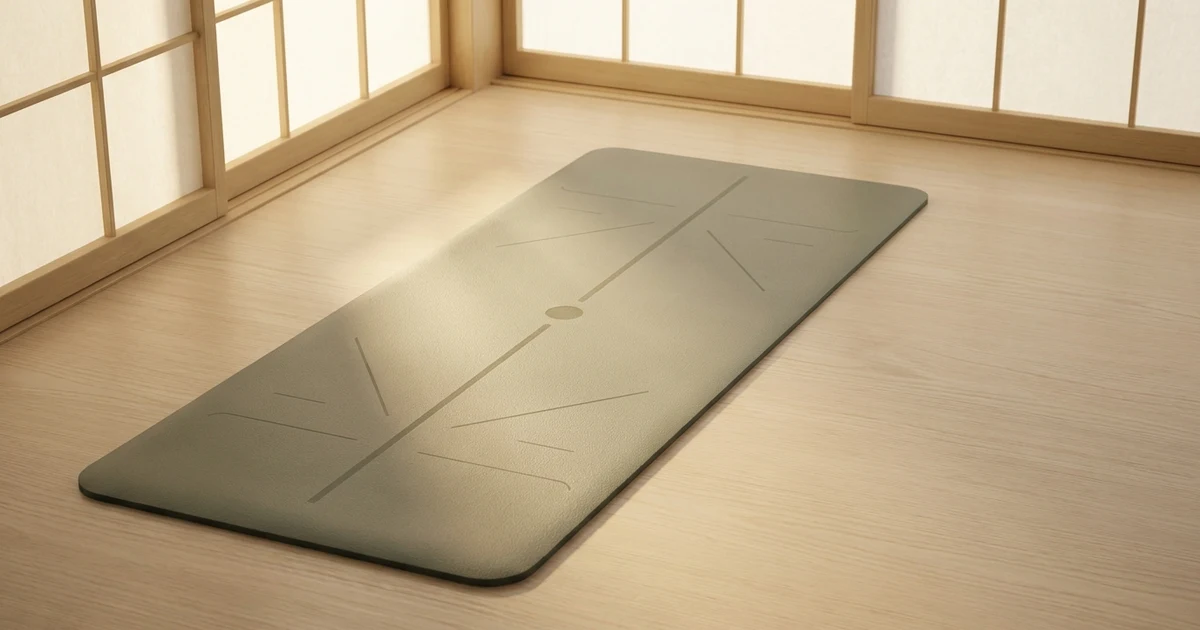
Best overall for low or medium pile
The strongest first choice because Liforme explicitly lists carpet use and the broad, moderately weighted sheet is designed to lie flat.
- Natural-rubber base with polyurethane practice surface
- 185 × 68cm, approximately 4.2mm and 2.5kg
- Wider than the Manduka options
- Trade-off: absorbent top needs careful drying and maintenance
Specifications and carpet-use statement checked against Liforme on August 25, 2026.
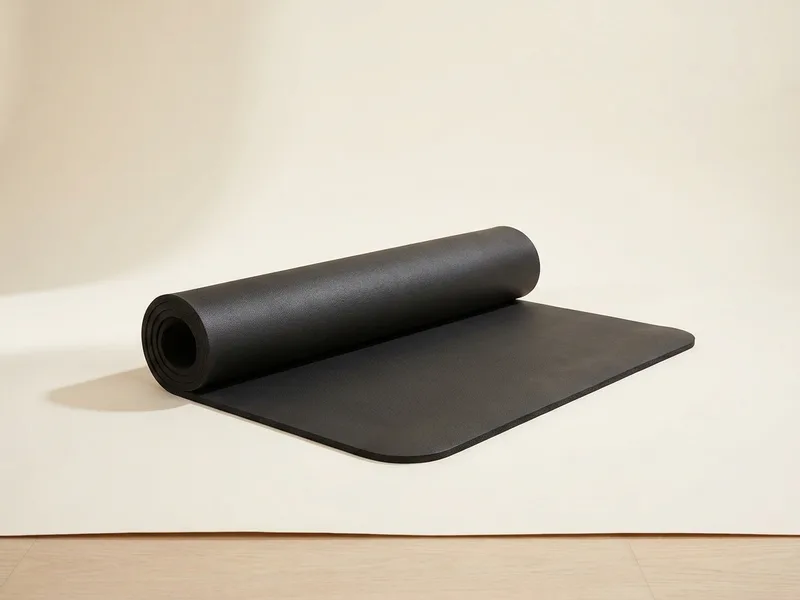
Best firmness-first home mat
A heavy, coherent sheet for low or medium pile when maximum firmness matters more than portability.
- Dense closed-cell PVC with dot-pattern base
- 71 × 26in, 6mm and 7.5lb in the standard size
- Weight helps it settle flat but cannot stiffen plush carpet
- Trade-off: heavy, and the dry-grip surface needs a break-in period
Manduka documents floor-like stability, not a universal carpet guarantee; specifications checked August 25, 2026.
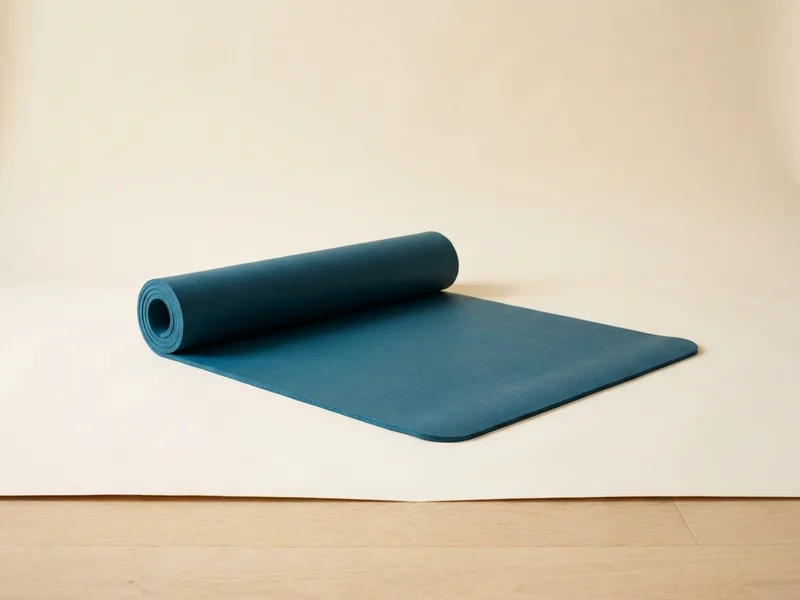
Best lighter option for low pile
The practical small-room choice when a full PRO is unnecessarily heavy and the carpet is already dense and shallow.
- Firm closed-cell PVC rather than soft exercise foam
- 71 × 24in, 4.7mm and 4.6lb in the standard size
- Narrower footprint fits between furniture
- Trade-off: less mass and width; not the pick for plush pile
Manduka specifications and the exact Amazon variant were checked August 25, 2026.
Affiliate links — we may earn a commission. Prices and stock change too often to print here.
The three direct Amazon destinations above were checked for an active main offer on August 25, 2026. Stock changes; if a button stops resolving to the exact named model, use the linked manufacturer specifications instead of substituting a different variant.
Why the Liforme ranks first
Liforme lists the Classic at 185 × 68cm, approximately 4.2mm and 2.5kg, with a natural-rubber base and polyurethane practice surface. More importantly for this page, the current official Liforme specifications explicitly include carpet among its supported home and studio surfaces. That is still not a promise for every pile and underlay, but it is stronger evidence than a generic “non-slip” claim.
The compromise is upkeep: its moisture-responsive top is more absorbent than the Manduka surfaces and should be dried flat after cleaning or a sweaty session. Natural rubber also makes it unsuitable for people avoiding latex contact.
Why the Manduka PRO is the firmness pick
The standard Manduka PRO 6mm is 71 × 26 inches and 7.5 pounds. Manduka describes dense, floor-like support and a dot-pattern bottom; it does not publish a universal carpet rating. The recommendation is therefore limited to low or medium pile where an empty setup check shows the sheet remains flat.
Its weight is useful at home and tiresome everywhere else. The closed-cell top can also feel slick when new or wet, so choose Liforme or the dedicated hot-yoga mat guide when top-surface sweat grip is the actual problem.
Why the PROlite is only for low pile
The Manduka PROlite 4.7mm uses the same firm closed-cell PVC direction but reduces the standard format to 71 × 24 inches and 4.6 pounds. That makes it easier to reposition in a small carpeted room while avoiding the soft foam that tends to amplify carpet movement.
Less mass also means less help settling over uneven pile. It is the conditional low-pile choice, not a bargain substitute for the PRO and not a solution for plush carpet.
Quick answer by carpet type
| Floor underneath | Start with | Watch for | Escalate to |
|---|---|---|---|
| Low-pile commercial carpet | Current 3–5mm mat | Whole-mat translation | Clean base or compatible thin underlay |
| Medium loop or cut pile | Firm 3–5mm construction | Edge ripple and local sinking | Heavier/firmer mat |
| Plush or deep pile | Firm mat for an initial check | Shear, folds, unstable edges | Rigid exercise platform |
| Carpet with thick foam underlay | Firm mat; no extra soft layer | Combined compression | Platform spanning the soft layers |
| Worn, uneven or damaged carpet | Do not assume a mat will level it | High spots, seams, exposed tack | Different clear floor area or repair |
The table is a diagnostic start, not a claim that pile height alone determines safety. Density, backing, underlay and condition all change the result.
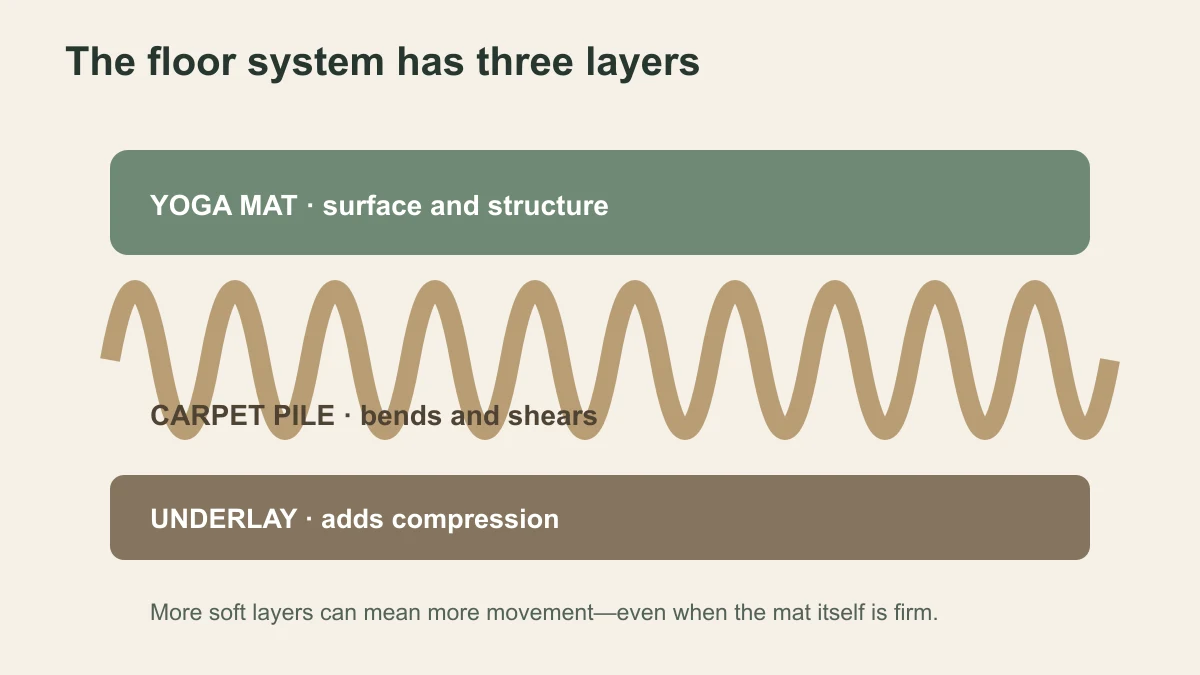
Why carpet changes mat behavior
On hard flooring, the mat base meets a relatively flat, non-compressible plane. On carpet, individual fibers bend, the backing can deform and the underlay may compress. That creates three separate motions:
- compression: the setup sinks vertically;
- shear: carpet fibers bend sideways under the mat;
- local buckling: a flexible mat edge or center forms a ripple.
A highly textured underside can grip hardwood well yet fail to engage carpet evenly. A heavy mat may resist translation but still sink into plush pile. A thick foam mat may feel cushioned while amplifying every soft layer underneath it.
This is why manufacturer phrases such as “non-slip base” do not prove performance on every carpet. They rarely define pile, underlay or a carpet-specific test.
Low pile, medium pile and plush carpet
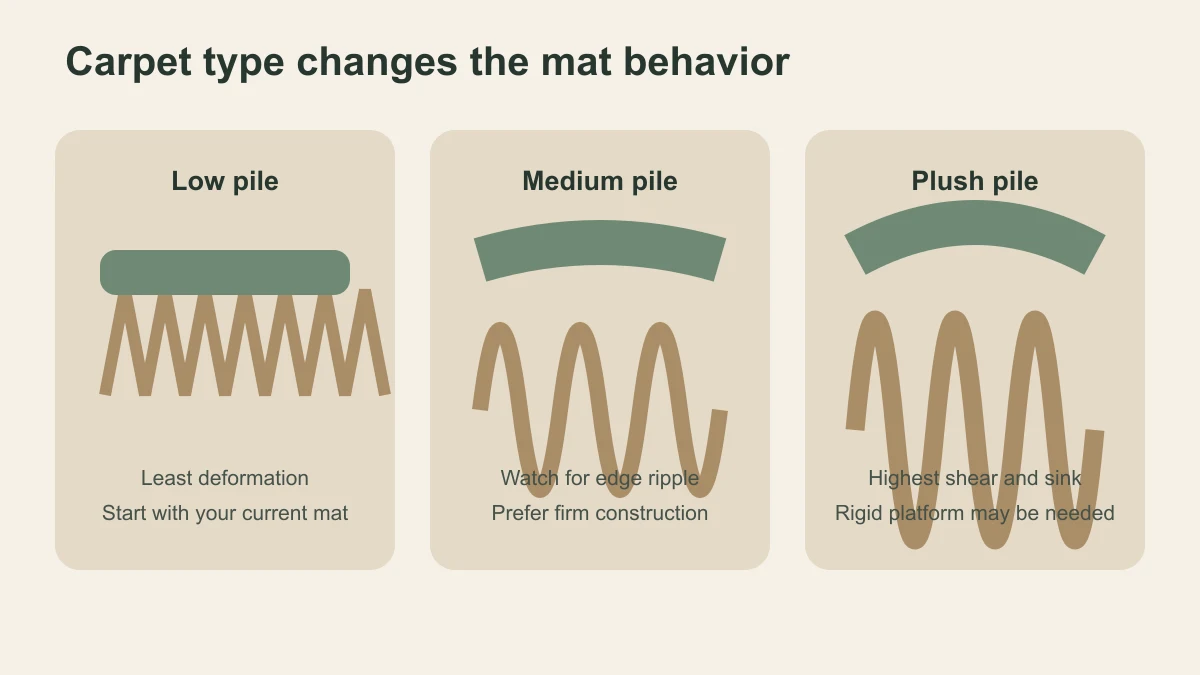
Low-pile carpet
Dense office-style or low-loop carpet is closest to a firm floor. Begin with the mat you already own. Unroll it fully, smooth the edges and inspect whether the sheet lies flat without tension.
Do not buy a “carpet mat” before this check. A standard firm mat may be completely adequate, and adding an underlay can create a new moving interface.
Medium-pile carpet
Medium pile introduces more lateral movement. Very thin travel mats can conform to every change in the fibers and develop wrinkles. Very soft thick mats can compound compression. A firm construction in the normal 3–5mm range is a more rational starting direction than maximum thickness.
Weight can help a mat settle, but it is not a guarantee. Our yoga mat weight guide separates mass from thickness and density.
Plush or deep-pile carpet
Deep pile can move even when the mat base does not slip against individual fibers. A rubber-bottomed mat may appear to grip while the entire carpet surface shears underneath it.
If the empty mat visibly waves, sinks deeply around light hand pressure or cannot hold straight edges, changing surface texture will not correct the soft foundation. A purpose-built rigid exercise platform placed according to its instructions can span the pile more effectively. Do not improvise with unfinished plywood, sharp-edged panels or anything that can damage carpet, shift, splinter or create a trip edge.
Diagnose the problem before changing equipment
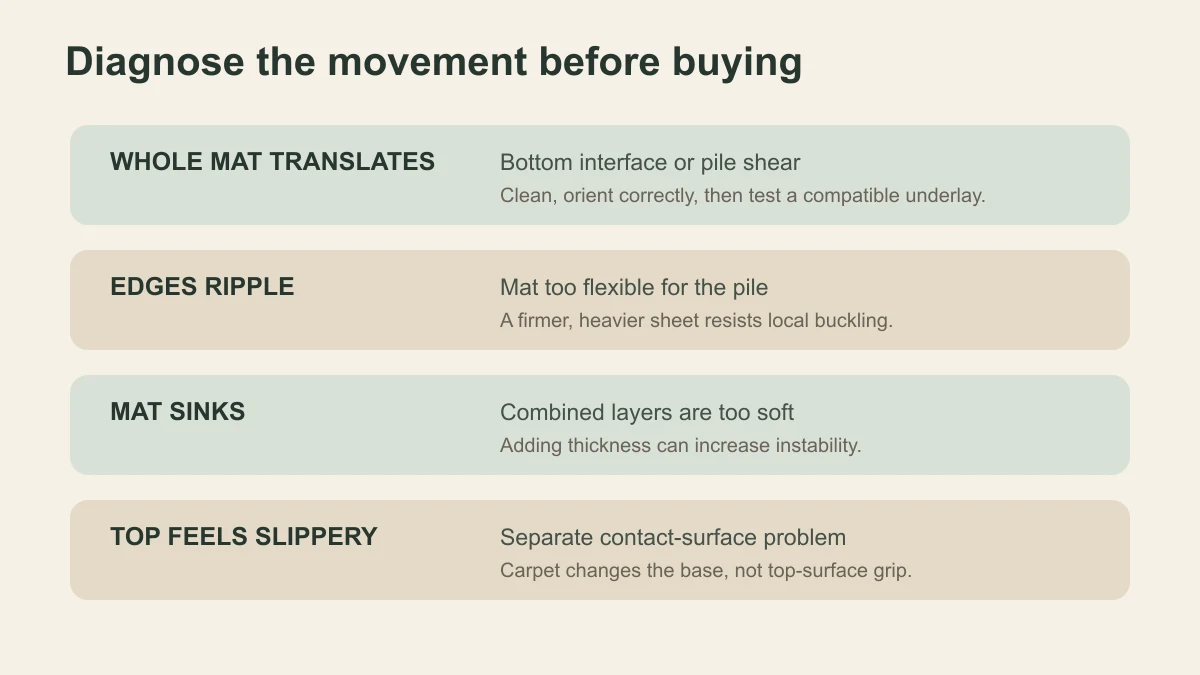
The whole mat moves across the room
Mark the initial edge position with a removable object placed beside—not under—the mat. Press and release the empty sheet at several points while staying off it. If its entire outline translates, inspect the mat base, carpet cleanliness and pile shear.
Vacuum loose dust and fibers, then clean the mat underside only according to its material instructions. Also confirm the correct side faces down using the mat orientation guide. Do not add adhesives, hook tape or spray coatings without approval from both mat and carpet manufacturers.
The edges ripple or corners lift
Rippling indicates that the mat is flexing locally rather than acting as one stable plane. Rolling direction, storage deformation and a thin flexible construction can contribute. Let the mat lie flat according to its care guide. If the carpet repeatedly pushes waves into it, a firmer sheet is more relevant than a stickier underside.
The center sinks while the edges stay put
This is combined compression. Extra mat thickness may add more deformation rather than correcting it. Compare firmness and support structure, not only millimeters. The yoga mat thickness guide explains why a thicker mat is not automatically more stable.
Contact slips on top, but the mat base stays still
That is a different interface. Carpet is not causing the user-facing surface to become mechanically grippy or slick; moisture, residue and top material are more relevant. Use the non-slip yoga mat guide rather than changing the carpet setup.
A setup check before use
This is an equipment inspection, not a balance or pose test.
- Clear and vacuum an area larger than the mat.
- Check for seams, damaged pile, exposed fasteners, dampness and uneven objects.
- Unroll the dry mat in its manufacturer-approved orientation.
- Let curled edges relax without heat or sharp reverse folding.
- Look along all four edges for waves, folds or deep local sink.
- Press and release the empty mat at several points with a hand.
- Confirm the sheet returns flat and its outline has not translated.
- Stop if movement, buckling or an uneven foundation remains.
Do not validate the setup by jumping, running, balancing or deliberately trying to make it skid. An aggressive test introduces forces unrelated to ordinary setup inspection and can move carpet that was never intended as a sports floor.
What makes a mat more carpet-compatible?
Firmness rather than plushness
A construction that behaves like a coherent sheet bridges small variations better than soft foam. “High density” is not standardized, however. Look for explicit material, thickness, mass and construction rather than relying on that adjective alone; our high-density mat guide explains the evidence gap.
Enough mass to lie flat
Mass can reduce curling and help a sheet settle, but carrying weight is the trade-off. Compare finished product weight from the exact size. A heavier mat cannot make plush carpet rigid.
A stable, non-damaging base
Dots, tread and rubber can perform differently against looped, cut or plush pile. Avoid a backing with hooks, adhesive or staining potential unless both surface makers approve it. Natural rubber can also have material-specific care and discoloration considerations.
Moderate thickness
Carpet already provides distance from the subfloor. A normal firm 3–5mm mat is a sensible starting band on low or medium pile; it is not a universal prescription. A 1.5mm travel sheet may wrinkle, while an 8–10mm soft mat can create excessive combined compression.
Full-size footprint
A standard footprint helps the sheet distribute load across more carpet. Do not shrink length or width merely because the room is carpeted. Use the yoga mat size guide to fit the person and space separately.
Do you need a mat at all on carpet?
Carpet provides a boundary and some cushioning, but it is not necessarily a substitute for a mat. It can retain dust, cleaning residue and moisture; pile direction can change traction; seams and wear can create uneven areas. A personal mat also creates a removable, cleanable contact surface.
Using carpet alone may be adequate for quiet floor-based activity when the surface is clean, firm and undamaged, but that is a personal equipment decision. Stop if skin drags against pile, the carpet shifts, or the foundation feels inconsistent. This page does not prescribe movements on carpet.
Rug pad, underlay or platform?
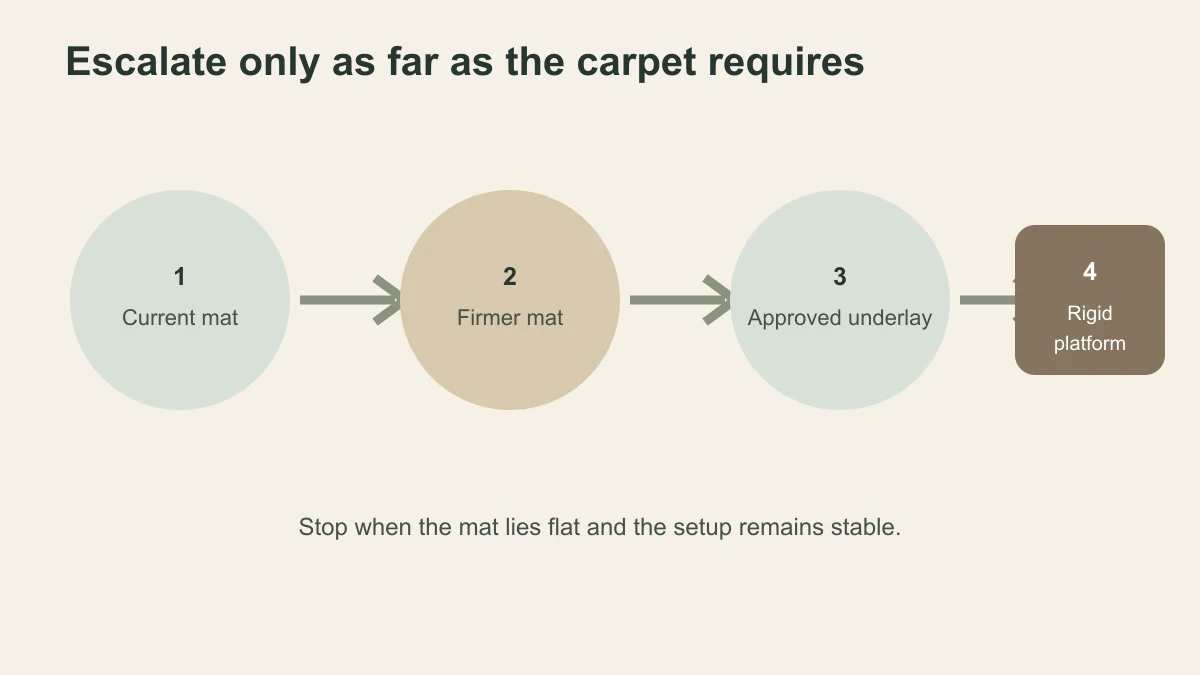
Thin non-slip underlay
A rug pad may reduce translation on some low- or medium-pile carpets, but compatibility matters. Some pads are designed for hard floors, some for carpet-on-carpet, and some rubber or PVC formulations can mark finishes or interact with a mat. Use only a product whose maker approves both surfaces and dimensions.
Cutting a pad smaller than the mat avoids an exposed trip edge, but modification can void instructions or expose a material edge. Follow the pad documentation rather than a universal DIY recipe.
Rigid exercise platform
On plush pile, stiffness may matter more than friction. A commercial platform distributes forces across a wider area and creates a flatter plane. It must itself be rated for carpet, large enough for the full mat, stable at every edge and free of a height transition that people can catch a foot on.
A loose household board is not automatically a platform. Unfinished edges, flex, small dimensions and carpet damage make improvised panels a poor default recommendation.
Another yoga mat underneath
Doubling mats adds thickness and another sliding interface. It can reduce local carpet texture reaching the top mat, but it may also increase squish and shear. Treat it as a temporary comparison, not a guaranteed fix, and stop if the stack moves independently.
Common mistakes
- Buying the thickest mat because carpet feels soft.
- Confusing top-surface grip with base stability.
- Adding adhesive or hook tape that can damage carpet or the mat.
- Assuming every rubber base works on every fiber.
- Testing movement with jumps or balance work.
- Ignoring underlay beneath an apparently short pile.
- Covering carpet seams, tack strips, moisture or damage with a mat.
- Leaving a rubber-backed mat indefinitely on carpet without checking manufacturer guidance.
- Using an undersized rigid board with exposed or raised edges.
Buying checklist for carpet use
- Identify low, medium or plush pile and whether a soft underlay exists.
- Test the current mat empty before buying anything.
- Prefer firm, dimensionally stable construction over extra-soft thickness.
- Record exact thickness, weight, dimensions and base material.
- Check whether the manufacturer mentions carpet compatibility.
- Avoid unapproved adhesives and hook-and-loop attachments.
- Verify return terms because carpet behavior is home-specific.
- Recheck the full setup whenever the mat, carpet or underlay changes.
The best yoga mat for carpet is not a universal product name. It is the least complicated combination that lies flat, resists translation and does not add unnecessary softness to the carpet system you actually have.
Frequently asked questions
Can you use a yoga mat on carpet?
Yes, if the mat lies flat and the combined carpet, underlay and mat do not move excessively. Low-pile carpet is usually easier than plush pile. Test the empty setup first and stop if the mat ripples, telescopes or shifts.
What is the best yoga mat for carpet?
There is no universal best model because carpet pile and underlay vary. Start with a firm, dimensionally stable mat that lies flat; avoid assuming extra thickness will help. On plush carpet, a compatible rigid platform may matter more than changing mats.
Should a yoga mat be thicker on carpet?
Usually not. Carpet already adds cushioning, and another thick soft layer can increase sinking and wobble. Firmness, weight, construction and resistance to rippling matter more than maximum millimeters.
How do you stop a yoga mat moving on carpet?
First identify whether the whole mat translates, the edges ripple or the layers sink. Clean the carpet and mat base, confirm the correct side faces down, and test a firmer mat. Use an underlay only when its maker approves it for both surfaces.
Can you do yoga directly on carpet without a mat?
Carpet can provide cushioning, but it is not engineered as a clean, consistent practice surface and its pile can move or abrade skin. Whether it is suitable depends on its condition, firmness and cleanliness; stop if the surface shifts or feels unstable.