

How this page has changed
July 26, 2026
Sources, internal links and safety or product context reviewed.
In this guide
If a full-length towel is bundled with the mat, compare both rectangles in the yoga mat and towel set guide. It covers corner-pocket fit, component care, packed volume and bundle value without duplicating the mat-size analysis here.
The standard yoga mat size is best understood as a range: roughly 68–72 inches long and 24 inches wide (173–183 × 61cm). Six current products in this guide span 178–185cm in standard length and 61–68cm in width. There is no governing standard that makes one of those dimensions universally correct.
Length and width define usable floor area. Thickness defines depth and belongs to a separate buying decision. A 5mm mat can be short or long; a 10mm mat can still be narrow. Treat listings that show only “standard size” as incomplete until exact measurements appear.
If you are comparing the larger end of the range for a taller or broader body, the best yoga mats for men page applies these measurements to four current products. Its criteria are height, shoulder width, grip and carry weight—not gendered colors or marketing.
Yoga mat size chart
| Format | Approximate dimensions | Square area | Practical direction |
|---|---|---|---|
| Compact standard | 68 × 24in / 173 × 61cm | 11.3 sq ft / 1.06m² | Shorter users, small storage, lighter carry |
| Modern standard | 71–72 × 24in / 180–183 × 61cm | 11.8–12 sq ft / 1.10–1.12m² | Broadest product choice and studio compatibility |
| Roomier standard | 71–73 × 26–27in / 180–185 × 66–68cm | 12.8–13.7 sq ft / 1.19–1.27m² | More side room without becoming a floor mat |
| Extra-long | 79–85 × 24–27in / 201–216 × 61–68cm | Product-dependent | Taller users and larger home spaces |
| Extra-wide / exercise | 72–84 × 30–36in / 183–213 × 76–91cm | 15–21 sq ft / 1.39–1.95m² | Home fitness and expansive movement; less studio-friendly |
| Travel | Often 68–71 × 24–26in / 173–180 × 61–66cm | Similar footprint, less depth | Folding or packing; size savings mainly come from thickness |
These are market categories, not certifications. “XL,” “long,” “wide” and “travel” have no fixed industry definition. Always compare numbers.
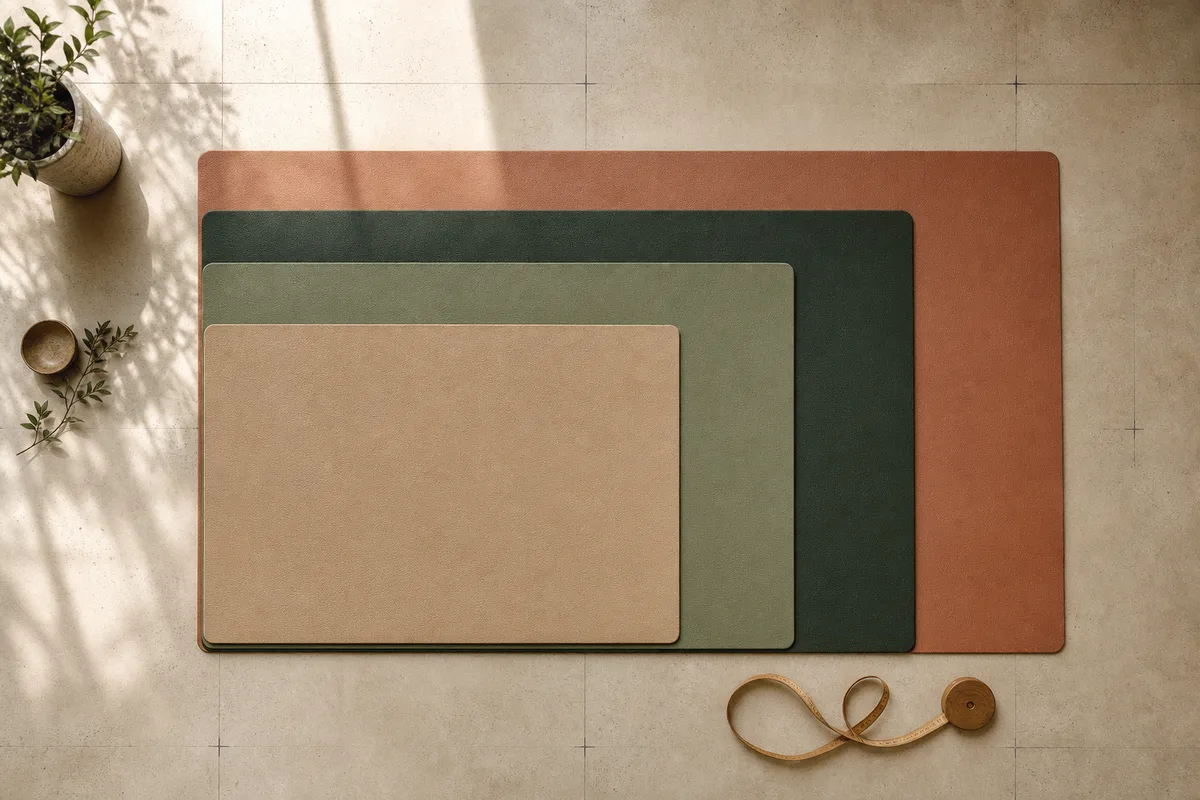
Six current sizes compared
| Current product | Length × width | Inches | Area | Weight |
|---|---|---|---|---|
| Yoga Design Lab Combo Geo | 178 × 61cm | 70 × 24in | 1.09m² | Variant listing is ambiguous; confirm selection |
| Manduka X 5mm | 180 × 61cm | 71 × 24in | 1.10m² | 1.54kg |
| Rogue NBR 10mm | 184 × 62.9cm | 72.5 × 24.75in | 1.16m² | 1.81kg |
| Liforme Classic | 185 × 68cm | 72.8 × 26.8in | 1.26m² | About 2.5kg |
| Manduka GRP Adapt standard | 180 × 66cm | 71 × 26in | 1.19m² | 2.6kg |
| Liforme Classic Travel | 180 × 66cm | 70.9 × 26in | 1.19m² | About 1.6kg |
Two mats can share the same footprint and travel very differently. The regular GRP Adapt and Liforme Travel are both about 180 × 66cm, yet their published weights are 2.6kg and 1.6kg because thickness and construction differ. “Travel size” often means thinner or foldable—not necessarily shorter or narrower.
What size mat do you need?
Use three separate constraints: body fit, available floor, and carry system.
1. Start with usable length
Measure your standing height, then compare mats with enough additional length for the end margin you prefer. A starting buffer of 2–6 inches (5–15cm) makes the shortlist practical, but it is not an anatomical prescription. Some users do not mind heels extending beyond the mat; others want their entire body and extra transition room on one surface.
| Your height | Length worth comparing | Why |
|---|---|---|
| Under 5ft 6in / 168cm | 68–72in / 173–183cm | Compact and modern-standard options provide some margin |
| 5ft 6in–5ft 10in / 168–178cm | 71–73in / 180–185cm | Common current products cover height plus limited buffer |
| 5ft 10in–6ft 2in / 178–188cm | 73–79in / 185–201cm | Standard mats may leave little or no end margin |
| Over 6ft 2in / 188cm | 79–85in / 201–216cm | Extra-long models become more relevant |
This table is a shopping range, not proof of fit. Check whether the brand measures the flat usable surface or includes rounded/tapered edges.
2. Measure comfortable width
The 24-inch/61cm width is efficient for crowded classes and standard carriers. It is not a universal body-width rule. Liforme’s 68cm and Manduka GRP’s 66cm formats provide 5–7cm more side room than a 61cm mat.
A useful at-home check is to mark candidate widths on the floor with removable painter’s tape, then place hands and feet in the positions you normally use—without attempting a new or difficult posture. Notice whether your ordinary spacing repeatedly crosses the boundary. This tests equipment territory, not yoga technique.
3. Measure the room and storage path
Product footprint is only part of space planning. Add clearance so doors, furniture and another person’s mat do not overlap.
| Space question | Measurement to take |
|---|---|
| Practice floor | Mat length and width plus the clearance you want on all sides |
| Studio row | Mat width plus instructor/studio spacing rules |
| Storage shelf | Rolled length usually follows mat width |
| Door/cabinet | Roll diameter depends on thickness and how tightly it may roll |
| Bag | Internal length, diameter and closure—not generic “fits most mats” |
| Car/bike carry | Rolled length and total weight |
An extra-wide mat can be comfortable at home and awkward in a busy studio. Check the studio’s policy before bringing a 30–36-inch mat.
Standard 24-inch versus 26–27-inch width
| Factor | 24in / 61cm | 26–27in / 66–68cm |
|---|---|---|
| Product availability | Widest selection | Common in premium lines, fewer budget choices |
| Studio fit | More space-efficient | Uses 8–11% more row width |
| Side margin | Compact | 2.5–3.5cm extra per side if centered |
| Rolled length | About 61cm | About 66–68cm |
| Bag compatibility | Most standard carriers | Verify internal bag length |
| Material/weight effect | Width alone adds some area | Same construction will generally weigh more |
The percentage difference is easy to underestimate. A 185 × 68cm Liforme footprint is about 15% larger than a 180 × 61cm Manduka X. That extra territory may be worthwhile, but it affects floor plans, carry and material use.
Long mats: when extra length helps
Extra-long mats are not only for height. They can provide more transition margin or let a home-practice user stay on one surface. The trade-offs are predictable:
- more material, usually more weight;
- a larger home storage footprint;
- higher likelihood of extending into studio walkways;
- fewer compatible bags;
- potentially more cleaning and drying area.
Manduka’s GRP Adapt page, for example, lists a standard 71 × 26in option and a long 79 × 26in option. The long version increases published weight from 5.8 to 6.5lb. Compare exact variants rather than assuming “long” only changes length.
Travel mat size is mostly a thickness story
A travel mat still needs enough surface area to use. Liforme’s current travel mat is 180 × 66cm—essentially a full practice footprint—but only about 2mm thick and 1.6kg. A folding travel design can fit luggage differently from a conventional roll without shrinking length or width.
Ask:
- Is it designed to fold, or only roll?
- Can it be used alone, or intended over a studio mat?
- What are packed dimensions and weight?
- Do creases flatten within the care instructions?
- Does the destination provide a base mat?
Our foldable yoga mat guide addresses packing construction; this page focuses on the surface footprint.
Size is not thickness
Length and width answer “do I fit on it?” Thickness and density answer “how does it respond under load?” Combining them into one “bigger is better” decision creates poor comparisons.
| Dimension | Primary effect | Common mistake |
|---|---|---|
| Length | End-to-end usable territory | Buying by height without any preferred margin |
| Width | Side-to-side territory and studio row space | Assuming broad shoulders require a fixed branded width |
| Thickness | Distance from floor | Treating more millimeters as automatic stability or comfort |
| Density | Compression and mass | Ignoring it because the listing says “high density” |
| Weight | Carry burden | Predicting it from size alone |
For cushioning, use the separate yoga mat thickness chart.
Convert inches and centimeters accurately
One inch equals exactly 2.54cm. Retailers round aggressively, so small discrepancies do not always indicate a different SKU.
| Inches | Exact centimeters | Common retail rounding |
|---|---|---|
| 24in | 60.96cm | 61cm |
| 26in | 66.04cm | 66cm |
| 27in | 68.58cm | 68 or 69cm |
| 68in | 172.72cm | 173cm |
| 71in | 180.34cm | 180cm |
| 72in | 182.88cm | 183cm |
| 79in | 200.66cm | 201cm |
| 85in | 215.90cm | 216cm |
Allow for manufacturing tolerances too. If a bag fit is tight, get the physical rolled measurement rather than relying on a rounded product page.
Buying checklist
- Record your height and preferred end margin.
- Tape the candidate length and width on your floor.
- Confirm exact flat dimensions for the selected SKU.
- Separate footprint from thickness and density.
- Calculate whether the mat fits the room with clearance.
- Check studio rules for extra-wide or extra-long mats.
- Verify rolled length, diameter and weight against your bag.
- Treat “standard,” “XL” and “travel” as labels until numbers confirm them.
- Check return terms in case the usable area feels different from the listing.
For most buyers, 71–72 × 24in (180–183 × 61cm) is the most flexible modern starting range. Choose 26–27 inches wide when side room matters and the carry/studio trade-off works; choose extra-long by measured height margin and available floor, not by the letters XL.
Frequently asked questions
What is the standard yoga mat size?
A standard yoga mat is commonly about 68–72 inches long and 24 inches wide, or roughly 173–183 × 61cm. Current premium examples also use 26–27-inch widths and slightly longer lengths, so “standard” is a range rather than one enforced specification.
How long should a yoga mat be for my height?
A practical starting point is your standing height plus enough margin for your head and heels to remain on the surface when lying lengthwise. Five to fifteen centimeters, or about two to six inches, is a useful comparison buffer, but test your preferred spacing and movement rather than treating it as a fit rule.
Is a 68-inch yoga mat long enough?
A 68-inch or 173cm mat can fit shorter users and is compact to carry. Anyone close to or taller than that length will have little or no end margin when lying down. A 71–73-inch mat is now common and may be a more flexible baseline.
Do I need a wide yoga mat?
A 24-inch or 61cm width is the common compact format. A 26–27-inch or 66–68cm mat gives more room for wider hand placement and side-to-side movement but occupies more studio floor and may require a larger bag. Measure your comfortable hand spacing and available floor area.
Does yoga mat size include thickness?
Retailers sometimes bundle length, width and thickness under “size,” but they solve different decisions. Length and width define usable area; thickness and density affect cushioning and stability. Compare all three measurements separately.