

This guide contains affiliate links — recommendations aren’t based on commission. Read our full disclosure.
How this page has changed
August 30, 2026
Sources, internal links and safety or product context reviewed.
July 25, 2026
First published.
In this guide
Search "foldable yoga mat" and you will be shown thick mats that collapse into a block. Search "travel yoga mat" and you will be shown thin mats that pack into a suitcase. They are different products solving different problems, and almost every buying guide on the subject treats them as one category and ranks them in a single list.
Quick answer. If your problem is a suitcase, buy a thin mat — and know that a mat which rolls small plus a strap does the same job, so folding is a convenience rather than a feature. If your problem is that a rolled mat will not fit anywhere in your flat, buy a thick fold-flat mat, because that is the one thing rolling cannot do. If you sweat heavily or have sensitive knees, buy neither.
By Marvin Smit · Long-time practitioner, not a certified instructor.
I have not practised on these mats. This page is built from manufacturer documentation, named long-term reviewers, and a straightforward audit of what the product listings actually say — which turns out to be the most useful thing here, because the listings and the manufacturers frequently disagree.
First: which problem are you solving?
Two classes, and the search results blur them.
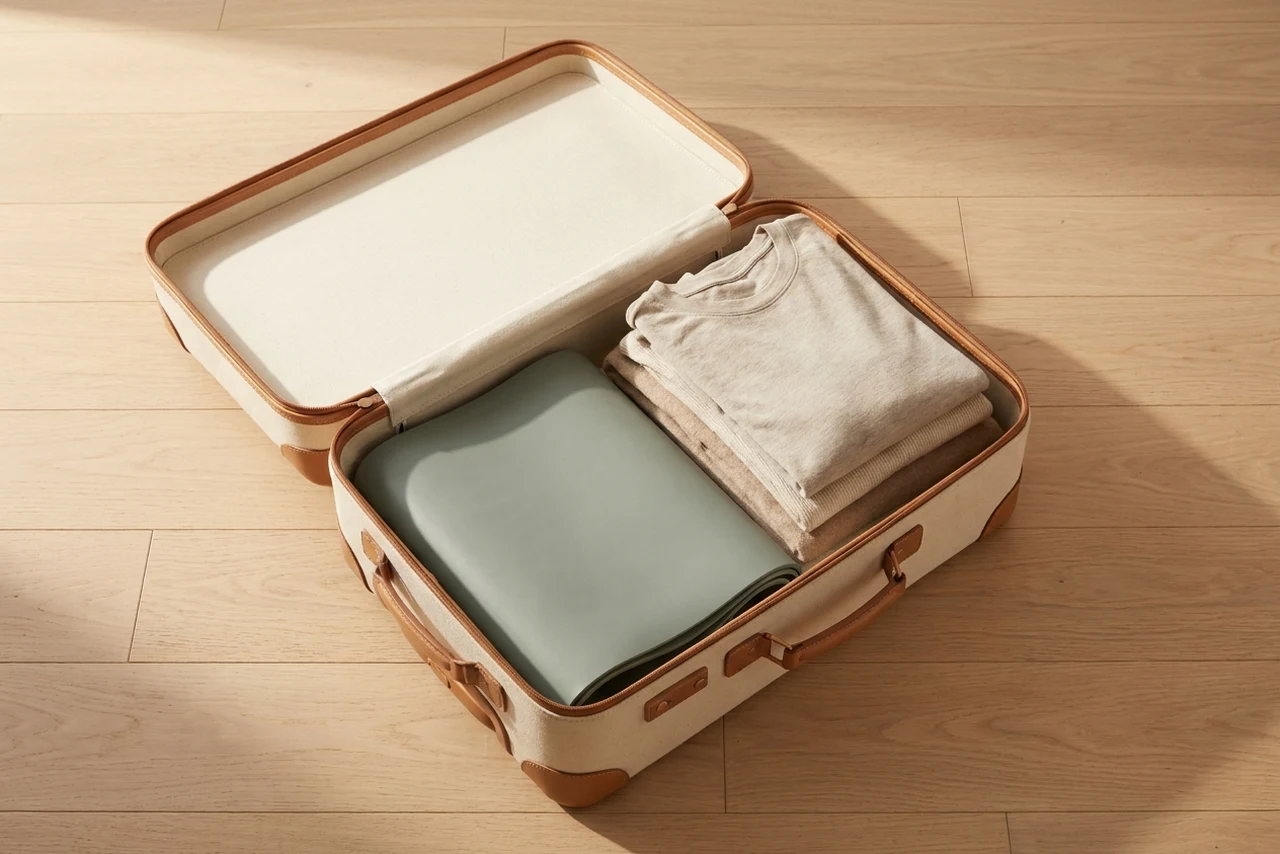
The packing class — 1.5mm to 3mm. Thin rubber or PVC mats that fold or roll into hand luggage. Jade's Voyager folds down to roughly the size of a yoga block. These are transit tools.
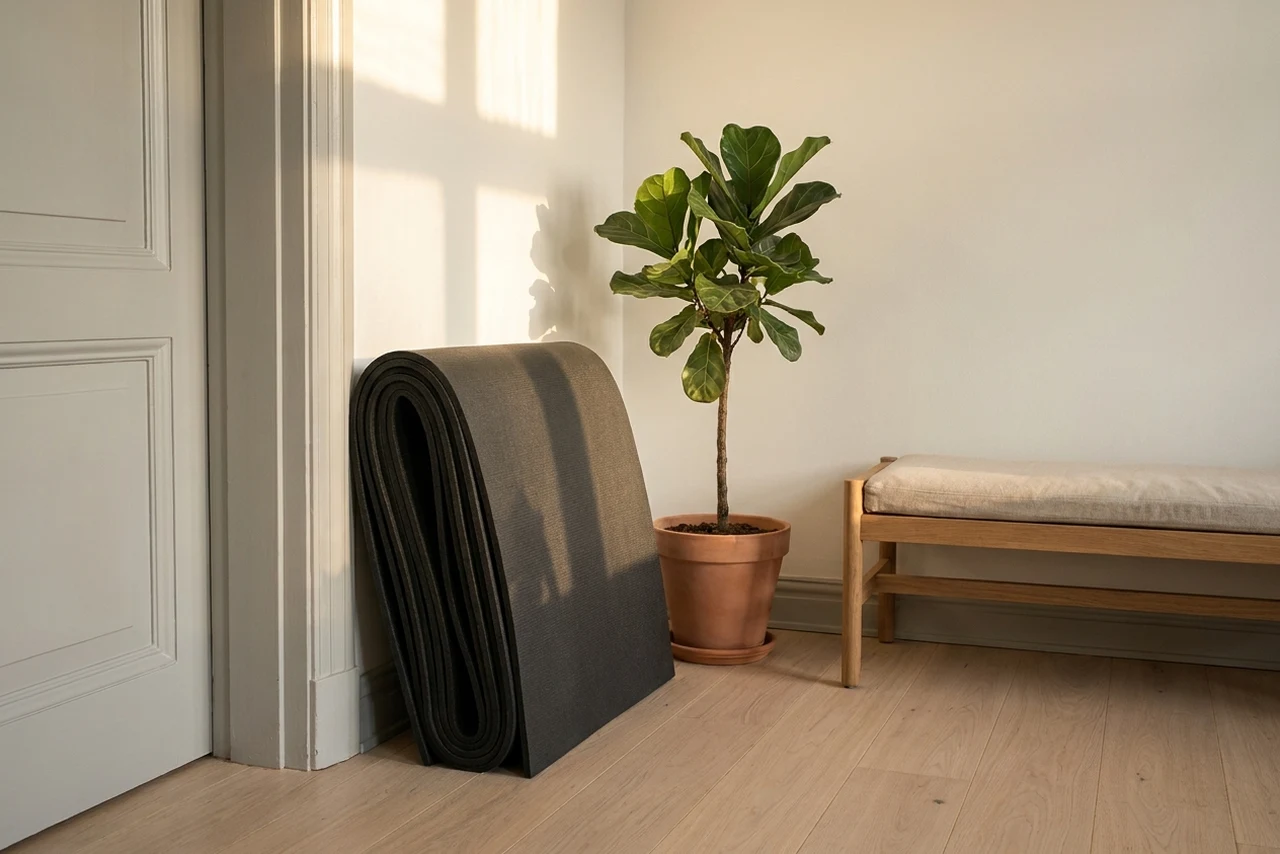
The storage class — 6mm to 12mm. Mats with engineered fold lines that collapse into a flat block. The Stakt opens to 69 by 24 inches and folds to 24 by 3 by 12 — a shape that stands behind a door or slides under a sofa. No rolled mat does that, because a rolled 12mm mat is a fat cylinder that has to lean somewhere.
The tell is in the search data. Interest in foldable mats climbs through November to January — the small-flat, new-year, home-practice window. Travel mats peak in November, when people are booking trips. Different problems, different months.
This matters because the classes are not interchangeable. A named reviewer at NBC Select who has used a thick fold-flat mat since 2023 describes exactly the storage-class use case: sliding it under the bed or standing it in a corner when she is not practising. Nobody buys a 12mm mat for a suitcase, and nobody solves a small-flat problem with a 1.5mm sheet.
Does folding ruin a mat?
This is the question everyone actually has, and the industry's answer is quietly incoherent.
Manduka sells the eKO SuperLite with "Foldable & Travel Friendly" in the product title. On the same listing, its own product description tells you to store the mat rolled.
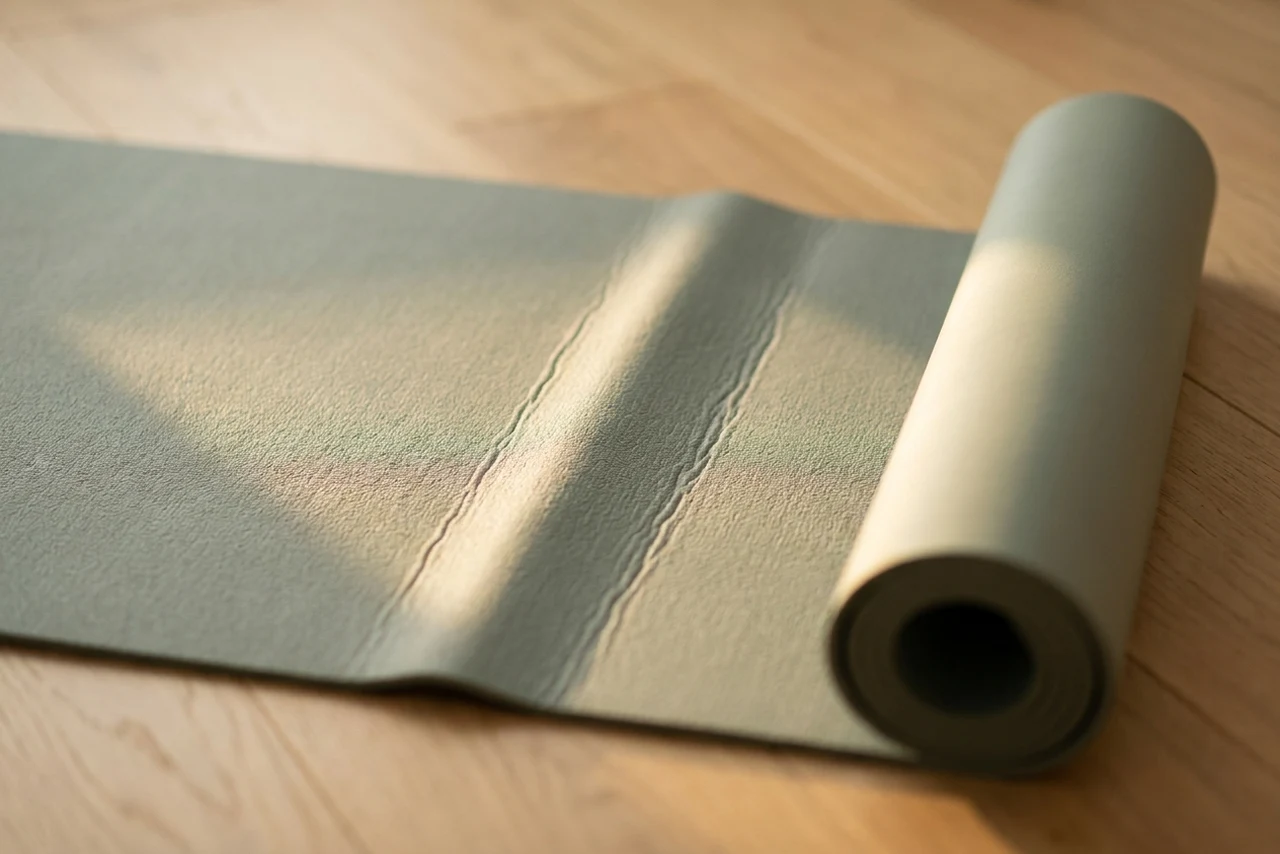
JadeYoga is the only major brand that says the quiet part out loud. On its own Voyager page it states that creases are a natural consequence of folding, exactly as you would expect creases in clothes you packed, and that the way to minimise them is to keep the mat rolled when you are not using it.
A yoga therapeutic specialist quoted in the one editorial page currently ranking for this term puts it plainly: repeated folding along the same creases reduces a mat's durability over time, and it is always better to roll.
So here is the honest synthesis, assembled from those sources rather than from any test I ran:
- Folding concentrates stress on a narrow line. Rolling spreads the same bend across a broad curve. That is the whole mechanism.
- Moisture makes it stick. A mat folded while damp and left folded is the one that keeps its lines.
- Shallow lines in thin rubber often relax. Left flat and dry, they tend to settle.
- A crease is permanent once it ridges and cracks. At that point the material has failed, not just deformed.
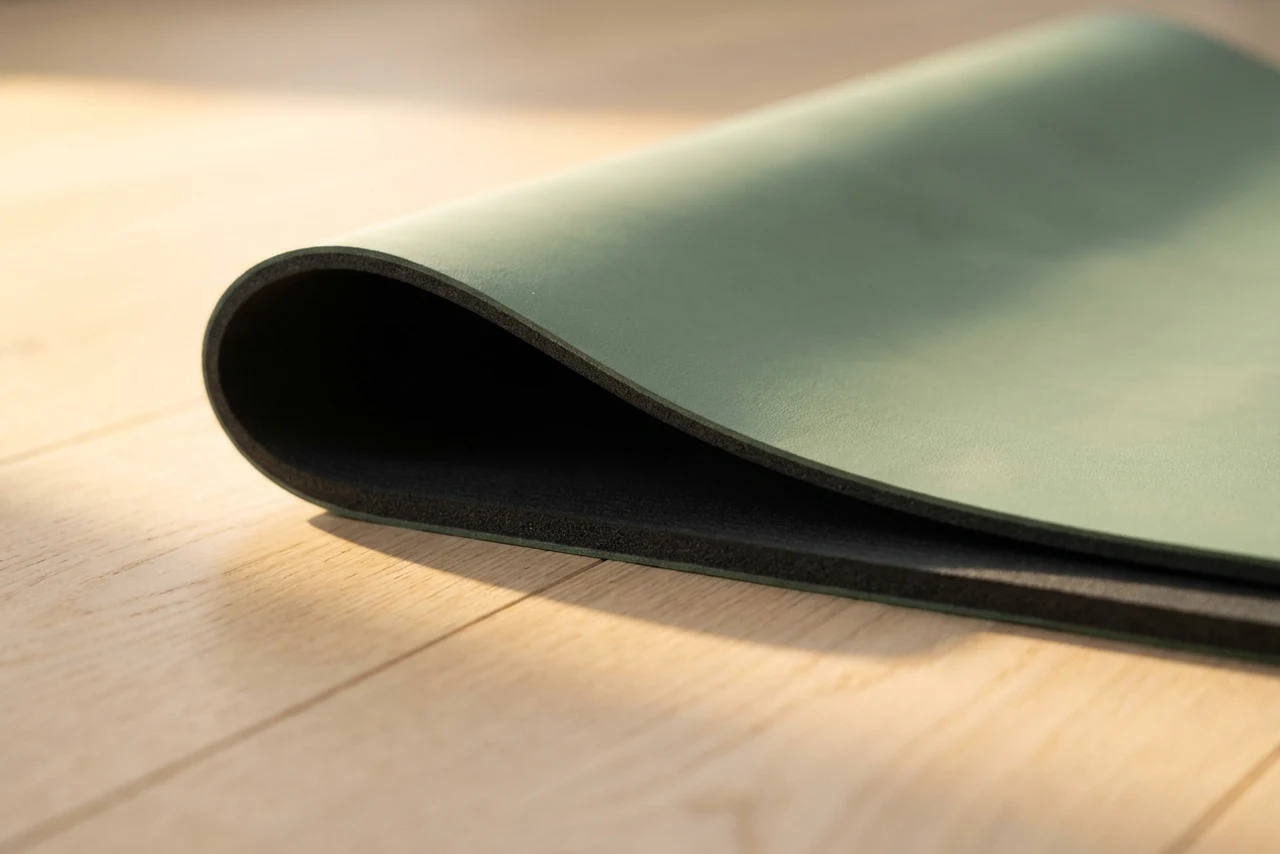
- Engineered fold lines are a different thing entirely. Mats built to fold have reinforced internal scrim along designed lines. Gaiam's budget foldable is described by Gaiam as "scored" — the lines are permanent by design, not damage.
Nobody has run a controlled comparison of PVC against TPE against natural rubber for crease permanence. I looked. If a page tells you material X never creases, it is describing one person's suitcase.
The practical rule, and it is what a travelling teacher actually does: fold it for the journey, roll it at home and in the hotel room.
Who should not buy one
No page currently ranking for this term contains any version of this section. It is the most useful part of the article.
Anyone with sensitive joints practising on a hard floor. Hugger Mugger says a foldable mat may not be the right only-mat for sensitive joints. Our own thickness guide puts the comfortable range at 4-5mm — a 1.5mm packing mat gives you roughly a third of that. One tester at 1.5mm reports feeling every pebble and crack through it.
Anyone doing hot yoga on a thick fold-flat mat. The NBC Select reviewer who had used hers almost daily for around eighteen months took it to one hot class and regretted it inside ten minutes, because sweat pooled on the surface rather than being absorbed. If you sweat, read our hot yoga mat guide instead.
Anyone practising outdoors. Jade states its natural-rubber mats are not intended for outdoor use and should not be exposed to sunlight. Gaiam says its PVC foldable may fade and grow brittle. Both materials, same answer.
Anyone who wants plush support for restorative work. Buy cushion, not portability.
Anyone whose real problem is packing rather than storage. Which brings us to the part that costs me a commission.
The cheapest answers are not a purchase
Three of them, and two are free.
A yoga towel over the studio or hotel mat. Hugger Mugger recommends exactly this as the best travel substitute, and Google surfaces it as an answer on this very search. It folds flat, weighs almost nothing, and if your only issue is not wanting to touch a shared mat, it is the complete solution. Our yoga mat towel guide covers which ones grip.
A thin mat plus a strap. For anything in the packing class, folding adds no capability that rolling lacks — the same Manduka listing that sells the mat as fold-and-go tells you to store it rolled. If you already own a thin mat, buy a strap.
Fold the mat double under you. For long kneeling holds and seated work on a thin mat, double it under the contact point. A named tester recommends precisely this for a 2mm mat, and every guide buries it inside a product blurb instead of telling you plainly.
The picks
Five mats across the two classes. No scores, because I have not tested them; the reasoning is the recommendation.
The storage answer — Stakt Foldable Yoga Mat
The mat that genuinely folds rather than rolls: five panels collapsing to 24 by 3 by 12 inches from 69 by 24 open. It is the only pick here that solves the small-flat problem, and it has real provenance — its own Amazon listing title carries the Shark Tank appearance.
The long-term evidence is unusually good and unusually honest. The NBC Select reviewer who has used it since 2023 discloses that the brand sent it to her, reports sliding it under the bed for storage, and also reports two faults: training shoes have scuffed and scratched the surface over time, and it was miserable in a hot class.
Buy it for home practice in a small space. Do not buy it for hot yoga.
Check price on AmazonBest evidenced for packing — JadeYoga Voyager
The pick whose specs I could verify identically on the manufacturer's site and the listing, which after auditing this category counts for something. 1/16 inch thick, 68 by 24 inches, just over 1.5 pounds, and Jade says it folds down to about the size of a yoga block.
Jade is also the brand that publishes the crease caveat rather than hiding it. Natural rubber, so keep it out of sunlight and off the balcony.
Note that the Voyager and the Jade Travel are different mats, and competitor roundups mix them up. The Travel is thicker at 1/8 inch and is not a folding mat.
We have no shop link for this one. Checking our links in August 2026, the Voyager had no live listing we could send you to — and the mat that is stocked under Jade's travel name is the Travel, the 1/8 inch one that does not fold. Rather than point you at the wrong mat, we would rather you buy it from Jade directly. We earn nothing on that, which is the honest trade here.
If you sweat while travelling — Manduka GRP Adapt Travel
1.5mm, 71 inches long, marketed as foldable and travel-friendly, with the absorbent grip surface from Manduka's hot-yoga line. If your problem is a slippery hotel-room floor rather than a cold studio one, this is the thin mat that addresses it.
One thing the marketplace listing does not tell you and the manufacturer page does: it contains latex, and Manduka does not recommend it for latex sensitivities. There is also a width disagreement — Amazon says 24 inches in three places, Manduka's own page says 26. Our full GRP Adapt review covers how that line behaves.
Check price on AmazonThe natural-rubber packer — Manduka eKO SuperLite
1.5mm, 71 by 24 inches, natural rubber, described as 99% latex-free with a closed-cell surface — so sweat sits on top rather than soaking in, which makes it easier to wipe down in a hotel.
It is also the mat that best illustrates this category's contradiction: sold as foldable in the title, stored rolled per its own description. It ships in several colourways under one parent listing, so check you are looking at the size and colour you think you are.
Check price on AmazonCheapest true fold-flat — Gaiam Foldable Yoga Mat
2mm, 68 by 24 inches, and it folds to roughly a 10 by 12 inch square rather than rolling. Gaiam calls it "scored", which is the honest word: the fold lines are engineered in and permanent by design. You will see them forever. For a mat that lives in a bag and comes out on holiday, that may be entirely fine.
Two disclosures. It is PVC, which sits awkwardly beside our eco-friendly mat guide — if material matters to you, the Jade is the pick. And I am not printing a weight for it, because the listing gives one figure in its structured field and a different one in its own bullet points.
A third disclosure, added 30 August 2026: we have no checked shop link for this one. The Amazon listing we used stopped resolving, and a search of the catalogue turned up no Gaiam mat that folds — only their roll-up mats, which are a different product and the exact confusion this page exists to warn you about. Rather than substitute something that merely looks similar, here is Gaiam's own product page. We earn nothing from that link.
Read the listing sceptically
Auditing this category turned up enough contradictions that it is worth telling you how to check before you buy.
The care instructions on the listing may not be the manufacturer's. On two Manduka listings, Amazon's structured care field reads "Hand Wash Only, Hang Dry" while Manduka's own bullets on the same page say something different. Follow the manufacturer.
Recycled boilerplate. One 2mm travel mat carries a product description promising that thick padding ensures excellent support and joint care — text plainly copied from the 6mm version of the same mat. A 2mm mat has no thick padding.
Widths and weights disagree. One mat is 24 inches on the listing and 26 on the manufacturer page. Another has three different weights across two sources, one of which is its own listing.
Titles overstate folding. Several mats sold as foldable simply roll thin. If the listing does not show a folded form or state a folded dimension, assume it rolls.
None of this is exotic. It took an afternoon with the product pages open, and it is the part no ranking page does.
Thin is not only a sacrifice
One counterweight, because the guides that dismiss thin mats overstate it.
A thin mat gives you more ground feel, and in standing balance work that can be an advantage rather than a loss — a squishy mat makes tree pose vaguer, not steadier. A certified instructor also makes the point that fold-flat mats do not curl at the edges, which is the standard way rolled mats fail over years.
The sources genuinely disagree here and no one names a minimum usable thickness. My own reading: below about 3mm you are choosing portability and accepting the cost, and above about 6mm in a folding mat you are choosing storage and accepting the bulk. There is no foldable mat that is also the most comfortable mat you own.
Related reading
- How thick should a yoga mat be? — the trade-off this whole page runs on.
- How to store a yoga mat so it lasts — rolling, hanging, and why damp storage is the real enemy.
- Best yoga mat bags and carriers — if a strap solves your problem, start here instead.
- How to choose a yoga mat — the full decision framework.
Frequently asked questions
Do foldable yoga mats crease permanently?
Sometimes, and the material decides it. JadeYoga is the only major brand honest enough to publish the answer: creases are a natural consequence of folding, and the way to minimise them is to keep the mat rolled when you are not travelling. Shallow fold lines in thin rubber often relax out; a mat folded damp and left folded is the one that keeps them.
Is it better to roll or fold a yoga mat?
Roll, whenever you have the choice. Folding concentrates stress along one narrow line while rolling spreads it across a broad curve. Manduka markets the eKO SuperLite as foldable in its own title and then instructs you to store it rolled on the same page. Fold for the journey, roll at home.
What is the difference between a foldable and a travel yoga mat?
In practice, nothing — but the search results treat them as one and the products are not. Search foldable and you mostly get thick 8-12mm mats that fold flat for storage in a small home. Search travel and you get 1.5-3mm mats that pack into a suitcase. Buying the wrong class is the most common mistake in this category.
Can you use a foldable yoga mat as your only mat?
It depends entirely which kind. A thick fold-flat mat can absolutely be a daily mat — one long-term reviewer used a 12mm one almost daily for around eighteen months. A 1.5-3mm packing mat should not be, unless you practise on carpet. Our thickness guide puts the comfortable range at 4-5mm, and a 1.5mm mat gives roughly a third of that.
Are foldable yoga mats good for hot yoga?
The thick fold-flat ones are not. A reviewer who had used hers almost daily for eighteen months took it to a single hot class and regretted it within ten minutes — sweat pooled on the surface instead of being absorbed. If you sweat heavily, you want an absorbent mat or a towel, not a folding one.
Do I even need a foldable yoga mat?
Often not. If the problem is packing, a thin mat that rolls small plus a strap does the same job, and a yoga towel over the studio or hotel mat does it for less. If the problem is that a rolled mat will not fit anywhere in your flat, that is the one thing folding genuinely solves.