

How this page has changed
August 30, 2026
Sources, internal links and safety or product context reviewed.
July 26, 2026
First published.
In this guide
- 01Quick yoga mat weight chart
- 02Seven current yoga mat weights compared
- 03What determines the weight of a yoga mat?
- 04Light versus heavy yoga mats
- 05Choose a weight by your real route
- 06Weight is only half of portability
- 07How to compare inconsistent product listings
- 08Common weight-shopping mistakes
- 09Final buying checklist
Most full-size yoga mats weigh about 1–3kg (2.2–6.6lb), but that range is only a shopping shortcut. Seven current products checked for this guide run from 0.7kg to 3.4kg. Their weights do not rise neatly with thickness: material structure, density and surface area all matter.
Choose by transport first. A mat that stays at home can reasonably prioritize other specifications. A mat carried through a station four times a week needs to work as part of a complete load: mat, carrier, water, clothes and anything else you bring.
Quick yoga mat weight chart
| Published mat weight | Useful comparison label | Likely transport fit | Main check before buying |
|---|---|---|---|
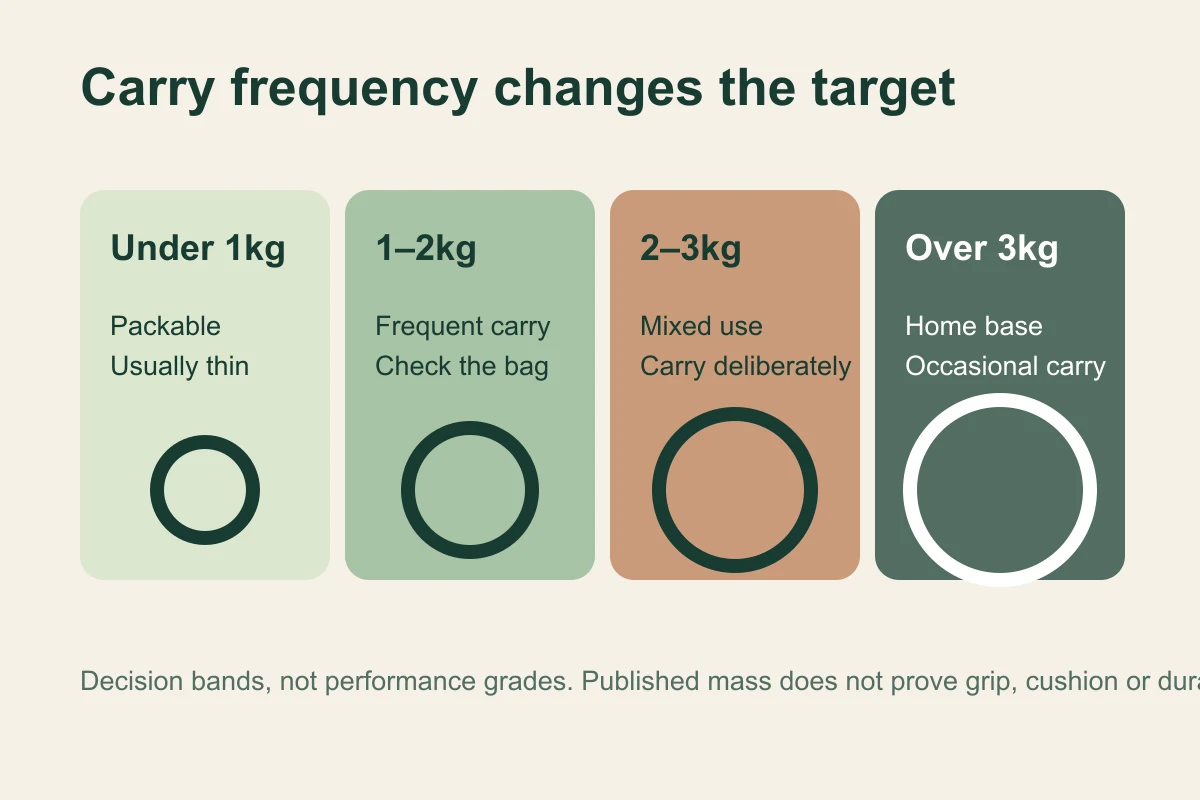
| Under 1kg / 2.2lb | Very light | Flights, packing, long walks | Thickness, foldability and standalone use |
| 1–2kg / 2.2–4.4lb | Light to middleweight | Frequent studio commute | Total bag load and rolled dimensions |
| 2–3kg / 4.4–6.6lb | Middleweight to heavy | Mixed home/studio use | Route length and carrier comfort |
| Over 3kg / 6.6lb | Heavy | Home base or short transfers | Storage, stairs and deliberate transport |
These are decision bands, not industry standards or performance grades. A 3.4kg mat is not automatically more stable; a 0.7kg mat is not automatically less capable. Published mass says how much you carry, not why the product performs as it does.
Seven current yoga mat weights compared
| Current product | Size | Thickness | Published weight | Calculated kg/m² |
|---|---|---|---|---|
| Adidas Yoga Mat | 183 × 61cm | 6mm | 0.70kg / 1.54lb | 0.63 |
| Manduka X | 180 × 61cm | 5mm | 1.50kg / 3.4lb | 1.37 |
| Liforme Classic Travel | 180 × 66cm | About 2mm | About 1.60kg / 3.5lb | 1.35 |
| Rogue NBR | 184 × 62.9cm | 10mm | 1.81kg / 4lb | 1.56 |
| Liforme Classic | 185 × 68cm | About 4.2mm | About 2.50kg / 5.5lb | 1.99 |
| Manduka GRP Adapt | 180 × 66cm | 5mm | 2.60kg / 5.8lb | 2.19 |
| Manduka PRO | 180 × 66cm | 6mm | 3.40kg / 7.5lb | 2.86 |
The kg/m² column divides published mass by flat surface area, using the displayed dimensions. It makes differently sized mats easier to compare, but it is not material density. A mat may contain several layers, reinforcement and air-filled structure; specifications are also rounded.
The contrast is useful. The Adidas mat and Manduka PRO are both 6mm thick, yet their published masses differ by 2.7kg. The 10mm Rogue NBR is lighter than three thinner products. Thickness alone cannot answer “how heavy will this be?”
Product specifications can change, and some brands sell multiple lengths under one page. Verify the selected variant at checkout. Our values use the standard variants named in the table, not long or XL versions.
What determines the weight of a yoga mat?
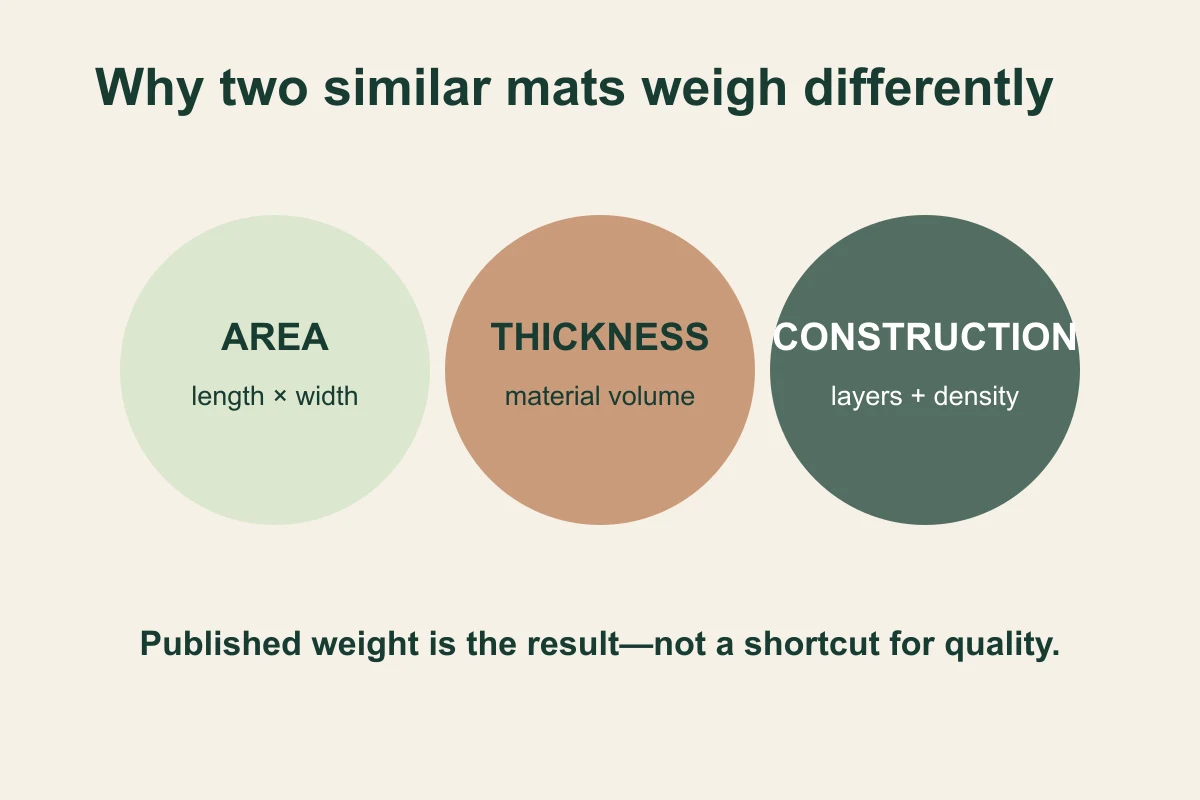
Three variables interact: flat area, thickness and construction.
1. Length and width create the area
A larger mat uses more material when construction and thickness stay comparable. Moving from 180 × 61cm to 185 × 68cm adds roughly 15% in surface area. That can also increase rolled length and bag requirements.
Area does not tell the whole story, however. The Liforme Travel and Manduka GRP Adapt have the same listed 180 × 66cm footprint. Their published weights differ by about 1kg because thickness and layered construction differ.
2. Thickness changes material volume
If every other variable were fixed, a thicker sheet would use more material and weigh more. Retail products do not hold every other variable fixed. Foam structure, compression and coatings can outweigh the simple millimeter count.
Use thickness to decide how much distance from the floor you want, then check weight as its own specification. The separate yoga mat thickness guide explains why millimeters are not a complete proxy for cushioning either.
3. Construction changes mass per area
TPE, NBR, PVC, natural rubber and polyurethane composites can be manufactured with very different structures. Even within one material family, foaming, reinforcement and surface layers vary. “Rubber” or “high density” is therefore not enough to calculate a reliable finished weight.
Light versus heavy yoga mats
| Decision factor | Lighter mat direction | Heavier mat direction |
|---|---|---|
| Regular walking or transit | Less carried mass | More noticeable as route length grows |
| Flights and luggage | Preserves more baggage allowance | May consume a meaningful share of allowance |
| Staying at home | Portability advantage matters less | Carry penalty may be irrelevant |
| Thickness choice | Often, but not always, thinner | Often, but not always, denser or thicker |
| Floor behavior | Must be judged directly | Extra mass does not prove grip or flatness |
| Bag compatibility | Roll can still be wide | Check both roll diameter and load rating |
When a lightweight mat makes sense
A lower weight is valuable when transportation is the recurring constraint: walking to a studio, changing trains, cycling with a secure carrier or packing for flights. It can also make storage on a high shelf easier.
Do not let “travel” replace the specifications. Liforme calls its 1.6kg model a travel mat; Adidas publishes 0.7kg for a full-size 6mm foam mat. Products solve portability differently. Confirm whether a thin travel mat is intended for independent use or as a grippy layer over another surface.
When a heavier mat can be reasonable
A heavier mat can be a rational choice when it lives in a home practice space or studio locker. In that setting, the carry cost is rare and other properties can lead the decision. Dense or multilayer construction may be part of what you want, but assess grip, dimensions and care instructions directly.
Avoid reversing the logic: mass is not proof of quality. The Manduka PRO’s 3.4kg figure describes the standard 180 × 66cm product. It does not, by itself, establish that the mat suits your floor, hands, practice or storage.
Choose a weight by your real route
Replace vague labels such as “easy to carry” with a route audit.
| Route variable | Question to record | Why it changes the decision |
|---|---|---|
| Frequency | How many one-way carries per week? | Small friction repeats |
| Duration | How many minutes is the longest carry? | Mass matters more over time |
| Transfers | Stairs, gates, bike, bus or train? | Handling can matter more than distance |
| Other gear | Bottle, laptop, clothing, blocks? | Total load is the relevant load |
| Storage | Floor, shelf, locker or car? | Determines how often lifting occurs |
| Carrier | Sling, open strap or full bag? | Changes load distribution and control |
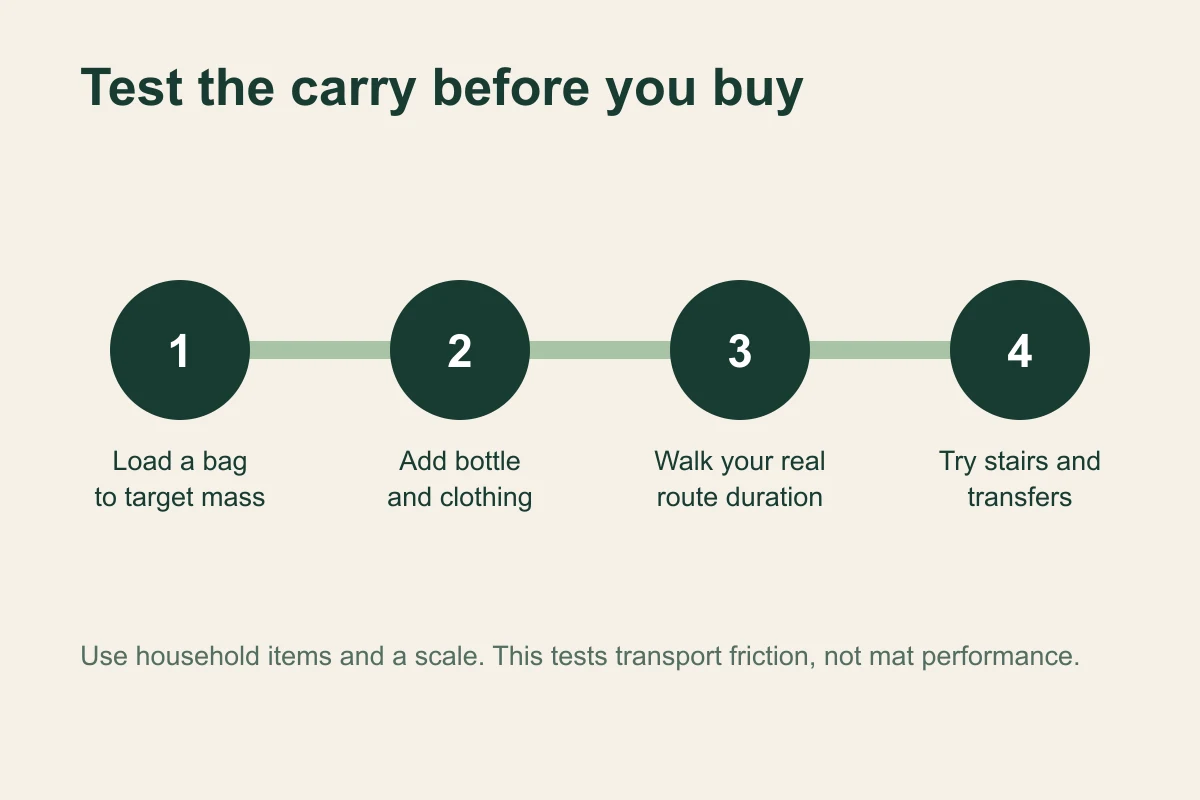
Then run an equipment-only simulation at home. Put household items equal to the candidate mat’s published weight into a secure bag. Add your normal bottle and clothing. Carry it for roughly the duration of your real route, including ordinary stairs if safe and familiar. This does not simulate the bulky roll perfectly, but it reveals whether a 1kg difference is trivial or decisive for you.
Weight is only half of portability
A light mat can still be awkward if the roll is long, wide or difficult to secure. Check four transport numbers together:
- Mat weight: the exact variant, ideally in both kilograms and pounds.
- Rolled length: usually close to mat width, unless the brand specifies another roll direction.
- Rolled diameter: affected by thickness, construction and how tightly the mat may be rolled.
- Total carry weight: mat plus bag, bottle, clothes and accessories.
For a carrier, compare internal length and diameter rather than accepting “fits most mats.” A 68cm-wide mat may not fit a bag designed tightly around a 61cm roll. A 10mm mat may create a much larger roll even when its mass is manageable. Our yoga mat bag guide separates open slings, straps and enclosed bags.
For luggage, a foldable yoga mat can solve shape more effectively than weight alone. Check airline rules and the packed configuration; never force a product to fold when its care instructions only permit rolling.
How to compare inconsistent product listings
Retail specifications are not always presented consistently. Use this sequence:
- Select the exact size before reading the weight.
- Check whether “standard,” “long” and “XL” weights appear separately.
- Determine whether the figure includes a supplied bag or strap.
- Convert units: 1kg is about 2.205lb; 1lb is about 0.454kg.
- Treat “approximately” and rounded values as estimates.
- Ask the manufacturer when weight is missing—do not infer it from thickness.
- Save or screenshot the specification if transport is a purchase-critical constraint.
Manduka’s GRP Adapt page, for example, publishes 5.8lb for the standard size and 6.5lb for the long version. The PRO page lists three different weights. Copying one number without its variant creates a misleading comparison.
Common weight-shopping mistakes
Treating light as a complete benefit
Low mass is useful, but it may accompany trade-offs in thickness, packed behavior or intended use. Compare what the design changes to achieve its weight.
Treating heavy as proof of stability
Floor grip depends on bottom-surface design, floor conditions and care, not just gravity. Weight may contribute to how an object feels to handle, but it is not a stability certification.
Comparing pounds with kilograms by eye
The numbers look deceptively close. A 3.4lb Manduka X is about 1.5kg; a 3.4kg Manduka PRO is 7.5lb. Always attach the unit.
Ignoring everything else in the bag
A 1.6kg mat can become a much larger total when combined with water, clothing and a laptop. Weigh the normal packed bag rather than optimizing one component in isolation.
Buying by a category average
“Travel,” “standard” and “professional” have no enforced weight ranges. The seven source-checked examples span nearly fivefold from lightest to heaviest. Exact specifications beat averages.
Final buying checklist
- Decide whether the mat is for travel, frequent commuting, mixed use or a home base.
- Record the exact product, size variant, weight and whether accessories are included.
- Compare flat area and kg/m² when sizes differ, but do not call that material density.
- Test the candidate mass as part of your normal total load.
- Check rolled length and diameter against the carrier and storage location.
- Compare thickness, grip construction and care separately from weight.
- Recheck the product page before purchase because specifications can change.
For frequent transport, under 2kg is a useful shortlist boundary, not a rule. For a mat that stays home, weight can drop lower in the decision. In every case, buy from the exact published specification: neither “lightweight” nor “heavy duty” tells you how much you will actually carry.
Frequently asked questions
How much does a yoga mat weigh?
Current full-size examples in this guide weigh from 0.7kg (1.5lb) to 3.4kg (7.5lb). A useful broad expectation is about 1–3kg (2.2–6.6lb), but travel foam can be lighter and dense, large or multilayer mats can be heavier. Check the exact variant rather than relying on a category average.
What is a good yoga mat weight for commuting?
There is no universal ideal. Under 2kg is a practical comparison band for frequent walking or public transport, but test the total carried load—including bag, bottle and clothing—over your real route. A lighter mat can trade away thickness or use a different construction.
Are heavier yoga mats better?
Weight alone does not prove grip, cushioning, stability or durability. Extra mass may come from greater area, thickness or denser layers. Compare those properties directly and choose weight according to how often and how far you carry the mat.
Does a thicker yoga mat always weigh more?
Not necessarily. At the same area and construction, more thickness generally adds mass, but materials and internal structure vary greatly. In the current examples, a 10mm NBR mat weighs less than several thinner multilayer or dense mats.
How can I check yoga mat weight before buying?
Open the specifications for the exact size and color variant, verify whether the stated figure includes a bag or strap, and convert pounds to kilograms if needed. If no weight is published, ask the manufacturer instead of estimating from thickness alone.