

How this page has changed
October 24, 2026
Sources, internal links and safety or product context reviewed.
In this guide
- 01Yoga mat materials at a glance
- 02Synthetic materials: PVC, TPE, PU, NBR and EVA
- 03Natural rubber: grip, latex and sunlight
- 04Fiber and bark materials: cork, jute, cotton, hemp and wool
- 05Layers and cell structure: why the material name is only a start
- 06How to read a yoga mat label or product page
- 07Which yoga mat material is best for you
- 08A short history: from carpet underlay to PVC
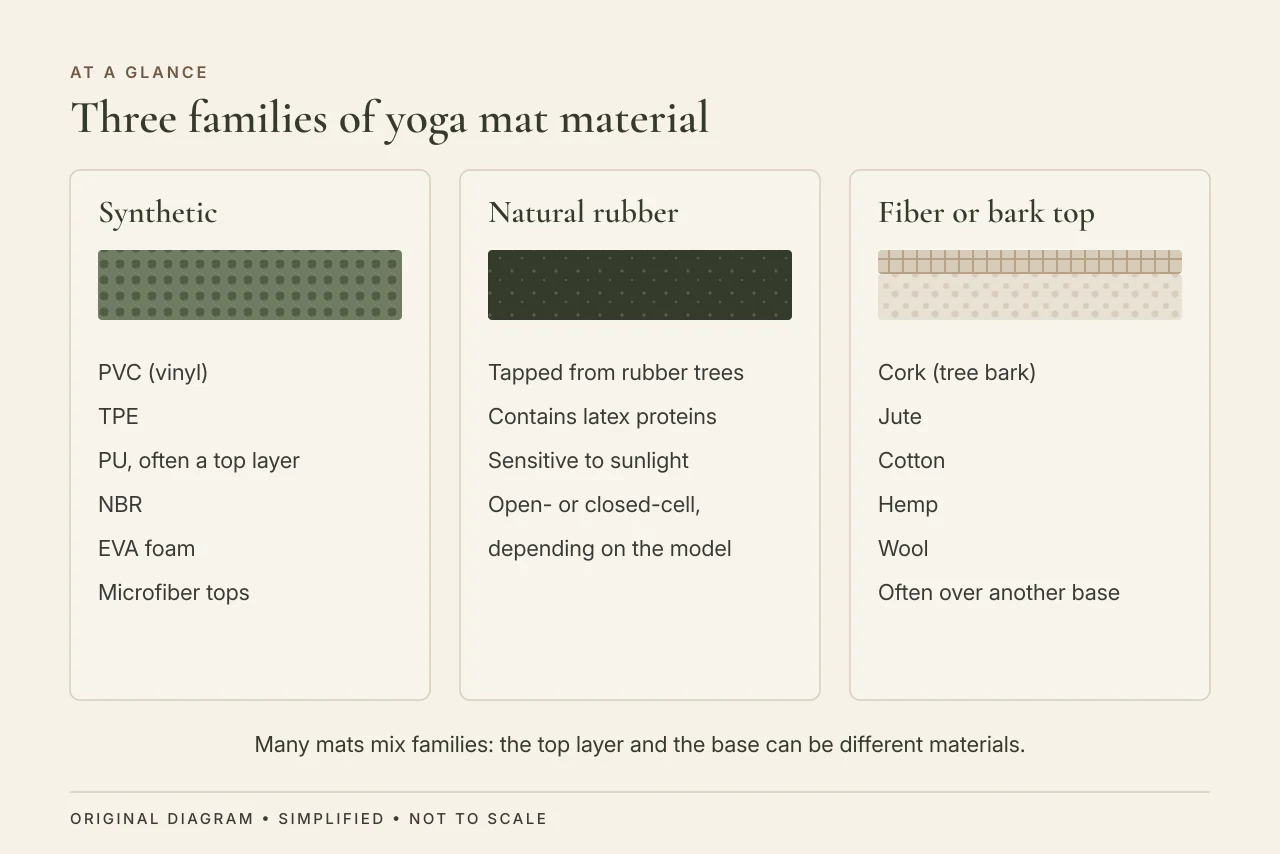
Most yoga mats are made from one of three material families. The first is synthetic, meaning factory-made plastics, foams and rubbers such as PVC (vinyl), TPE, PU, NBR or EVA. The second is natural rubber from rubber trees. The third is a plant or animal material such as cork, jute, cotton, hemp or wool, which is usually laid over a base. Many mats mix families, so the top you touch can be a different material from the layer underneath.
The material changes grip, weight, smell, cleaning, latex content and how the mat wears over time. Gaiam lists texture, stickiness, eco-friendliness, sponginess and wear as the things material decides. What the material name does not tell you is whether the surface soaks up sweat. That depends on how the exact model is built.
This page is a reference map. Each material gets a short entry and a link to our full guide on it. It is based on the manufacturer pages and public references cited on this page; we did not lab-test any mat. If you want help choosing one mat rather than understanding materials, start with how to choose a yoga mat.
Yoga mat materials at a glance
Here are the twelve materials you will meet most often on product pages. Read across a row for the basics, then follow the link for the details.
| Material | What it is | Feel and grip | Watch out for | Full guide |
|---|---|---|---|---|
| PVC | Plastic, also called vinyl | Tacky dry grip; cell structure varies | Closed-cell versions can turn slick when sweat pools | PVC yoga mat |
| TPE | Blend of plastic and rubber polymers | Light, soft, squishy | Some blends react to sun; check latex | TPE yoga mat |
| Natural rubber | Made from rubber-tree resin | Strong grip; often dense and heavy | Latex; sunlight; smell when new | Natural rubber yoga mat |
| PU top layer | Polyurethane bonded to a base | Smooth, matte, very grippy | Often absorbent; can show stains | PU yoga mat |
| Cork | Bark of the cork oak, used as a top | Firm, warm surface | The base can be rubber, TPE or foam | Cork yoga mat |
| Jute | Coarse plant fiber, used as a top | Rough, textured | Often on a rubber backing | Jute yoga mat |
| Cotton | Woven cloth or rug | Firm, low grip on its own | Fibers wear out over time | Cotton yoga mat |
| Hemp | Woven plant fiber | Firm, light, smooth weave | Low grip; softens with use | Hemp yoga mat |
| Wool | Animal-fiber face on a backing | Soft textile surface | Backing may be latex or PU | Wool yoga mat |
| Suede / microfiber | Synthetic microfiber top | Often grips better once damp | Can feel slippery when bone-dry | Suede yoga mat |
| NBR | Synthetic rubber | Very soft and thick | Can stretch when you jump | NBR yoga mat |
| EVA | Light foam, usually closed-cell | Very light, smooth | Less grip; can flatten | EVA yoga mat |
A note on "most common". Hugger Mugger calls PVC "the most common material for yoga mats worldwide", and Gaiam says "most standard yoga mats are made of PVC". Both companies sell PVC mats, and neither page gives a market figure. Treat it as a brand view, not a measured share.
Synthetic materials: PVC, TPE, PU, NBR and EVA
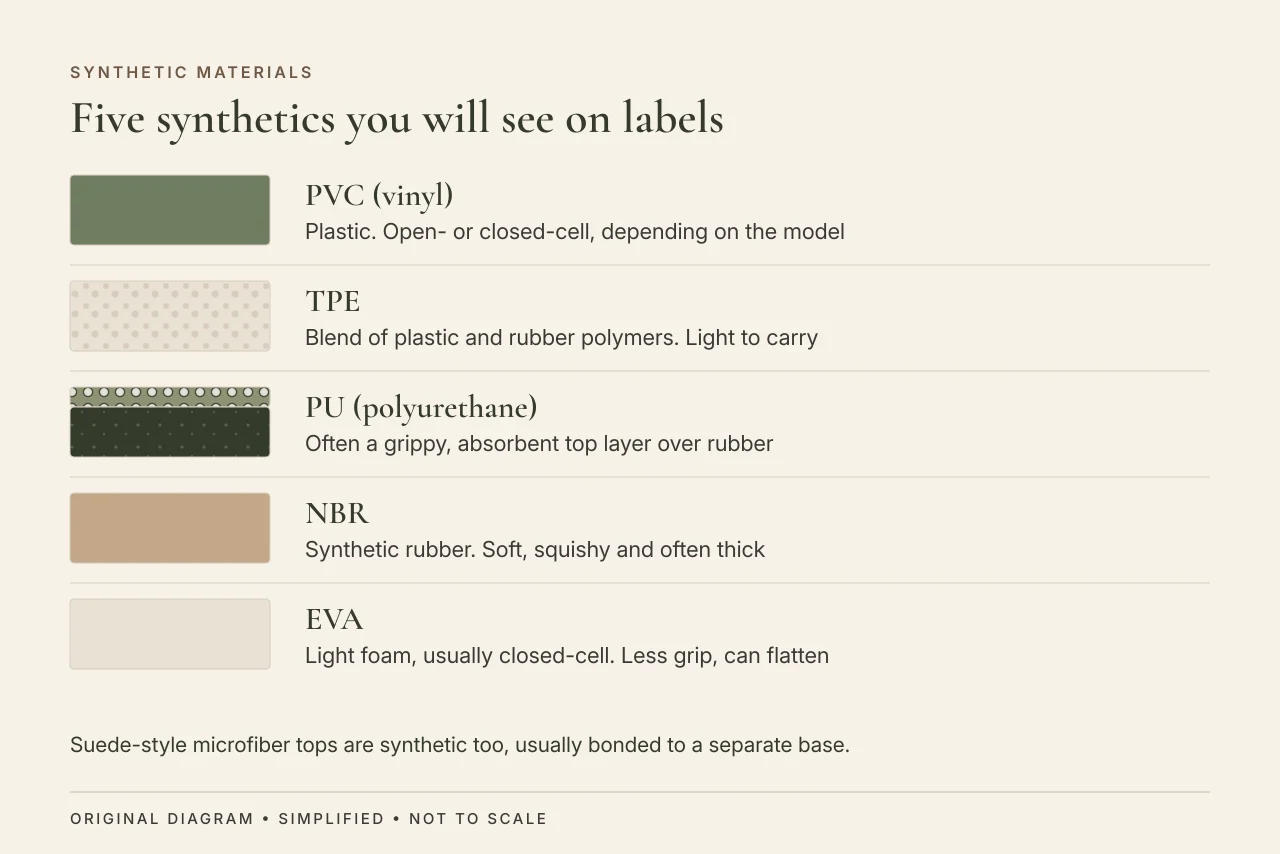
Synthetic means the material is made in a factory rather than harvested from a plant or an animal. This guide covers five of them, plus microfiber tops.
PVC (vinyl)
PVC stands for polyvinyl chloride, a plastic also called vinyl. According to Wikipedia's yoga mat article, the first commercially produced sticky mats were PVC. Hugger Mugger's material guide describes PVC as closed-cell: sweat stays on top instead of soaking in, so it wipes clean. Not every PVC mat is built that way, though. Hugger Mugger's own Tapas Original listing calls that mat open-cell PVC, so check the exact model page. The same brand warns that cheap, mass-produced PVC often uses phthalates, chemicals that make plastic flexible and can give off a strong smell. More in our PVC yoga mat guide.
TPE (thermoplastic elastomer)
TPE is a man-made blend of plastic and rubber polymers. Hugger Mugger calls it very lightweight and "typically PVC-free and latex-free". Note the word "typically": still check the label. TPE is often marketed as recyclable, but whether anyone near you takes it back is a separate question, covered in yoga mat recycling. More in our TPE yoga mat guide.
PU (polyurethane)
On yoga mats, PU is usually a thin top layer bonded to a natural rubber base. Hugger Mugger describes it as open-cell and absorbent. That gives it a strong grip, but it can show sweat stains and may not last as long as solid PVC. Liforme, for example, describes its mats as an eco-polyurethane top over natural rubber. More in our PU yoga mat guide.
NBR (nitrile butadiene rubber)
Despite the word "rubber", NBR is synthetic. Hugger Mugger says it is very squishy and thick, which makes it popular for Pilates and floor work. The trade-off it names: NBR can stretch when you jump to the front of the mat. More in our NBR yoga mat guide, and the two light synthetics are compared in TPE vs NBR.
EVA (ethylene-vinyl acetate)
EVA is a light foam, usually closed-cell, the same kind used in running-shoe midsoles and kids' play mats. Hugger Mugger says it is cheap and light, but its smooth, almost waxy surface gets slippery once your hands are damp. It can also "bottom out": the spots under your hands and feet stay pressed down. More in our EVA yoga mat guide.
Suede and microfiber tops
A "suede" yoga mat usually has no animal suede in it. Hugger Mugger describes these tops as microfiber, often made from recycled PET (plastic bottles), bonded to a separate base. They can feel slippery when bone-dry and grip better as they take in moisture. More in our suede yoga mat guide.
Natural rubber: grip, latex and sunlight
Natural rubber comes from rubber trees. JadeYoga says its mats are made with rubber "tapped from rubber trees, a renewable resource". Hugger Mugger describes rubber as grippy even once you start to sweat, heavier than many other mats, and smelling of rubber when new, a smell it says fades with use.
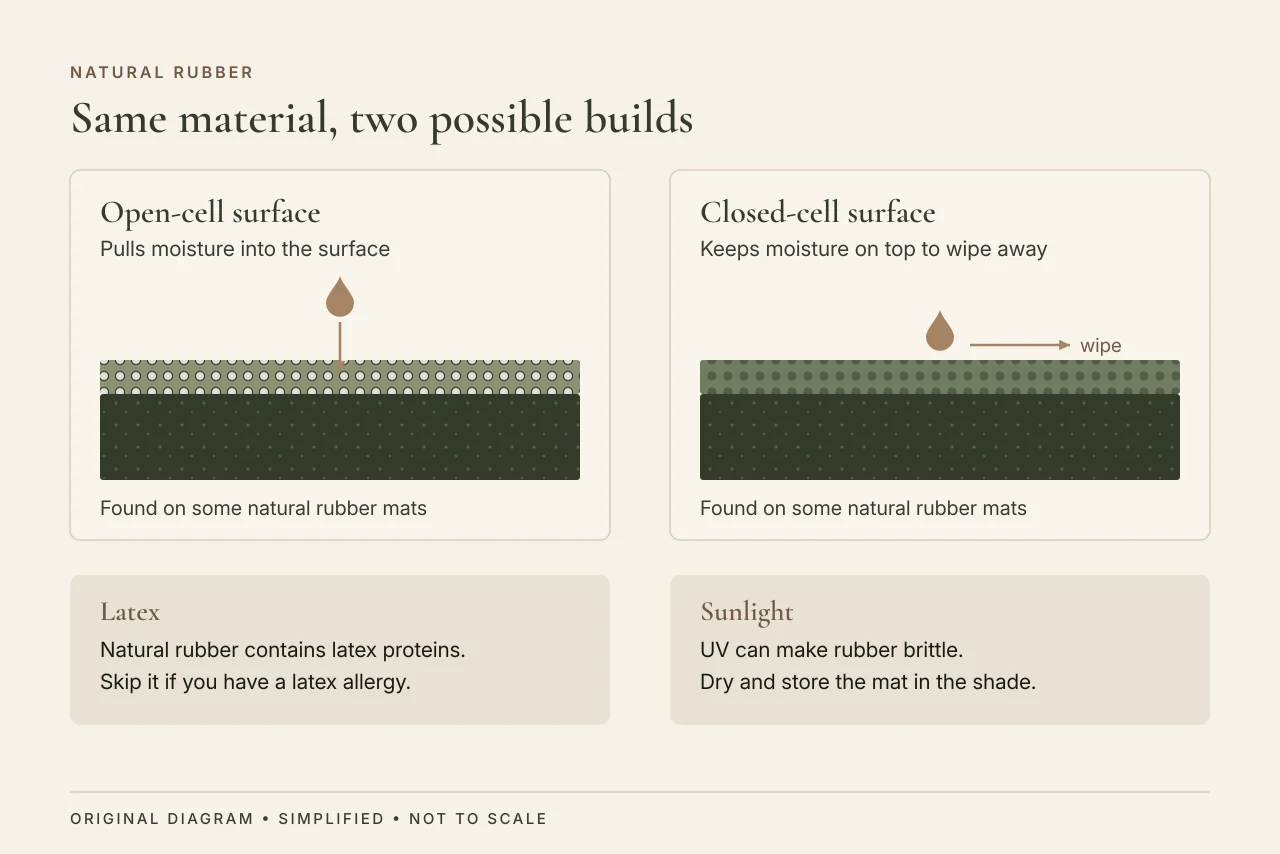
Latex. Natural rubber contains latex. Hugger Mugger says it plainly: "Natural rubber mats contain latex." JadeYoga says its mats are 99% latex free but may carry trace latex proteins, so it recommends that people with latex allergies avoid contact. Manduka marks its natural rubber eKO mat "not recommended for those with latex sensitivities". Gaiam's advice is short: if you are allergic to latex, avoid natural rubber.
Sunlight. JadeYoga says its rubber mats are not meant for outdoor use and should not be exposed to sunlight. Manduka says UV light can make the eKO fade or turn brittle. Hugger Mugger adds that some TPE blends react the same way and advises drying any mat in the shade.
Open or closed cell. Here the sources disagree. Hugger Mugger writes that "many natural rubber mats feature an open-cell structure", meaning tiny pores that take in moisture. Manduka describes its natural rubber eKO series as closed-cell, meaning sweat stays on top. Both statements can be true at once: one material, built two ways. Check the exact model. For more, read our natural rubber yoga mat guide or cork vs rubber.
Fiber and bark materials: cork, jute, cotton, hemp and wool
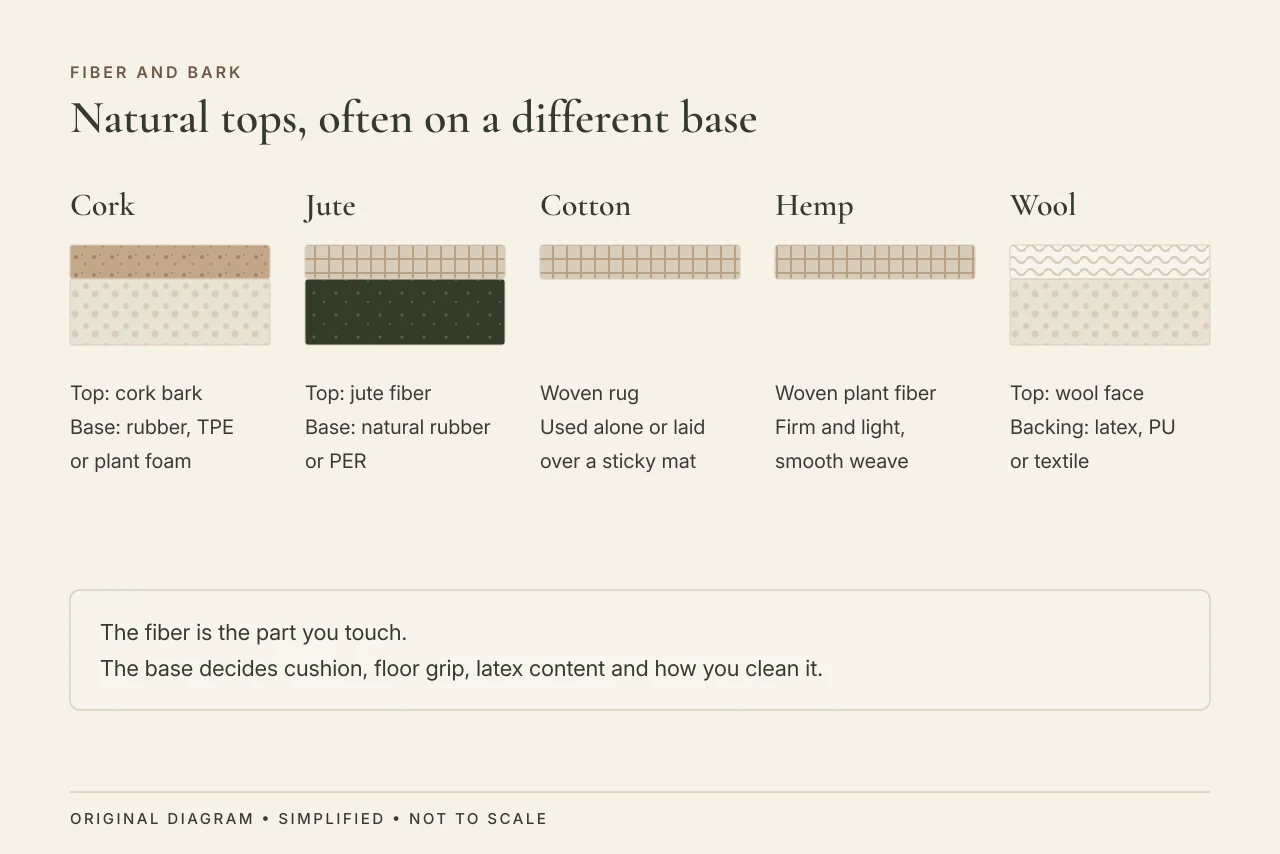
These materials come from plants or animals. On most mats they form the top layer, with something else underneath for cushion and floor grip. Gaiam's jute mat, for example, is "made partly from the natural fibers of the jute plant" and lists jute plus PER. Hugger Mugger describes PER (polymer environmental resin) as a synthetic material.
Cork
Cork is bark from the cork oak tree. It usually sits on top of something else: Yoloha's spec chart lists cork surfaces on TPE foam or plant-based foam, and Wikipedia's comparison table lists cork on rubber. Hugger Mugger says cork gets grippier when wet, and Gaiam calls it antimicrobial. Those are brand descriptions, not lab results. More in our cork yoga mat guide.
Jute
Jute is a strong plant fiber spun into coarse threads. Hugger Mugger says it is often combined with a natural rubber backing, which matters if you avoid latex. Wikipedia's comparison calls jute mats the roughest, and Hugger Mugger notes some people find jute too rough for their skin. More in our jute yoga mat guide.
Cotton
Cotton mats are woven cloth. In Ashtanga yoga, cotton rugs, often called Mysore rugs, are traditionally laid over a sticky mat to soak up sweat. Wikipedia's table rates cotton as firm, light and washable, with poor grip and fibers that wear out. Gaiam explains that "natural cotton" means the fabric is not treated with synthetic finishes during manufacturing. More in our cotton yoga mat guide.
Hemp
Hemp is a plant fiber woven much like cotton. Wikipedia's table lists hemp as firm and light, with a smooth weave, poor grip and a surface that softens with use. More in our hemp yoga mat guide.
Wool
Wool mats have a soft wool face. The backing often decides the rest. Yogisha lists one model with pure new wool over a natural-latex backing; Texelana lists a wool-fleece top over a backing of PU and polyester yarn. Same headline fiber, different latex and care answers. More in our wool yoga mat guide.
Layers and cell structure: why the material name is only a start
Many mats are built in layers. Liforme describes a "three-layer construction" in which a barrier keeps sweat out of its natural rubber base. Manduka describes its GRP mats as "an open-cell PU and rubber construction" and its eKO mats as having two layers of different densities.
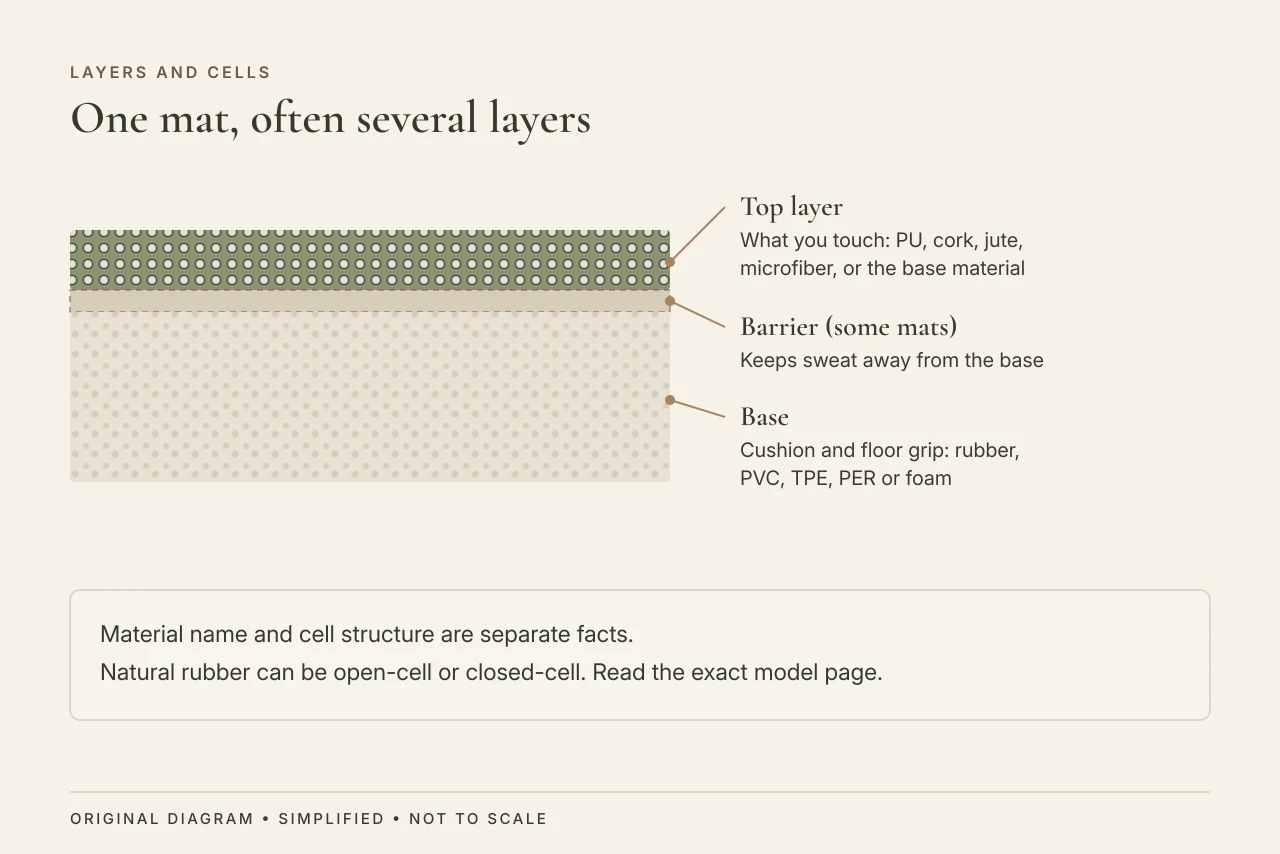
Open-cell means the surface has tiny connected pores that take in moisture, like a sponge. Closed-cell means the pores are sealed, so sweat stays on top. Manduka compares it to water on a sponge versus water on glass. In its help center, Manduka says closed-cell mats stay more hygienic and generally last longer but can feel slippery when you sweat. Open-cell mats grip well as they absorb moisture but, in general, do not last as long.
Hugger Mugger explains that open- and closed-cell describes how a material is "blown" or formed in the factory. That is why the material name alone cannot tell you the cell type. Our open-cell vs closed-cell guide covers this in depth.
How to read a yoga mat label or product page
Product pages use the same few words to mean different things. Work through them in this order.
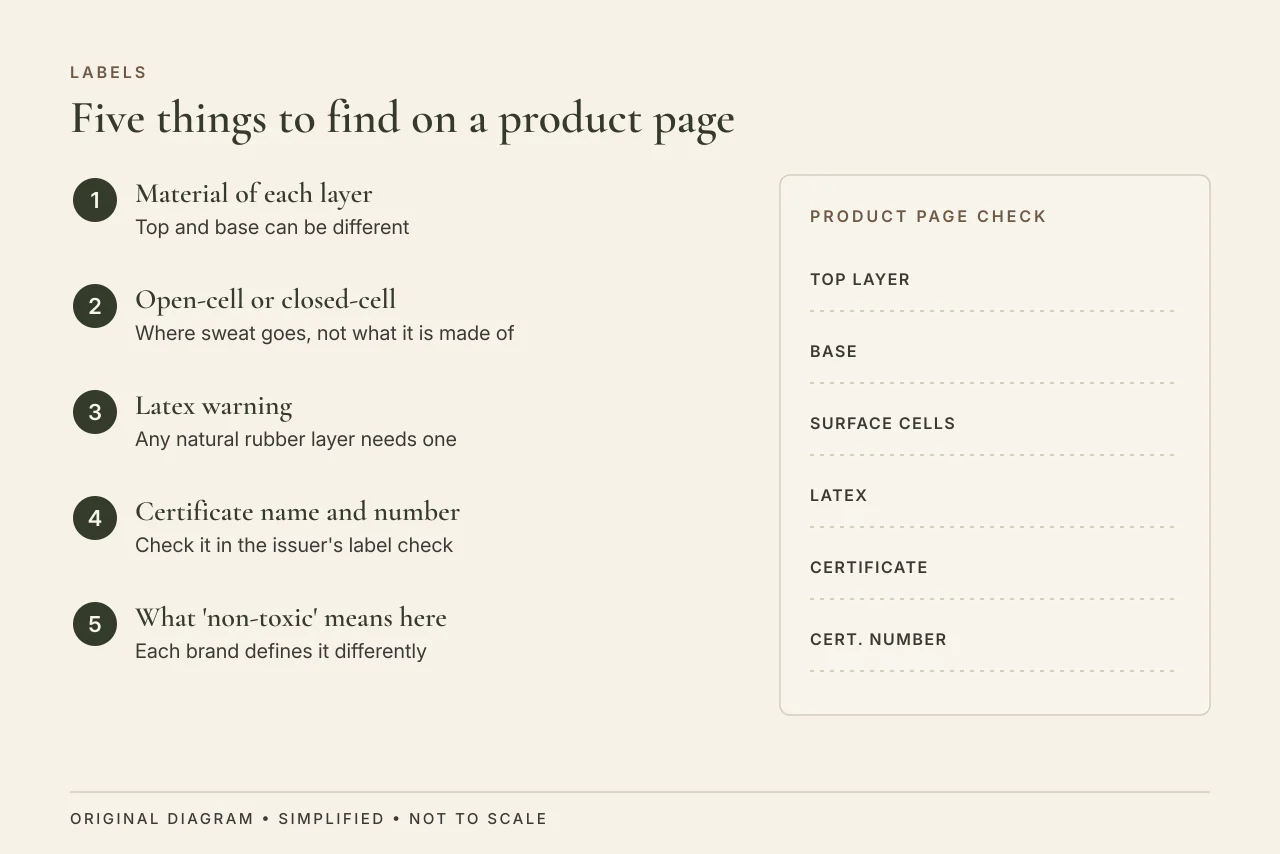
- Material of each layer. Look for the top and the base separately. "Natural cork" or "jute" may describe only the top.
- Cell structure. Look for open-cell, closed-cell, absorbent or sealed. If the page says nothing, treat it as unknown.
- Latex warning. Any natural rubber layer needs a latex check. JadeYoga and Manduka both print one on their rubber mat pages.
- Certificate name and number. A real certificate names the standard and gives a number. Manduka lists its PRO series as "certified STANDARD 100 by OEKO-TEX® (12.HUS.17706 | Hohenstein)". OEKO-TEX says you can check a label by scanning its QR code or typing the certificate number into its Label Check.
- Claims like "non-toxic" and "eco". Read what the brand says the word means for that mat.
What OEKO-TEX STANDARD 100 tells you
OEKO-TEX describes STANDARD 100 as a label for textiles and materials tested for harmful substances, against a list of over 1,000. The limits get stricter the more skin contact a product has. That is its scope: testing the certified item for harmful substances. It is not an organic-fiber label.
What GOTS tells you
GOTS, the Global Organic Textile Standard, certifies textiles made with organic fibers. Its list includes cotton, hemp, jute and wool. To sell a product as GOTS-certified, every company involved in processing it must be certified by an approved independent body. On a yoga mat, check which part carries the label, because the backing under a certified fiber top is a different material.
"Non-toxic" means different things
JadeYoga uses "non-toxic" to mean its mats contain no PVC, EVA or other synthetic rubber. Liforme pairs it with "PVC-free and Vegan Certified". Manduka's PRO is made from PVC and carries an OEKO-TEX STANDARD 100 certificate. Gaiam calls its jute mat "non-toxic, latex- and silicone-free". Same word, four different meanings, so look for the specific fact behind it.
Hugger Mugger publishes its own list of things to avoid: cheap PVC made with phthalates, foam the maker never names, and mats not tested for heavy metals such as lead and cadmium.
Eco claims need the same care. Hugger Mugger, which sells PVC mats, argues that a PVC mat lasting 15 years may have a lower total impact than three or four "eco-friendly" mats that crumble after two years. Liforme says its mats are designed to biodegrade within 1–5 years under normal landfill conditions. Both are brand claims, and they are not measured the same way. Our eco-friendly yoga mat guide goes further.
Which yoga mat material is best for you
No source names one best material for everyone. Hugger Mugger calls the choice "ultimately a personal choice". The useful question is which problem the mat has to solve.
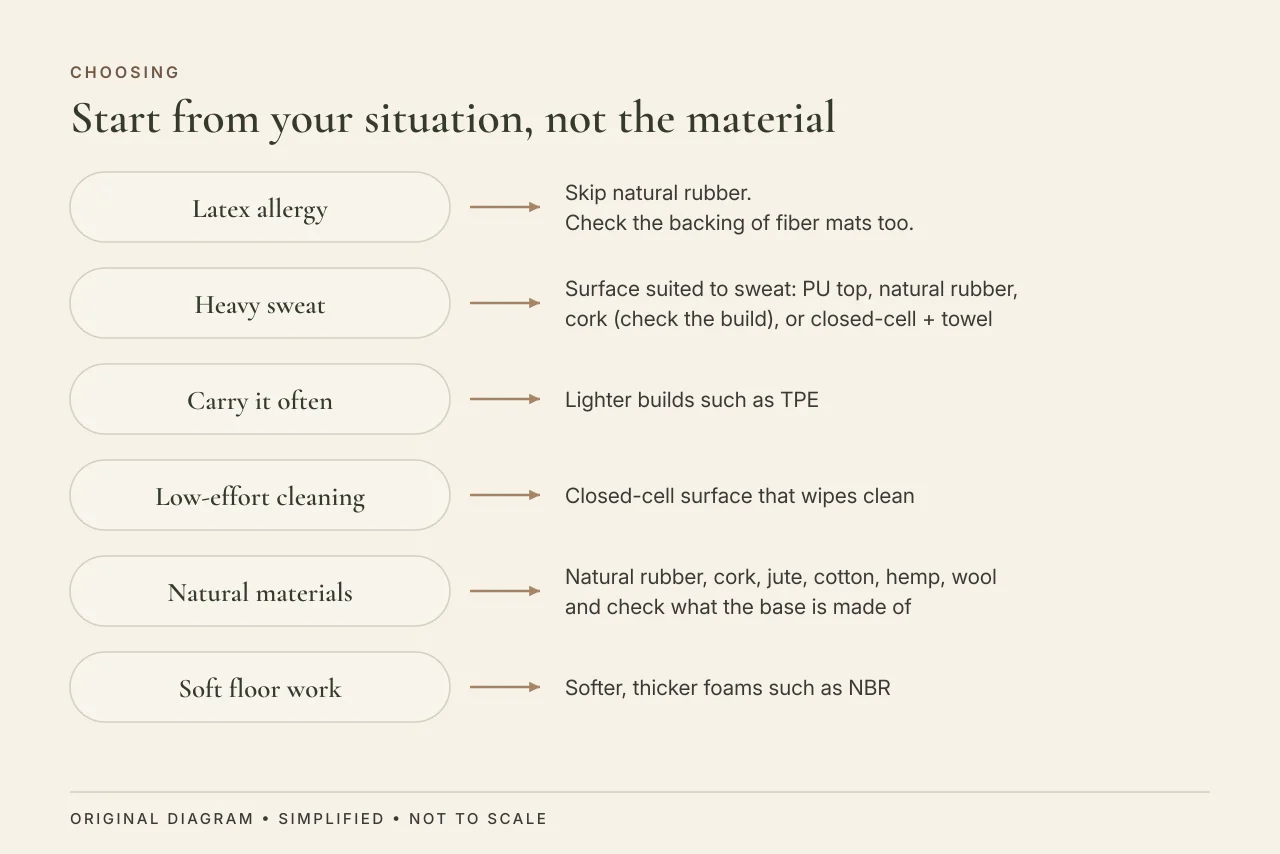
- Latex allergy. Skip natural rubber; Gaiam, JadeYoga and Manduka all say so. Hugger Mugger points to PVC or TPE instead. Also check the backing on jute, wool and cork mats, which can be rubber or latex.
- Heavy sweat or hot yoga. Hugger Mugger suggests natural rubber or a PU-topped mat, and also lists cork. Manduka takes another route: a closed-cell mat with a yoga towel on top. Both approaches hold up; they ask for different cleaning habits. Our hot yoga mat comparison sets the two setups side by side.
- Carrying the mat often. Hugger Mugger points to TPE for light weight. EVA is light too, but the same brand says it gives up grip. Our yoga mat weight guide compares the published weights of seven current mats.
- Low-effort cleaning. Manduka says a closed-cell surface keeps sweat on top, so it wipes clean. Hugger Mugger says open-cell tops need more thorough cleaning. See how to clean a yoga mat once you know your material.
- Natural materials. Natural rubber, cork, jute, cotton, hemp and wool all qualify, but check what the base is made of.
- Soft floor work. Hugger Mugger names NBR as squishy and thick, and TPE as soft for slower practice. It also says density is often more important for joint protection than thickness alone; our high-density yoga mat guide explains why.
A short history: from carpet underlay to PVC
Before modern mats, yoga in India was practiced on kusha grass, bare earth, or a deer or tiger skin rug, according to Wikipedia. When yoga spread to the West, many people used towels or cotton mats on wooden floors, and feet tended to skid.
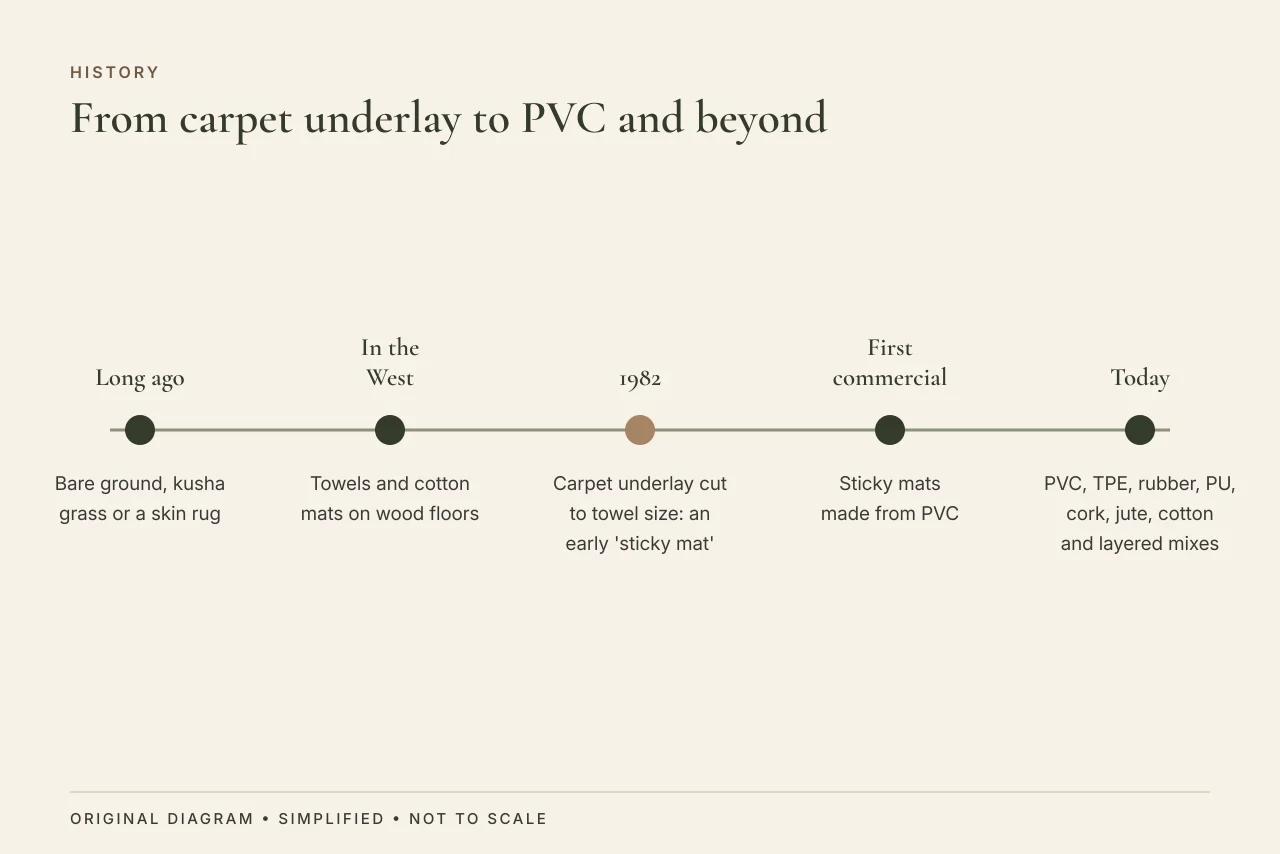
In 1982, while teaching in Germany, yoga teacher Angela Farmer used carpet underlay cut to towel size in her classes. That early mat was called a sticky mat. The first commercially produced sticky mats were made from PVC. Hugger Mugger says it was the first company to make purpose-made yoga mats in the US. Today's mix of TPE, natural rubber, PU, cork, jute and cotton grew from that start.
Frequently asked questions
What material is best for a yoga mat?
No single material is best for everyone. Hugger Mugger calls it a personal choice and suggests natural rubber or a PU top for heavy sweat, TPE for light weight and PVC for easy care. Manduka pairs closed-cell mats with a towel for sweaty practice. Start from your situation: latex allergy, sweat, weight or cleaning.
What is the healthiest material for a yoga mat?
None of the sources ranks one material as the healthiest. Look for checkable facts instead: the material of each layer, a latex warning where natural rubber is used, and a named harmful-substance certificate such as OEKO-TEX STANDARD 100 with a number you can verify. For sensitive skin, Hugger Mugger suggests OEKO-TEX certified TPE, organic cotton or PVC labeled phthalate-free.
What material should you avoid in a yoga mat?
If you have a latex allergy, avoid natural rubber, including rubber backings under jute or wool. Hugger Mugger also advises avoiding cheap PVC made with phthalates, mats that only say foam without naming it, and mats not tested for heavy metals such as lead and cadmium.
What are most yoga mats made of?
Gaiam says most standard yoga mats are made of PVC, and Hugger Mugger calls PVC the most common material worldwide. Both brands sell PVC mats and neither gives a market figure. Other common materials are TPE, natural rubber, PU top layers, cork, jute, cotton, NBR and EVA foam.
Are yoga mats latex-free?
Not all of them. Natural rubber contains latex; JadeYoga says its rubber mats are 99% latex free but may hold trace latex proteins. Gaiam describes PVC as latex free, and Hugger Mugger says TPE is typically latex-free. Fiber mats can sit on a rubber or latex backing, so check every layer on the label.