

How this page has changed
July 26, 2026
Sources, internal links and safety or product context reviewed.
In this guide
- 01Jute yoga mats at a glance
- 02What “jute yoga mat” really means
- 031. Gaiam Performance Jute 5mm — best for more cushioning
- 042. Hugger Mugger Sattva Jute — best lightweight, firm option
- 05How jute texture changes grip
- 06How to inspect a jute mat before buying
- 07Cleaning a jute yoga mat safely
- 08Jute vs cork, rubber and TPE
- 09The verdict
- 10Frequently asked questions
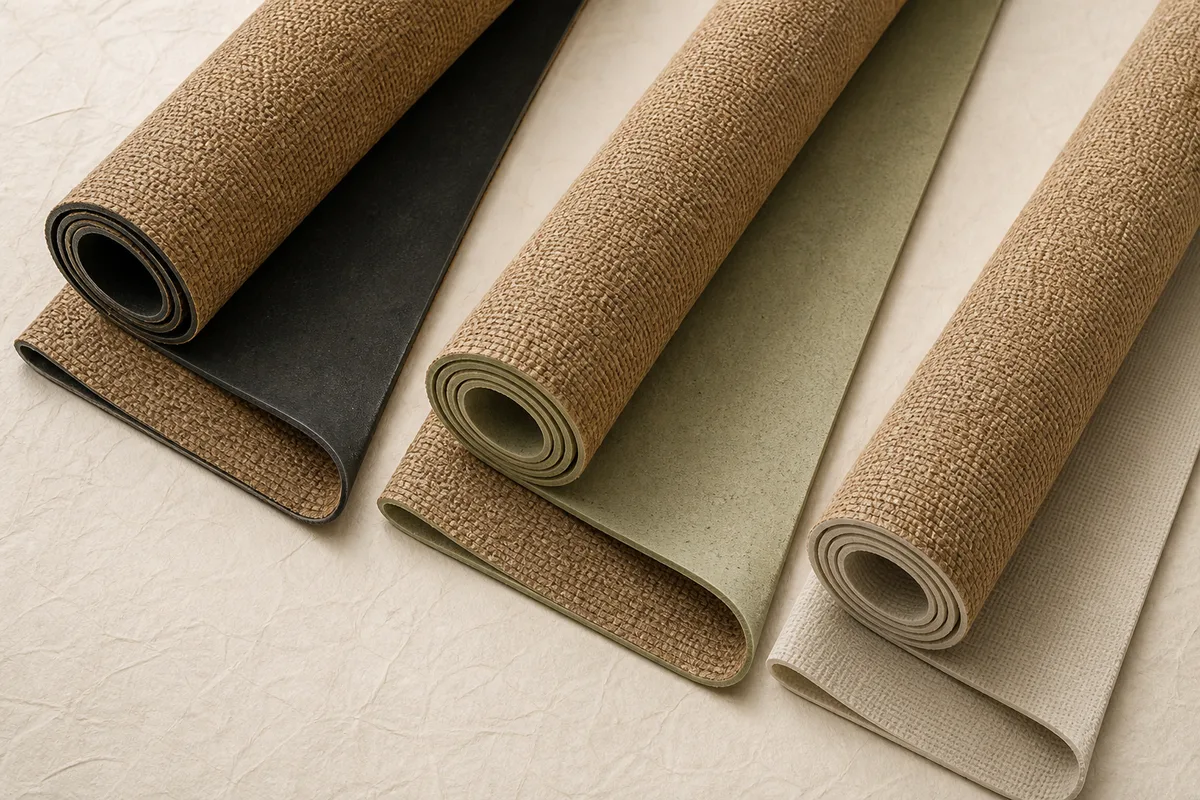
A jute yoga mat is almost never a mat made only from jute. It is usually a composite: visible plant fibers provide a dry, tactile practice surface while a polymer or rubber layer supplies cushioning and floor grip. That hidden backing determines whether the mat contains latex, how heavy it feels and how it should be cleaned.
Of the current products with stable manufacturer specifications, the Gaiam Performance Jute 5mm is the more cushioned choice. The Hugger Mugger Sattva Jute is thinner and lighter. Both pair jute with PER and are explicitly labeled latex-free; neither proves that every jute mat shares those properties.
This is a source comparison, not a claim that The Yoga Sensei has laboratory-tested or used every product. The shortlist stays at two because adding marketplace-only mats with unclear materials would create more names, not better information.
Jute yoga mats at a glance
| Pick | Best for | Published construction | Size / weight | Main limitation |
|---|---|---|---|---|
| Gaiam Performance Jute 5mm | More cushioning; latex avoidance | Jute and PER; 5mm | 68 × 24in; weight not published on the product page | Short standard length; no numeric weight |
| Hugger Mugger Sattva Jute | Lighter, firmer mat | Jute and PER; 1/8in | 68 × 24in / 3lb | Coarse texture and limited cushioning |
Neither product is presented as a universal winner. Choose by skin feel, backing disclosure and dimensions before color or a broad sustainability label.
What “jute yoga mat” really means
Jute is a bast fiber taken from the stem of plants in the Corchorus genus. It can be spun and woven into a strong, visibly fibrous surface. A woven rug can be mostly plant fiber, but a rollable yoga mat also needs cushioning and traction against a smooth floor. Manufacturers therefore embed or bond jute to another material.
That distinction prevents three common buying mistakes:
- Natural surface does not mean all-natural mat. A small visible fraction can support a plant-based headline while most of the mass is polymer foam.
- Jute does not determine latex status. A PER-backed product may be labeled latex-free; a natural-rubber-backed product may contain natural-rubber latex.
- Jute does not determine recyclability. Bonded fibers and foam can be difficult to separate even when one component is technically recyclable or biodegradable.
| Backing disclosed | Likely practical effect | What to verify |
|---|---|---|
| PER | Lightweight foam-like support; can be latex-free | Exact thickness, restricted-substance claims and local end-of-life route |
| Natural rubber | Dense floor grip and planted feel | Latex warning, weight, odor and sunlight care |
| TPE | Usually light and low-absorption | Polymer disclosure, layer bond and heat sensitivity |
| Not stated | Performance cannot be inferred | Ask the brand before buying; do not rely on “natural jute” alone |
1. Gaiam Performance Jute 5mm — best for more cushioning
Gaiam currently specifies its Performance Jute mat as 68 × 24 inches and 5mm, made from jute and PER. The product page calls it latex- and silicone-free and says the fibers absorb moisture. Five millimeters gives it more nominal distance from the floor than the 1/8-inch Sattva, although thickness alone does not reveal density or pressure response.
Its strongest buying case is disclosure: construction, dimensions, latex status and care are all on one current manufacturer page. The standard 68-inch length may feel short for taller practitioners, and the page does not publish a numeric product weight. “Lightweight” is therefore a directional brand claim, not a comparison-ready measurement.
Choose it if you want a visibly fibrous surface with more nominal cushion or need a manufacturer-labeled latex-free mat. Skip it if you need a long practice area, a published carry weight or independently verified wet-grip testing. Check the current details at Gaiam.
2. Hugger Mugger Sattva Jute — best lightweight, firm option
Hugger Mugger publishes the Sattva as 68 × 24 × 1/8 inches, 3lb, with an open-cell jute-and-PER construction. It is also labeled latex-free. Compared with the Gaiam, its listed thickness is roughly 3.2mm rather than 5mm, so expect a closer-to-floor platform rather than plush knee cushioning.
The visible fiber texture is the point: it creates mechanical traction instead of the tacky sensation of some smooth PVC or rubber surfaces. That texture can also be abrasive during poses that put bare knees, forearms or a cheek on the mat. Texture preference is personal; a short skin-contact test is more useful than another “non-slip” adjective.
Choose it when a published 3lb weight, firm profile and coarse surface suit your practice. Skip it if you want soft padding or frequently do restorative shapes with prolonged skin contact. See the current Sattva specification.
How jute texture changes grip
Smooth mats depend mainly on surface friction or tack. Exposed jute adds microscopic edges that hands and feet can catch against. This can feel secure without stickiness, especially to people who dislike a glossy polymer surface.
But “absorbent” is not the same as unlimited wet grip. Sweat can move into the fibrous region, and enough moisture can still change friction, remain inside an open structure or require longer drying. Neither featured manufacturer publishes a standardized coefficient of friction across dry and wet conditions. Treat hot-yoga language as intended use, not laboratory proof.
| Practice condition | Jute-surface consideration | Sensible test |
|---|---|---|
| Dry flow | Fiber texture may feel secure without tack | Test Downward Dog and transitions with clean, dry hands |
| Sweaty hands | Fibers may manage some surface moisture | Increase intensity gradually; keep a towel available |
| Kneeling | Coarse fibers may irritate exposed skin | Hold Tabletop or Low Lunge briefly before committing |
| Balance work | Thin, firm construction can improve floor feedback | Check whether the foam compresses unevenly |
| Studio floor | Backing—not jute—controls floor movement | Push laterally at both ends on the actual floor type |
For sustained heat and heavy sweat, compare purpose-built surfaces in the hot yoga mat guide and bring a yoga mat towel.
How to inspect a jute mat before buying
Read the complete material line
Look past the first word. A useful listing says “jute and PER” or “jute with natural-rubber backing,” not only “natural jute.” If the backing is absent, latex status, weight and disposal claims remain unresolved.
Check the edge and fiber exposure
Product photos should show whether fibers are densely embedded, loosely woven or only printed to resemble burlap. Loose ends, sparse patches and cracking at a rolled edge are warning signs. A neat edge does not guarantee durability, but it reveals more than a front-on lifestyle image.
Compare numbers, not adjectives
Record length, width, thickness and weight. “Portable,” “extra cushioned” and “professional” have no shared standard. A 3lb number can be compared; “lightweight” cannot.
Bound every environmental claim
Jute itself is renewable plant material. The completed mat may still include fossil-derived foam, pigments, stabilizers and a permanent layer bond. Ask for the percentage by mass, backing identity, durability evidence and an actual collection route. The eco-friendly yoga mat guide provides a full claims checklist.
Cleaning a jute yoga mat safely
The two featured products call for restrained cleaning rather than soaking. Gaiam recommends spot cleaning with its mat wash or a damp cloth, cold water and mild detergent, then drying flat. Hugger Mugger recommends mat wash or a dilute mild-dish-soap solution and hanging to dry. Manufacturer directions differ, so keep the instructions for your exact model.
Use this conservative routine when it does not conflict with the product label:
- Blot sweat soon after practice with a clean, soft cloth.
- Apply cleaner to the cloth rather than saturating the fibrous mat.
- Wipe with the grain and avoid aggressive scrubbing that can lift fibers.
- Open the mat fully and dry both faces before rolling.
- Keep it away from prolonged direct sun and hot-car storage.
Do not machine wash, submerge or use bleach, essential oils or a steam cleaner unless the manufacturer explicitly approves them. Residue can change skin contact and traction; trapped water can create odor or weaken a composite bond. See the complete yoga mat cleaning guide.
Jute vs cork, rubber and TPE
| Alternative | Where jute may suit you better | Where the alternative may suit you better |
|---|---|---|
| Cork laminate | More obviously fibrous dry texture | Smoother skin feel; some cork surfaces are designed around moisture |
| Natural rubber | Lighter PER-backed options; latex-free models exist | Denser, planted feel and often more continuous surface traction |
| TPE foam | More tactile, less synthetic-feeling practice face | Softer skin contact and simpler wipe-down |
| Cotton yoga rug | Backing can work directly on a studio floor | More textile-like, washable designs and heavy-sweat tradition |
These are category patterns, not promises. Compare exact constructions in the cork yoga mat guide, natural rubber guide and TPE guide.
The verdict
Choose the Gaiam Performance Jute 5mm when extra nominal cushioning and a clearly labeled latex-free PER construction lead your list. Choose the Hugger Mugger Sattva Jute when a published 3lb carry weight, thinner platform and strong fiber texture are more useful.
The durable lesson is broader than either product: buy the backing first and the jute story second. A plant-fiber surface can be useful, but the complete construction determines latex exposure, floor grip, care and environmental impact.
Frequently asked questions
Are jute yoga mats good?
A jute-composite mat can suit people who like a firm, tactile surface and want more moisture management than a smooth closed-cell mat. Backing, thickness and fiber exposure matter more than the word jute alone.
Are jute yoga mats slippery?
Visible fibers create mechanical texture, but grip varies by weave, moisture, wear and backing stability. A jute label does not guarantee wet or dry traction.
Are jute yoga mats latex-free?
Some are and some are not. The two PER-backed examples here are labeled latex-free by their manufacturers. A jute mat with natural-rubber backing may contain natural-rubber latex.
How do you clean a jute yoga mat?
Follow the manufacturer instructions and use minimal moisture. Spot clean with a damp cloth or approved mild solution, then dry thoroughly. Do not soak or machine wash unless explicitly allowed.
Is a jute yoga mat eco-friendly?
Jute is a plant fiber, but the mat is usually a composite. Evaluate backing, adhesives, material percentages, durability, packaging and a realistic end-of-life route before accepting a broad claim.
Frequently asked questions
Are jute yoga mats good?
A jute-composite mat can suit people who like a firm, tactile surface and want more moisture management than a smooth closed-cell mat. The backing, thickness and fiber exposure matter more than the word jute alone.
Are jute yoga mats slippery?
Visible jute fibers create mechanical texture, but grip still varies by weave, moisture level, wear and backing stability. A jute label is not a guarantee of wet or dry traction.
Are jute yoga mats latex-free?
Some are and some are not. The two current PER-backed examples in this guide are labeled latex-free by their manufacturers. A jute mat with natural-rubber backing may contain natural-rubber latex.
How do you clean a jute yoga mat?
Follow the maker instructions and use minimal moisture. The current Gaiam and Hugger Mugger products call for spot cleaning with a damp cloth or mild solution, followed by thorough air drying. Do not soak or machine wash unless the manufacturer explicitly allows it.
Is a jute yoga mat eco-friendly?
Jute is a plant fiber, but a yoga mat is usually a composite. Evaluate the backing, adhesives, disclosed material percentages, durability, packaging and realistic end-of-life route before accepting a broad environmental claim.