

How this page has changed
July 26, 2026
Sources, internal links and safety or product context reviewed.
In this guide
- 01TPE yoga mats at a glance
- 02What TPE tells you—and what it does not
- 031. Manduka X 5mm — best documented TPE mat
- 042. Manduka Begin 5mm — best beginner direction
- 053. Hugger Mugger Earth Elements 5mm — best lightweight option
- 06How to choose a TPE mat
- 07TPE vs rubber, PVC and cork
- 08Sweat, cleaning and useful life
- 09Is TPE eco-friendly?
- 10The verdict
- 11Frequently asked questions
A TPE yoga mat is usually the light, closed-cell middle ground between inexpensive PVC foam and heavy natural rubber. The Manduka X 5mm is the best documented premium TPE example for mixed yoga and fitness; the Manduka Begin 5mm is the simpler beginner direction, while the Hugger Mugger Earth Elements 5mm prioritizes minimum carrying weight.
TPE means thermoplastic elastomer, but it does not identify one formula. It describes a broad class of materials that combines rubber-like flexibility with thermoplastic processing. Two brands can both print “TPE” on a label while using different polymer families, foam density, additives, textures and layer construction.
This guide compares current manufacturer disclosures and material behavior, not a claim that The Yoga Sensei laboratory-tested every mat. No temporary price, marketplace rating or vague environmental slogan is used as evidence of quality.
TPE yoga mats at a glance
| Pick | Best for | Published construction | Size / weight | Main limitation |
|---|---|---|---|---|
| Manduka X 5mm | Mixed yoga, strength and outdoor training | High-density, closed-cell TPE; dual surface | 71 × 24in / 3.4lb | Dry-grip focus; not a hot-yoga specialist |
| Manduka Begin 5mm | First yoga mat | Closed-cell TPE with alignment stripe | About 68 × 24in; lightweight | Shorter practice area; fewer stable public specs |
| Hugger Mugger Earth Elements 5mm | Lowest carrying weight | TPE, textured dry-grip surface | 72 × 24in / 2.4lb | Light foam feel; verify current product availability |
The shortlist is deliberately small. Many marketplace mats disclose only “eco-friendly TPE,” with no stable manufacturer page, density, chemical standard or warranty. More products would not create more reliable choice.
What TPE tells you—and what it does not
TPEs soften when heated during manufacturing and recover a flexible form after cooling. That makes them suitable for foamed mats, molded textures and bonded layers. It also means “TPE” can cover materially different blends.
| Label on the page | Useful signal | Missing information |
|---|---|---|
| TPE | Broad thermoplastic-elastomer family | Exact polymer, additives, density and recycled content |
| Closed-cell | Low moisture absorption | Wet grip and disinfectant compatibility |
| Dual-layer | Top and base can use different density or texture | Bond strength and each layer's composition |
| 6P-free | Six named phthalates are excluded under the maker's scope | Every other substance or complete toxicology |
| Recyclable | Material may be technically reprocessable | Whether local collection accepts a used yoga mat |
| Biodegradable | Requires a stated test and conditions | Home-compostability or rapid breakdown in landfill |
Treat unqualified “non-toxic” and “eco-friendly” as claims to investigate, not product specifications. A credible page names what is absent, which test applies or what percentage is recycled or bio-based.
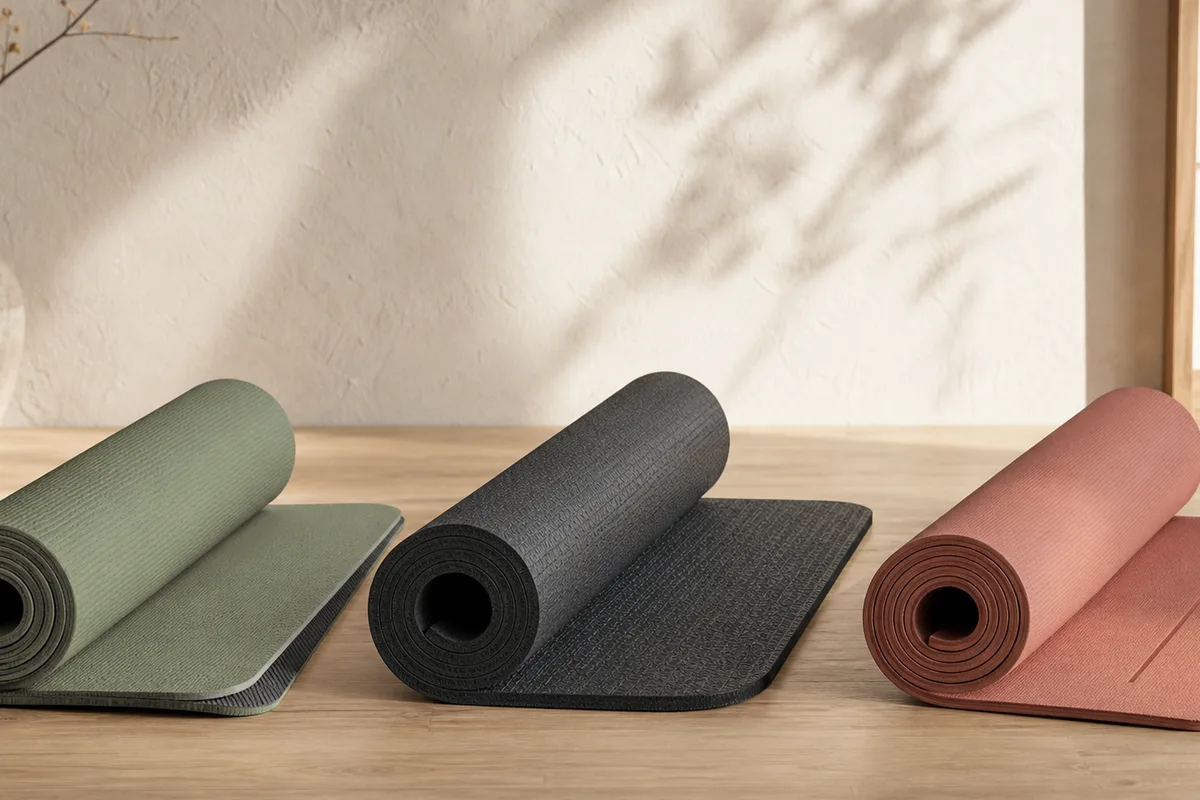
1. Manduka X 5mm — best documented TPE mat
Manduka publishes the X as high-density TPE, 5mm thick, 71 × 24 inches and 3.4lb. Its closed-cell construction resists moisture and its two usable surfaces emphasize a crosshatch dry grip. The current product is designed for yoga, Pilates, strength work and outdoor training rather than yoga alone.
The company separately identifies the material as latex-free and 6P-free. Those are meaningful bounded disclosures: useful for someone avoiding natural-rubber latex, but not proof that every possible chemical question has been answered.
Choose it if you want one light mat for yoga and training or expect easy wipe-down after outdoor use. Skip it if heavy sweat is the primary problem: a closed-cell dry-grip surface lets moisture remain on top. See the current specification at Manduka.
2. Manduka Begin 5mm — best beginner direction
Manduka groups the Begin and X in its TPE closed-cell Foundation Series. The Begin adds a center alignment stripe and 5mm cushioning in a lighter, less training-oriented design. It is the more direct first-yoga-mat proposition, while the X is built for mixed workouts.
The trade-off is size and documentation. The Begin is shorter than the X, and the stable public material detail is spread across Manduka's collection and care pages rather than one comprehensive specification block. Check the selected listing before ordering rather than assuming every Foundation mat shares the X's weight or texture.
Choose it for a simple latex-free beginner mat with a visual center reference. Skip it if you are tall, want numeric density or need a robust outdoor training surface. Beginners can compare non-TPE alternatives in the best yoga mats for beginners guide.
3. Hugger Mugger Earth Elements 5mm — best lightweight option
Hugger Mugger's current mat guide lists the Earth Elements as 72 × 24 inches, 5mm and 2.4lb, with TPE construction and dry-grip texture. That is roughly a pound lighter than the Manduka X at similar thickness, making portability its clearest advantage.
Hugger Mugger describes the material as recyclable and biodegradable. Those terms require context that the guide does not fully supply: technical recyclability does not guarantee curbside or local acceptance, while biodegradation depends on time, environment and test method. Buy it for weight and dimensions, not an unqualified end-of-life promise.
Choose it if carrying comfort and ordinary dry practice matter most. Skip it for a dense planted feel or a clearly documented hot-yoga surface. Confirm the current listing from Hugger Mugger's mat guide.
How to choose a TPE mat
Density before thickness
Six millimeters of low-density foam can compress more than five millimeters of dense TPE. Thickness shows distance from the floor; density affects stability and pressure response. Since consumer pages rarely publish density, use total weight, edge firmness and product purpose as imperfect clues.
Texture before “non-slip”
Look for photos and descriptions of molded texture on both faces. The practice surface needs skin contact; the base needs floor contact. A reversible mat may use the same material but different texture, while a dual-layer mat may tune firmness separately.
Dimensions before the color
TPE mats often target beginners and can be shorter or narrower than premium rubber mats. Compare your height with the actual length and consider shoulder width. A light mat that leaves hands and feet off the edge is not the better commuter choice.
| Your priority | Useful TPE signal | Warning sign |
|---|---|---|
| Daily commute | Published weight below 4lb | “Lightweight” without a number |
| Mixed training | Dense 5mm build, scrim or reinforced structure | Very soft foam with no tear detail |
| Dry yoga | Molded top texture and floor texture | Smooth generic surface photos |
| Heavy sweat | Explicit wet-grip design or towel plan | Dry-grip claim presented as hot-yoga proof |
| Material avoidance | Latex-free plus named restricted-substance scope | “Non-toxic TPE” without definitions |
TPE vs rubber, PVC and cork
| Material | Typical TPE advantage | Typical TPE compromise |
|---|---|---|
| Natural rubber | Much lighter, less rubber odor, can be latex-free | Usually less planted and tactile |
| Dense PVC | Lighter and no long break-in expectation | Often shorter useful life; blend transparency varies |
| Cork laminate | More predictable dry texture and easier wipe-down | Cork generally handles moisture differently |
| NBR foam | Firmer, thinner and more yoga-specific | Less plush for floor exercise |
These are category tendencies, not guarantees. The natural rubber guide explains why cell structure changes rubber, and the cork guide shows how hidden backing changes cork mats.
Sweat, cleaning and useful life
Closed-cell TPE does not absorb much moisture, which makes routine wiping straightforward. It also leaves sweat at the skin interface. Bring a mat towel for a heated or high-sweat session unless the specific mat documents wet grip.
Follow the brand's cleaner instructions. Avoid soaking, machine washing, abrasive scrubbers and long exposure to hot cars or direct sunlight. Dry fully before rolling. Replace the mat when texture smooths away, the layers separate, deep compression stops recovering or the base moves on the floor.
The phrase “lasts for years” should not be assumed from a material label. Usage, density, storage and layer bond dominate the answer. See how long a yoga mat lasts for a function-led replacement test.
Is TPE eco-friendly?
Not by default. TPE is generally polymer-based and can sometimes be reprocessed more easily than thermoset rubber, but a complete mat may combine foamed layers, colorants, fillers, adhesives or reinforcement. Local recycling programs rarely accept an unmarked rolled exercise mat simply because the base material is technically recyclable.
Ask better questions: Is recycled content quantified? Is the polymer family disclosed? Is a take-back route actually available? Is packaging documented? How long is the warranty? The eco-friendly yoga mat guide evaluates those claims across materials rather than awarding a green label to an acronym.
The verdict
Choose the Manduka X 5mm for the strongest disclosed TPE construction and mixed fitness use. Choose the Begin 5mm for a simpler first mat with a center reference, or Hugger Mugger Earth Elements when minimum published weight is the priority.
TPE's real strengths are low weight, closed-cell care and the possibility of latex-free construction. Its weakness is opacity: the same three letters can hide very different blends and densities. Buy the exact specification, not the material acronym.
Frequently asked questions
Is TPE a good material for a yoga mat?
TPE can make a useful lightweight, latex-free, closed-cell mat. Performance depends on polymer blend, density, texture and construction; it is a family rather than one recipe.
Is a TPE yoga mat non-toxic?
Do not infer that from TPE alone. Look for named restricted-substance standards, test reports or precise product disclosures. “Eco-friendly,” “SGS-tested” and “6P-free” cover different scopes.
Is TPE better than natural rubber?
TPE is usually lighter, less odorous and can be latex-free. Rubber generally feels denser and more tactile. Choose by portability, texture and sweat behavior.
Can you use a TPE mat for hot yoga?
Closed-cell TPE lets sweat remain on top, so traction may fall. Unless specifically designed for wet grip, use a towel or choose a hot-yoga surface.
How do you clean a TPE yoga mat?
Follow the product instructions. Usually wipe with a damp cloth or approved cleaner and dry completely. Do not assume soaking, machine washing or harsh disinfectant is safe.
Frequently asked questions
Is TPE a good material for a yoga mat?
TPE can make a useful lightweight, latex-free and closed-cell mat for beginners, studio commuting and mixed fitness. Performance depends on the specific polymer blend, density, surface texture and construction; TPE is a family of materials rather than one recipe.
Is a TPE yoga mat non-toxic?
Do not infer non-toxic from TPE alone. Look for a named restricted-substance standard, test report or precise manufacturer disclosure for the actual product. Terms such as eco-friendly, SGS-tested or 6P-free cover different scopes and are not interchangeable.
Is TPE better than natural rubber for yoga mats?
TPE is usually lighter, has less initial odor and can be latex-free. Natural rubber usually feels denser and more tactile. Neither is universally better: choose TPE for portability and easy care, rubber for planted texture, and verify sweat behavior for both.
Can you use a TPE mat for hot yoga?
A closed-cell TPE mat does not absorb sweat, so moisture can pool and reduce traction. Unless the product is specifically designed and documented for hot yoga, use a mat towel or choose a wet-grip surface.
How do you clean a TPE yoga mat?
Follow the product instructions. A typical routine is wiping with a damp cloth or approved mat cleaner and drying completely before rolling. Do not assume soaking, machine washing, harsh disinfectant or prolonged sun exposure is safe.