

How this page has changed
July 26, 2026
Sources, internal links and safety or product context reviewed.
In this guide
- 01The four tests: keep, clean or replace?
- 021. Grip no longer returns after correct cleaning
- 032. Cushion stays permanently compressed
- 043. The surface flakes, cracks or delaminates
- 054. Odour returns after cleaning and full drying
- 06Cosmetic wear versus performance failure
- 07Lifespan by material: what can safely be said
- 08What shortens a yoga mat's useful life
- 09Care that extends life without damaging the material
- 10Can you reuse or recycle an old yoga mat?
- 11The answer in one minute
- 12Frequently asked questions
Most ordinary yoga mats are replaced within roughly six months to two years, but that is a shopping estimate—not an expiry date. A lightweight foam mat used daily may lose its cushion in months. A dense premium mat can remain useful for many years. Manduka, unusually, defines the useful life of a properly cared-for PRO mat as approximately ten years of regular use.
The honest answer is to replace a mat when its function fails, not when a calendar tells you to. Grip, cushioning and structural integrity matter. Fading colour and a few scuffs usually do not.
The four tests: keep, clean or replace?
| What you find | Test it this way | What to do |
|---|---|---|
| Slipping in familiar poses | Clean with the method approved for your material, dry fully, then repeat a normal dry practice | Keep if grip returns; replace if worn hand and foot zones remain slick |
| Flat or sunken areas | Leave the mat unrolled for 24 hours, then compare the knee, hand and foot zones with an unused edge | Replace when permanent compression removes cushion or creates an uneven base |
| Flaking, cracking or separating layers | Flex the affected area gently and inspect both sides and edges | Replace if pieces shed, a crack spreads or bonded layers lift during use |
| Persistent odour | Clean correctly, air both sides until completely dry, then leave it unrolled overnight | Keep if the smell clears; replace if a musty odour returns from inside the mat |
One failed test can be enough. A mat does not need to look dramatic before it stops doing its job.
1. Grip no longer returns after correct cleaning
Slipping alone does not prove a mat is worn out. Body oil, dust, lotion and cleaner residue can all coat a healthy surface. New dense PVC mats can also become grippier with use rather than less grippy. Clean first, using the maker's instructions, and judge only after the mat is completely dry.
Then compare zones. If the centre still grips but the exact places where your hands and feet land feel polished, the surface texture may be gone. That is functional wear. If the whole mat feels soapy, the cleaner is the more likely culprit.
For hot yoga, test under the conditions that matter. A mat can be fine when dry and unsafe once wet. Heat and frequent sweat also accelerate degradation in some open-cell and biodegradable constructions; Liforme explicitly warns that regular heated practice or a hot, humid climate may shorten its mats' lifespan.
2. Cushion stays permanently compressed
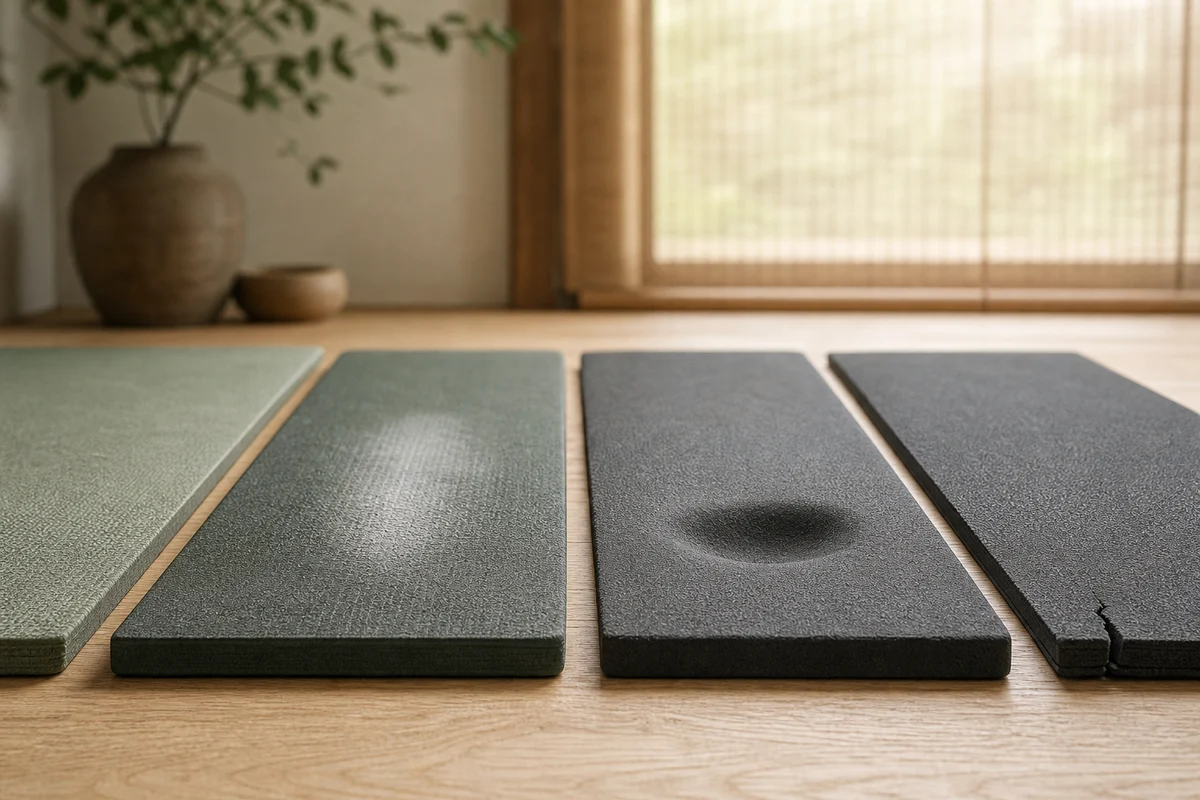
Every mat compresses under load. The failure is when it no longer recovers. Unroll the mat for a day, place it on a flat floor and view it from a low angle. Permanent hollows beneath knees, hands or standing feet mean the material has taken a set.
Small dents can be cosmetic. Replace the mat when the compressed area bottoms out under a knee, tilts a wrist, or makes one standing foot noticeably less stable than the other. Thick, soft foam generally shows this kind of wear earlier than dense PVC or rubber because comfort comes from allowing the material to give.
3. The surface flakes, cracks or delaminates
A rubbed patch is not automatically a dead mat. Loose pieces are different. Flaking foam changes traction and leaves debris. Cracks can grow when the mat rolls. On bonded mats, a lifting polyurethane, cork or fabric layer can move independently from its base.
Do not glue a working surface back down unless the manufacturer provides an approved repair. A hard glue ridge introduces a new pressure point, and an unsuitable adhesive can attack foam or rubber. A tiny nick at an unused corner can be monitored; active separation under hands or feet is a replacement signal.
4. Odour returns after cleaning and full drying
A surface smell after a sweaty class is a cleaning problem. A sour or musty smell that returns after correct cleaning and thorough drying may be inside an absorbent layer. Rolling a mat while damp gives that moisture nowhere to go.
Do not mask persistent odour with essential oil or perfume. Fragrance does not remove trapped moisture and can leave slippery residue. If both sides have dried fully in moving air and the smell returns from within—especially alongside bubbles or delamination—the material is no longer realistically recoverable.
Cosmetic wear versus performance failure
Colour fading, harmless stains, printed graphics wearing thin and a softened edge can make a mat look old while it still performs well. Manduka's PRO guarantee terms make the distinction unusually explicit: ordinary cosmetic marks are not covered, while regular top-surface wear that affects performance can be.
That same test works without a warranty. Ask three questions:
- Does the mat still grip in the conditions where I use it?
- Does it still provide even support without bottoming out?
- Does it remain one intact, cleanable surface?
Three yeses mean the mat can stay. Appearance alone is a poor reason to discard a functioning product.
Lifespan by material: what can safely be said
Exact ranges are unreliable because frequency, sweat, storage and construction vary. A material table is more useful than invented year counts.
| Material or build | Typical wear pattern | Lifespan clue |
|---|---|---|
| Dense closed-cell PVC | Surface slowly smooths; creases appear after improper folding | Can be exceptionally durable; Manduka publishes about ten years only for its covered PRO Series |
| TPE or lightweight foam | Hand, foot and knee zones compress; edges can stretch or tear | Replace by recovery and stability, not the inexpensive mat's age |
| Natural rubber | Oxidation, colour change, drying or cracking; grip can change | Sun, heat and unsuitable cleaners accelerate ageing |
| PU top over rubber | High-contact zones polish; top layer may separate from the base | Wet grip can remain excellent until the grippy surface layer wears through |
| Cork composite | Cork surface sheds or lifts from its base; edges fray | Judge the bond and usable grip; “natural” does not guarantee a standard lifespan |
Even within one row, density and layer quality matter. The safe comparison is between documented products, not broad claims that every PVC mat lasts longer than every rubber mat.
What shortens a yoga mat's useful life
Frequent sweat adds salts, oil and repeated cleaning. Abrasive or dirty floors grind the underside every time weight moves across it. Direct sun, hot cars and radiators speed oxidation, warping and adhesive failure. Harsh cleaners can harden PVC, dry rubber or damage a polyurethane top.
Soaking and machine washing are especially risky unless the label clearly permits them. Manduka's current material-specific care guide says not to soak, shower or submerge PRO mats and warns against soap on its natural-rubber eKO mats. That is why one universal homemade spray is not responsible advice.
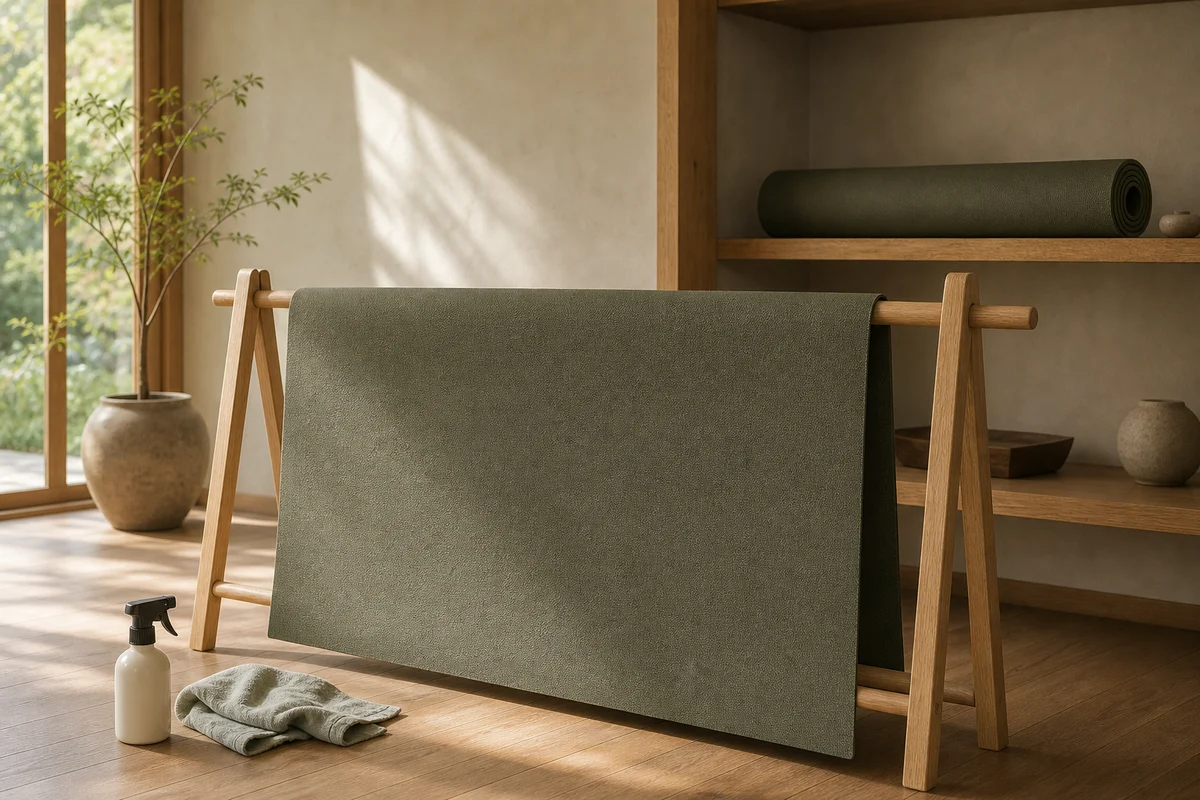
Finally, rolling while damp traps moisture and transfers dirt between surfaces. Drying is part of cleaning, not an optional final flourish.
Care that extends life without damaging the material
Start with the care label. For closed-cell PVC, surface wiping and complete drying are usually appropriate, but warranty-approved products may matter. For natural rubber, avoid prolonged sunlight and use only a cleaner the maker permits. For absorbent PU tops, use minimal liquid and allow extra drying time. For cork composites, keep the bond between cork and base from staying wet. For generic foam, do not assume it can survive a bath because it looks waterproof.
Our yoga mat cleaning guide gives a material-by-material method, while the storage guide covers rolling direction, drying and small-space storage.
Can you reuse or recycle an old yoga mat?
Reuse only if the mat is clean and structurally sound. A retired but intact mat can protect a car boot, line a gear shelf or provide non-slip padding beneath household equipment. Do not donate a mat that smells, sheds, has unknown contamination or is unsafe to practise on. Passing a failure to someone else is not sustainability.
Recycling is local and material-specific. Mixed-material mats may combine a top layer, adhesive and rubber base that facilities cannot separate. PVC, TPE and natural rubber do not belong automatically in household recycling. Check the manufacturer's current take-back programme, then ask the local facility about the exact material before travelling there. If neither accepts it, dispose of it according to local rules rather than wish-cycling.
For the trade-offs behind lower-impact materials, read the eco-friendly yoga mat guide.
The answer in one minute
Do not replace a yoga mat simply because it reaches six months, one year or two years. Clean it correctly, dry it fully and test the four functions: grip, recovery, structure and odour. Replace it when one of those fails in a way that affects practice.
If replacement is justified, use the failure to choose better next time. A compressed foam mat points toward greater density. A worn wet-grip surface may mean accepting a consumable top layer or using a towel. A heavy mat you never carried points toward portability. The complete yoga mat buying guide turns those lessons into the next choice.
Frequently asked questions
How long does a yoga mat last with daily use?
Daily practice concentrates wear in the hand and foot zones, so check function every few months rather than following a fixed replacement date. Lightweight foam may compress relatively quickly, while a dense, properly cared-for mat can remain useful for years. Replace it when grip, support or structure fails after correct cleaning and drying.
Does hot yoga wear out a mat faster?
Usually, yes. Heat, frequent sweat, repeated cleaning and moisture entering an open-cell surface all increase stress on the material. Dry the mat fully after every heated session and follow its exact care label. A surface made for wet grip can perform well in heat while still wearing faster than it would in a dry practice.
Should I replace my yoga mat when it becomes slippery?
Clean it correctly and let it dry fully before deciding. Body oil, detergent residue and the wrong cleaner can make a sound mat slippery. If the same hand and foot zones stay slick after material-appropriate cleaning, and the surface texture is visibly polished away, replacement is reasonable.
Should I replace a yoga mat that smells?
First clean it according to the manufacturer's instructions and dry both sides completely. If a musty or sour odour returns from inside the mat, moisture may be trapped in an absorbent layer. Persistent internal odour, especially with delamination or surface breakdown, is a replacement signal.
Can an old yoga mat be recycled?
Sometimes, but not through every household recycling service. Mixed layers, glues, PVC, TPE and natural rubber follow different local rules. Check the manufacturer's take-back options and ask your local facility about the exact material. Reuse only when the mat is clean and structurally safe.
Frequently asked questions
How long does a yoga mat last with daily use?
Daily practice concentrates wear in the hand and foot zones, so check function every few months rather than following a fixed replacement date. Lightweight foam may compress relatively quickly, while a dense, properly cared-for mat can remain useful for years. Replace it when grip, support or structure fails after correct cleaning and drying.
Does hot yoga wear out a mat faster?
Usually, yes. Heat, frequent sweat, repeated cleaning and moisture entering an open-cell surface all increase stress on the material. Dry the mat fully after every heated session and follow its exact care label. A surface made for wet grip can perform well in heat while still wearing faster than it would in a dry practice.
Should I replace my yoga mat when it becomes slippery?
Clean it correctly and let it dry fully before deciding. Body oil, detergent residue and the wrong cleaner can make a sound mat slippery. If the same hand and foot zones stay slick after material-appropriate cleaning, and the surface texture is visibly polished away, replacement is reasonable.
Should I replace a yoga mat that smells?
First clean it according to the manufacturer's instructions and dry both sides completely. If a musty or sour odour returns from inside the mat, moisture may be trapped in an absorbent layer. Persistent internal odour, especially with delamination or surface breakdown, is a replacement signal.
Can an old yoga mat be recycled?
Sometimes, but not through every household recycling service. Mixed layers, glues, PVC, TPE and natural rubber follow different local rules. Check the manufacturer's take-back options and ask your local facility about the exact material. Reuse only when the mat is clean and structurally safe.