

This guide contains affiliate links — recommendations aren’t based on commission. Read our full disclosure.
How this page has changed
July 26, 2026
Sources, internal links and safety or product context reviewed.
In this guide
- 01The best thick yoga mats at a glance
- 02Best overall: Manduka PRO 6mm
- 03Best budget thick mat: Gaiam Premium 6mm
- 04Best for maximum floor-work cushion: Retrospec Solana 1/2 inch
- 05Density matters more than the thickness label
- 06What 4.7mm, 5mm, 6mm, 8mm and 12mm actually mean
- 07Who should skip a thick yoga mat
- 08How to choose the right thick mat
- 09Care: thick mats need more drying room
- 10The verdict
- 11Frequently asked questions
The best thick yoga mat for most home practitioners is a dense 6mm mat, not the deepest foam mat on the shelf. Six millimetres gives knees and hips useful separation from a hard floor while a dense construction still feels steady under standing feet. Soft mats between roughly 10mm and 25mm solve a different problem: they are comfortable for restorative yoga, stretching and Pilates-style floor work, but less precise for balance and flowing practice.
My first pick is the Manduka PRO 6mm for a planted, durable home mat. The Gaiam Premium 6mm is the lighter budget option. The Retrospec Solana 1/2 inch is the cushion-first choice for gentle or floor-heavy sessions—not the default for standing flows.
This is a research-and-specifications guide. I have not personally tested all three mats side by side, so there are no invented grip scores, laboratory claims or frozen prices here. I compared current manufacturer specifications, material behaviour and the consistent trade-offs documented in our existing product research. Affiliate links may earn The Yoga Sensei a commission at no extra cost to you.
The best thick yoga mats at a glance
| Pick | Build | Best for | Main compromise |
|---|---|---|---|
| Manduka PRO 6mm | Dense closed-cell PVC; 71 × 26 in; 7.5 lb | Stable home practice and long service life | Heavy, expensive and needs a grip break-in |
| Gaiam Premium 6mm | Lightweight cushioned PVC; 68 × 24 in | Beginners and budget-conscious mixed practice | Shorter and less convincing when sweaty |
| Retrospec Solana 1/2 in | Soft NBR foam; about 13mm; 72 × 24 in | Restorative, stretching and floor exercise | Too yielding for precise standing balance |
The table is deliberately short. A thick mat is not won by adding millimetres; it is won by matching compression, surface and practice style. Start with that distinction and the product choice becomes much easier.
Best overall: Manduka PRO 6mm
The Manduka PRO is the thick-mat default because its 6mm body is dense. Under a knee, it offers depth without collapsing like soft exercise foam. Under a standing foot, it stays comparatively planted. That combination is what most shoppers actually mean when they ask for a thick yoga mat: more protection from a hard floor without turning tree pose into a balance-board exercise.
Manduka lists the standard PRO at 71 × 26 inches, 6mm thick and 7.5 pounds, with a closed-cell PVC construction. Closed-cell means sweat stays on the surface rather than soaking into the body of the mat, which makes routine cleaning simpler. The weight is part of why it feels planted—and the reason it is a poor daily commuter.
The useful durability claim is narrower than “lasts forever.” Manduka backs the PRO series with a lifetime guarantee against defects and defines useful life at roughly ten years of regular use. Cosmetic wear, improper cleaning and damage from folding or soaking are not the same as a product failure. That is still unusually substantial cover for a yoga mat, but it is not permission to mistreat it.
There is one practical catch: the surface can feel slick when new. Manduka publishes a salt break-in method, and repeated practice changes the feel over time. If you want immediate wet grip for heated classes, look at a purpose-built hot-yoga mat instead of assuming thickness will solve sweat.
Choose it if: your mat mostly lives at home, stability matters as much as knee cushion, and buying one durable mat is preferable to replacing lighter foam.
Skip it if: you walk or cycle to class, dislike heavy gear, want plush softness or need strong grip straight from the box.
Check price on AmazonRead the deeper Manduka PRO review for grip, care and guarantee details.
Best budget thick mat: Gaiam Premium 6mm
The Gaiam Premium 6mm is a less intimidating entry point. It provides the quarter-inch thickness many beginners are looking for, remains light enough to carry and costs far less than a dense premium mat. For a first home practice—especially a slower mix of standing poses, kneeling and stretching—that is a sensible combination.
Its softness is both benefit and limitation. It feels more immediately cushioned than dense PVC, but gives more under a standing foot. The standard 68 × 24-inch format can also feel short for taller practitioners. If you are around six feet tall, check whether your head and heels fit during lying poses before committing to this format.
Surface grip is adequate for ordinary dry sessions, not a reason to choose it for heat. Lightweight printed PVC mats also tend to show compression and surface wear sooner than dense premium mats. That does not make this a bad purchase; it makes it a budget mat whose value comes from accessible comfort rather than decade-long ownership.
Choose it if: you are beginning at home, want genuine 6mm cushion without premium weight or cost, and your sessions are mostly dry.
Skip it if: you are tall, sweat heavily, practise fast transitions or want the most stable possible standing surface.
Check price on AmazonBest for maximum floor-work cushion: Retrospec Solana 1/2 inch
Half an inch is about 12.7mm, more than twice the thickness of the two yoga-first mats above. The Retrospec Solana uses that depth to soften contact in kneeling poses, seated stretches, restorative holds and Pilates-style floor work. It is the pick for someone whose priority is clearly cushion—not a stealth recommendation for every kind of yoga.
The high-density NBR foam is still much softer than the Manduka PRO's PVC. That creates a comfortable surface under knees, elbows, hips and spine, while also allowing feet and hands to sink and tilt. In standing balances and precise transitions, the mat can feel vague. The even thicker one-inch Solana pushes further toward floor exercise; it is not the version I would buy for a mixed yoga practice.
The half-inch version is listed at 72 × 24 inches and includes a carry strap. It is physically large when rolled, even if the foam itself is not especially heavy. Retrospec advises wiping it with gentle soap and water and not submerging it. Foam that holds moisture or is stored rolled while damp is a predictable route to odour and material damage.
Choose it if: your sessions are gentle, restorative or floor-heavy, and comfort matters more than crisp balance feedback.
Skip it if: you practise vinyasa, inversions, single-leg balance or hot yoga, or you need a compact studio mat.
Check price on AmazonOur Retrospec review explains the cushion-versus-stability trade-off in more depth.
Density matters more than the thickness label
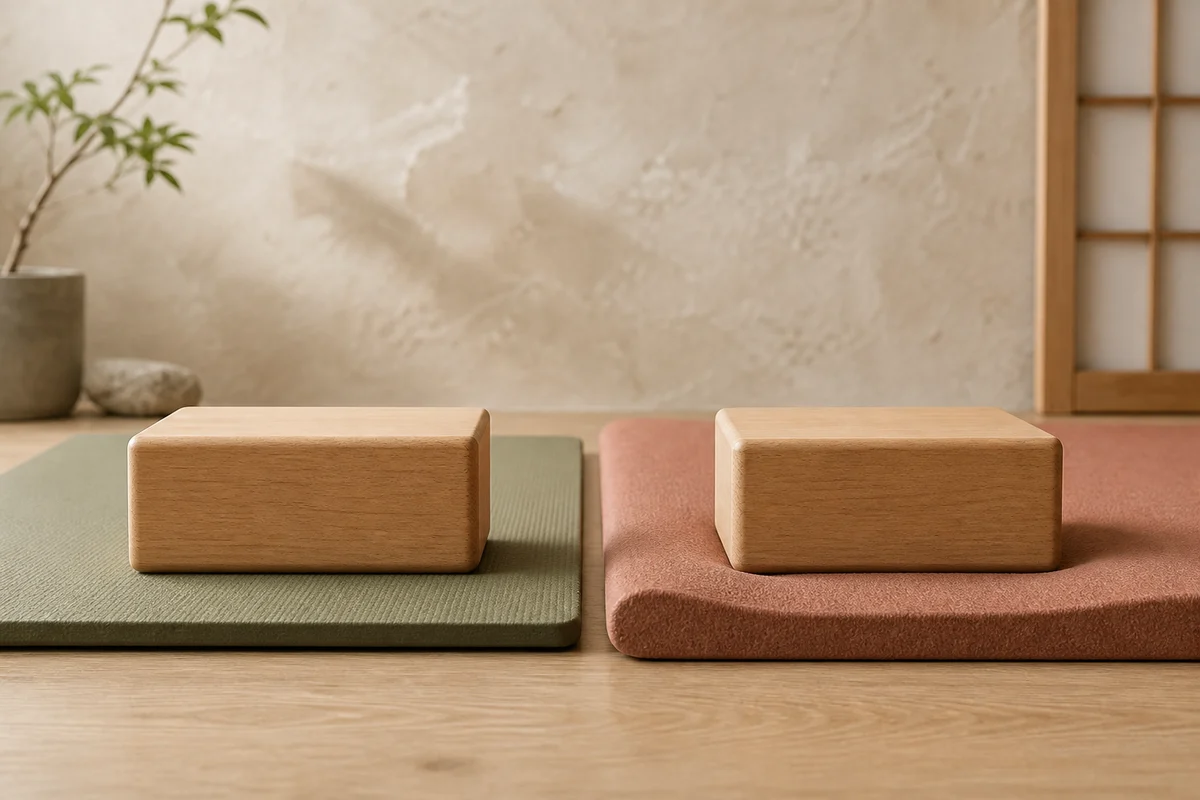
Thickness tells you the distance between the floor and the top surface. Density tells you how much of that distance remains when your weight presses into it. Retail listings rarely explain this well, yet it is the reason two 6mm mats can feel unrelated.
A dense 6mm PVC mat resists a concentrated load. Your knee makes a shallow impression and your standing foot stays comparatively level. The feel can be firm rather than plush, but the mat keeps doing its job when weight is focused into a small area.
A soft 12mm NBR mat makes a deep impression. That spreads pressure and feels comfortable in low-load floor work. During standing poses, however, the same movement means the ankle has to make constant small corrections. More thickness cannot compensate for a material that compresses too far for the task.
Cushion vs. stability
Illustrative
This is why “extra thick” is not a quality grade. It describes a dimension, not whether the mat is suitable for yoga. If a listing does not name the material, dimensions and intended use, treat the thickness headline cautiously.
What 4.7mm, 5mm, 6mm, 8mm and 12mm actually mean
4.7–5mm is the all-purpose range. It offers enough padding for most healthy knees on an ordinary floor while keeping strong floor feedback. Many premium rubber and PVC mats live here. It is not usually marketed as extra thick, but density can make it more supportive than a cheaper 6mm mat.
6mm is thick in conventional yoga terms. This is the sweet spot when hard floors or longer kneeling holds make 4–5mm feel unforgiving. Dense construction preserves stability; soft construction begins to trade it away.
8mm is a crossover thickness. It can suit gentle yoga, fitness work and users who accept less feedback underfoot. At this depth, length matters: some 8mm fitness mats are shorter than standard yoga mats, so check all three dimensions rather than the thickness alone.
10–12mm belongs mainly to restorative, stretching and Pilates-adjacent use. It is possible to do yoga on one, but standing balance is no longer the design priority. A half-inch mat sits at the top of this band.
15–25mm is exercise-mat territory. It can be excellent for floor mobility, rehabilitation exercises or a spine-sensitive Pilates session, but calling it a yoga mat does not make it appropriate for a flowing standing practice.
Thickness at a glance
Illustrative
For a measurement-first explanation, use the full guide to how thick a yoga mat should be.
Who should skip a thick yoga mat
A thick mat is not the automatic answer to discomfort. Skip it—or at least test a firmer option first—if any of these describe your practice:
- Standing balance is central. Ashtanga, fast vinyasa and balance-heavy sequences benefit from clear floor feedback.
- You commute with your mat. Dense thickness adds weight; soft thickness adds bulk. Neither is pleasant on a long walk.
- You practise on carpet. Carpet already introduces movement. Adding soft foam can make the surface less stable, not more comfortable; compare the carpet-specific mat picks instead.
- You rely on wet grip. Hot-yoga performance comes from the top surface and moisture management, not from extra depth.
- Only one or two kneeling poses bother you. A stable 4–5mm mat plus a folded blanket or knee pad may solve the local pressure without compromising the rest of the session.
Persistent, sharp or injury-related pain is not a shopping problem. A mat can change pressure and comfort; it cannot diagnose or treat the cause. Seek qualified guidance instead of buying progressively thicker foam.
How to choose the right thick mat
Match the mat to the practice you do most
Buy for the repeated part of your week, not the occasional edge case. Mixed home yoga points to dense 5–6mm. Restorative sessions and floor exercise can justify 10–13mm. Hot yoga points first to wet grip. Pilates points toward spinal cushion. Our Pilates mat guide covers that overlap separately.
Check material before millimetres
PVC can be either light and softly cushioned or exceptionally dense, so thickness alone still needs context. Natural rubber tends to be dense, grippy and heavy; it also contains latex. TPE is often lighter and softer. NBR foam is thick, light and comfortable but normally less stable and less durable under repeated compression.
Marketing terms such as “high density” are not standardised. Product weight, material and owner reports about compression are useful clues. A 7.5-pound 6mm mat and a three-pound half-inch mat clearly distribute material very differently.
Measure the room, the body and the rolled mat
Length is easy to overlook while comparing cushion. A 68-inch mat is compact but can leave a taller user's head or feet on the floor. Widths around 24 inches are standard; 26 inches feels notably roomier. Thick foam also produces a large roll that may not fit a normal yoga-mat bag or wall rack.
Treat grip as a separate specification
Grip has a dry and a wet version. Textured PVC can work well in an ordinary room and poorly once covered in sweat. Open polyurethane tops can grip moisture but need more careful cleaning. Closed-cell surfaces are easier to wipe but keep sweat on top. Decide which environment matters before assuming a premium label covers both.
Consider the true ownership cost
A lower purchase price is useful if you are testing a new habit. A higher price can make sense when density, dimensions and warranty align with years of regular use. Avoid false precision: prices change, discounts come and go, and a “lifetime” guarantee has conditions. Compare today's checkout price with the product you will actually receive.
The broader yoga mat buying guide connects thickness to material, grip, dimensions, sustainability and care.
Care: thick mats need more drying room
Do not soak a thick mat unless its maker explicitly allows it. Foam seams and deep rolls hold water longer than a thin mat, while closed-cell PVC is designed to be surface-cleaned. Use a lightly damp cloth and the manufacturer's recommended cleaner, then unroll the mat fully until both sides are dry.
Store it loosely rolled in a cool, dry place. Do not fold a dense mat that is meant to roll; repeated creases can become permanent. Keep thick foam away from radiators, hot cars and direct sun, which can accelerate hardening, expansion or surface breakdown. The mat-storage guide covers practical setups for small spaces.
The verdict
For one thick mat that still behaves like a yoga mat, choose a dense 6mm construction. The Manduka PRO 6mm is the strongest home-practice pick because it combines meaningful depth with stability and unusually clear durability terms. The Gaiam Premium 6mm is the more accessible beginner option when low weight and budget matter. Choose the Retrospec Solana half-inch only when floor comfort genuinely outranks standing precision.
The useful question is not “what is the thickest mat?” It is “how much cushion can I add before it interferes with the practice I actually do?” For most yogis, that answer stops at 6mm.
Frequently asked questions
Is a 6mm or 10mm yoga mat better?
A dense 6mm mat is the better all-purpose yoga choice because it cushions kneeling poses without making standing balance excessively vague. A 10mm mat suits restorative yoga, stretching and floor exercise better, especially when it uses soft foam. Thickness alone is not enough: a firm 6mm PVC mat and a soft 10mm foam mat behave very differently.
Does a thick yoga mat make balance harder?
It can. Your feet and hands sink into soft foam, so the surface moves while you balance. Dense 6mm mats limit that movement and remain practical for standing yoga; very soft mats around 10mm and above favour floor work. If balance is central to your practice, choose density before maximum thickness.
Can I use a thick yoga mat for Pilates?
Yes. A 10–15mm foam mat can be comfortable for floor-heavy Pilates because it cushions the spine, hips and tailbone. If your sessions mix Pilates with standing yoga, a dense 6mm mat is the more stable compromise. A dedicated Pilates mat and a yoga mat do different jobs.
Is a thick yoga mat suitable for hot yoga?
Only when its surface is designed for wet grip. Thickness does not create traction, and soft closed-cell foam can become slippery with sweat. For hot yoga, prioritise a proven moisture-gripping surface and easy cleaning; then choose the thickest version that remains stable enough for your practice.
What is the difference between dense PVC and soft NBR foam?
Dense PVC resists compression, so a 6mm mat can feel supportive and stable but heavy. Soft NBR foam compresses more, making a 12mm mat feel plush under knees and hips but less precise under standing feet. PVC usually suits general yoga; NBR suits gentle, restorative and floor-based work.
What thickness counts as a thick yoga mat?
In conventional yoga mats, 6mm is thick. Mats around 8–10mm sit between yoga and general exercise, while 12mm and above are usually soft floor-work mats. The label is inconsistent across shops, so compare the actual millimetres, material and density rather than relying on the word thick.
Frequently asked questions
Is a 6mm or 10mm yoga mat better?
A dense 6mm mat is the better all-purpose yoga choice because it cushions kneeling poses without making standing balance excessively vague. A 10mm mat suits restorative yoga, stretching and floor exercise better, especially when it uses soft foam. Thickness alone is not enough: a firm 6mm PVC mat and a soft 10mm foam mat behave very differently.
Does a thick yoga mat make balance harder?
It can. Your feet and hands sink into soft foam, so the surface moves while you balance. Dense 6mm mats limit that movement and remain practical for standing yoga; very soft mats around 10mm and above favour floor work. If balance is central to your practice, choose density before maximum thickness.
Can I use a thick yoga mat for Pilates?
Yes. A 10–15mm foam mat can be comfortable for floor-heavy Pilates because it cushions the spine, hips and tailbone. If your sessions mix Pilates with standing yoga, a dense 6mm mat is the more stable compromise. A dedicated Pilates mat and a yoga mat do different jobs.
Is a thick yoga mat suitable for hot yoga?
Only when its surface is designed for wet grip. Thickness does not create traction, and soft closed-cell foam can become slippery with sweat. For hot yoga, prioritise a proven moisture-gripping surface and easy cleaning; then choose the thickest version that remains stable enough for your practice.
What is the difference between dense PVC and soft NBR foam?
Dense PVC resists compression, so a 6mm mat can feel supportive and stable but heavy. Soft NBR foam compresses more, making a 12mm mat feel plush under knees and hips but less precise under standing feet. PVC usually suits general yoga; NBR suits gentle, restorative and floor-based work.
What thickness counts as a thick yoga mat?
In conventional yoga mats, 6mm is thick. Mats around 8–10mm sit between yoga and general exercise, while 12mm and above are usually soft floor-work mats. The label is inconsistent across shops, so compare the actual millimetres, material and density rather than relying on the word thick.