

This guide contains affiliate links — recommendations aren’t based on commission. Read our full disclosure.
How this page has changed
June 21, 2026
Sources, internal links and safety or product context reviewed.
In this guide
- 01What beginners actually need in a mat
- 02Quick picks: the best beginner yoga mats
- 031. Gaiam Premium 6mm — Best for most beginners
- 042. Retrospec Solana — Best cheap cushion
- 053. Jade Harmony — Best grip (natural rubber)
- 064. Liforme Original — Best for learning alignment
- 075. Manduka PRO 6mm — Best buy-it-for-life
- 08What thickness should a beginner mat be?
- 09Materials to be cautious with as a beginner
- 10Do beginners need an expensive mat?
- 11Where to go next
The best yoga mat for beginners is not the most expensive one — it is the one cheap and grippy enough that you actually unroll it three times this week. Beginners overthink the mat. You do not need premium rubber or alignment tech to learn Down Dog. You need a stable surface, a bit of cushion for your knees, and enough grip that your hands do not slide.
This is a budget-first shortlist. I did not test these in a lab — I cross-referenced manufacturer specs, construction details and broad reviewer consensus, and I flag latex and care issues openly. The aim is a calm, honest pick for each budget, plus the part most listicles skip: how thick a beginner mat should actually be, and why a cheaper mat is often the wiser first buy.
By Marvin Smit · Long-time practitioner, not a certified instructor.
Quick answer. For most beginners, the Gaiam Premium 6mm is the right first mat: cushioned, grippy enough, and cheap enough to find out whether yoga sticks before spending more. Want maximum cushion for the least money? The Retrospec Solana. Ready to buy one mat for years? The Manduka PRO. You do not need an expensive mat to start — you need one you will actually use. New to all of this? Start with our yoga for beginners guide first.
What beginners actually need in a mat
Before the picks, the short framework. Three things decide whether a mat helps or annoys a beginner:
- Thickness — aim for 4–6mm. Enough cushion for kneeling and seated poses, stable enough for standing balance. More on this below.
- Grip — dry grip is what you'll notice first. As a beginner in gentle, slower practice, you need your hands and feet to stay put. Cheap, slick foam is the usual culprit when poses feel wobbly.
- Durability over premium. A mat that survives daily home practice for a year beats a fancy mat you are afraid to wear out. Buy for the practice you have now, not the one you imagine.
That is the whole decision. For the full framework across material, size and care, see the pillar guide on how to choose a yoga mat — this page is the beginner-focused shortlist that comes out of it.
Quick picks: the best beginner yoga mats
| Pick | Best for | Thickness | Material | Latex flag |
|---|---|---|---|---|
| Gaiam Premium 6mm | Best for most beginners (budget) | 6 mm | PVC (6P-free) | No |
| Retrospec Solana | Best cheap cushion | ~12.7 mm | NBR foam | No |
| Jade Harmony | Best grip (natural rubber) | 5 mm | Natural rubber | Yes |
| Liforme Original | Best for learning alignment | 4.2 mm | Eco-PU + rubber base | Yes |
| Manduka PRO 6mm | Best buy-it-for-life | 6 mm | PVC (closed-cell) | No |
Three of these are budget or mid-price on purpose — that is where most beginners should start. The two premium mats are here for people who already know they will keep practising and want to buy once. If you are latex-sensitive, skip the Jade and Liforme.
1. Gaiam Premium 6mm — Best for most beginners
The Gaiam Premium 6mm is the mat I would point most beginners to first. It is cheap, widely available, and gives real 6mm cushion in a light PVC build (3.3 lb on OutdoorGearLab's scale, since Gaiam publishes no weight), so kneeling and seated poses feel kind on the joints while the mat stays easy to carry and store. For someone still finding out whether yoga fits their week, it removes the friction without a big spend — the full Gaiam yoga mat review covers its length and Prop 65 caveats.
The honest trade-off is density. A budget 6mm mat feels a little softer and less planted than a premium mat, so standing balance is slightly less stable and it will not last as long under hard daily use. That is the right compromise for a first mat: you get cushion and grip at a low price, and you upgrade later only if your practice tells you to.
Best for: most beginners, gentle and home practice, anyone who wants cushion first without spending much.
Skip it if: you already practise hard daily, or you know you want a denser, longer-lasting mat from the start.
2. Retrospec Solana — Best cheap cushion
The Retrospec Solana is the pick when you want the most cushion for the least money. It is a thick NBR-foam mat — around a half-inch — so it is genuinely soft underfoot, which makes kneeling, floor work and practising on a hard floor much more comfortable. For beginners with sensitive knees or wrists, that padding can be the difference between practising and avoiding it. The full Retrospec Solana review has the details.
Here is the honest caveat: that same thickness costs you stability. Soft, thick foam lets your feet sink in, so standing and balance poses feel less steady than on a firmer 4–6mm mat. It is also less durable than denser mats. Treat it as a comfortable, low-risk way to start — especially if cushion is your main worry — and accept that you may want a more stable mat once your balance work grows.
Best for: the smallest budget, sensitive knees, hard floors, and gentle floor-based practice.
Skip it if: you want steady balance for standing flows, or a mat that lasts years of daily use.
3. Jade Harmony — Best grip (natural rubber)
The Jade Harmony is the step up for beginners who keep sliding and want a mat that feels planted to the floor. Its natural-rubber surface has strong dry grip and a grounded, tactile feel that cheap foam cannot match — which is exactly what makes early standing poses feel more secure. Jade also plants a tree with every mat. The full Jade yoga mat review covers grip, care and the eco story.
Two honest caveats. First, latex: natural rubber is latex-relevant, so this is not a safe choice if you have a latex allergy or rubber sensitivity — pick a PVC mat instead. Second, care: natural rubber dislikes direct sun and heat, and open-cell rubber can lose grip when soaked with sweat, so it is better for dry and gentle practice than for hot yoga. If grip is your main beginner frustration and latex is not a concern, it is a mat you grow into rather than out of.
Best for: beginners who want grip and a grounded feel, dry and gentle practice, and a more natural surface.
Skip it if: you have any latex sensitivity, sweat heavily, or store gear in heat or sun.
4. Liforme Original — Best for learning alignment
The Liforme Original is the beginner pick that helps you learn where to put your body. Etched alignment guide-lines on the surface give you reference points for hands and feet, which is genuinely useful when you are new and cannot yet feel correct spacing in lunges, Down Dog and standing poses. It also has excellent grip on an eco-PU top over a natural-rubber base. This is a premium mat, so it is for beginners who already know they are committed.
The caveats are price and latex. At 4.2mm it is grippy and supportive rather than thickly cushioned, so if your knees need real padding, pair it with a folded towel or a knee pad. And the natural-rubber base is latex-relevant — not a neutral choice if you have a latex allergy. If you want guidance built into the mat and the budget is there, it shortens the awkward early-alignment phase.
Best for: committed beginners who want alignment help and top-tier grip, and who do not need maximum cushion.
Skip it if: you are on a budget, latex-sensitive, or want a thick, cushion-first surface.
5. Manduka PRO 6mm — Best buy-it-for-life
The Manduka PRO 6mm is the pick if you would rather buy one mat and keep it for years. It is a dense, closed-cell PVC mat with 6mm of cushion that stays stable underfoot — so you get knee comfort without the wobble of soft foam — and it is backed by a long-standing durability reputation and a lifetime guarantee (terms apply). For a beginner who is already sure yoga is sticking, it can be the only mat you buy. The full Manduka review has the detail.
The honest caveats are weight and break-in. At around 7.5 lb it is a mat that wants to live beside your practice space, not commute daily. And the surface is famously slick when new — it needs a short break-in (and Manduka's care routine) before the grip settles, which can surprise beginners expecting instant stickiness. If durability and stable cushion matter more to you than price, it is hard to wear out.
Best for: committed beginners who want one durable mat, kneeling-heavy or slower practice, and stable cushion that lasts.
Skip it if: you want a light commuter mat, the lowest price, or grip that works straight out of the box.
What thickness should a beginner mat be?
For most beginners, 4–6mm is the right range. It is the balance between two things that pull in opposite directions: cushion and stability. More foam protects your knees and wrists in kneeling and seated poses, but the same softness makes standing and balance poses harder, because your feet sink instead of pressing into a firm floor.
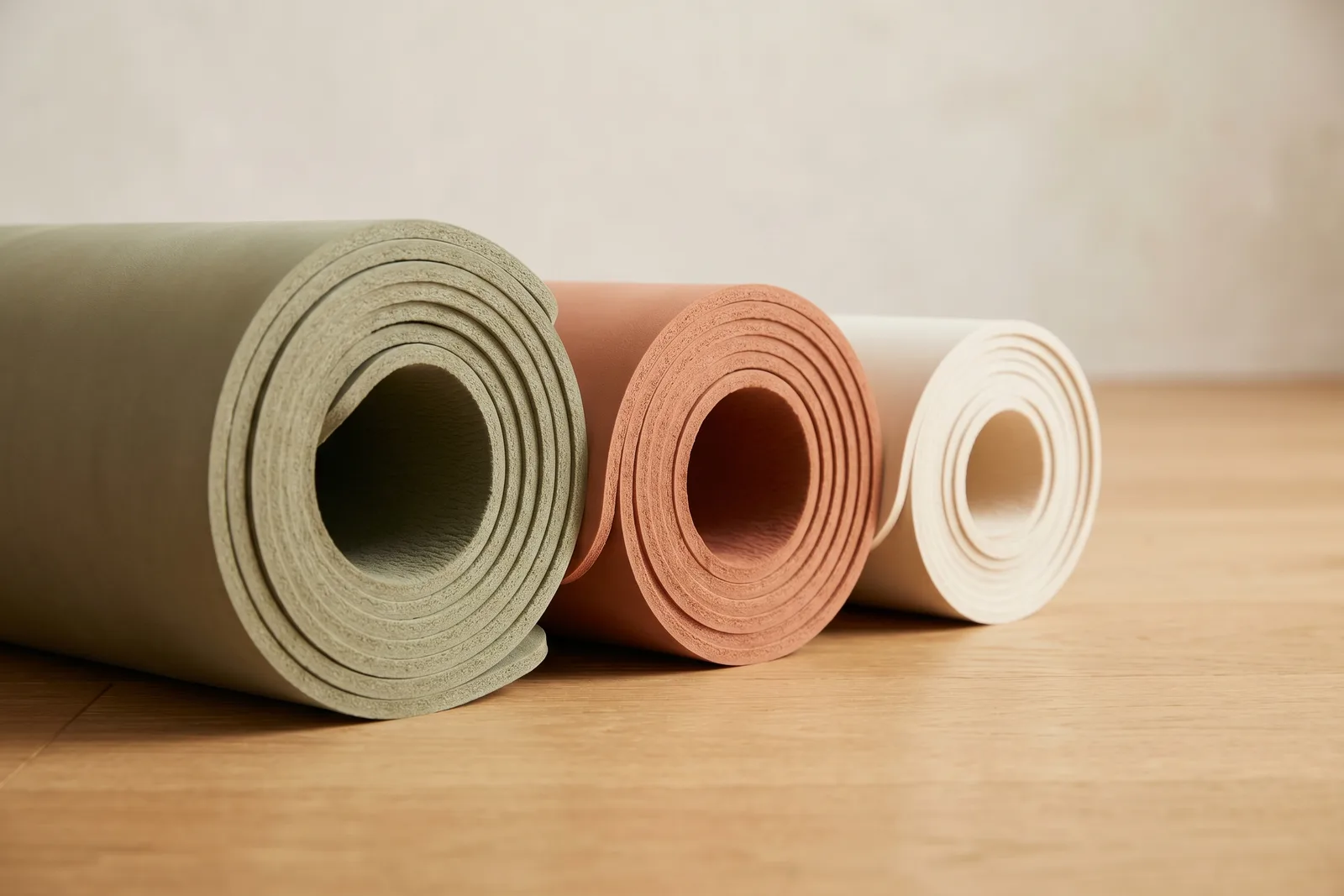
REI's gear guidance makes the same point: thicker mats are more comfortable for kneeling and tender joints, but harder to balance on during standing poses. So thicker is not automatically better. A stable 5mm mat is usually a kinder teacher than a squishy 10mm one, because balance is hard enough when you are learning without the floor moving under you.
Two shortcuts: if your knees are the main worry, lean to 6mm of dense cushion (not soft foam). If balance and a planted feel matter more, 4mm is plenty. For the full breakdown of millimetres and floor-feel, read the yoga mat thickness guide.
Materials to be cautious with as a beginner
You do not need to memorise materials, but two warnings save beginners money and frustration. First, the cheapest, softest foam mats: they feel nice in the shop, then compress flat, slide on the floor, and sometimes smell for the first weeks. They are fine for gentle, occasional use, but they are the usual reason a new practitioner thinks "I'm bad at this" when really the mat is moving under them.
Second, latex. Natural-rubber mats (like the Jade Harmony, and the base of the Liforme) grip beautifully, but natural rubber is latex-relevant. If you have a latex allergy or known sensitivity, do not gamble — choose a PVC or TPE mat instead, and check the manufacturer's material notes if you are unsure.
Beyond that, do not overthink it. Grip, a stable thickness, and a price you are comfortable with matter far more for a first mat than the exact material name.
Do beginners need an expensive mat?
No — and starting cheap is usually the smarter move, not a compromise. The honest reason: the biggest variable for a beginner is not the mat, it is whether you keep showing up. A reliable budget mat that you unroll every other day will do more for your practice than a premium mat that makes you anxious about wear.
Spend more when a real problem appears: you slide even on a clean mat, the surface compresses or flakes within months, or your joints clearly need more support than a budget mat gives. Those are signals to upgrade. "It would look nicer" is not. Plenty of long-term practitioners are perfectly happy on an entry-level mat for years.
If you do want to invest once, the Manduka PRO above is the classic buy-it-for-life choice — just buy it because you have decided yoga is part of your life, not to make it part of your life.
Where to go next
- Yoga for beginners: how to start — the full beginner guide: how to start, the best first poses, and a simple routine.
- How to choose a yoga mat — the complete decision framework across material, grip, size and durability.
- How thick should a yoga mat be? — the millimetre-by-millimetre breakdown.
- Best yoga mats, ranked — our wider best-of roundup once you are past the beginner stage.
Frequently asked questions
What is the best thickness for a yoga mat for beginners?
For most beginners, 4–6mm is the sweet spot. It gives enough cushion for kneeling and seated poses without making standing balance feel wobbly. Go thinner (3mm) only if you want a firm, planted feel or easy travel; go thicker (8mm+) only if joint comfort matters more to you than stability.
Do beginners need an expensive yoga mat?
No. A reliable budget mat is enough to start, and it is the smarter buy while you find out whether yoga sticks. Spend more later only if a real problem shows up — slipping, fast wear, or joints that need more support. The first goal is consistency, not premium gear.
What yoga mat material should beginners avoid?
Be cautious with very cheap, very soft foam mats: they compress flat, slide on the floor, and can smell at first. They are fine for gentle occasional use but frustrating if you practise regularly. If you have a latex allergy, also avoid natural-rubber mats (like Jade or the Liforme base) and choose a PVC or TPE mat instead.
Is a thicker yoga mat better for beginners?
Not always. More thickness adds cushion for knees and wrists, but past about 6mm of soft foam your feet sink in and standing balance gets harder. As REI's gear guidance puts it, thicker mats are comfier for kneeling but trickier to balance on. For learning, a stable 4–6mm beats a very thick, squishy mat.
What size yoga mat should a beginner buy?
A standard mat is about 68 by 24 inches, which fits most people. If you are tall and your feet hang off the end in poses like Down Dog or Savasana, look for a 71 or 74 inch mat. If your stance feels cramped side to side, a wider mat helps.
Can I just use an exercise or fitness mat to start?
You can, but it is usually not ideal. Thick fitness mats are soft and unstable for standing yoga poses, and many lack the grip that keeps your hands and feet from sliding. A basic yoga mat is inexpensive and makes learning easier. If you only have a fitness mat, start on it — just expect to upgrade if you keep practising.