

How this page has changed
July 26, 2026
Sources, internal links and safety or product context reviewed.
In this guide
- 01Natural rubber yoga mats at a glance
- 021. JadeYoga Harmony — best overall
- 032. Manduka eKO 5mm — best closed-cell rubber mat
- 043. Hugger Mugger Para Rubber — best dual-sided grip
- 054. JadeYoga Fusion — best extra-thick option
- 065. Manduka eKO Superlite — best for travel
- 07Open-cell vs closed-cell rubber
- 08Latex, odor and oxidation
- 09Sustainability without shortcuts
- 10The verdict
- 11Frequently asked questions
The JadeYoga Harmony is the strongest general-purpose natural rubber yoga mat: a simple all-rubber construction, established independent recommendations and multiple lengths. Choose the Manduka eKO 5mm if a sealed surface and springier cushion matter more than minimum weight, or the Manduka eKO Superlite when the mat must fold into luggage.
This shortlist is based on current manufacturer specifications, not a claim that The Yoga Sensei personally wear-tested every mat. No manufacturer score, owner rating or environmental claim has been converted into an invented performance grade.
Natural rubber yoga mats at a glance
| Pick | Best for | Surface / build | Thickness | Published weight | Main limitation |
|---|---|---|---|---|---|
| Jade Harmony | Best overall | Open-cell natural rubber | 3/16in (about 4.7mm) | Varies by length; standard around 5lb | Absorbs moisture; latex; attracts dust |
| Manduka eKO 5mm | Best sealed surface | Closed-cell natural tree rubber, 30%+ recycled content | 5mm | 7lb standard | Heavy; can feel slick with sweat |
| Hugger Mugger Para Rubber | Best dual-sided texture | Open-cell natural rubber; grip on both sides | 5mm | 6.6lb | Shorter/narrower standard size |
| Jade Fusion | Best extra-thick rubber mat | Natural rubber | 5/16in (about 8mm) | Heavy home/studio format | Too bulky for routine commuting |
| Manduka eKO Superlite | Best travel option | Foldable natural rubber | 1.5mm | About 2lb | No meaningful cushioning |
Natural rubber is not one standardized surface. Cell structure, texture, density and added recycled content change grip, sweat behavior and care.
1. JadeYoga Harmony — best overall
The Harmony is the cleanest answer when “natural rubber yoga mat” means a straightforward, grippy all-rubber mat. Jade publishes a 3/16-inch thickness and several lengths; its standard format is approximately 68 × 24 inches. The brand says it contains no PVC, EVA or synthetic rubber and warns people with rubber or latex allergies not to use it.
Its open-cell texture is the main advantage and the care trade-off. It produces strong skin contact but can take in moisture, collect lint and require complete drying. Independent testing outlets repeatedly select the Harmony for grip, but that evidence does not make it a hot-yoga towel replacement for every sweater.
Choose it for tactile grip and a dense but not extra-thick platform. Skip it when latex, very light weight or low-maintenance closed-cell care is essential. See current dimensions on JadeYoga's official page and the deeper Jade mat review.
2. Manduka eKO 5mm — best closed-cell rubber mat
Manduka's updated eKO uses natural non-Amazon tree rubber, including more than 30% recycled content, with a textured Catch-Grip top and a cushioned lower layer. The standard mat is 71 × 26 inches, 5mm and 7lb; a longer 79-inch version is heavier.
Unlike many rubber mats, its surface is closed-cell. It does not absorb moisture, which helps cleaning and surface life, but Manduka plainly says sweat can make it feel slippery and recommends a hand towel or full mat towel for hot yoga. That disclosure is more useful than a universal “wet/dry grip” slogan.
Choose it for a sealed, springy rubber build and broader width. Skip it if you walk to class, sweat heavily without using a towel or want the PRO line's lifetime guarantee—the eKO is not covered by it. Check the current build at Manduka.
3. Hugger Mugger Para Rubber — best dual-sided grip
The Para Rubber is a 70 × 24-inch, 5mm, 6.6lb open-cell natural-rubber mat. Hugger Mugger publishes textured grip on both sides and also offers an XL version. That reversible traction is useful when floor contact is as important as the practice face.
The standard mat is shorter and narrower than newer 72 × 26-inch formats, so dimensions—not marketing—should decide whether it fits. The brand explicitly says not to use it with latex allergy and acknowledges that the initial rubber smell needs airing.
Choose it if you want two usable grippy surfaces and firm cushioning. Skip it if you need generous standard dimensions or a light commute. Review the current sizes and care on the official Para Rubber page.
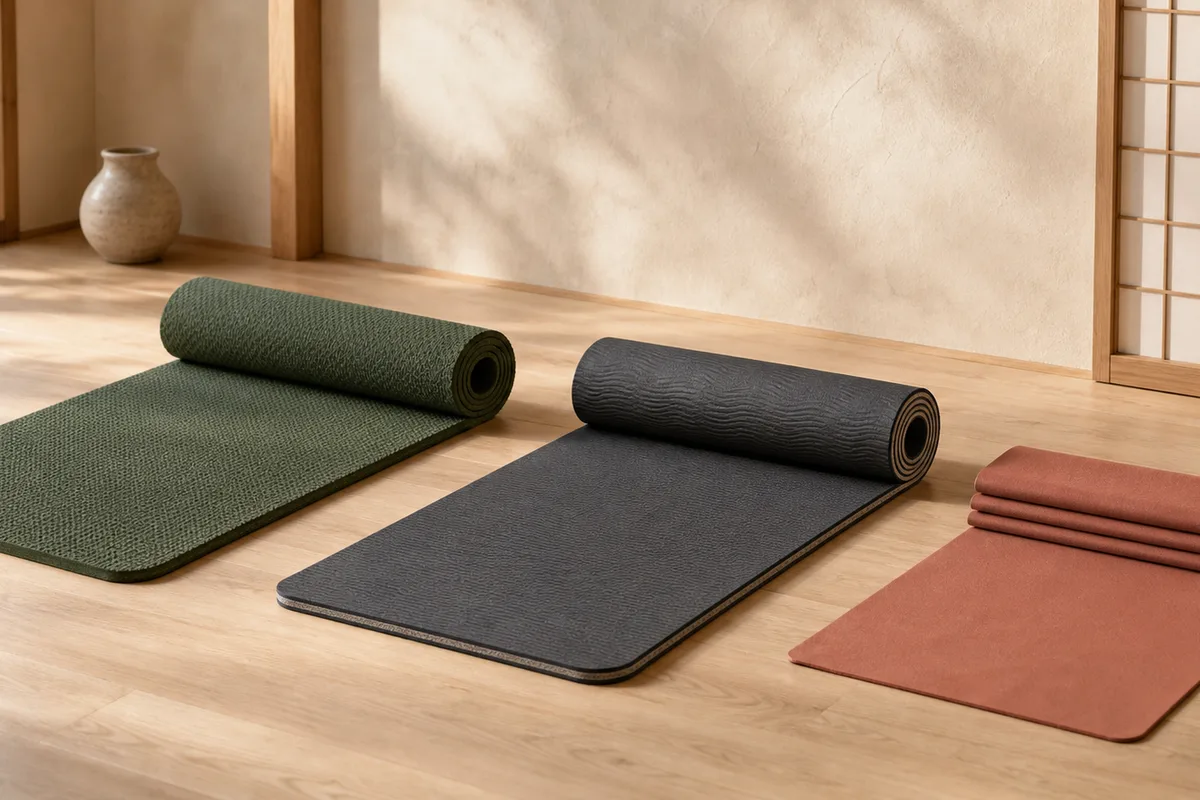
4. JadeYoga Fusion — best extra-thick option
The Fusion keeps Jade's natural-rubber approach but increases thickness to 5/16 inch, roughly 8mm. It is the category specialist for someone who wants rubber density with substantially more separation from a hard floor.
Extra thickness is not automatically better. More rubber means more weight and rolled bulk, and a very thick surface changes floor feedback. This is best treated as a home or car-to-studio mat, not an all-purpose commuter.
Choose it when the explicit priority is a thick natural-rubber platform. Skip it for travel, minimal storage or maximum floor feel. Verify size and weight for the selected variant at JadeYoga. Thickness is a comfort preference, not a treatment for joint pain.
5. Manduka eKO Superlite — best for travel
The eKO Superlite compresses natural-rubber surface feel into a 1.5mm sheet that can fold as well as roll. It weighs around two pounds and is intended for luggage, outdoor use or placement over a studio mat.
Its lack of cushioning is the design mechanism, not a concealed defect. On tile or concrete it will transmit nearly the entire floor. Like the other eKO mats, it remains inappropriate for latex-sensitive users despite Manduka's “99% latex-free” wording.
Choose it when packing volume outranks padding. Skip it for comfortable kneeling or a permanent home mat. Compare other packable constructions in the foldable yoga mat guide.
Open-cell vs closed-cell rubber
| Question | Open-cell rubber | Closed-cell rubber |
|---|---|---|
| Dry texture | Usually tactile and immediately grippy | Relies on molded surface texture |
| Sweat | Can take in moisture; must dry fully | Moisture remains on top and may pool |
| Cleaning | More careful; avoid saturation | Easier to wipe but still material-specific |
| Dust and lint | Often collects more | Usually less embedded debris |
| Service-life pressure | Moisture and cleaning reach the structure | Oxidation and surface wear still occur |
Neither cell type wins universally. Choose open-cell for immediate tactile contact, closed-cell for less absorption, and a PU-top rubber-base mat if heavy wet grip is the dominant need. Our non-slip mat guide separates dry and wet grip rather than treating them as one score.
Latex, odor and oxidation
Natural rubber originates from latex. A “99% latex-free” processing claim is not the same as verified safety for someone with latex sensitivity; Manduka itself says sensitive users should not use the eKO. Choose a confirmed latex-free material such as PVC, TPE or a specific foam construction when needed.
New rubber odor is normal and usually reduces with ventilation. Do not try to accelerate it with sun or harsh chemicals: ultraviolet light, heat and ozone contribute to oxidation. Changes in color, dryness or texture are material behavior, not automatically a dangerous contamination.
| Protect the mat from | Why | Better habit |
|---|---|---|
| Direct sun and hot cars | Speeds oxidation and fading | Store cool and shaded |
| Soaking or machine washing | Can weaken structure and deform layers | Wipe according to maker directions |
| Essential oils and harsh soap | May leave residue or damage rubber | Use an approved rubber cleaner |
| Rolling while wet | Traps moisture and odor | Dry completely before storage |
| Tight permanent compression | Can create shape memory | Roll loosely, surface as directed |
Sustainability without shortcuts
Tree rubber is renewable, but “natural” does not prove responsible plantation practices, low manufacturing impact or a long useful life. Look for named sourcing regions, recycled percentage, certification scope, packaging and take-back programs. Then consider how long the mat will actually remain useful.
The eco-friendly yoga mat guide compares rubber against cork, recycled inputs and long-life PVC. This page stays narrower: choosing among rubber constructions after you have already accepted latex, weight and oxidation as category trade-offs.
The verdict
Choose the Jade Harmony for the most established all-purpose open-cell rubber option. Choose the Manduka eKO 5mm for a sealed, layered surface and wider platform, or the Hugger Mugger Para Rubber for dual-sided texture. The Jade Fusion and eKO Superlite sit at opposite extremes: extra-thick home mat versus nearly cushion-free travel sheet.
No natural-rubber mat is neutral for latex sensitivity, and none is maintenance-free. The best one matches your preferred cell structure, real carrying tolerance and sweat behavior—not simply the word “natural.”
Frequently asked questions
Is natural rubber good for a yoga mat?
Natural rubber provides a dense, grounded feel and strong texture-led dry grip. It is usually heavier than foam, has an initial odor, can oxidize in sunlight and is unsuitable for latex-sensitive users.
Are natural rubber yoga mats non-slip?
Many have excellent dry grip, but sweat behavior depends on cell structure. Open-cell rubber manages some moisture but needs drying; closed-cell rubber may let sweat pool and require a towel.
Are natural rubber yoga mats safe for latex allergy?
No natural-rubber mat should be assumed safe. Even Manduka says its 99%-latex-free eKO is not recommended for latex-sensitive users. Choose a manufacturer-confirmed latex-free material.
How long does a natural rubber yoga mat last?
There is no universal lifespan. Sweat, sunlight, heat, cleaning and storage matter. Replace it when grip, surface integrity or floor stability no longer functions reliably.
How do you clean a natural rubber yoga mat?
Follow the exact maker instructions. Avoid soaking, machines, harsh soap, oils and direct sunlight. Wipe as directed, dry fully and store loosely rolled in a cool shaded place.
Frequently asked questions
Is natural rubber good for a yoga mat?
Natural rubber provides a dense, grounded feel and strong texture-led dry grip. It is usually heavier than foam, has an initial rubber odor, can oxidize in sunlight and is not suitable for people with latex sensitivity.
Are natural rubber yoga mats non-slip?
Many have excellent dry grip, but sweat behavior depends on surface structure. Open-cell rubber can manage some moisture but needs careful drying; a closed-cell rubber surface may let sweat pool and require a towel.
Are natural rubber yoga mats safe for latex allergy?
No natural-rubber mat should be assumed safe for latex allergy. Even Manduka, which labels eKO 99% latex-free, says it is not recommended for latex-sensitive users. Choose a manufacturer-confirmed latex-free material instead.
How long does a natural rubber yoga mat last?
There is no universal lifespan. Frequency, sweat, sunlight, heat, cleaning and storage all matter. Rubber naturally oxidizes and may change color or texture. Replace a mat when grip, surface integrity or floor stability no longer functions reliably.
How do you clean a natural rubber yoga mat?
Follow the exact manufacturer instructions. Generally, avoid soaking, machines, harsh soap, oils and direct sunlight. Wipe with an approved cleaner or damp cloth as directed, dry fully and store loosely rolled in a cool shaded place.