

How this page has changed
July 26, 2026
Sources, internal links and safety or product context reviewed.
In this guide
- 01Suede yoga mats at a glance
- 02What “suede” means on a yoga mat
- 03How dry and wet grip differ
- 041. Yoga Design Lab Combo Geo — most transparent construction
- 052. POPFLEX Meadow — light TPE-backed alternative
- 063. MARA BODY Cowgirl — washable recycled-PET option
- 07Suede mat versus a separate yoga towel
- 08Care without damaging the bonded layers
- 09Environmental claims to question
- 10Buying checklist
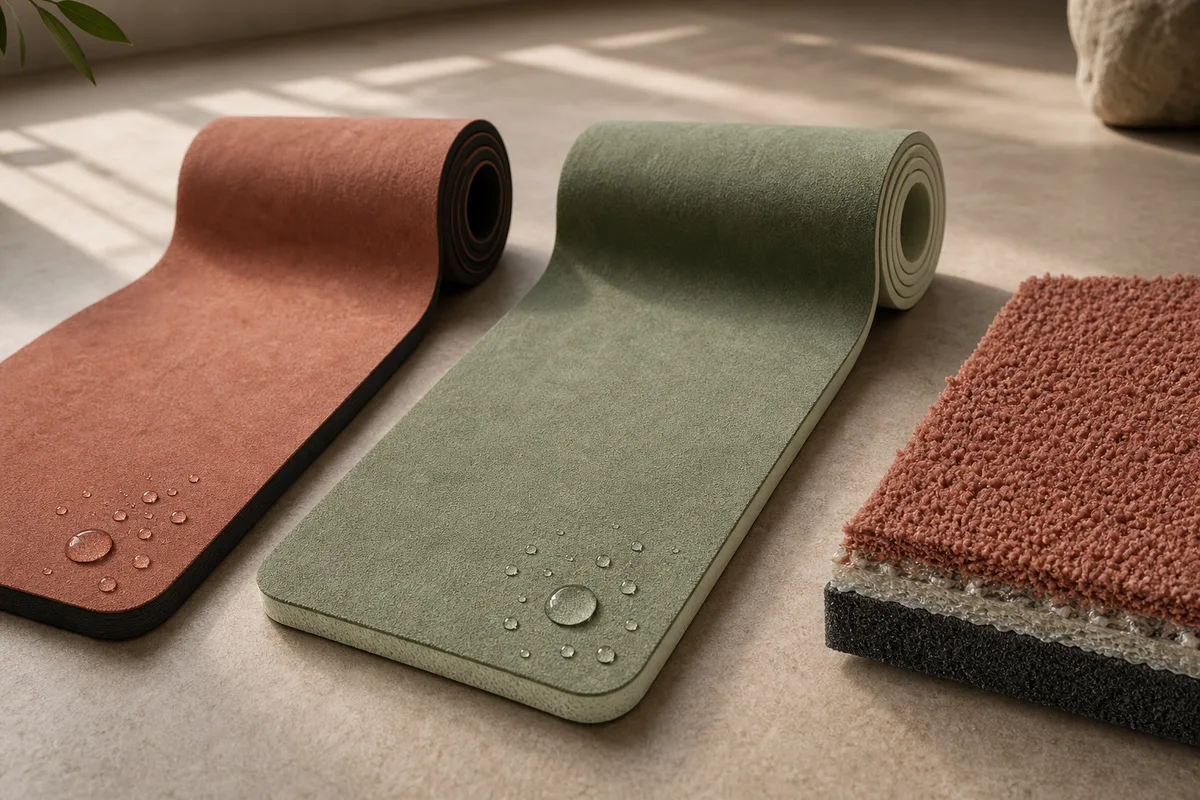
A suede yoga mat is usually not made from animal suede. In current yoga-gear listings, “suede,” “micro-suede” and “vegan suede” normally describe a soft synthetic microfiber top bonded to a thicker base. The top handles skin contact and moisture; the backing supplies most of the cushion, weight and floor traction.
That layered construction is the important buying fact. The three current options below include two rubber-backed mats and one TPE-backed mat. They look similar in a search result but differ sharply in weight, thickness, care and dry-surface behavior.
This is a source-checked comparison, not a claim of hands-on or laboratory testing. Manufacturer grip language is reported as a claim, then translated into practical limits.
Suede yoga mats at a glance
| Current option | Best fit | Published construction | Size, thickness and weight | Care signal |
|---|---|---|---|---|
| Yoga Design Lab Combo Geo | Sweat-heavy practice with a towel-like integrated surface | Recycled-PET microfiber over natural rubber | 178 × 61cm; 3.5 or 5.5mm; published weights 3.2 or 2.2kg | Hand wash preferred; conditional gentle machine cycle |
| POPFLEX Meadow | Lightweight, thick mat for shoppers who want a soft top | Micro-suede over high-density TPE | 183 × 61cm; 6mm; 0.64kg | Wipe clean and air-dry |
| MARA BODY Cowgirl | Washable printed mat with disclosed recycled-PET top | Recycled-PET microfiber suede over natural rubber | 178 × 61cm; 3.5mm; 2.5kg | Listed as machine washable; follow its care page |
Published weights can look counterintuitive. Yoga Design Lab’s page associates 3.5mm and 5.5mm with two weights but presents their order ambiguously, so confirm the selected variant before purchase. A precise-looking table should not conceal an unclear source.
What “suede” means on a yoga mat
Traditional suede is animal hide with a napped finish. The products in this guide instead use microfiber, micro-suede or recycled-PET microfiber. Fine synthetic fibers create a soft, towel-like face. “Vegan suede” therefore describes animal-material status, not a single fiber recipe or backing.
The bonded layers work as a system:
| Layer or listing term | What it can tell you | What it cannot tell you |
|---|---|---|
| Vegan suede / micro-suede | No animal suede is claimed; soft textile-like face | Exact polymer, recycled percentage, shedding or wet grip |
| Recycled-PET microfiber | Polyester fiber feedstock includes recycled PET | Full product impact, recyclability or backing material |
| Natural-rubber base | Dense, flexible rubber backing with strong floor contact potential | Latex suitability, plantation practices or biodegradation conditions |
| TPE base | Lightweight thermoplastic-elastomer foam | Exact elastomer family, blend, recycling route or durability |
| Moisture activated | Brand intends traction to increase as the surface dampens | A measured friction value or slip-proof performance for every person |
This is why “best suede mat” is not one material decision. First choose the surface behavior; then choose the backing, thickness and cleaning system.
How dry and wet grip differ
A tacky closed-cell mat aims to hold dry hands at the surface. A microfiber mat behaves more like a very short-pile towel: dry fibers may feel smooth, while light moisture can increase contact and reduce the feeling of skimming over the pile. Yoga Design Lab explicitly acknowledges that its Combo surface can feel slippery when dry and suggests a fine water mist before practice. POPFLEX similarly says its surface is designed to get grippier as hands become sweatier.
Treat those as product-specific design claims, not a law of microfiber. Weave, finish, contamination, cleaner residue and the amount of moisture all matter. Saturation can also become a problem; “more moisture” is not endlessly better.
| Practice condition | Likely microfiber behavior | Useful response |
|---|---|---|
| Cool room, dry hands | May feel less immediately tacky | Test return policy; use only a brand-approved light mist if instructed |
| Gradual perspiration | Surface may develop more traction | Spread hand and foot pressure; monitor transitions |
| Heavy, sustained sweat | Absorbent face can replace a loose towel for some users | Stop and wipe if pooling or sliding occurs |
| Cleaner residue or skin oils | Fibers may feel coated and inconsistent | Clean by the exact instructions and rinse residue where permitted |
| Still damp after cleaning | Grip and hygiene are unpredictable | Dry completely before rolling and reusing |
No material makes slipping impossible. If a hand or foot moves unexpectedly, leave the pose, dry the contact area and reset. A marketing phrase such as “anti-slip” is not a safety certification.
1. Yoga Design Lab Combo Geo — most transparent construction
The Combo Geo pairs a recycled-PET microfiber surface with a natural-rubber base. Its product page lists 178 × 61cm and 3.5mm or 5.5mm thickness choices. The brand’s FAQ adds the most useful disclosure: approximately 80% natural rubber and 20% recycled-bottle polyester, with the PET fabric heat-bonded to the rubber.
It is the clearest match for someone deliberately choosing an integrated mat-and-towel construction. The manufacturer also openly explains that the dry surface can feel slippery and recommends a fine mist. That limitation is more useful than an absolute grip promise.
Care is specific: hand washing is recommended for longevity; a gentle machine cycle is allowed only in a washer without a center agitator, using mild soap. Hang it away from direct sunlight and roll patterned side outward. Natural rubber is a source of natural-rubber latex, as the brand itself notes. This guide provides material information, not allergy advice; discuss personal risk with the manufacturer and an appropriately qualified clinician.
Choose it for unusually clear layer percentages, multiple thicknesses and documented dry-versus-damp behavior. Skip it if you want a very light travel mat or a reliably tacky dry surface. See the current Combo Geo specifications and manufacturer FAQ.
2. POPFLEX Meadow — light TPE-backed alternative
POPFLEX’s Meadow uses an ultra-absorbent micro-suede top over a high-density TPE bottom layer. It is 183 × 61cm, 6mm thick and listed at only 1.4lb (about 0.64kg). That makes it radically lighter than the rubber-backed examples while giving more nominal thickness.
Thickness is not the same as stability. A low-mass 6mm foam may compress or stretch differently from dense rubber, and POPFLEX does not publish density, compression recovery or friction test data. Still, the specification is useful for shoppers prioritizing easy carrying and a soft-feeling platform.
The care instructions differ from the washable rubber-backed mats: the brand tells users to wipe the mat with a gentle bleach-free product, then air-dry before rolling. Its page also suggests a diluted water-and-vinegar spray. Follow the current manufacturer instructions rather than applying a generic “microfiber can be machine washed” rule.
Choose Meadow for low published weight, 6mm thickness and a non-rubber backing. Skip it if you want natural rubber’s dense feel, verified machine washing or full material percentages. Review the live POPFLEX Meadow product page.
3. MARA BODY Cowgirl — washable recycled-PET option
MARA BODY publishes a recycled-PET microfiber-suede top and natural-rubber base, water-based inks, 178 × 61cm dimensions, 3.5mm thickness and 2.5kg weight. It presents the surface as a two-in-one mat and towel and lists the product as machine washable.
This is the middle-weight rubber option in the comparison and the simplest specification set. The brand calls the base recycled and biodegradable, but does not supply a percentage, certification, test method or disposal conditions on the product page. Those words should not be expanded into “the complete mat is biodegradable.” The synthetic textile, bonding and inks remain part of the finished object.
Machine washing is convenient only when drying space and the exact cycle requirements work for you. Read the linked use-and-care information before washing: a heavy wet rubber-backed mat can stress both mat and machine, and improper rolling while damp encourages odor.
Choose Cowgirl for a disclosed recycled-PET face, published weight and manufacturer-stated machine washability. Skip it if you need a light commuting mat, dislike printed surfaces or require independently verified environmental claims. Check the current MARA BODY Cowgirl specification.
Suede mat versus a separate yoga towel
An integrated microfiber mat removes one moving layer: the textile is bonded to its backing. A separate yoga mat towel can be laundered independently and used across several mats, but may bunch or shift unless sized and anchored well.
| Question | Integrated suede surface | Separate towel over a mat |
|---|---|---|
| Setup | One item; no alignment after bonding | Two items; towel must be positioned |
| Dry feel | Surface may be smooth before dampening | Depends on towel weave and base mat |
| Laundry | Entire mat follows one care method | Towel can usually be washed separately |
| Replacement | Worn top generally means replacing the mat | Replace towel or mat independently |
| Flexibility | Fixed surface and backing combination | Mix towel with different thicknesses and materials |
| Travel weight | Rubber versions can be heavy | A towel can pair with a studio mat |
For frequent studio travel, the replaceable system can be more practical. For home hot yoga, a bonded surface can reduce interruptions. Neither format is inherently more sustainable: lifespan, wash frequency, materials and replacement behavior determine more than the label.
Care without damaging the bonded layers
Cleaning advice must follow the exact model because water, heat and agitation affect both fibers and bond lines.
- Check the current care page. Save it when you buy; instructions can change.
- Remove surface moisture promptly. Blot rather than aggressively scrub the pile.
- Use only an approved cleaner. Essential oils, bleach, solvents and concentrated acids can leave residue or affect adhesives and rubber.
- Rinse if instructed. Detergent trapped in microfiber can alter feel.
- Dry fully and evenly. Keep away from radiators and prolonged direct sun unless the brand explicitly permits them.
- Roll in the stated direction. Some printed bonded mats specify top-side outward to avoid creasing.
| Option | Routine method | Deeper clean | Important restriction |
|---|---|---|---|
| Yoga Design Lab Combo | Mild clean and full air-dry | Hand wash preferred; conditional gentle machine cycle | No center agitator; avoid direct-sun drying |
| POPFLEX Meadow | Gentle wipe, then air-dry | Use only its approved wipe/spray approach | No published machine-wash instruction on the cited page |
| MARA BODY Cowgirl | Follow brand care guidance | Product is described as machine washable | Verify cycle, detergent and drying steps before use |
For broader principles, use our yoga mat cleaning guide, but let the product instructions override generic advice.
Environmental claims to question
“Vegan” answers one narrow question: the suede-like face is not animal hide. It does not establish carbon footprint, microfiber shedding, chemical safety, durability or recyclability. Likewise, natural rubber is bio-based but a bonded rubber-and-polyester mat is a multi-material product that ordinary curbside systems are unlikely to separate.
Ask brands for:
- fiber and backing percentages by mass;
- the source and percentage of recycled content;
- restricted-substance or emissions testing for the finished mat;
- bonding method and repair guidance;
- realistic take-back or recycling routes in your region;
- warranty coverage and replacement parts, if any.
Longevity is often the most actionable lever. Choose a surface you will actually use, follow its care limits and avoid replacing a functional mat for a vague “eco” upgrade. Our eco-friendly yoga mat guide explains how to assess substantiation rather than slogans.
Buying checklist
- Confirm whether “suede” means polyester, recycled PET or another disclosed fiber.
- Identify the backing: natural rubber, TPE or something else.
- Compare weight as well as thickness; dense rubber is less commute-friendly.
- Decide whether you need immediate dry tack or moisture-responsive traction.
- Read the exact washing and drying instructions before purchase.
- Treat “vegan,” “eco-friendly,” “non-toxic” and “biodegradable” as separate claims requiring separate evidence.
- Check dimensions; 178cm may be short for taller practitioners.
- Use a return policy to assess feel, because published materials do not predict every hand, foot or practice climate.
The best suede yoga mat is therefore not simply the softest one. It is the construction whose surface behavior, backing, weight and care burden fit your actual practice. For heavy sweat, compare these with the dedicated hot-yoga mat guide. For dry practice, a conventional textured or tacky surface may remain the more predictable choice.
Frequently asked questions
What is a suede yoga mat made from?
Most products sold as suede or vegan suede yoga mats use a synthetic microfiber textile surface rather than animal hide. That surface is bonded to a cushioning and floor-gripping backing such as natural rubber or TPE. Check both layers because the surface name does not describe the entire mat.
Are suede yoga mats slippery when dry?
They can feel less tacky than polyurethane or textured rubber when completely dry. Some manufacturers explicitly design the microfiber surface to gain traction with moisture and recommend a light water mist before a low-sweat practice. Performance varies by weave, finish and user, so a moisture-activated claim is not a universal guarantee.
Are suede yoga mats good for hot yoga?
An absorbent bonded microfiber top can manage sweat without a separate towel, making this construction relevant to hot yoga. Check the exact product’s wet-grip claim, care method, thickness and backing. No mat eliminates the need to stop if your hands or feet slide.
Can a suede yoga mat go in the washing machine?
Only if the manufacturer of that exact mat permits it. Yoga Design Lab allows a gentle cycle in a machine without a center agitator but recommends hand washing for longevity; MARA BODY describes its mat as machine washable; POPFLEX instructs users to wipe its Meadow mat. Never infer washability from the word suede.
Is vegan suede eco-friendly?
Vegan means the surface is not animal suede; it does not mean plastic-free, biodegradable or low impact. Many vegan-suede surfaces are polyester microfiber. Evaluate recycled content, backing, bonding, durability, wash frequency, packaging and realistic end-of-life options separately.