

Direct answer
Which should you choose?
Choose TPE
If you want a lighter, firmer mat for standing poses and general yoga.
Choose NBR
If floor cushioning matters more than compact storage or standing stability.
Biggest practical difference: TPE is commonly thinner and more supportive; NBR is usually thicker, softer and bulkier.
- Typical feel
- Firmer and springier
- Softer and plusher
- Standing stability
- Usually the stronger fit
- Can feel less stable when thick
- Floor cushioning
- Moderate
- High in common 10mm formats
- Carry
- Thinner, often lighter
- Bulkier roll
- Sweat grip
- Product-specific
- Product-specific
- Composition
- Often a proprietary blend
- Synthetic rubber foam
- Best for
- General yoga and transitions
- Floor work and extra padding
How this page has changed
July 26, 2026
Sources, internal links and safety or product context reviewed.
In this guide
- 01TPE vs NBR: quick verdict
- 02Four current products, not four stereotypes
- 031. Stability and compression
- 042. Portability: weight plus bulk
- 053. Surface grip and sweat
- 064. Materials, latex and claims
- 075. Cleaning and storage
- 086. Environmental trade-offs
- 09Choose TPE when…
- 10Choose NBR when…
- 11Final decision checklist
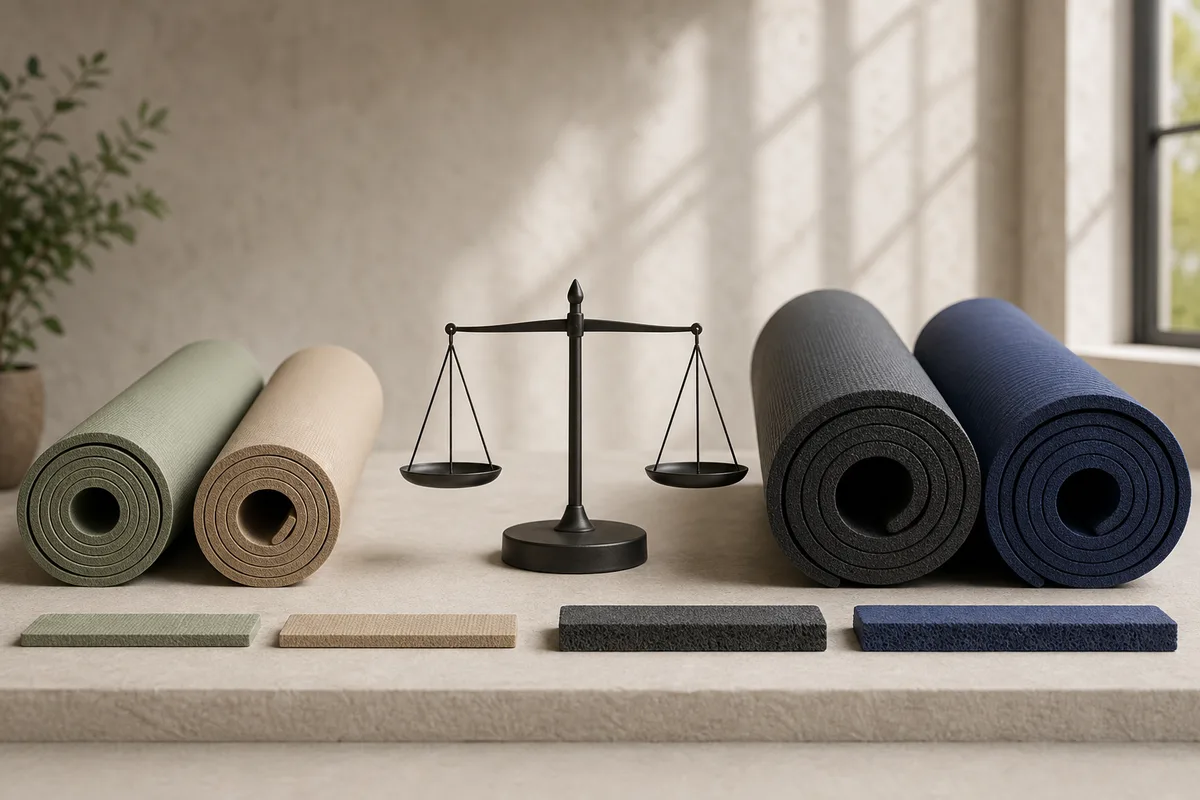
The practical TPE vs NBR yoga mat decision is usually not “which polymer wins?” It is whether you need a mid-thickness, compact platform for standing yoga and mixed training, or a thick, soft exercise mat for floor work. Current product formats—not chemistry alone—create much of that difference.
TPE means thermoplastic elastomer, a broad family of rubber-like materials processed with thermoplastic methods. NBR means nitrile butadiene rubber, a specific synthetic-rubber copolymer. Both can be foamed, textured and formulated at different densities, so no honest comparison can assign universal grip or durability scores from the acronym.
This comparison uses four current manufacturer-documented mats and makes no hands-on or laboratory-testing claim.
TPE vs NBR: quick verdict
| If your priority is… | Better starting point | Why | Verify before buying |
|---|---|---|---|
| Standing poses and transitions | 5mm TPE | Less nominal sink and closer floor feedback | Density, stretch and dry/wet grip |
| Floor stretching or general exercise | 10mm NBR | More separation from a hard floor | Bottoming-out and lateral stretch |
| Studio commuting | TPE | Thinner roll; current examples are lighter | Exact weight and roll diameter |
| Softest unloaded feel | NBR | Marketed in plush 10mm foam formats | Loaded compression, not touch alone |
| Heavy sweat | Neither by default | Both compared families use closed-cell surfaces | Product-specific wet friction or add a towel |
| Transparent composition | Product-dependent | TPE may be a blend; NBR listings also omit formulation | Percentages and finished-product tests |
Choose TPE as the more versatile default for mixed yoga. Choose NBR when thick padding for ground-based exercise is the explicit goal and reduced standing stability is acceptable. If one pressure point is the only problem, a firm standard mat plus a targeted pad may preserve more stability than 10mm foam everywhere.
Four current products, not four stereotypes
| Product | Family | Published construction | Size / thickness / weight | Best-documented use |
|---|---|---|---|---|
| Manduka X | TPE | High-density closed-cell TPE; dual surfaces | 180 × 61cm / 5mm / 1.54kg | Mixed yoga, strength and outdoor training |
| Hugger Mugger Earth Elements | TPE | TPE; textured dry-grip face | 183 × 61cm / 5mm / 1.09kg | Lightweight everyday carry |
| Rogue NBR | NBR | High-density closed-cell NBR; brand says latex-free | 184 × 62.9cm / 10mm / 1.81kg | Yoga, stretching and meditation with extra cushion |
| Reebok Training Mat | NBR | 100% NBR foam; ridged base | Thickness 10mm; size/weight omitted globally | Ground-based exercise |
This table exposes the strongest evidence gap. Reebok names a clean 100% NBR recipe but withholds dimensions and weight; Hugger Mugger publishes usable measurements but does not identify a specific TPE chemistry or density. “More specifications” is often a more defensible reason to shortlist a mat than a sweeping claim about its material family.
1. Stability and compression
Thickness is visible; density and compression recovery are not. A 10mm mat may feel luxurious when pressed by hand yet sink deeply under a standing foot. A firmer 5mm mat can feel less plush while preserving a more consistent base for balance.
| Load condition | TPE question | NBR question |
|---|---|---|
| Standing foot | Does 5mm foam tilt or stretch? | Does 10mm foam sink unevenly? |
| Knee or elbow | Does it bottom out despite moderate thickness? | Does softness prevent bottoming-out or only delay it? |
| Plank | Do opposing forces elongate the mat? | Does thick foam stretch or wrinkle? |
| Fast transition | Does the surface rebound before the next contact? | Does a compressed zone recover slowly? |
| Long-term storage | Does a tight roll curl the edges? | Do straps leave permanent dents? |
No brand in this comparison publishes numeric foam density or standardized indentation-force data. That prevents a scientific comfort ranking. Test loaded behavior within the return window, on the floor you actually use, and stop if the platform shifts.
The Manduka X is the best documented TPE stability direction because Manduka calls it high-density and positions it across yoga and strength work. Rogue also calls its NBR high-density, yet regional customer feedback includes repeated observations of some stretch. Two reviews are not population evidence, but they are a reason to test lateral force rather than accepting “high density” as a measurement.
2. Portability: weight plus bulk
TPE wins this set on compactness. Both TPE products are 5mm, versus 10mm for both NBR products. Even when weight is close, a mat twice as thick makes a larger roll and takes more space in a bag, locker or small home.
The Hugger Mugger Earth Elements publishes the lowest weight at 2.4lb (1.09kg). Manduka X is 3.4lb (1.54kg). Rogue NBR is 4lb (1.81kg). Reebok calls its mat lightweight but provides no number on the cited global page, so it cannot honestly take a portability rank.
| Carry factor | What matters more than the label |
|---|---|
| Scale weight | Finished product measurement, including all layers |
| Roll size | Thickness, length, foam stiffness and how tightly it may be rolled |
| Strap | Whether included and whether it compresses soft foam during storage |
| Shape recovery | Whether the mat lies flat after transport |
| Dimensions | Taller/wider mats add volume regardless of material |
If you walk or cycle to class, compare the actual packed dimensions. If the mat stays at home, NBR’s bulk may be irrelevant.
3. Surface grip and sweat
All four products use non-absorbent or wipe-clean foam directions rather than a towel-like or open-cell PU sweat surface. Closed-cell construction limits liquid penetration, but sweat then remains on top and can change skin friction.
Manduka describes the X around dry grip and advises pairing it with a towel for sweat-heavy practice. Hugger Mugger also frames Earth Elements as a textured dry-grip mat. Rogue uses “non-slip” without publishing dry/wet friction values. Reebok says its ridged base increases floor stability, which addresses mat-to-floor traction—not necessarily hand-to-top wet traction.
Separate three tests:
- Do hands and feet hold the upper face when dry?
- Does the entire mat hold the floor?
- Does the foam deform internally under opposing force?
A mat can pass one and fail another. Neither TPE nor NBR should be selected for hot yoga without product-specific wet-grip evidence or a suitable towel plan.
4. Materials, latex and claims
TPE is a category, not one polymer. A manufacturer may blend different thermoplastic elastomers, fillers and colorants. “TPE” does not automatically mean recyclable, biodegradable, non-toxic or latex-free.
NBR itself is synthetic nitrile rubber rather than natural rubber, but that does not prove a finished mat contains no natural-rubber latex or other blend. Rogue explicitly calls its exact product latex-free. Reebok does not make that product-specific statement on the cited global page. Do not transfer Rogue’s claim to the whole category.
| Claim | Evidence needed |
|---|---|
| Recyclable | Exact formulation plus a facility that accepts it locally |
| Biodegradable | Named method, conditions, time and pass criteria |
| Non-toxic | Defined substances, limits, laboratory and finished-product report |
| Latex-free | Product-specific manufacturer statement or appropriate test scope |
| Eco-friendly | Measured life-cycle boundary rather than a standalone adjective |
| High-density | Numeric density and test method |
For a known allergy, use manufacturer documentation and advice from an appropriately qualified clinician; this comparison provides material information, not allergy guidance.
5. Cleaning and storage
Both families in this comparison are designed around low liquid absorption. That makes routine wiping straightforward, but cleaner compatibility still varies.
- Manduka says to wipe the X with its approved cleaner and damp cloth, air-dry and avoid soaking or machine washing.
- Hugger Mugger’s guidance centers on gentle wiping and complete drying; confirm the current product instructions.
- Rogue says to wipe with a clean towel after use.
- Reebok calls the surface easy to clean but does not publish a detailed cleaner recipe on the cited page.
When instructions are incomplete, ask the brand before using bleach, concentrated vinegar, essential oils, solvents or a washing machine. Dry both sides fully before rolling. Do not tighten a carry strap so far that it permanently dents soft NBR foam.
6. Environmental trade-offs
TPE can be remelted and reprocessed in principle, unlike a cured thermoset rubber, but consumer recycling is not guaranteed. Pigments, blends and contamination can prevent acceptance. NBR is petrochemical synthetic rubber, and ordinary curbside systems generally do not accept foam exercise mats.
The most practical questions are product-specific:
- Is the full formulation or recycled percentage disclosed?
- Is the mat durable under the intended practice and cleaning cycle?
- Does the brand offer take-back in your country?
- Can a local specialist name this exact material as accepted?
- Does the warranty cover premature tearing or permanent deformation?
Do not replace a functional mat just to change acronyms. Extending useful life and buying a construction you will keep are stronger actions than relying on an unsupported “eco” label.
Choose TPE when…
- you want one mat for standing yoga and mixed exercise;
- 5mm gives enough cushioning without a large roll;
- studio commuting makes bulk important;
- you prefer a closed-cell, wipe-clean surface;
- the exact product publishes weight, dimensions and care.
Start with the complete TPE yoga mat guide for all three source-checked options.
Choose NBR when…
- your routine is predominantly stretching, floor exercise or slower work;
- a soft 10mm format is the deliberate priority;
- the mat stays home and roll size matters less;
- you can test compression, stretch and underside movement;
- the exact product provides the material and finished-product claims you need.
Use the complete NBR yoga mat guide for the full specification and claims audit.
Final decision checklist
- Choose the activity before the material acronym.
- Compare thickness, weight and dimensions from the exact SKU.
- Ask for numeric density and compression recovery where possible.
- Separate dry top grip, wet top grip and underside floor grip.
- Verify full composition and product-specific latex wording.
- Read cleaning, heat and storage restrictions.
- Test loaded stability and stretch during the return period.
- Require a real recycling route before counting recyclability as a benefit.
For most mixed yoga practices, a documented 5mm TPE mat is the more versatile starting point. For comfort-first floor work, 10mm NBR is the clearer specialist tool. That conclusion comes from current product format and use—not a claim that every TPE formulation is firmer or every NBR foam is softer.
Frequently asked questions
Is TPE or NBR better for a yoga mat?
Neither is universally better. In the current products compared here, 5mm TPE mats are the better starting point for standing yoga, mixed training and easier carrying. The 10mm NBR mats prioritize soft floor-work cushioning but can trade away stability and compactness. Density and texture still matter more than the acronym alone.
What is the main difference between TPE and NBR mats?
TPE is a broad family of thermoplastic elastomers that can be reheated and processed as thermoplastics. NBR is a specific synthetic rubber copolymer of acrylonitrile and butadiene. Consumer TPE yoga mats are commonly mid-thickness; NBR exercise mats are commonly thick foams, but those market conventions are not chemical rules.
Which is better for standing balance, TPE or NBR?
A thinner, sufficiently firm TPE mat is generally the safer starting point for direct floor feedback than a soft 10mm NBR mat. Actual stability depends on foam density, compression, surface texture and floor grip. Test the exact mat rather than relying on material category alone.
Which is easier to carry, TPE or NBR?
The product data are mixed: the 5mm TPE examples weigh 1.09–1.54kg, while the fully specified 10mm Rogue NBR weighs 1.81kg. NBR rolls are also bulkier at twice the thickness. Weight must be checked per model because Reebok does not publish it on the cited global page.
Are TPE and NBR yoga mats eco-friendly?
Neither acronym proves low environmental impact. TPE may be reprocessable in manufacturing, but local recycling depends on the exact formulation and facility. NBR is synthetic rubber and is not normally accepted curbside. Look for full composition, verified recycled content, durability evidence and a real local end-of-life route.