

Direct answer
Which should you choose?
Choose open-cell
If sweat grip matters and you accept more careful cleaning and drying.
Choose closed-cell
If easy wiping and low moisture absorption matter most.
Biggest practical difference: Open-cell surfaces absorb moisture; closed-cell surfaces resist it, which changes both wet grip and care.
- Moisture
- Absorbs it
- Resists it
- Damp-hand grip
- Often the stronger fit
- More surface-dependent
- Cleaning
- Careful surface cleaning
- Usually easier to wipe
- Drying
- Needs thorough air-drying
- Usually faster
- Odor risk
- Higher if stored damp
- Lower absorption
- Best for
- Sweaty sessions
- Low-maintenance practice
How this page has changed
July 26, 2026
Sources, internal links and safety or product context reviewed.
In this guide
- 01Open-cell vs closed-cell at a glance
- 02What “open-cell” means on a yoga mat
- 03What “closed-cell” means on a yoga mat
- 04The layer problem: surface is not the whole mat
- 05Five current constructions, classified carefully
- 06Which one should you choose?
- 07Hot yoga: absorbent mat or closed mat plus towel?
- 08Cleaning and drying: where generic advice fails
- 09How to verify an unlabelled product
- 10Common myths to reject
- 11Final buying checklist
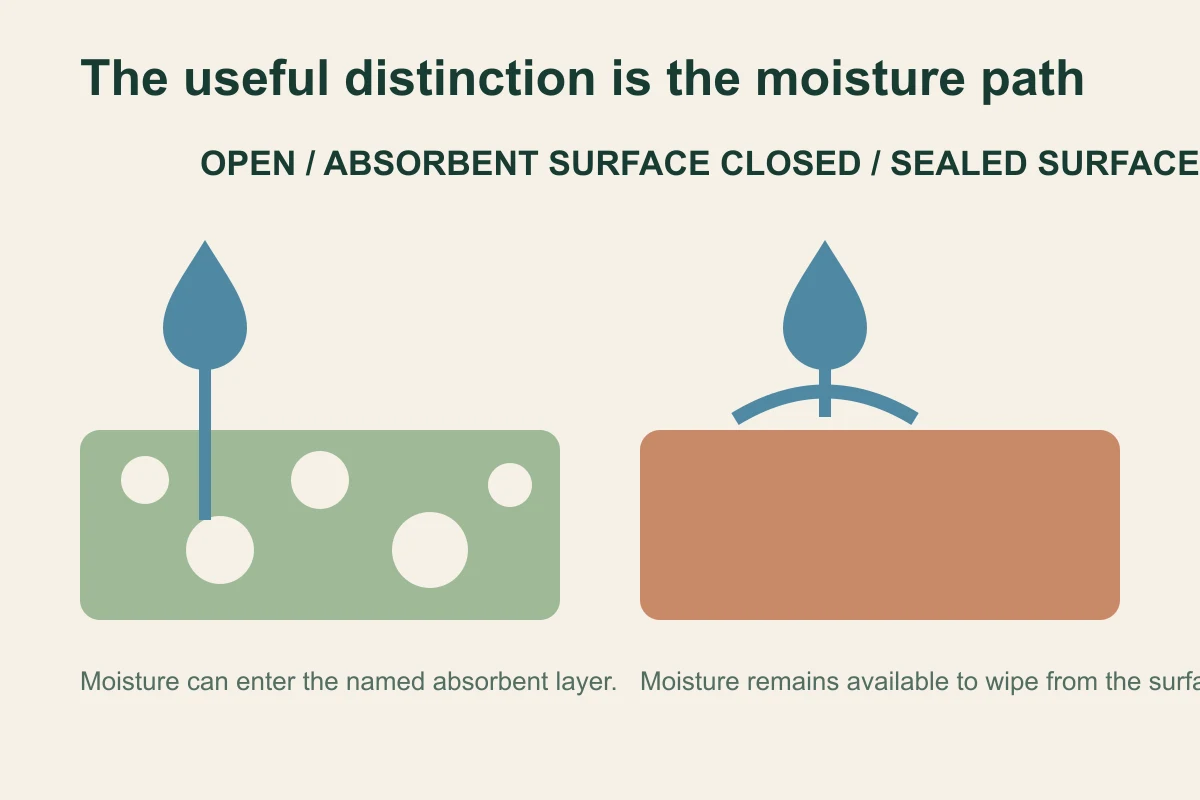
The practical difference between an open-cell and closed-cell yoga mat is where moisture goes. An open-cell or absorbent practice layer accepts moisture; a closed-cell or sealed surface keeps it on top. That changes sweat management, cleaning and drying—but it does not let you predict every other property of the mat.
The most important correction to common buying advice is this: a material is not a cell structure, and a mat is not always one layer. Natural rubber can appear in a sealed design. Polyurethane can form an absorbent top over a barrier and rubber base. “Open-cell mat” may describe the practice surface rather than every millimeter beneath it.
Open-cell vs closed-cell at a glance
| Question | Open-cell / absorbent surface | Closed-cell / sealed surface |
|---|---|---|
| Where does moisture go? | Into the named absorbent layer | Remains on the surface |
| Sweat strategy | Surface may be designed to gain wet grip | Wipe moisture or add a towel when needed |
| Routine care | Controlled cleaning plus thorough drying | Surface wiping is usually central |
| Deep cleaning | Product-specific; never assume soaking | Product-specific; never assume soaking |
| Material shortcut | None—PU or rubber alone does not decide it | None—PVC, TPE or rubber labels are incomplete |
| Main buying risk | Underestimating drying and retained moisture | Underestimating surface sweat and towel needs |
This table describes moisture behavior, not universal grip, hygiene, density, softness or lifespan. Those are frequent SERP shortcuts, but manufacturers build foams and layered mats differently. Compare the exact product’s surface, base and care guide.
What “open-cell” means on a yoga mat
In an open cellular structure, connected spaces can accept liquid. Yoga brands also use “open-cell” more practically for an absorbent practice surface. Manduka describes its GRP line as an open-cell polyurethane-and-rubber construction designed to take in moisture. Liforme describes the thin polyurethane practice layer on its mats as open-celled and moisture absorbing.
That can support a wet-grip strategy: instead of sweat pooling between hand and surface, the named layer takes it in. It also means the liquid has to leave again. Cleaning must stay within the brand’s instructions, and the mat must be fully dry before storage.
Open-cell does not automatically mean:
- natural rubber throughout;
- soft or thick;
- safe to submerge;
- permanently non-slip;
- shorter-lived by a predictable number of years;
- the same absorbency through every layer.
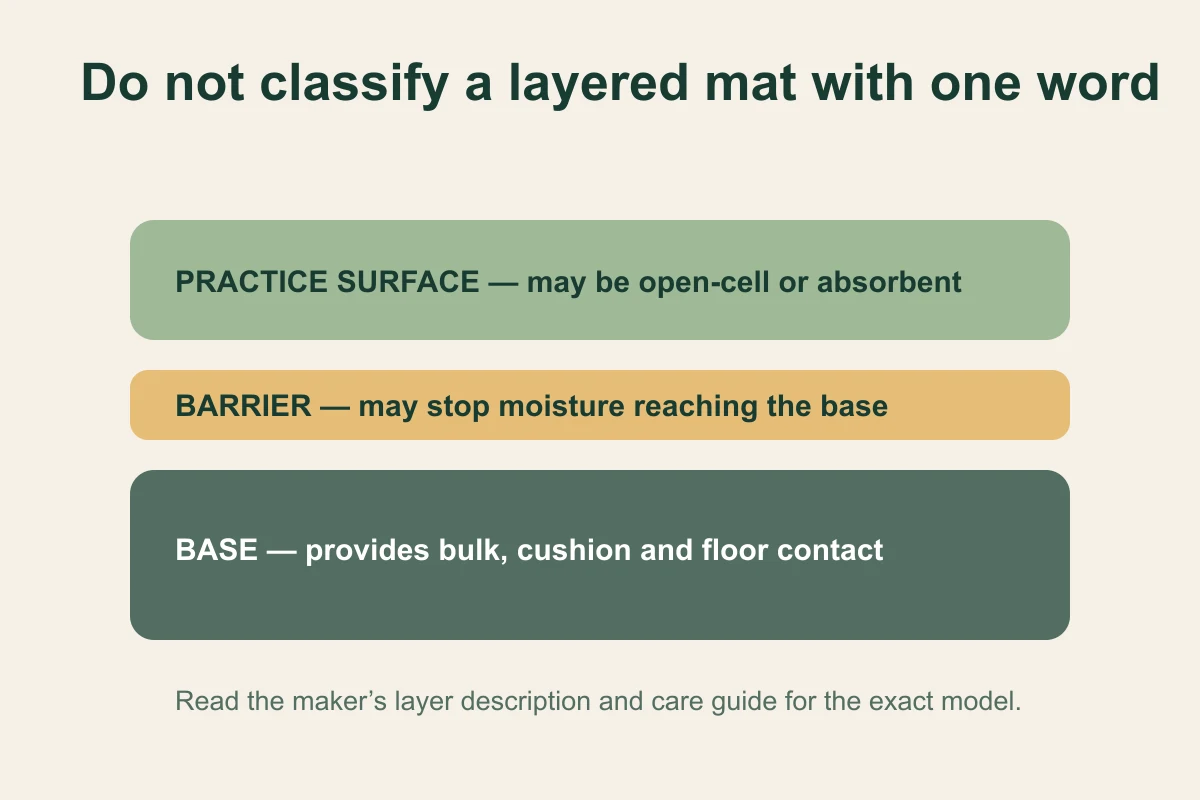
Liforme is a useful counterexample to whole-mat labeling. Its published construction uses a very thin absorbent polyurethane top, then a nonabsorbent barrier, then a foamed natural-rubber base. Moisture behavior at the hand is not necessarily the behavior of the entire cross-section.
What “closed-cell” means on a yoga mat
A closed-cell or sealed surface is nonabsorbent: sweat and cleaning liquid remain available at the top rather than entering that surface. This usually makes a wipe-down straightforward and reduces the amount of liquid the practice surface retains.
It can also leave sweat exactly where contact happens. A closed mat may use texture or a proprietary surface for dry grip, but “closed-cell” alone does not promise wet traction. Manduka recommends a yoga towel for its closed-cell PRO and eKO lines in very sweaty practice.
Closed-cell does not automatically mean:
- PVC;
- cheap or lightweight;
- smooth;
- slippery in every condition;
- safe for harsh disinfectants;
- waterproof at every seam or edge;
- maintenance-free.
Manduka currently classifies three very different constructions as closed-cell: the dense PVC PRO, natural-rubber eKO and TPE Manduka X/Foundation designs. That single list disproves the idea that material name reliably reveals cell type.
The layer problem: surface is not the whole mat
Many comparison pages force every product into one of two boxes. Modern multilayer mats make that unreliable.
| Layer | Possible job | Specification to find |
|---|---|---|
| Practice surface | Hand/foot contact, texture, moisture response | Absorbent/open or sealed/closed; coating material |
| Barrier or scrim | Limits moisture transfer; adds structure | Whether the brand explicitly describes a barrier |
| Cushion/base | Thickness, mass, compression, floor contact | Foam/rubber type, density claims and bottom texture |
| Printed/treated finish | Alignment, color or surface behavior | Care restrictions and wear notes |
If a product page says “open-cell top,” do not rewrite that as “the entire mat absorbs sweat.” If it says “closed-cell surface,” do not assume a cut edge or another layer behaves identically. Preserve the level at which the manufacturer makes the claim.
Five current constructions, classified carefully
| Current model | Brand’s cell description | Main published construction | Moisture decision |
|---|---|---|---|
| Manduka PRO 6mm | Closed-cell construction/surface | PVC | Moisture remains at the practice surface; towel for heavy sweat |
| Manduka eKO 5mm | Textured closed-cell surface | Natural rubber | Sealed rubber surface; use rubber-specific care |
| Manduka X 5mm | Closed-cell Foundation construction | High-density TPE | Surface-cleaning direction; designed as multipurpose mat |
| Manduka GRP Adapt 5mm | Open-cell, absorbent | PU / natural rubber / latex | Takes in moisture; GRP-specific care and drying |
| Liforme Classic 4.2mm | Open-celled PU top plus nonabsorbent barrier | PU surface, barrier, rubber base | Absorbent hand-contact layer without treating the base as one open sponge |
These examples are deliberately not ranked. They demonstrate construction language. PRO versus eKO also proves that two closed-cell mats can use different materials and feel different; GRP versus Liforme proves that two absorbent tops can have different layer systems.
Latex relevance is a separate filter. Manduka lists natural rubber/latex in GRP construction, and natural-rubber mats require attention from anyone with a known sensitivity. Cell structure neither creates nor removes that issue. Check the exact bill of materials and manufacturer warning.
Which one should you choose?
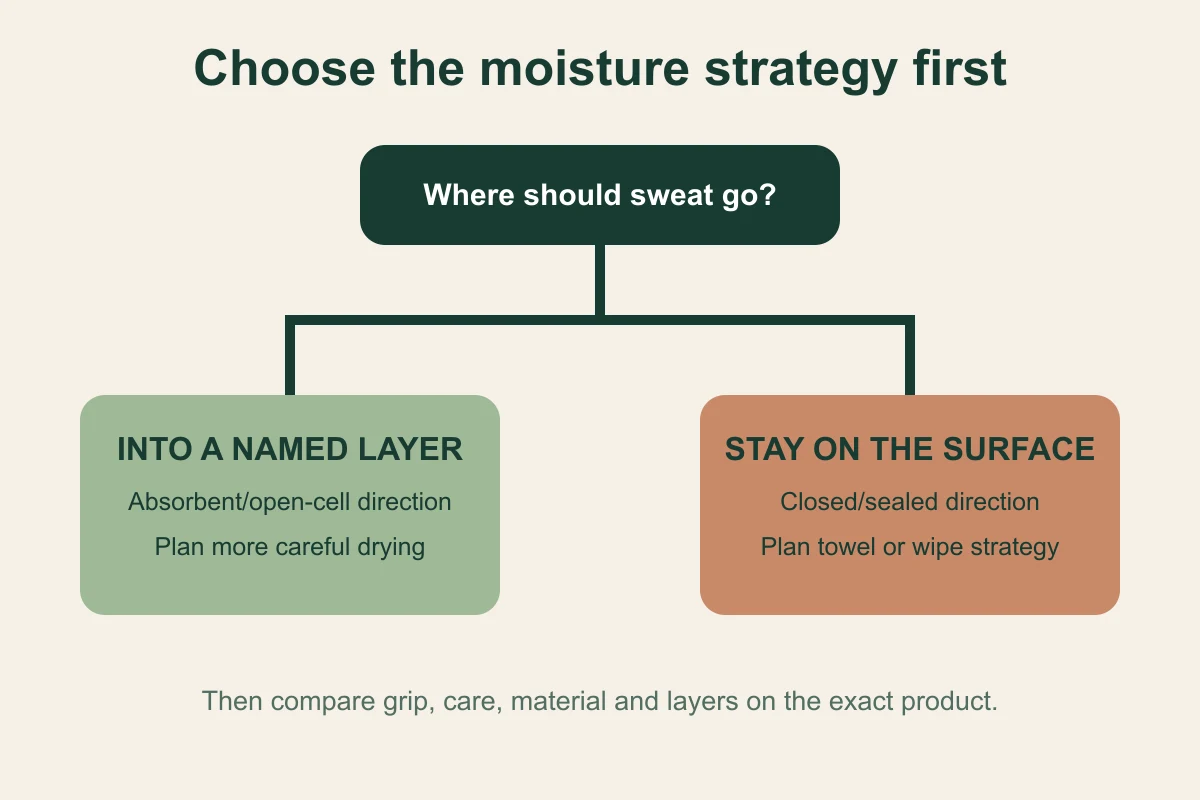
Choose the moisture system before comparing brands.
Favor an absorbent/open-cell direction when
- you specifically want a surface engineered to take in sweat;
- you prefer not to rely on a full-size towel during a hot class;
- the manufacturer documents wet-grip behavior for that model;
- you can clean it with the specified product or method;
- you have enough unrolled drying space and time.
The last two requirements matter as much as grip. An absorbent mat rolled damp is a poor ownership system regardless of how good it feels during class.
Favor a sealed/closed-cell direction when
- you want sweat and soil to remain available for surface wiping;
- the mat will be shared or transported before a long drying window;
- you prefer a mat-plus-towel strategy for very sweaty sessions;
- you mostly practice dry and the model’s documented surface suits that use;
- you want care that does not depend on an absorbent practice layer.
This is not a claim that sealed surfaces are sterile. Cleaning removes soil; disinfecting is a separate process, and chemicals that work on a hard floor can damage a yoga mat. Only use products and contact methods approved for the exact model.
Hot yoga: absorbent mat or closed mat plus towel?
Both systems can be coherent.
| Hot-class setup | Main advantage | Main obligation |
|---|---|---|
| Absorbent/open-cell practice surface | Moisture is managed by the contact layer | Clean correctly and dry completely |
| Closed/sealed mat + full towel | Mat does not need to absorb the session | Keep towel placed securely; wash and dry it |
| Closed/sealed mat without towel | Minimal extra gear | Only when the exact surface and sweat level remain workable |
Do not infer a safe setup from “rubber,” “PU” or “non-slip.” Check whether the brand tests or markets the selected surface for sweaty conditions. Our non-slip mat guide compares grip systems, while this page stays focused on moisture construction.
A towel is also not a universal repair. It needs to fit, remain flat and become sufficiently damp if its grip mechanism depends on moisture. Test familiar, low-risk movement first rather than discovering the system during a fast class.
Cleaning and drying: where generic advice fails
Cell type changes the question, but the maker supplies the answer.
| Care step | Absorbent/open surface | Sealed/closed surface |
|---|---|---|
| After practice | Remove surface residue using approved method | Wipe using approved cleaner/method |
| Added liquid | Use the minimum/method the maker specifies | Avoid assuming “sealed” permits saturation |
| Drying | Allow more time; unroll until completely dry | Still dry both sides before rolling |
| Deep clean | Follow model-specific instructions | Follow model-specific instructions |
| Never infer | “Porous means soakable” | “Nonabsorbent means chemical-proof” |
Manduka assigns different care products to PRO, eKO and GRP even though two are closed and one is open. That is the right mental model: cell label first, exact material and brand care second.
Use our general cleaning guide only after identifying the mat material and checking its current instructions. Never put a mat in a washing machine or bathtub simply because a third-party article generalizes about open or closed cells.
How to verify an unlabelled product
Do not perform a home absorption experiment on a new mat. Water-drop behavior can be changed by coatings, residues, wear or a thin top layer, and a test may violate care guidance.
Instead, work down this evidence list:
- Exact model product page, not a retailer category page.
- Manufacturer FAQ or care center naming open, closed, sealed or absorbent.
- Layer diagram that separates top, barrier and base.
- Approved cleaning method and explicit “do not soak” language.
- Direct manufacturer support when the above stays ambiguous.
If the maker never discloses cell structure, describe only observable published facts: “moisture-resistant surface” or “absorbent polyurethane top,” for example. Do not promote a guess into a technical classification.
Common myths to reject
“All rubber mats are open-cell”
False. Manduka describes eKO natural-rubber mats as closed-cell and its GRP PU/rubber construction as open-cell.
“Open-cell means the whole mat absorbs”
Not necessarily. Liforme publishes an open-celled PU practice layer over a nonabsorbent barrier and rubber base.
“Closed-cell means non-slip is impossible”
Too broad. Cell structure tells you where moisture goes, not the complete friction behavior of texture, finish and conditions. Evaluate the exact surface and towel plan.
“Open-cell mats can be soaked clean”
Unsafe as a generic rule. Absorbency can make complete rinsing and drying harder, and adhesives or layers may not tolerate immersion. Follow model care.
“Closed-cell means hygienic forever”
No surface cleans itself. Sweat, skin oils and floor soil still remain on top and must be removed. “Does not absorb” is not the same as “does not need cleaning.”
Final buying checklist
- Find whether the practice surface, a named layer or the whole construction is called open or closed.
- Separate material—PVC, TPE, PU or rubber—from cell structure.
- Decide between absorb-and-dry and sealed-surface-plus-wipe/towel moisture strategies.
- Confirm hot/sweaty use on the exact product page.
- Check all materials and latex warnings independently.
- Read the model-specific cleaner, water and drying instructions before purchase.
- Make sure you have enough space and time to dry an absorbent surface fully.
- Treat missing cell information as unknown rather than guessing.
For most buyers, the right question is not “which cell type is better?” It is where do I want moisture to go, and can I maintain that system every time I use it? Answer that, then compare grip, thickness, weight, size and material on their own evidence.
Frequently asked questions
What is the difference between an open-cell and closed-cell yoga mat?
An open-cell or absorbent practice surface allows moisture into the named layer. A closed-cell or sealed surface keeps moisture at the surface where it can be wiped away. Those labels do not define the whole product: a layered mat can combine an absorbent top, a barrier and a different base.
Is an open-cell yoga mat better for hot yoga?
An absorbent top can be designed to maintain grip as it takes in moisture, which is why open-cell constructions appear in hot-yoga products. It also creates a drying and cleaning obligation. A sealed mat plus a full-size towel is another valid moisture strategy. Follow the exact manufacturer guidance.
Are natural-rubber yoga mats open-cell?
Not automatically. Manduka describes its natural-rubber eKO series as closed-cell, while its polyurethane-and-rubber GRP series is open-cell. Material name and cell structure are separate specifications, so verify the exact model.
Can I tell whether a yoga mat is open-cell by putting water on it?
A home water-drop test cannot reliably identify a multilayer product and may conflict with its care instructions. Surface coatings, wear and barriers can change the result. Use the manufacturer’s construction and care documentation instead.
Which type of yoga mat is easier to clean?
A sealed surface usually keeps moisture and soil available for surface wiping. An absorbent surface requires more attention to controlled cleaning and complete drying. The safe cleaner, amount of moisture and whether soaking is allowed still depend on the exact product—not just the open/closed label.