

How this page has changed
July 26, 2026
Sources, internal links and safety or product context reviewed.
In this guide
- 01Quick answer: what high density does and does not tell you
- 02Density is not thickness
- 03Six current “high-density” yoga mats compared
- 04How the apparent-density estimate works
- 05Does high density mean firm?
- 06Does high density mean more cushioning?
- 07Density, grip and moisture are separate
- 08When a high-density direction makes sense
- 09How to evaluate a “high-density” listing
- 10Common mistakes
- 11Final buying checklist
A high-density yoga mat should contain more mass in a given volume than a lower-density alternative. Retail listings rarely prove that comparison. “High density” has no shared yoga-mat threshold, and current products use the term for everything from a 2mm PVC travel mat to a 10mm NBR mat.
Treat the phrase as a prompt to inspect specifications—not as a certification. Density can influence compression and firmness, but the marketing label alone does not establish grip, cushioning, durability or stability. The exact material, surface, dimensions and finished weight still matter.
Quick answer: what high density does and does not tell you
| The claim can suggest | The claim does not prove |
|---|---|
| More material per unit volume than the maker’s reference | A comparable numerical density across brands |
| Firmer support or less easy compression | Better cushioning for every user |
| A construction designed to retain shape | Long-term durability without test or warranty evidence |
| More mass when size and thickness are equal | A heavy finished mat when dimensions differ |
| A deliberate foam or PVC formulation | Grip, sweat handling or floor traction |
The missing phrase is “compared with what?” A brand may mean denser than its own entry-level foam. Another may use “high density” simply as a category adjective. Unless both publish numbers or a controlled test, their claims are not on one scale.
Density is not thickness
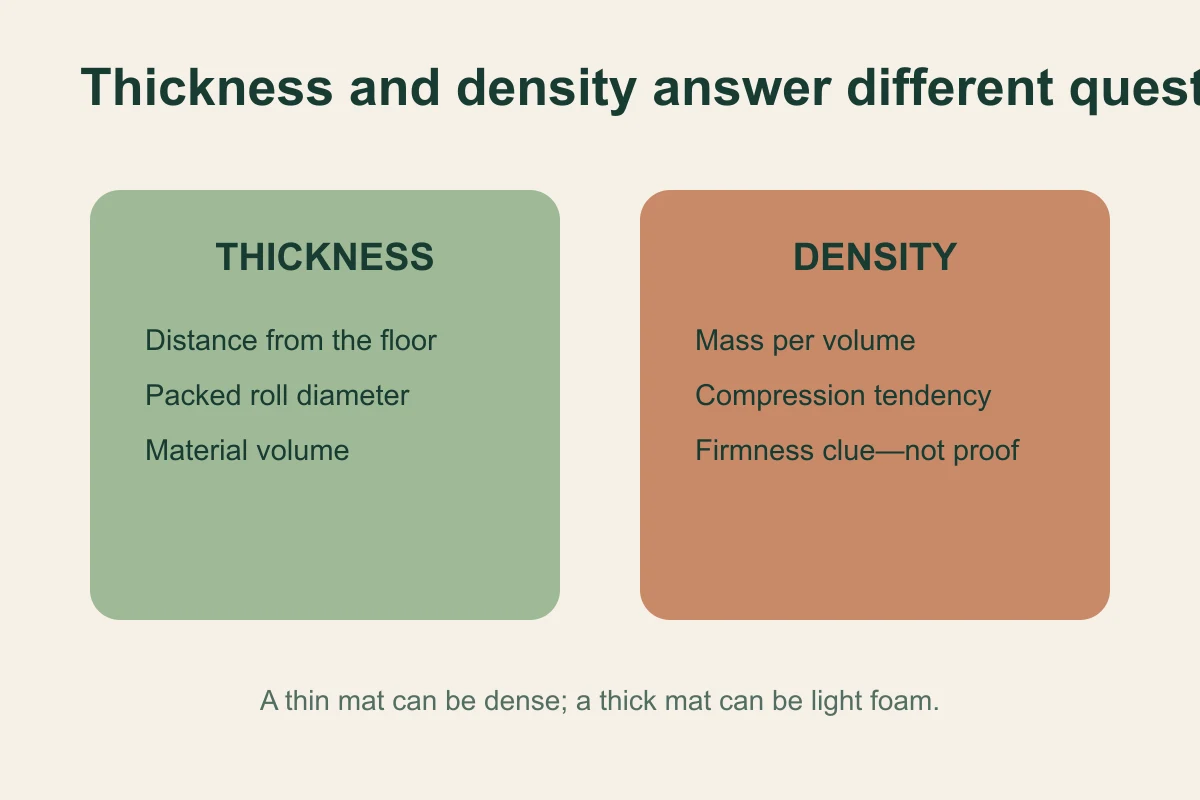
Thickness measures distance: 2mm, 5mm, 10mm. Density measures mass divided by volume, commonly kilograms per cubic meter. A thick low-density foam can feel soft and remain light; a thin high-density sheet can feel firm while using little total material.
| Specification | Unit | Primary buying question |
|---|---|---|
| Thickness | mm or inches | How far is the top surface from the floor? |
| Density | kg/m³ or lb/ft³ | How much mass exists in a volume? |
| Weight | kg or lb | How much must I carry? |
| Area | length × width | How much usable floor surface is provided? |
| Compression | change under a defined load | How much does the support yield? |
| Hardness | test-specific scale | How resistant is the surface to indentation? |
Retail pages almost never publish compression or hardness tests. Density is only one ingredient in those behaviors; cell structure, layers and material chemistry also matter.
Six current “high-density” yoga mats compared
| Current product | Published material | Thickness | Weight and size | Apparent kg/m³* |
|---|---|---|---|---|
| Manduka PRO Travel | PVC | 2mm | 1.3kg; 180 × 61cm | 592 |
| Sunny High-Density 4mm | PVC | 0.16in / 4.1mm | 2lb; 68 × 24in | 212 |
| Manduka X Hybrid | High-density TPE | 5mm | 1.5kg; 180 × 61cm | 273 |
| Top Fitness High Density | PVC | 5mm | 69 × 24in; weight not published | Not calculable |
| Manduka PRO standard | PVC | 6mm | 3.4kg; 180 × 66cm | 477 |
| Rogue NBR | High-density NBR foam | 10mm | 4lb; 72.5 × 24.75in | 157 |
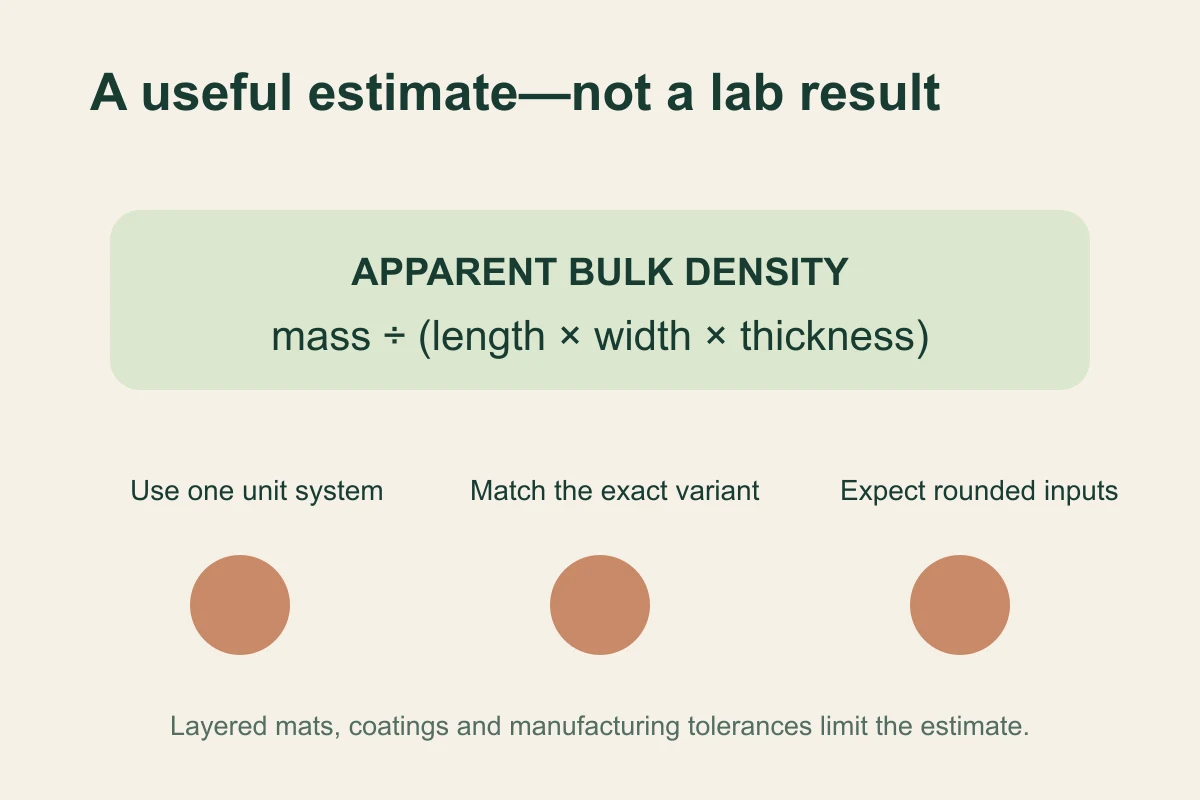
*Calculated from rounded product-page values: mass ÷ (length × width × thickness). These are apparent bulk-density estimates, not laboratory-certified material densities.
The range is the point. All six pages use “high density,” “ultra-dense” or an equivalent construction claim, yet the five calculable estimates span roughly 157–592kg/m³. That does not make the highest number the best mat. It shows that the adjective cannot carry a cross-brand comparison by itself.
The 2mm PRO Travel produces the highest estimate while remaining a relatively light 1.3kg product because it has little volume. The 10mm Rogue NBR produces the lowest estimate in this set despite being five times thicker. This is why “high density” and “extra thick” deserve separate URLs and decisions.
How the apparent-density estimate works
For a rectangular mat:
apparent density = mass ÷ (length × width × thickness)
Using the standard Manduka PRO values as an example:
- mass: 3.4kg;
- dimensions: 1.80 × 0.66m;
- thickness: 0.006m;
- flat volume: 1.80 × 0.66 × 0.006 = 0.007128m³;
- estimate: 3.4 ÷ 0.007128 ≈ 477kg/m³.
Why this is only an estimate
- Product weights and dimensions are rounded.
- Thickness can vary across texture, edges and manufacturing tolerance.
- Layered mats may combine materials of different densities.
- Scrims, coatings and printed layers contribute mass.
- A nominal rectangle may have rounded corners or tapered edges.
- Brands may update a product without changing every retailer listing.
Use the result to challenge vague claims and compare scale—not to announce a precise material property. Reporting “477kg/m³ apparent from published finished-product specs” is defensible; calling it “PVC density” is not.
Does high density mean firm?
Often, but not automatically. More solid material and less air can reduce easy compression within a comparable foam family. Different polymers and structures respond differently, however. A dense elastomer can still deform; a lower-density engineered structure may feel firm under a particular load.
“Firm support” is therefore stronger evidence when the maker pairs it with:
- a compression or indentation test;
- a defined comparison within its own line;
- consistent long-term testing;
- a warranty covering permanent compression;
- transparent material and layer information.
Manduka describes both PRO and PRO Travel as high-density with floor-like stability. That same family comparison is more meaningful than assuming an unrelated NBR mat uses the term identically.
Does high density mean more cushioning?
Density and cushioning are not synonyms. Cushioning depends on how a construction deforms and returns under load, plus how much depth is available. A dense 2mm travel mat has little distance to compress. A 10mm foam offers more depth but may yield more easily.
For shoppers, separate three sensations:
| Desired outcome | Specification direction | What to verify |
|---|---|---|
| More distance from hard floor | Greater thickness | Exact millimeters and material |
| Less sinking or wobble | Firmer/less compressible construction | Brand evidence, return test or controlled review |
| Easier transport | Lower finished weight and smaller roll | Exact weight and packed dimensions |
Our yoga mat thickness chart handles the first decision. Density is relevant to the second; yoga mat weight handles the third.
Density, grip and moisture are separate
A dense mat does not necessarily grip hands or floor better. The top texture, finish, moisture behavior and bottom pattern do different jobs. Manduka PRO is dense and closed-cell; Manduka X is also marketed as high-density and closed-cell, but it uses TPE and a different texture. Rogue’s NBR construction is thick, closed-cell foam.
Use the open-cell versus closed-cell guide for moisture path. Do not infer absorbency from apparent density: closed cells can exist across a wide range of bulk densities, and layered tops complicate the model further.
When a high-density direction makes sense
A firmer, relatively dense construction is worth comparing when:
- you dislike soft foam collapsing noticeably under ordinary use;
- you want a thinner mat that still feels structurally substantial;
- the mat stays at home and extra finished weight is acceptable;
- the manufacturer supports its claim with specifications or warranty terms;
- floor-like feedback matters more than a plush sensation.
It may be the wrong direction when:
- low carry weight is the primary constraint;
- you specifically want soft, deep compression;
- the phrase is the only useful specification on the listing;
- there is no return route for an untested firmness preference;
- the chosen surface or material conflicts with your sweat/care needs.
No density number determines personal comfort. This is equipment comparison, not a medical prescription.
How to evaluate a “high-density” listing
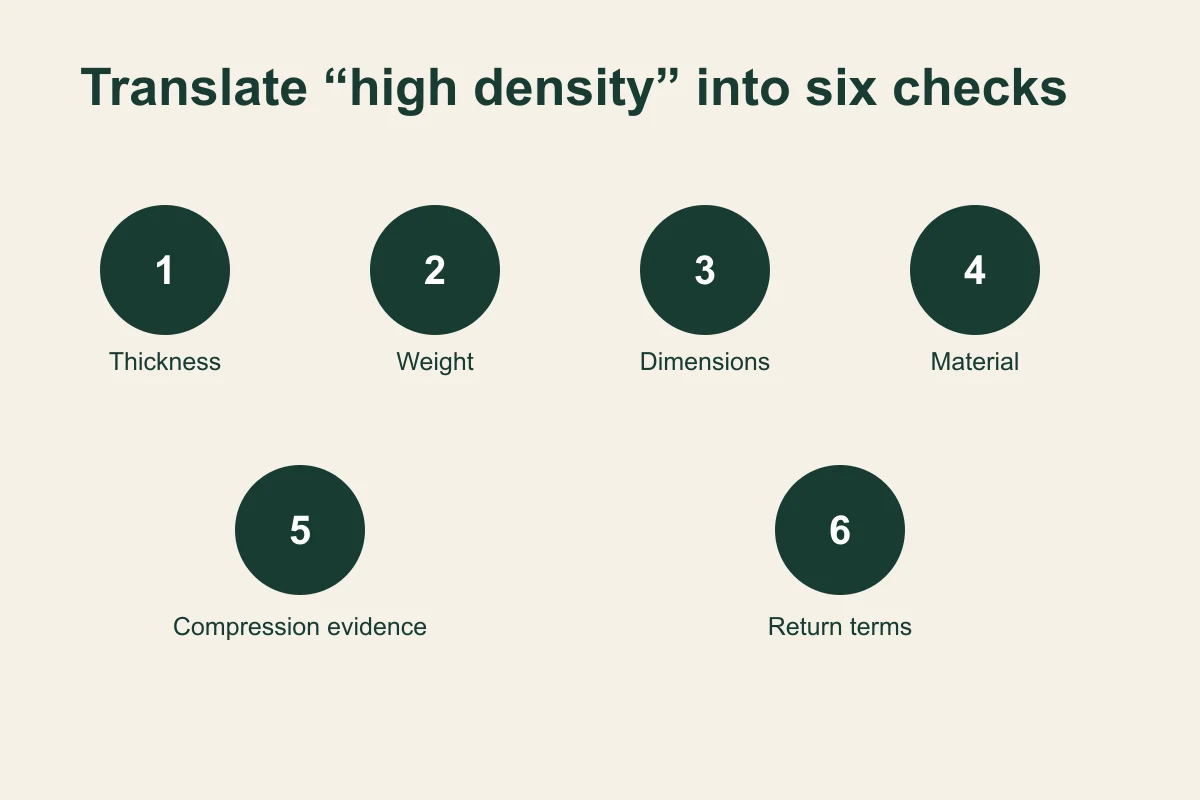
1. Find exact thickness
Reject “extra cushion” without millimeters or inches. Thickness establishes total volume and roll size.
2. Find finished weight
Weight lets you assess transport and supports an apparent-density calculation. Confirm the selected size, not a different variant.
3. Record length and width
Area changes both usable space and total material. A wider mat can be heavier without being denser.
4. Identify the complete material description
“Foam” is incomplete. Look for NBR, TPE, PVC, rubber or a named multilayer system, plus latex warnings where relevant.
5. Look for evidence beyond the adjective
Firm-support language, compression testing, a warranty or within-line comparison adds context. Customer adjectives alone are not controlled evidence.
6. Check return and warranty terms
Density cannot predict your preference. A legitimate trial or return route is more useful than another unsupported superlative.
Common mistakes
Buying the highest calculated number
Apparent density is not a leaderboard. It says nothing direct about surface grip, allergens, durability, size or whether you like the response.
Predicting density from weight alone
A heavy mat may simply be larger or thicker. Divide by volume before comparing, and retain the calculation caveats.
Predicting comfort from thickness alone
Two 6mm mats can compress differently. Thickness provides depth; construction determines how that depth behaves.
Comparing different variants
Long and wide versions have different mass. Use weight, length, width and thickness from one selected SKU.
Trusting “high-density foam” without material
NBR, TPE and PVC do not become equivalent because a seller applies the same adjective. Care, heat tolerance, smell and surface behavior can differ.
Final buying checklist
- Treat “high density” as an unstandardized claim.
- Collect exact thickness, weight, length and width for one variant.
- Calculate apparent bulk density only when all inputs are available.
- Label the result as an estimate from finished-product specs.
- Compare material, cell structure, surface grip and care separately.
- Look for compression evidence or meaningful warranty language.
- Test personal firmness preference within the return terms.
- Choose finished weight for your route, not density in isolation.
The best high-density yoga mat is not the one with the largest adjective—or even the largest estimate. It is the construction whose measured size, finished weight, documented support and surface system match the way you will actually store, carry and use it.
Frequently asked questions
What is a high-density yoga mat?
It is a mat whose maker describes its foam or support as relatively dense or firm, but there is no shared retail threshold behind the phrase. Without mass, dimensions and thickness—or a tested density value—the label cannot be compared objectively across brands.
Is a high-density yoga mat the same as a thick yoga mat?
No. Thickness is the distance between the floor and top surface; density is mass per volume. Current products marketed as high-density range from 2mm travel mats to 10mm NBR mats, so either can vary independently.
Are high-density yoga mats better?
Not universally. A denser construction may resist compression and feel firmer, but the label alone does not prove grip, durability, cushioning or floor stability. Compare material, surface, dimensions, weight and product-specific evidence.
How can I compare yoga mat density?
When the exact mass, length, width and thickness are published, divide mass by flat volume to estimate apparent bulk density. Use the result only as a screening metric because rounded dimensions, coatings, scrims and multiple layers make it different from a laboratory material-density test.
Does high density make a yoga mat heavy?
At equal dimensions and thickness, greater density means more mass. Real mats are not equal in size or depth: a thin dense travel mat may remain lighter overall than a larger standard mat. Compare finished product weight separately.