

How this page has changed
July 26, 2026
Sources, internal links and safety or product context reviewed.
In this guide
- 01EVA yoga mats at a glance
- 02What EVA foam actually is
- 031. Reebok 4mm Yoga Mat — best disclosed EVA blend
- 042. Cosco EVA-FIT 6mm — best simple EVA option
- 05Density matters more than most listings admit
- 06EVA grip and sweat behavior
- 07How to choose an EVA mat
- 08EVA vs TPE, PVC and NBR
- 09Cleaning and replacement
- 10The verdict
- 11Frequently asked questions
An EVA yoga mat is usually a light, closed-cell foam mat aimed at entry-level yoga, travel or general floor exercise. EVA stands for ethylene-vinyl acetate. That name identifies a polymer, not a performance grade: expansion, density, vinyl acetate content, molded texture and blends all change how the mat feels and wears.
The current Reebok 4mm Yoga Mat is the most transparent blend in this guide, publishing 95% EVA, 5% TPE and 50% recycled content. The Cosco EVA-FIT 6mm is the simpler single-material direction with a published weight. Neither is presented as a universal winner, and The Yoga Sensei did not claim hands-on or laboratory testing.
The shortlist stays at two because many marketplace “EVA mats” omit percentages, weight, density and stable manufacturer documentation. More product names would not create more reliable choice.
EVA yoga mats at a glance
| Option | Best for | Published construction | Size / weight | Main limitation |
|---|---|---|---|---|
| Reebok 4mm Yoga Mat | Thin, firm everyday platform | 95% EVA + 5% TPE; 50% recycled content | 176 × 61cm / weight not published | Shorter than many premium mats; no numeric weight or density |
| Cosco EVA-FIT 6mm | More nominal cushioning on a budget | EVA foam; carry strap | Manufacturer pages differ slightly: about 180–183 × 61–63cm / 930g | Regional availability; inconsistent dimensions across official pages |
That Cosco discrepancy is worth keeping visible. The corporate listing states 183 × 61cm while the current store page states 180 × 63cm. Confirm the delivered variant rather than silently selecting the more convenient number.
What EVA foam actually is
EVA is a copolymer made from ethylene and vinyl acetate. Changing the proportion and the foam-making process changes flexibility, resilience and surface behavior. Air or gas-filled cells reduce weight; additives and molded patterns tune color, feel and traction.
“EVA” therefore does not tell you:
- the foam density or compression recovery;
- how much vinyl acetate is present;
- whether another polymer is blended in;
- whether recycled content is pre- or post-consumer;
- which substances or emissions were tested;
- dry or wet coefficient of friction;
- whether a local recycler accepts the finished foam mat.
| Listing phrase | Useful signal | Still missing |
|---|---|---|
| EVA foam | Specific copolymer family in expanded form | Density, recipe, blowing process and additives |
| EVA + TPE | A polymer blend rather than pure EVA | Exact TPE family and percentages unless stated |
| Closed-cell | Low liquid absorption into the foam | Wet grip and cleaner compatibility |
| High-density | Directionally firmer foam | Numeric density and test method |
| Recycled content | Some feedstock is reused | Percentage, mass basis, source and certification |
| Eco-friendly | Marketing position only | Measured impact, durability and end-of-life route |
Avoid equating EVA with “natural rubber,” “latex,” “TPE” or “non-toxic.” These terms answer different questions. A manufacturer needs to disclose and substantiate each claim for the exact finished product.
1. Reebok 4mm Yoga Mat — best disclosed EVA blend
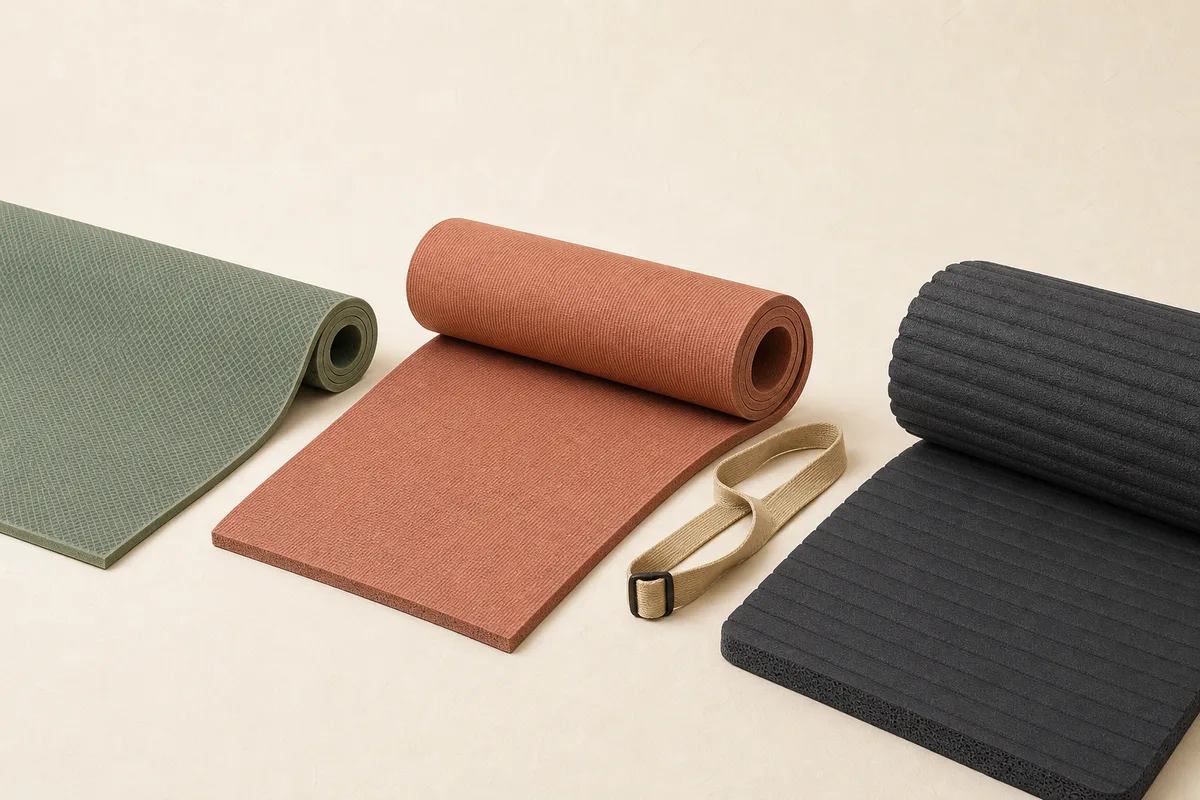
Reebok publishes unusually specific material information: 95% EVA and 5% TPE, 4mm thick and 176 × 61cm. Both faces have a diamond texture. The brand also states 50% recycled content but does not publish a certification, mass-balance method or whether that content is pre- or post-consumer.
At 4mm, this is the firmer, closer-to-floor choice in the shortlist. That can help balance feedback, but thickness does not reveal density or guarantee pressure comfort. Reebok calls the foam medium-density without giving a numeric value or compression test, so compare the claim only within the brand’s own range.
The blend illustrates why “EVA mat” is sometimes shorthand. Five percent TPE may affect resilience or processing even though EVA is the dominant component. A shopper excluding TPE should not rely on the product category name.
Choose it for transparent percentages, a thin platform and documented recycled content. Skip it if you need a longer mat, published carry weight or independently verified environmental claims. See the current Reebok specification.
2. Cosco EVA-FIT 6mm — best simple EVA option
Cosco identifies the EVA-FIT as an EVA mat, 6mm thick and 930g. The corporate page lists it at 183 × 61cm, while the linked store page lists 180 × 63cm. Both are current official surfaces; the difference may reflect a variant or a content error. Ask the seller to confirm if fit is important.
Six millimeters provides more nominal separation from the floor than the Reebok’s 4mm. It does not automatically mean more useful cushioning: low-density foam can compress quickly and may feel less stable in standing work. The 930g figure makes its portability concrete, although the included strap contributes some portion of shipped weight if counted.
Cosco uses broad terms such as eco-friendly, antibacterial and no-tear. The listing does not link a test method, certificate or durability protocol for those claims. Buy it for the disclosed EVA construction, thickness and weight—not for unbounded adjectives.
Choose it for low published weight and a simple 6mm EVA build. Skip it if you need globally consistent availability, verified dimensions or named material certification. Check the current Cosco store listing.
Density matters more than most listings admit
Thickness measures distance between the two faces. Density measures mass per unit volume. Expansion creates lightweight foam, but highly expanded material may compress deeply, dent or tear sooner. Dense foam can feel firmer and more stable at the same thickness.
Consumer listings rarely give density in kg/m³, so use imperfect secondary clues:
- Compare weight only among mats with similar dimensions and thickness.
- Inspect close edge photos for very large pores, weak skins or uneven layers.
- Look for compression-recovery data rather than “extra cushioned.”
- Check whether a reinforcement mesh or second polymer is disclosed.
- Prefer a real warranty and replacement criteria over “no tear.”
| Observation | Possible interpretation | What it does not prove |
|---|---|---|
| Very low weight at 8mm | Highly expanded foam | Poor quality without a recovery test |
| Clean, fine edge cells | Controlled foam structure | Long useful life |
| Deep permanent footprints | Weak recovery or early fatigue | A specific polymer defect |
| Edge splits near strap | Concentrated storage stress | That every mat in the model will fail |
| Smooth shiny wear zones | Surface texture is abrading | That the core has lost cushioning |
EVA grip and sweat behavior
Most EVA mats are closed-cell, which makes routine wiping easier because liquid stays near the surface. It also means sweat can remain between hands or feet and the mat. Molded diamonds, ribs and crosshatches create mechanical texture, but a pattern photographed dry is not proof of wet grip.
Test traction progressively. Start with clean, dry hands, then note how the surface changes as the practice warms. Stop using the mat if either face shifts unexpectedly. For high-sweat sessions, use a yoga mat towel or select a mat whose manufacturer documents a wet-grip surface.
Residue matters. Body oils, lotions and excess cleaner can fill fine texture and change friction. More aggressive scrubbing is not always the answer because it may abrade the foam skin.
How to choose an EVA mat
Verify the percentage
A listing may call a mat EVA when it is an EVA-TPE blend or contains only an EVA foam layer. Neither is inherently wrong, but percentages make comparisons possible. If the page says only “eco foam,” the material remains unknown.
Compare usable dimensions
Budget mats are often 173–183cm long and about 61cm wide. Measure the space your body uses lying down rather than accepting “standard.” Taller practitioners and broader shoulders may need a longer or wider construction.
Match thickness to movement
Four to six millimeters is common for yoga-oriented EVA. Eight to ten millimeters can favor floor exercise and pressure comfort but may feel less stable if the foam is soft. The thick yoga mat guide separates exercise-mat plushness from balance-focused support.
Demand bounded claims
“PVC-free” states one excluded polymer. “50% recycled” should identify the basis and source. “Biodegradable” needs a test and conditions. “Recyclable” needs a collection route. A product can make one substantiated claim without satisfying all the others.
EVA vs TPE, PVC and NBR
| Material | Typical EVA advantage | Typical EVA compromise |
|---|---|---|
| TPE | Often simpler and inexpensive | TPE blends may offer better resilience; formulas still vary |
| Dense PVC | Much lighter and little break-in expectation | Usually less planted and may have shorter useful life |
| NBR foam | Thinner, more yoga-oriented options | NBR is often plusher for floor exercise |
| Natural rubber | Low weight, no rubber odor and no inherent natural-rubber latex | Less immediate tactile grip and density |
These are tendencies, not guarantees. Compare exact products in the TPE yoga mat guide, PVC guide and natural rubber guide.
Cleaning and replacement
Follow the model-specific care label. A conservative EVA routine is to wipe with a soft damp cloth and an approved mild cleaner, remove residue and air-dry both faces fully. Avoid prolonged direct sun, hot-car storage, machine washing, soaking and strong solvents unless the manufacturer explicitly permits them.
Replace by function rather than calendar. Retire the mat when compressed areas stop recovering, the base slides, the top texture becomes smooth, edges split into the practice area or the foam sheds. The yoga mat lifespan guide gives a repeatable inspection sequence.
Technical recyclability is not a disposal program. Flexible foams are rarely accepted curbside and blends can complicate processing. Before treating EVA as recyclable, identify a local collector that names the material and form it accepts. Reuse as protective padding only when the mat remains clean and structurally sound.
The verdict
Choose the Reebok 4mm Yoga Mat for the clearest blend percentages, thin stability and quantified recycled content. Choose the Cosco EVA-FIT 6mm when more nominal cushioning and a published 930g weight are more useful.
EVA’s strengths are light weight, easy surface wiping and inexpensive foam construction. Its weakness is information quality: density and composition are often missing. Buy the numbers and the complete formula—not the acronym alone.
Frequently asked questions
Is EVA a good material for a yoga mat?
EVA can suit dry, lower-intensity practice when low weight and simple care matter. Density, thickness, texture and blend matter more than the material name alone.
What is EVA foam?
EVA is ethylene-vinyl acetate, a flexible synthetic copolymer expanded into lightweight foam. Formula, expansion, density and additives change the finished mat.
Is EVA the same as TPE?
No. EVA is a specific copolymer; TPE is a broad material class. Some mats blend the two, so check percentages.
Can you use EVA for hot yoga?
Typical closed-cell EVA leaves sweat on top. Unless the product documents wet grip, use a towel or a purpose-built high-sweat surface.
How do you clean an EVA yoga mat?
Follow the product instructions. Usually wipe with a soft damp cloth and approved mild cleaner, remove residue and air-dry away from prolonged heat or sun.
Frequently asked questions
Is EVA a good material for a yoga mat?
EVA can make a lightweight, closed-cell and relatively inexpensive mat for dry, lower-intensity practice. Its usefulness depends on foam density, thickness, surface texture and whether it is pure EVA or a blend. It is not automatically the best choice for heavy sweat or long-term daily use.
What is EVA foam in a yoga mat?
EVA is ethylene-vinyl acetate, a flexible synthetic copolymer that can be expanded into lightweight closed-cell foam. The vinyl acetate proportion, expansion, density, additives and any TPE blend change the finished mat.
Is EVA the same as TPE?
No. EVA is a specific copolymer, while TPE is a broad class of thermoplastic elastomers. Some yoga mats blend EVA with a TPE, so listings should state percentages rather than treating the terms as interchangeable.
Can you use an EVA mat for hot yoga?
A typical closed-cell EVA surface does not absorb much sweat, so moisture can remain on top and reduce traction. Unless the exact product documents wet grip, use a towel or choose a surface designed for high-sweat practice.
How do you clean an EVA yoga mat?
Follow the exact product instructions. As a conservative default, wipe with a soft damp cloth and an approved mild cleaner, remove residue and air-dry fully away from prolonged heat or direct sun. Do not assume machine washing, soaking or harsh disinfectants are safe.