

How this page has changed
July 26, 2026
Sources, internal links and safety or product context reviewed.
In this guide
- 01PVC yoga mats at a glance
- 02What PVC means in a yoga mat
- 031. Manduka PRO 6mm — best dense PVC platform
- 042. Hugger Mugger Tapas Original — best lightweight sticky mat
- 053. Manduka PRO Travel 2mm — best packable PVC option
- 06Closed-cell vs open-cell PVC
- 07How to choose a PVC yoga mat
- 08PVC vs TPE, rubber and cork
- 09Cleaning, storage and end of life
- 10The verdict
- 11Frequently asked questions
A PVC yoga mat can be a thin, light sticky mat or a dense 7.5lb platform. The shared polymer does not make those products equivalent. Foam density, cell structure, reinforcement, texture and thickness determine how the finished mat carries, grips, compresses and handles sweat.
Among current options with useful manufacturer disclosures, the Manduka PRO 6mm is the dense home-practice choice, the Hugger Mugger Tapas Original 1/8in is the light classic sticky mat, and the Manduka PRO Travel 2mm is the foldable direction. This guide compares published construction—not temporary prices, marketplace reviews or unqualified “non-toxic” claims.
The Yoga Sensei did not laboratory-test or personally use every listed mat, so performance statements remain tied to documented construction and manufacturer instructions.
PVC yoga mats at a glance
| Option | Best for | Published construction | Size / weight | Main limitation |
|---|---|---|---|---|
| Manduka PRO 6mm | Dense home or studio platform | Closed-cell, OEKO-TEX STANDARD 100 certified PVC | 71 × 26in / 7.5lb | Heavy; dry-grip surface needs break-in and sweat planning |
| Hugger Mugger Tapas Original | Lightweight classic sticky feel | Open-cell, heavy-metal- and phthalate-free PVC | 68 × 24in / 2.4lb | Thin and short; certification is not stated |
| Manduka PRO Travel 2mm | Packing and floor feedback | Closed-cell, high-density, OEKO-TEX STANDARD 100 certified PVC | 71 × 24in / 2.9lb | Minimal cushioning; must be stored rolled |
“Best PVC mat” therefore needs a purpose. The PRO is not the practical airport option, while the PRO Travel is not a substitute for 6mm cushioning.
What PVC means in a yoga mat
PVC is polyvinyl chloride, a thermoplastic polymer. Rigid PVC is used in products such as pipe, but yoga mats require a flexible formulation and usually a foamed structure. Manufacturers can tune that formulation, foam density and surface embossing across a broad range.
The material label tells you the polymer family. It does not reveal:
- which plasticizers, pigments or stabilizers were used;
- whether the finished article was tested to a named standard;
- whether the foam is open-cell or closed-cell;
- the density, reinforcement or compression recovery;
- dry or wet friction;
- whether a recycling facility accepts the complete used mat.
| Listing term | Useful information | What remains unknown |
|---|---|---|
| PVC | Polymer family | Formula, density, additives and finished-product testing |
| Phthalate-free | Manufacturer excludes a defined plasticizer class under its claim | Which alternative plasticizer is used and every other substance |
| Closed-cell | Low liquid absorption into the foam | Wet traction and disinfectant compatibility |
| Open-cell | Surface may accept more moisture and feel tackier | Pore size, drying time and deep-cleaning tolerance |
| OEKO-TEX STANDARD 100 | Named finished article passed the standard’s harmful-substance criteria | Carbon footprint, biodegradability and local recyclability |
Certification language should stay precise. OEKO-TEX describes STANDARD 100 as testing textiles and accessories against a list of harmful substances, with stricter criteria for more intensive skin contact. That is stronger evidence than a free-floating “safe” badge. It does not turn PVC into a natural, biodegradable or curbside-recyclable material.
1. Manduka PRO 6mm — best dense PVC platform
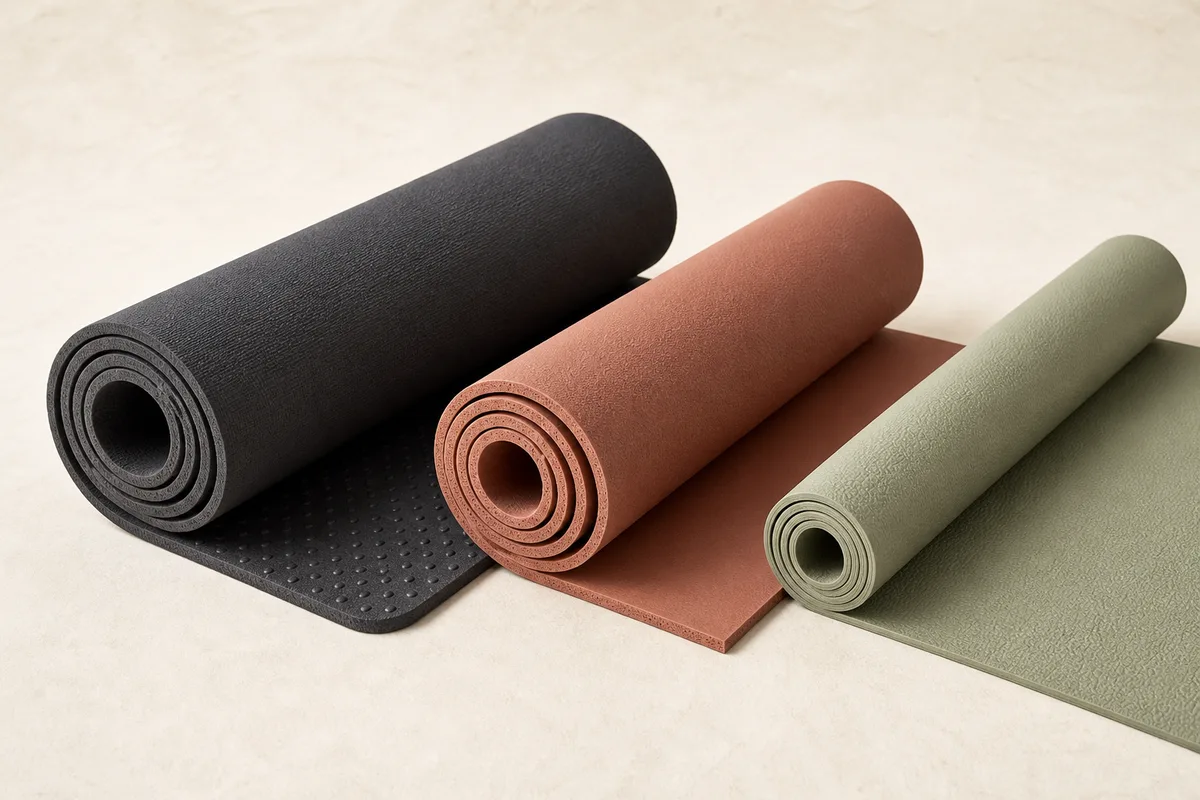
Manduka specifies the standard PRO at 71 × 26 inches, 6mm and 7.5lb. It uses closed-cell PVC, a textured fabric-like top and a dotted floor side. The current product page identifies the PVC as OEKO-TEX STANDARD 100 certified, lists the mat as latex-free and attaches a lifetime guarantee subject to its terms.
The unusual weight is informative. At similar dimensions, more mass generally signals more material and density, although it is not a direct laboratory density measurement. A dense platform can resist bottoming out and feel planted, but 7.5lb is a serious commuting burden.
Manduka also says the surface improves with use. That makes the PRO a poor fit for someone expecting maximum grip immediately out of the package. Because the closed-cell surface does not absorb sweat, moisture remains between skin and mat; a towel is the documented fallback for sweaty practice.
Choose the PRO for stable home practice, long intended service life and the strongest finished-product certification in this shortlist. Skip it if you carry a mat daily or need immediate wet grip. Verify the current Manduka PRO specification.
2. Hugger Mugger Tapas Original — best lightweight sticky mat
The current Tapas Original 68-inch listing publishes 68 × 24 × 1/8 inches and 2.4lb. Hugger Mugger identifies the material as open-cell PVC, free from heavy metals and phthalates, and labels the mat latex-free. Longer 74- and 80-inch versions are also documented with increasing weight.
Its advantage over the PRO is portability: it is roughly one-third of the listed weight. The trade-off is a thinner, less substantial platform. The standard 68-inch length is also shorter than many modern premium mats, so taller users should compare the long variants before ordering.
Hugger Mugger instructs owners to wash it before first use for maximum traction. That is a useful product-specific direction—not permission to scrub every PVC mat with the same solution. The brand recommends mat wash or a dilute mild-dish-soap solution and hanging it to dry.
Choose it for a light, classic sticky surface and published open-cell construction. Skip it if you want dense cushioning, a wide practice area or third-party certification documented on the listing. Review the current official entry in Hugger Mugger’s product collection.
3. Manduka PRO Travel 2mm — best packable PVC option
Manduka lists the standard PRO Travel at 71 × 24 inches, 2mm and 2.9lb. It uses high-density closed-cell PVC with the PRO Series dot-pattern base and shares the OEKO-TEX STANDARD 100 certification. The manufacturer labels it latex-free and describes it as foldable for packing.
Two millimeters preserves floor feedback but offers limited isolation from a hard surface. Manduka suggests layering it on hotel carpet or a shared studio mat when more support is needed. The product can fold for transit, yet the care instructions say to store it rolled with the top facing outward rather than leaving it folded.
Choose it when a familiar dense surface and packability matter more than cushion. Skip it for sensitive pressure points, a dedicated home mat or heavy sweat without a towel. Check the PRO Travel product page.
Closed-cell vs open-cell PVC
Cell language is often simplified too aggressively. A closed-cell surface limits moisture entry and is normally easier to wipe, but sweat can pool on top. An open-cell structure can interact differently with moisture and may feel stickier, yet it can require more drying and more restrained cleaning.
| Priority | Closed-cell PVC | Open-cell PVC |
|---|---|---|
| Quick wipe-down | Usually stronger fit | Follow pore-specific care carefully |
| Heavy sweat | Moisture remains on the surface; towel often needed | May manage some moisture but is not automatic wet-grip proof |
| Deep cleaning | Low absorption helps, but cleaner compatibility still matters | Saturation and drying deserve extra caution |
| Dry tack | Often textured rather than truly sticky | Can provide a classic sticky feel |
| Odor control | Easier to keep residue near the surface | Thorough drying is especially important |
Do not infer cell structure from the polymer alone. The Manduka examples are closed-cell; Hugger Mugger explicitly calls the Tapas open-cell. A generic claim that “all PVC mats are nonporous” would contradict current manufacturer disclosures.
How to choose a PVC yoga mat
Start with weight and dimensions
Weight is the quickest proxy for the daily experience. A 7.5lb mat may feel excellent once it is down and still be the wrong purchase for a train commute. Check length and width numerically; “standard” ranges from 68 to 71 inches in this shortlist, while the PRO is two inches wider than the others.
Match thickness to use, not pain claims
Thickness changes distance from the floor, but density determines how much material compresses. A soft 6mm mat can bottom out more than a dense 4.7mm mat. No thickness treats a medical condition. For pressure comfort, test whether knees, wrists and hips feel supported without making standing balance unstable.
Separate dry grip from wet grip
PVC can provide excellent dry traction, yet texture, skin oils, cleaner residue and sweat change the interface. Look for explicit wet-grip data or plan to use a yoga mat towel. “Non-slip” without test conditions is not a complete specification.
Look for bounded substance evidence
A current certificate number, named standard or precisely scoped restricted-substance statement is useful. “Eco,” “clean,” “premium PVC” and “non-toxic” without definitions are not. Check the certificate owner, product match and current validity when that issue drives your purchase.
PVC vs TPE, rubber and cork
| Alternative | Typical PVC advantage | Typical PVC compromise |
|---|---|---|
| TPE | Dense PVC can be more durable and planted | TPE is often much lighter |
| Natural rubber | Latex-free PVC models exist; less rubber odor | Rubber often offers stronger immediate tactile grip |
| Cork composite | More predictable dry tack and varied density | Cork surfaces may suit moisture differently |
| Jute composite | Smoother skin contact and easier surface wiping | Jute offers a distinct fibrous texture |
These are category patterns, not guarantees. Compare exact constructions in the TPE guide, natural rubber guide, cork guide and jute guide.
Cleaning, storage and end of life
Use the cleaner and method approved for the exact mat. Even within this shortlist, Hugger Mugger recommends a mild dilute solution while Manduka says other cleaning solutions are not tested or recommended for PRO Travel. One universal DIY recipe is not responsible guidance.
Wipe the full practice surface, remove residue and let both sides dry before rolling. Avoid machine washing, soaking, harsh solvents and prolonged high heat unless explicitly permitted. Roll in the direction specified by the maker; that can prevent corners from curling.
PVC’s durability can reduce replacement frequency, but long life is not the same as low environmental impact. The completed foam mat may contain pigments, plasticizers and reinforcement and is rarely accepted curbside. Before buying, check warranty terms, repair or reuse options, a real take-back program and local specialty recycling. The eco-friendly yoga mat guide evaluates those claims without assigning virtue to one material word.
The verdict
Choose the Manduka PRO 6mm for a dense, wide home platform with named finished-product certification. Choose the Tapas Original for low carry weight and a classic open-cell sticky surface. Choose the PRO Travel 2mm when packability and firm floor feedback lead.
PVC can make an excellent functional mat, but “PVC” is not a quality grade. Buy the documented density clues, cell structure, dimensions, certification scope and care instructions—not the polymer name alone.
Frequently asked questions
Is PVC good for a yoga mat?
PVC can make a durable, stable mat with controllable density and texture. Its main trade-offs are weight in dense models, limited wet grip on many closed-cell surfaces and difficult end-of-life recycling.
Are PVC yoga mats safe?
PVC alone does not answer that question. Check the exact finished article for current independent certification or bounded restricted-substance disclosures. Certification does not automatically transfer to every PVC product.
Are PVC yoga mats slippery?
Many offer strong dry traction after any required break-in, but closed-cell surfaces leave sweat on top. Texture, moisture, residue and wear all affect grip.
Are PVC yoga mats latex-free?
PVC does not inherently require natural-rubber latex, and all three products here are manufacturer-labeled latex-free. Verify the exact model because constructions can differ.
Can PVC yoga mats be recycled?
PVC is technically recyclable, but ordinary curbside programs rarely accept used foam mats. Confirm a real local or manufacturer take-back route before treating recyclability as a disposal plan.
Frequently asked questions
Is PVC good for a yoga mat?
PVC can make a durable, stable mat with controllable density and texture. Its performance depends on formulation, cell structure, thickness and surface finish. Its main trade-offs are weight in dense models, weak wet grip on many closed-cell surfaces and difficult end-of-life recycling.
Are PVC yoga mats safe?
PVC alone does not answer product safety. Check the exact finished mat for current independent certification or bounded manufacturer disclosures about restricted substances. A certification applies to its stated article, test criteria and validity period, not automatically to every PVC mat.
Are PVC yoga mats slippery?
Many PVC mats offer strong dry traction after any required break-in, but closed-cell surfaces leave sweat on top and may become slippery. Surface texture, skin moisture, residue and wear all affect grip.
Are PVC yoga mats latex-free?
PVC does not inherently require natural-rubber latex, and all three products in this guide are labeled latex-free by their manufacturers. Still verify the exact model because accessories, blends and production disclosures can differ.
Can PVC yoga mats be recycled?
PVC is technically recyclable, but used yoga mats are rarely accepted in ordinary curbside programs. Foam, pigments, plasticizers and reinforcement can complicate processing. Confirm an actual local or manufacturer take-back route before treating recyclability as an end-of-life plan.