

How this page has changed
July 26, 2026
Sources, internal links and safety or product context reviewed.
In this guide
- 01Cotton yoga mats at a glance
- 02What “cotton yoga mat” can mean
- 03Cotton texture and grip are not the same thing
- 04Cushion, thickness and floor feedback
- 05Organic cotton: verify the scope
- 06How to wash a cotton yoga mat
- 07Shrinkage, dye transfer and durability
- 08Cotton versus hemp, jute and conventional mats
- 09Buying checklist
- 10The verdict
- 11Frequently asked questions
A cotton yoga mat is usually a dense woven textile, but the name also covers rubber-dotted rugs, bonded composites and padded floor mats. Those forms do different jobs. An unbacked weave prioritizes absorption, packability and washing; a rubber underside prioritizes floor stability; padding prioritizes soft contact.
This is not merely a marketing category. India’s Bureau of Indian Standards published IS 17873:2022, Cotton Yoga Mat — Specification, covering types, sizes, construction, chemical requirements, sampling, testing, marking and packaging. That does not mean every listing conforms, but it proves that “cotton mat” can be evaluated through construction and testable requirements rather than lifestyle language.
This guide uses current public specifications and does not claim hands-on testing. The existing yoga rug versus mat guide answers the format comparison; this page owns the broader cotton-material decision, including backings, organic scope and care.
Cotton yoga mats at a glance
| Type | Practice face | Floor interface | Main strength | Main limitation |
|---|---|---|---|---|
| Woven cotton rug | Cotton weave | Cotton weave | Washable textile simplicity | Can bunch or move |
| Rubber-dotted cotton | Cotton weave | Distributed rubber dots | More floor resistance | Mixed-material care |
| Bonded cotton + rubber | Cotton textile | Continuous rubber layer | Stable, dense platform | Latex, weight, separation |
| Padded cotton mat | Quilted cotton | Textile or coated underside | Softer floor contact | Bulky; weak standing feedback |
Cotton is not a substitute for every sticky mat. It is a strong candidate when textile feel, absorbency and washability matter more than foam cushion or tack.
What “cotton yoga mat” can mean
Search results mix “mat,” “rug” and “carpet.” The most useful distinction is not the product noun but the physical stack.
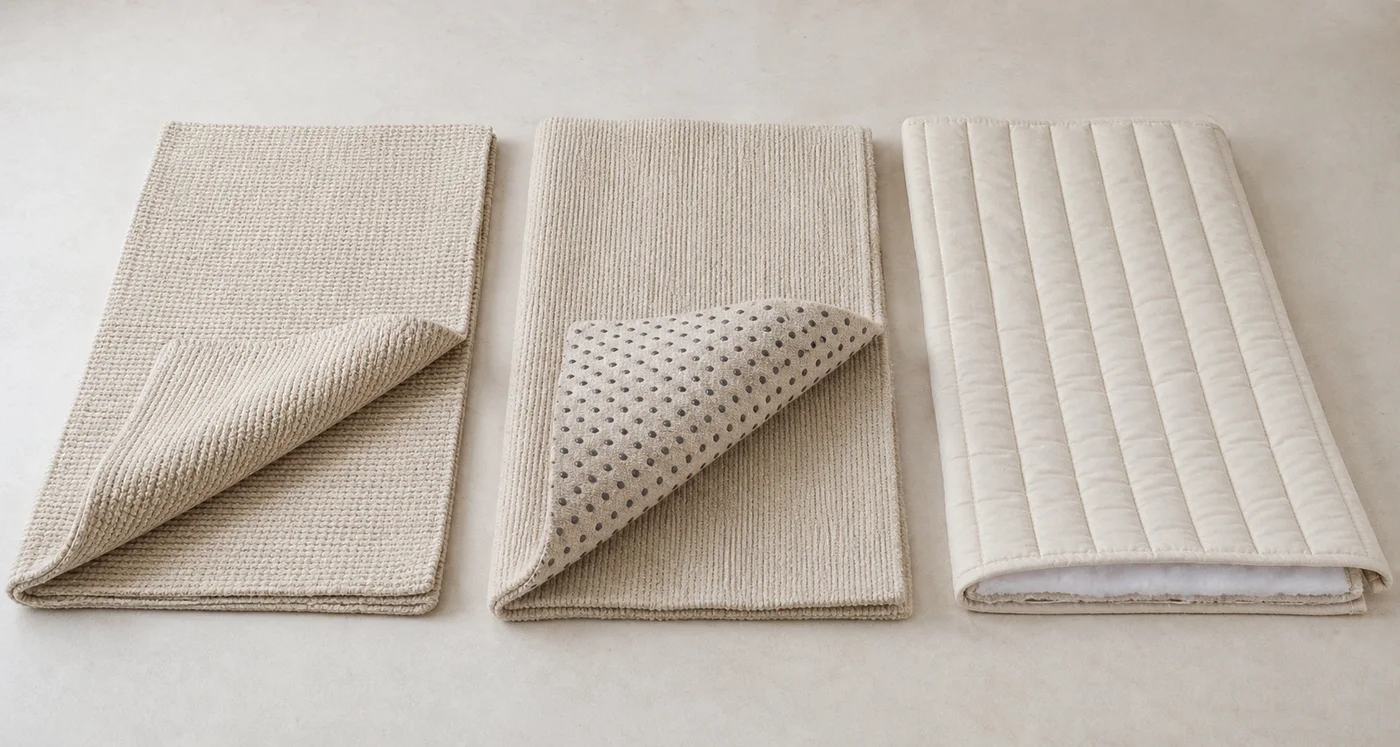
Unbacked woven cotton
This is the closest form to a traditional yoga rug: warp and weft create the entire working surface, sometimes with extra ridges or stripes. There is no bonded cushion. The mat can fold compactly and may tolerate laundering, but floor stability depends on weight, weave, moisture and the surface underneath.
Organic Cotton Mart currently lists a 100% organic-cotton woven product at 78 x 27 inches and describes it as machine washable. That is useful disclosure, but “100%” still needs scope: verify whether sewing thread, labels and any finish are included.
Cotton with anti-slip dots
Small rubber or polymer dots preserve much of the textile flexibility while increasing contact points on a smooth floor. Shunya Wellness publishes a cotton mat with dotted rubber backing and a weight of 2kg. Its care instruction is damp-cloth spot cleaning rather than saturation.
Dots do not guarantee stability. Coverage, compound, wear and floor dust all matter. They also turn an otherwise mono-material textile into a composite whose latex status and disposal route need checking.
Continuous rubber-backed cotton
A bonded rubber sheet can create a denser, more planted setup. It also adds weight, changes rolling behavior and may contain natural-rubber latex. Washing rules are commonly stricter because prolonged water and flexing can affect the bond.
Padded cotton
Quilted or filled mats are closer to a floor pad than a conventional traction mat. They can suit quiet seated or reclined use, but compression and fabric movement make them a poor default for quick standing transitions. Ask what the filling is; “cotton mat” may describe only the cover.
Cotton texture and grip are not the same thing
Woven cotton creates mechanical texture. It can also absorb moisture rather than leaving a film on top. Those traits may improve the body-to-mat interface for some users, but they do not prove standardized wet grip.
The whole mat can still slide or bunch on the floor.
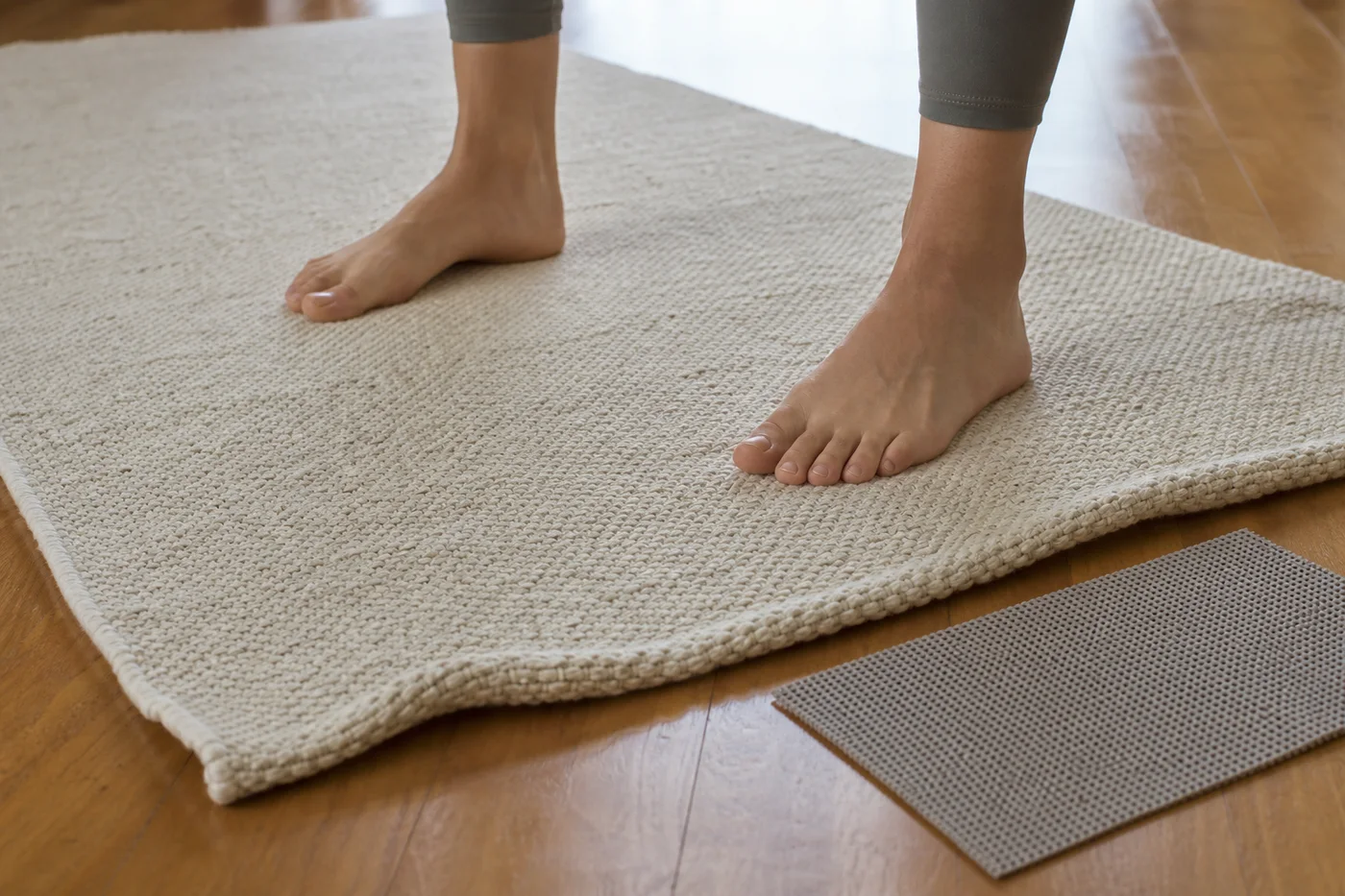
Test a cotton mat in this order:
- Place it on a clean, dry version of the floor you will actually use.
- Press laterally near both short ends and watch for whole-mat movement.
- Check whether the weave stretches or ridges under turning feet.
- Add intensity and moisture gradually rather than assuming absorbency equals grip.
- Stop if edges curl, the center bunches or a backing sheds.
For heavy-sweat practice, a cotton rug is often used over a stable base mat. That layering can work, but it adds another interface that can shift. Compare towels and purpose-built surfaces in the hot yoga mat guide.
Cushion, thickness and floor feedback
Woven cotton thickness is not directly comparable with foam thickness. A 5mm pile or folded textile can compress much more than a 5mm dense rubber mat. Sellers often omit density and compression figures, so the word “thick” does not tell you how knees or standing balance will feel.
Use four measurements where available:
- Flat thickness before load;
- weight per area, which helps distinguish dense weave from airy bulk;
- dimensions after washing, not only when new;
- rolled or folded volume for storage.
If joint comfort drives the purchase, a separate blanket or pad may be more controllable than a thick textile used for every movement. The yoga mat thickness guide explains why softness and support are not synonyms.
Organic cotton: verify the scope
“Organic cotton” can refer to farmed fiber, processed textile or a certified finished product. Those are not equal claims. A credible listing names a standard, certificate or license and allows the claim to be checked.
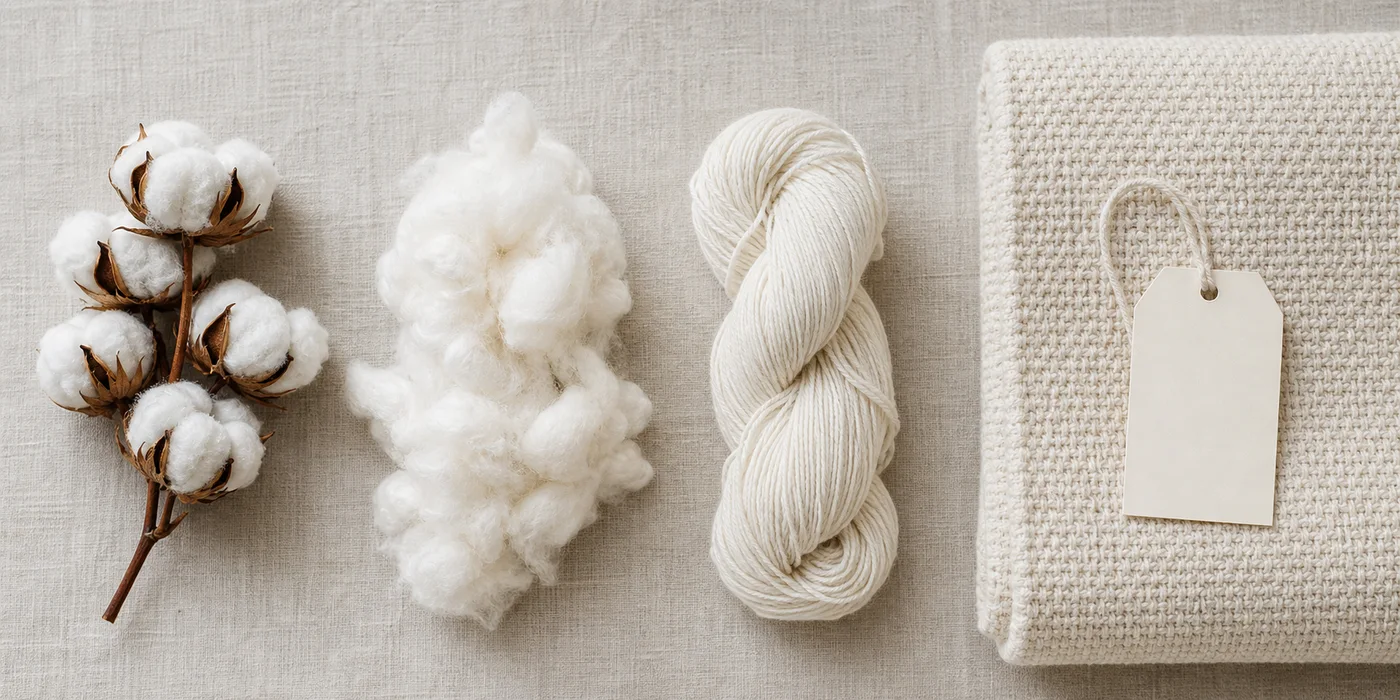
The Global Organic Textile Standard, commonly shortened to GOTS, covers processing requirements for certified organic fibers and includes environmental and social criteria. A GOTS logo or claim should be traceable under the scheme’s rules. The phrase “made with organic cotton” on its own is not equivalent to a certified finished mat.
Check:
- the standard’s exact name rather than a leaf icon;
- certificate or license details and current validity;
- whether the claim covers fiber, fabric or finished product;
- cotton percentage by mass;
- dyes, finishes, backing, filling and sewing thread;
- whether rubber is natural, synthetic or unspecified.
Do not translate organic into “chemical-free,” “non-toxic” or universally hypoallergenic. Those are different claims requiring different evidence.
How to wash a cotton yoga mat
Cotton’s washability is a major advantage only when the complete construction permits it. An unbacked rug may be machine washable; dotted rubber, bonded latex, padding, fringe and dyes can change the method.
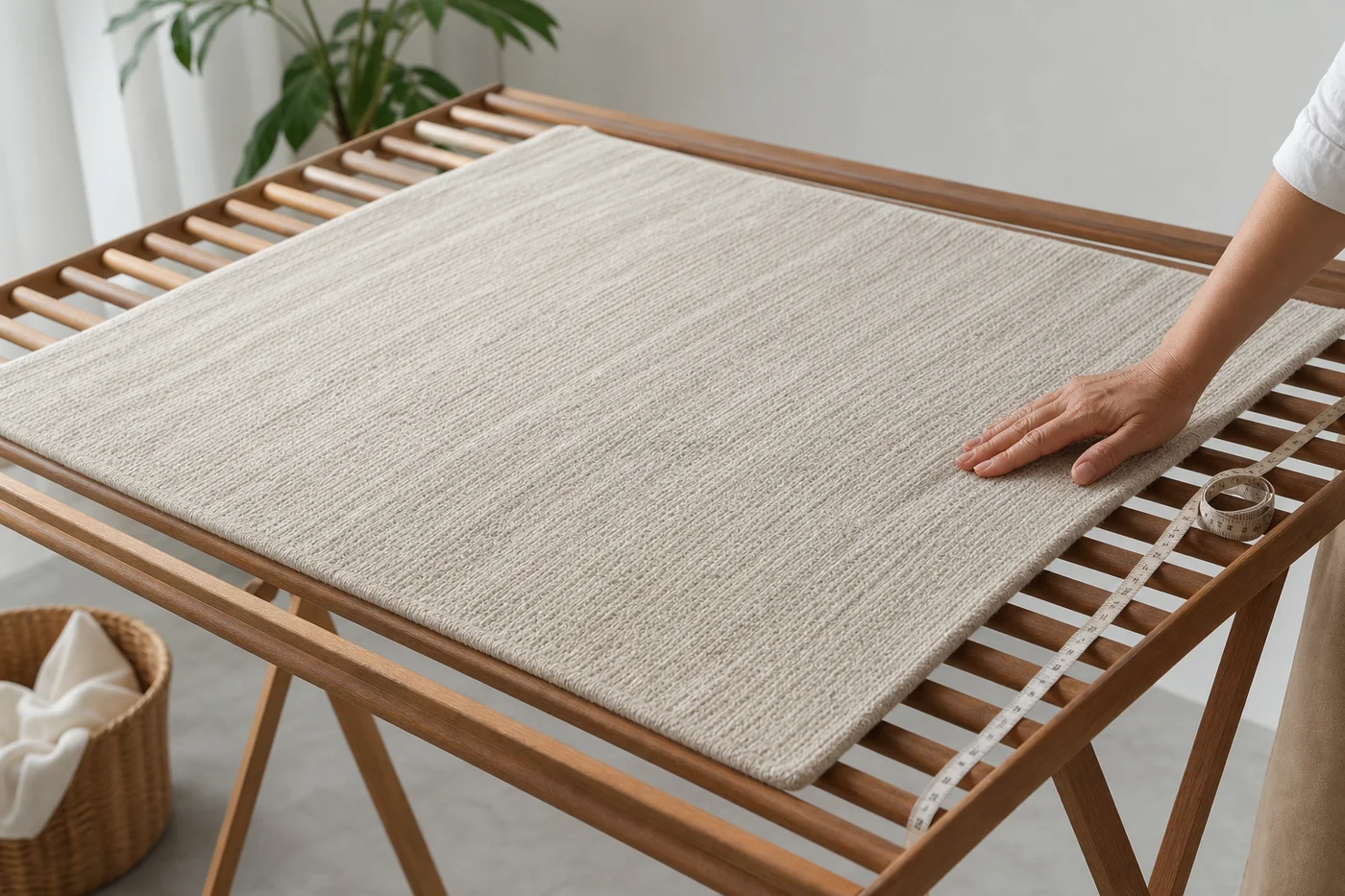
When the care label allows washing:
- Measure length and width before the first wash.
- Shake off grit and pre-treat only as the maker permits.
- Use cold water, a gentle cycle or hand wash, and modest mild detergent.
- Avoid bleach and fabric softener unless explicitly approved; residue can change feel and traction.
- Support the wet mat—do not stretch it by one corner.
- Reshape it square and dry flat or hang as directed.
- Let the center and edges dry fully before folding or rolling.
- Measure again and record shrinkage.
Never machine wash a rubber-backed or padded model merely because its top is cotton. Do not tumble dry unless the label permits it; heat can shrink cotton, affect dyes and degrade backing. The general mat-cleaning guide covers routine frequency and ventilation.
Shrinkage, dye transfer and durability
Cotton fibers can relax and contract during washing, especially when a product is not preshrunk or is exposed to heat. Uneven shrinkage can pull edges out of square. Dark or saturated dyes can also transfer during early washes or when sweat remains against a pale floor.
Before first use:
- check the manufacturer’s stated shrinkage tolerance;
- test colorfastness with a damp white cloth in an inconspicuous area;
- wash separately if instructed;
- inspect bound edges and fringe for loose yarn;
- confirm the return policy before laundering.
Durability depends on yarn size, weave density, edge finishing, wash frequency and floor abrasion. “Handwoven” describes a production method, not a durability guarantee. A visible skipped thread or loose binding is more informative than another artisan adjective.
Cotton versus hemp, jute and conventional mats
| Alternative | Cotton may suit you better when | Alternative may suit you better when |
|---|---|---|
| Hemp textile | Softer familiar feel and clearer wash options | Firmer bast-fiber texture is preferred |
| Jute composite | You want a foldable textile rather than foam | A structured, textured rollable mat is needed |
| Natural rubber | Absorption and laundering matter | Dry grip and planted floor feedback lead |
| PVC/TPE | You prefer fabric contact | Wipe-clean care and foam cushion matter |
Category labels overlap. A rubber-backed cotton mat may behave more like a rubber composite than an unbacked cotton rug. Compare full layers in the hemp mat guide, jute guide and natural-rubber guide.
Buying checklist
Require concrete answers before ordering:
- Is it woven, dotted, bonded or padded?
- What percentage of the finished product is cotton?
- What are the backing, filling, edge thread and treatments?
- Is natural-rubber latex present?
- What are measured length, width, weight and thickness?
- Is it preshrunk, and what shrinkage is allowed?
- Is washability stated for the exact model?
- Which organic or chemical standard is named and verifiable?
- Can it be returned before washing if floor behavior disappoints?
If a seller gives fiber poetry but no dimensions, backing or care label, the product is not comparison-ready.
The verdict
A cotton yoga mat is strongest as a firm, absorbent textile surface that may be washable and foldable. An unbacked weave is the simplest form but needs careful floor testing. Rubber dots or a bonded base may improve stability while adding latex, synthetic content and stricter care. Padding changes the product into a comfort-first floor mat.
Choose by construction first, then verify dimensions, wash method, shrinkage and certification scope. “Cotton” describes a fiber; a safe, durable and useful yoga surface is a complete system.
Frequently asked questions
Are cotton yoga mats good?
They can suit people who want textile feel, absorption and washability. They offer little foam cushion, and unbacked versions may move on smooth floors.
Do cotton yoga mats slip?
Cotton texture may help body-side friction, but whole-mat movement depends on weight, weave, backing and floor. Test both interfaces.
Can you machine wash a cotton yoga mat?
Only when the exact label permits it. Unbacked rugs are more likely to be washable than rubber-backed or padded composites.
What is the difference between a cotton yoga mat and a yoga rug?
The terms overlap. Yoga rug usually means an unbacked woven textile; cotton yoga mat also includes dotted, bonded and padded designs.
Is an organic cotton yoga mat completely organic?
Not necessarily. Certification may cover only the fiber or textile. Verify backing, thread, filling, dyes and the scope of the named standard.
Frequently asked questions
Are cotton yoga mats good?
A dense woven cotton mat can suit people who want a firm textile surface, sweat absorption and washability. It offers little foam-like cushioning, and an unbacked design may move on smooth floors.
Do cotton yoga mats slip?
Cotton texture can provide body-side friction, especially as it becomes damp, but floor movement depends on weave, weight and backing. Rubber dots or a separate underlay may help; test the complete setup.
Can you machine wash a cotton yoga mat?
Only if the exact care label permits it. Unbacked woven mats are more likely to be washable than rubber-backed or padded composites. Cold, gentle washing and flat or line drying can reduce risk, but the manufacturer instructions control.
What is the difference between a cotton yoga mat and a yoga rug?
The terms overlap. A yoga rug is usually an unbacked woven textile used alone or over another mat. Cotton yoga mat is broader and also includes rubber-dotted, rubber-backed and padded constructions.
Is an organic cotton yoga mat completely organic?
Not necessarily. Organic certification may cover the cotton fiber or textile while the finished mat also contains rubber, polyester thread, filling, dyes or anti-slip treatment. Verify certification scope and the complete material list.