

Direct answer
Which should you choose?
Choose a yoga rug
If you deliberately want a foldable, absorbent textile surface and can follow its floor and washing guidance.
Choose a yoga mat
If you want integrated grip, cushioning and a more predictable floor-facing base.
Biggest practical difference: A rug manages contact through its weave and may need another layer; a mat integrates the contact surface, cushion and base into one unit.
- Construction
- Woven textile
- Continuous or bonded sheet
- Cushion
- Minimal and weave-dependent
- Built into a measured thickness
- Moisture
- Cotton-rich weaves absorb it
- Depends on open- or closed-cell build
- Floor stability
- May need a mat underneath
- Base is normally integrated
- Packing
- Folds or rolls
- Usually rolls
- Cleaning
- Product-specific washing
- Usually surface cleaning
- Best for
- Textile feel and absorbency
- Integrated grip and support
How this page has changed
July 26, 2026
Sources, internal links and safety or product context reviewed.
In this guide
- 01Yoga rug vs mat at a glance
- 02What counts as a yoga rug?
- 03The surface-system difference
- 04Grip, bunching and the floor underneath
- 05Cushioning and floor feedback
- 06Sweat and absorbency
- 07Travel and outdoor use
- 08Washing a yoga rug
- 09Sustainability claims need boundaries
- 10Which should you choose?
- 11Buying checklist
A yoga rug is a woven, practice-size textile—not simply a decorative rug placed in a yoga room. Compared with a conventional yoga mat, it is usually more foldable and absorbent, has less integrated cushioning and depends more heavily on the weave, floor and layering method for stability.
Choose a rug when you deliberately want a textile surface, compact folded packing or washable sweat absorption and can follow its floor guidance. Choose a mat when you want an integrated grippy base, predictable cushioning and a surface engineered as one continuous sheet. Some people layer a rug over a mat to combine absorption with base stability.
Yoga rug vs mat at a glance
| Feature | Woven yoga rug | Conventional yoga mat |
|---|---|---|
| Structure | Interlaced yarns; edges may be hemmed or fringed | Continuous foam, rubber, PVC or layered sheet |
| Cushioning | Usually minimal and weave-dependent | Built into a measured thickness |
| Moisture | Cotton-rich surfaces absorb it | Open- and closed-cell surfaces behave differently |
| Floor interface | Product-dependent; may need a mat underneath | Base is normally integrated |
| Packing | Folds or rolls; conforms to luggage | Usually rolls; thin travel mats may fold |
| Cleaning | May allow hand or machine washing | Usually surface cleaning; machine washing is rare |
| Dimensional change | Cotton can shrink; handmade size can vary | Typically more dimensionally consistent |
| Best reason to choose | Intentional woven feel and absorbency | Integrated stability, grip and cushion |
The labels still overlap. Some brands call woven products “mats,” and some modern rugs add a rubber backing. Check construction rather than assuming every item named yoga rug behaves like a loose cotton weave.
What counts as a yoga rug?
A practice rug should have dimensions and construction intended for body contact and movement. Current official examples illustrate the range:
- Manduka Shala: 71 × 26 inches, about 2.3 pounds, made from 95% recycled pre-consumer cotton and 5% polyester; machine wash cold and hang dry. Manduka notes handmade dimensions can vary.
- JadeYoga Organic Cotton Mysore Rug: 72 × 26 inches, 2.5 pounds, organic cotton with vegetable dyes; machine wash colors separately in cold water and hang dry. Jade instructs users to place it over a Jade mat on hard smooth floors.
- Hugger Mugger Cotton Yoga Rug: 74 × 28 × 1/8 inches, 2.8 pounds, cotton; hand wash and hang dry. Its official page says it can be used over a mat or on its own.
Those specifications show why “cotton rug” is not enough information. Wash method, width, mass and hard-floor guidance differ even among three established practice-rug products.
Decorative rugs are outside this category. They may have stiff backing, raised pile, loose fringe, incompatible dyes, unverified skin-contact materials or dimensions that do not create a stable practice boundary. A foam yoga mat printed to resemble a Persian rug is still a mat, not a woven yoga rug.
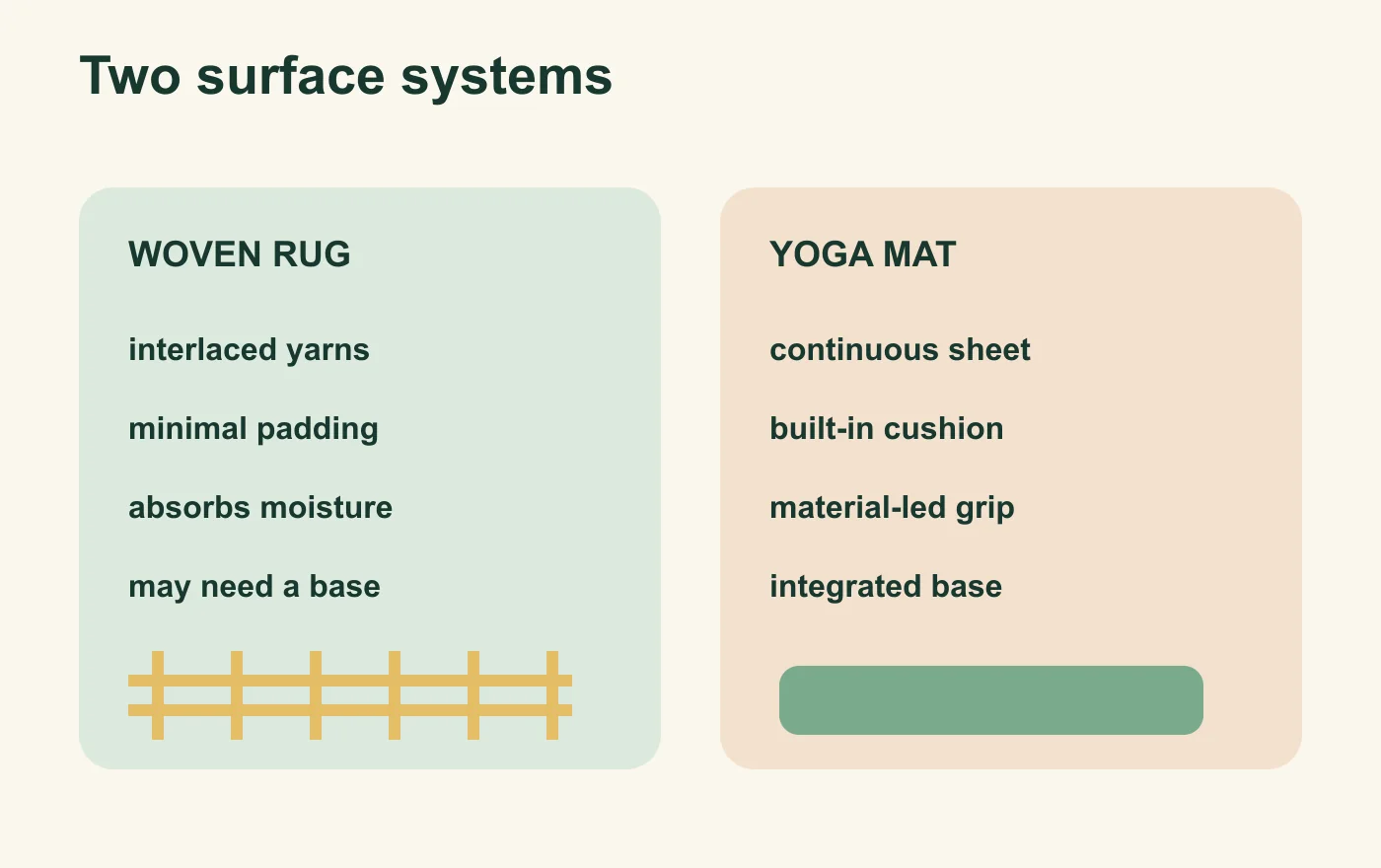
The surface-system difference
A mat is usually an integrated system
A conventional mat combines the contact surface, cushion and floor-facing base. Materials can still be layered—such as polyurethane over rubber—but the factory bonds them into one unit. That reduces the number of loose interfaces the user must manage.
Mat grip varies substantially. Natural rubber, PVC, cork, TPE and microfiber-topped mats do not respond identically to dry hands, sweat or cleaning. See the yoga mat buying guide for those material differences.
A rug may depend on another layer
A loose woven textile can absorb moisture and create a distinctive hand feel, yet it has little built-in control over the floor beneath it. Yarn direction, weave tension, mass, hem and backing all affect bunching and translation.
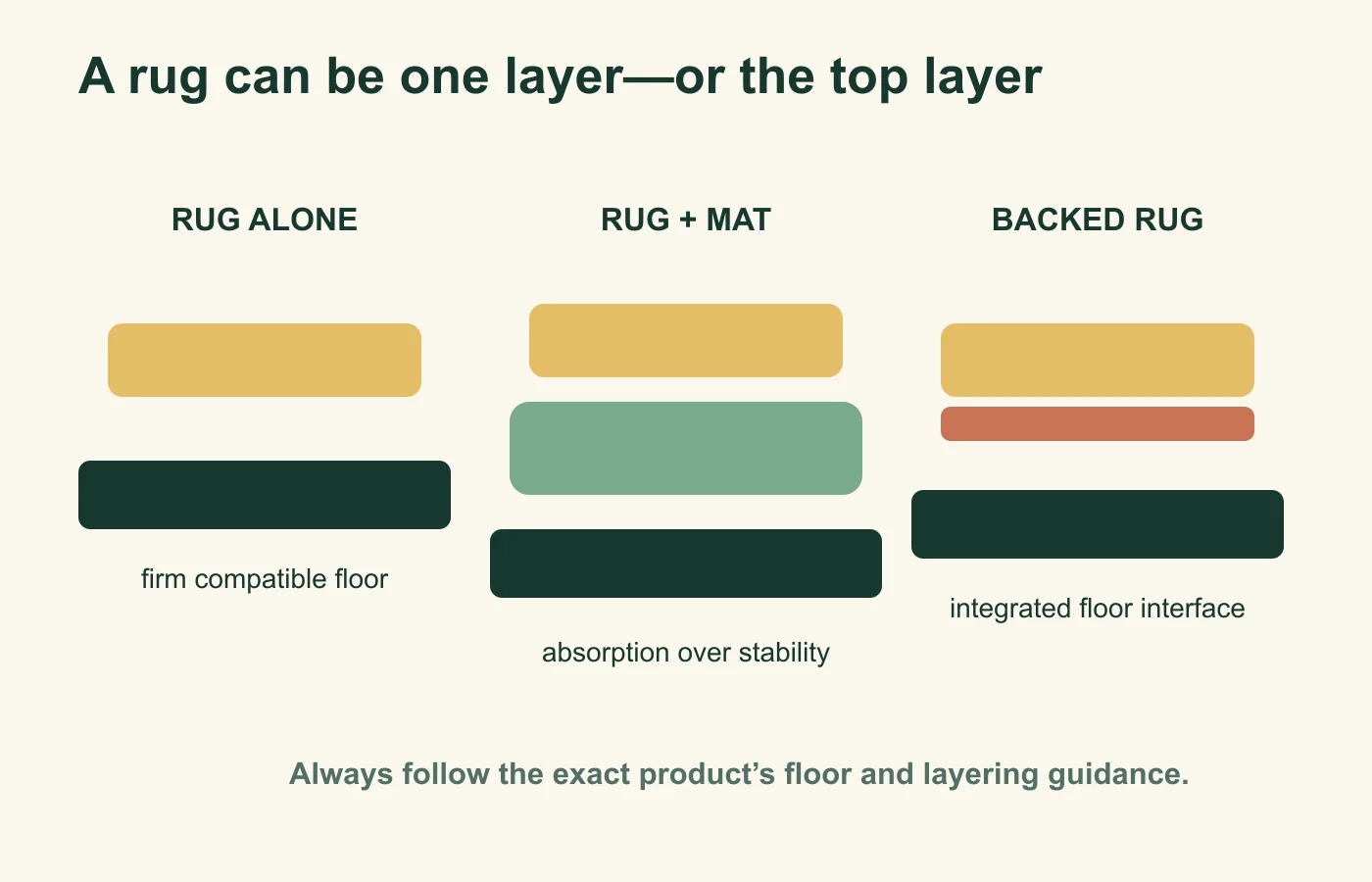
This does not mean every rug slides. It means floor compatibility must be stated by the maker or verified conservatively. Jade’s explicit hard-floor layering instruction is stronger evidence than a retailer simply calling a rug “non-slip.”
Grip, bunching and the floor underneath
Grip has two interfaces: body to rug, and rug to floor. Moisture may change the first while doing nothing useful for the second. A cotton weave that feels more secure under damp hands can still translate as a whole on polished flooring.
Before use, place the dry rug according to its instructions and inspect it empty. It should lie flat without rolled hems, folded tassels or diagonal tension. Light hand pressure at several points should not push a wave across the fabric. This is an equipment check, not a pose or balance test.
Stop if the rug visibly bunches, folds or migrates. Do not improvise with adhesive spray, carpet tape or hook fasteners: they can leave residue, damage fibers and make washing unpredictable. Use an approved underlying mat or a different compatible surface instead.
On carpet, the rug and carpet can both deform. Adding a rug does not make plush pile rigid; consult the yoga mat on carpet guide for the underlying compression problem.
Cushioning and floor feedback
A woven rug provides separation and texture, but not the engineered foam depth of a mat. Even the 1/8-inch specification on Hugger Mugger’s current rug describes a textile construction, not a promise that it compresses like a 3mm foam mat.
Layering a rug over a mat adds their heights and changes surface behavior. The result may be useful when absorption is the priority, but wrinkles or independent movement between layers remain possible. A thicker base is not automatically more stable; firmness and layer adhesion matter.
Choose cushioning independently from aesthetics. If measured support is the dominant requirement, compare mat thickness and density first. The yoga mat thickness guide explains why millimeters and softness are not synonyms.
Sweat and absorbency
Cotton-rich rugs absorb moisture rather than leaving all of it on a non-absorbent film. That can be a rational reason to choose one. It also creates a drying obligation: absorbed moisture must leave the full weave before storage.
Do not generalize “grippier when wet” to every rug. Yarn, weave, dye, skin moisture and the underlying layer vary. Product marketing rarely publishes a standardized coefficient of friction, and customer reports cannot replace a defined test.
If the only desired feature is an absorbent removable top layer, compare a yoga mat towel. Towels are usually lighter and designed primarily for mat layering; yoga rugs tend to be heavier woven surfaces that may have a broader standalone or outdoor role.
Travel and outdoor use
Rugs fold into luggage without preserving a cylindrical roll, and their textile construction can conform to irregular outdoor ground. Manduka explicitly positions the current Shala for travel and outdoor use, including layering over grass, sand, outdoor carpet or a yoga mat.
That permission does not make every outdoor location suitable. Clear the area of glass, thorns, sharp stones, moisture, animal waste and unstable ground. A rug does not level holes or protect against hidden objects. Follow local rules and avoid leaving dyes or fibers on sensitive surfaces.
Weight can be less different than expected. The current examples above range from about 2.3 to 2.8 pounds, similar to some travel and standard mats. Foldability—not merely scale weight—is the clearer packing advantage.
Washing a yoga rug
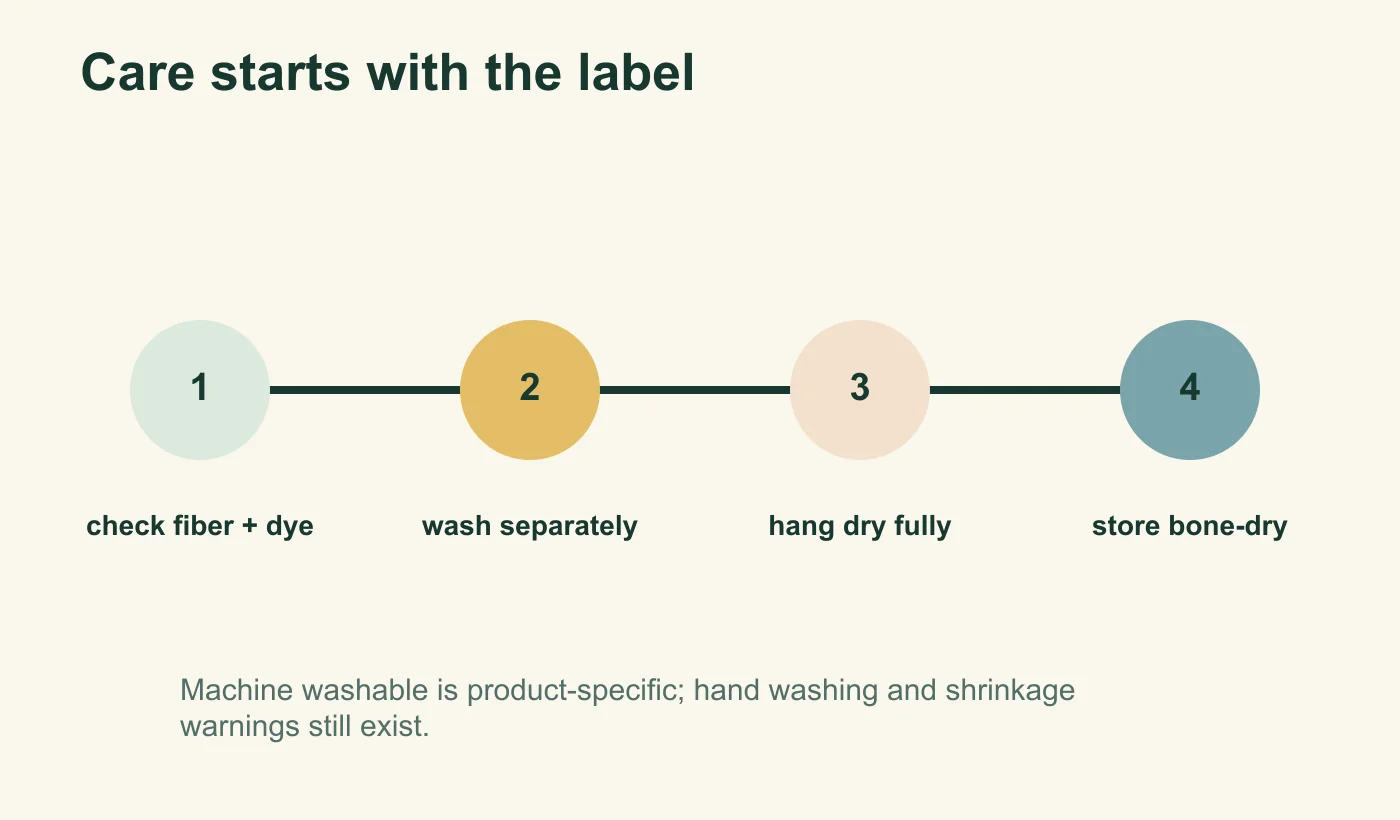
There is no universal yoga-rug wash cycle:
- Manduka says to wash the Shala separately in cold water before use, machine wash cold and hang dry; colors may fade or bleed.
- JadeYoga says to machine wash colors separately in cold water and hang dry, noting that rugs may shrink.
- Hugger Mugger specifies hand washing and hang drying for its cotton rug.
These are materially different instructions. Do not copy the most convenient method from another cotton product. Avoid bleach, fabric softener, essential oils, high heat and machine drying unless the exact label permits them.
Dry the rug completely before folding. A wet dyed textile should not remain on wood; Manduka specifically warns against placing its wet rug on a wooden floor. Support the rug while drying so its wet weight does not distort one small section.
Conventional mats usually follow a surface-cleaning process rather than machine washing. The mat cleaning guide routes care by material and manufacturer.
Sustainability claims need boundaries
Natural-looking texture does not prove a complete environmental advantage. Ask for fiber percentages, recycled or organic certification details, dye disclosure, backing material, manufacturing location, wash energy and expected service life.
Manduka discloses a 95% recycled pre-consumer cotton and 5% polyester composition for the Shala. Jade identifies organic cotton and vegetable dyes for its Mysore rug. Those are specific product statements, not proof that every yoga rug is plastic-free, biodegradable or lower-impact than every durable mat.
Frequent washing, replacement and shipping also matter. Avoid converting one material attribute into an unsupported whole-life conclusion.
Which should you choose?
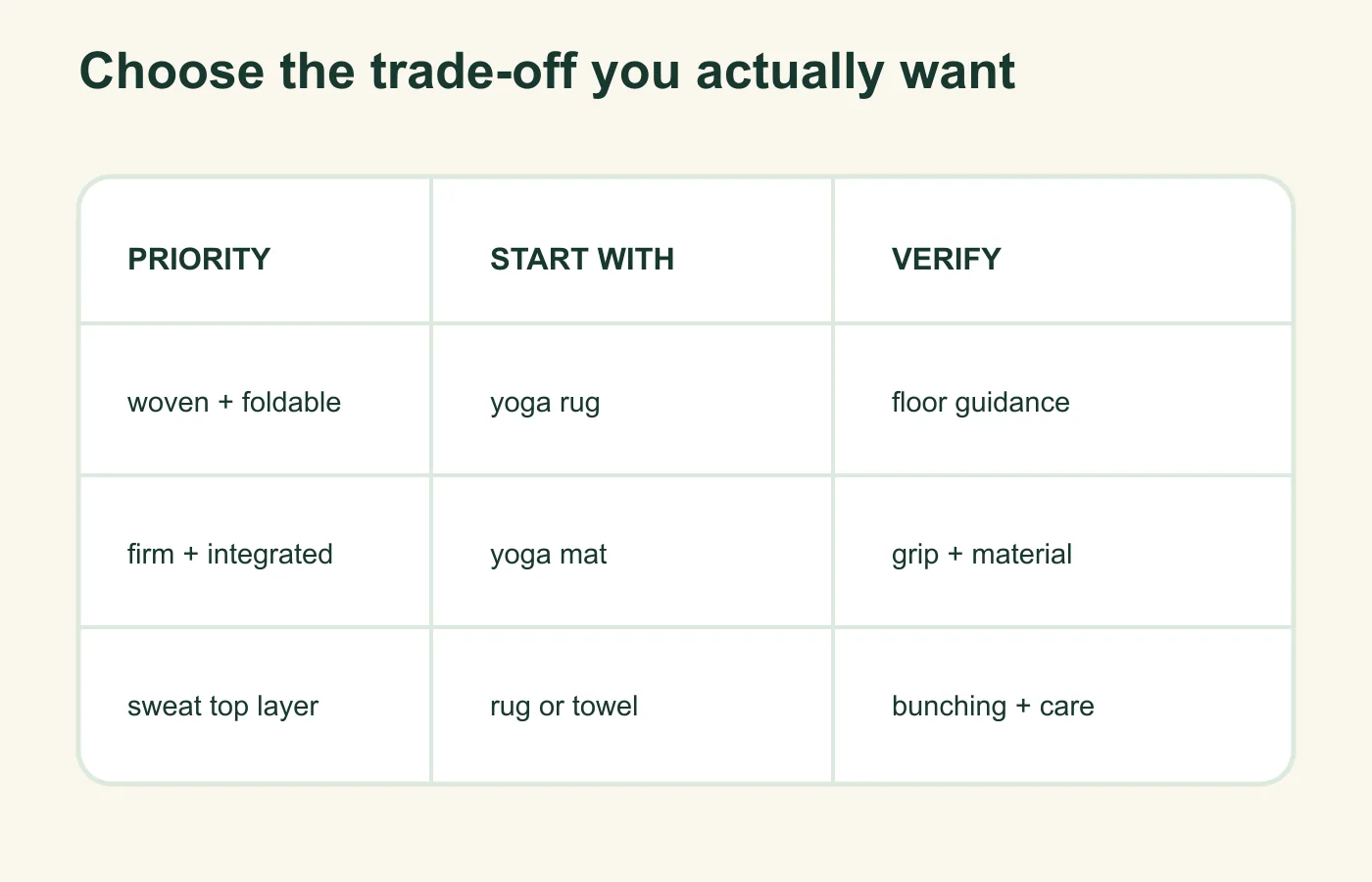
Choose a yoga rug when
- a woven textile surface is the deliberate preference;
- folding flat matters more than rolling;
- absorbency and washable construction are useful;
- minimal integrated cushion is acceptable;
- the exact floor or layering guidance fits the space;
- variation from handmade weaving is acceptable.
Choose a yoga mat when
- an integrated floor-facing base is the priority;
- predictable measured cushioning matters;
- the practice depends on consistent material-led grip;
- surface cleaning is preferable to laundering;
- the studio expects a conventional mat footprint.
Layer a rug over a mat when
- the rug maker permits or recommends it;
- absorption is needed without giving up the mat’s base stability;
- both layers lie flat and do not move independently;
- the combined height and storage load are acceptable.
Choose a towel instead when
- the goal is only a light removable sweat layer;
- silicone nubs or corner pockets are preferred;
- fast laundering and compact packing matter more than woven rug feel.
Buying checklist
- Confirm it is a practice rug, not room décor or a rug-print foam mat.
- Record exact fiber percentages and backing material.
- Compare open dimensions, weight and folded size.
- Read whether it is approved alone, over a mat or outdoors.
- Check hard-floor and carpet instructions separately.
- Verify machine wash, hand wash, water temperature and drying method.
- Expect possible bleeding or shrinkage when the maker warns about it.
- Avoid broad sustainability claims without product-level evidence.
- Check return terms before washing, because washing may change dimensions.
- Reinspect flatness, hems and weave after every wash.
The best yoga rug vs mat choice is a surface-system decision. A rug gives you woven texture, absorption and foldability. A mat gives you integrated grip, cushion and base control. Layer them only when the manufacturer permits it and the combined setup remains flat.
Frequently asked questions
What is a yoga rug?
A yoga rug is a woven textile surface sized for yoga practice, commonly made primarily or entirely from cotton. Depending on its construction and maker guidance, it may be used alone, over a yoga mat or outdoors. It is different from a decorative room rug.
Is a yoga rug better than a yoga mat?
Neither category is universally better. A rug is foldable, absorbent and textile-like but usually offers little integrated cushioning. A mat normally provides a more controlled base, built-in cushion and material-led grip. Choose by floor, moisture, care and stability requirements.
Can you use a yoga rug without a mat underneath?
Only when the exact rug maker permits it and the floor is clean, suitable and stable. Some woven rugs may shift on smooth hard floors; JadeYoga explicitly tells buyers to place its Mysore rug over a Jade mat on hardwood, laminate and tile.
Are yoga rugs machine washable?
Some are, but not all. Manduka and JadeYoga currently specify cold machine washing and hang drying for their rugs, while Hugger Mugger specifies hand washing and hang drying. Follow the exact label because dyes may bleed and woven cotton may shrink.
What is the difference between a yoga rug and yoga towel?
A yoga rug is generally a heavier woven practice surface that may sometimes work alone. A yoga towel is usually a lighter absorbent layer designed primarily to sit on a mat. Product construction and backing matter more than the category name.