

How this page has changed
July 26, 2026
Sources, internal links and safety or product context reviewed.
In this guide
- 01PU yoga mats at a glance
- 02What polyurethane means in a yoga mat
- 03Grip is a system, not one material claim
- 041. Liforme Classic — clearest three-layer explanation
- 052. Manduka GRP Adapt — most explicit absorbent system
- 06PU surface versus suede microfiber
- 07PU versus natural rubber
- 08Cleaning without sacrificing grip
- 09Environmental and durability questions
- 10Buying checklist
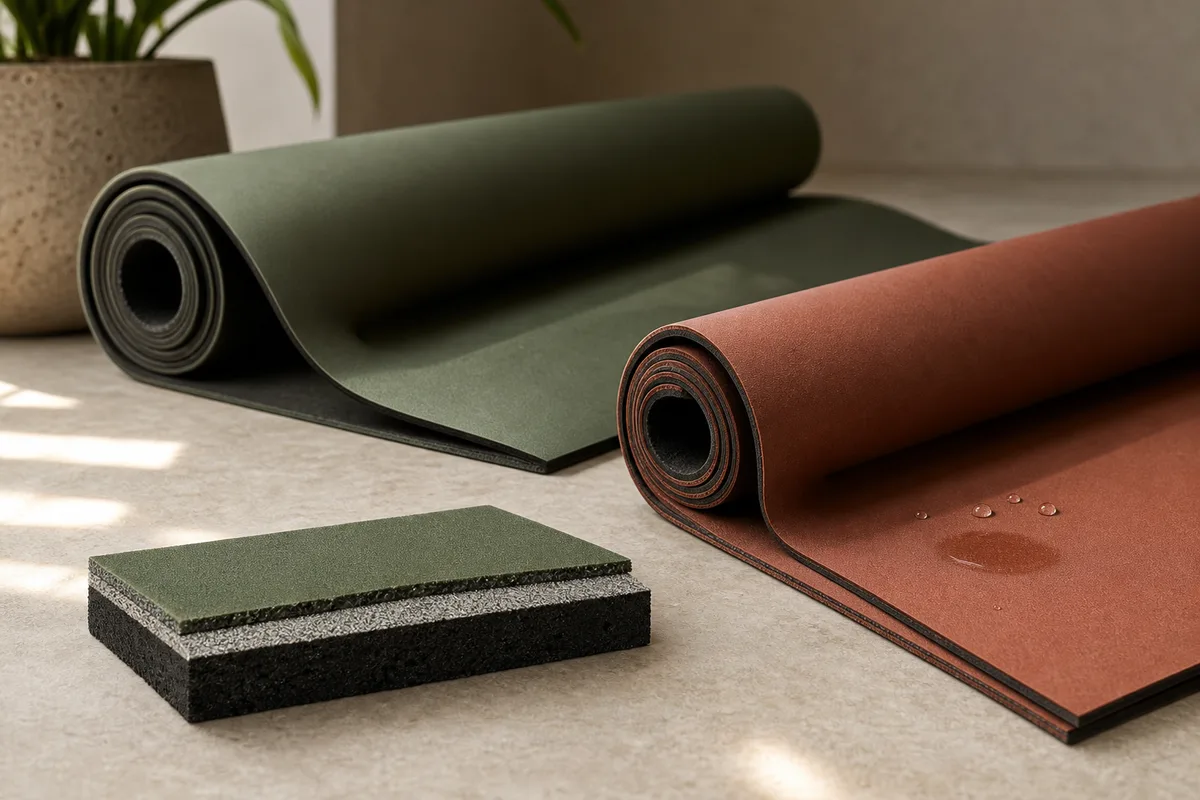
A PU yoga mat is usually a layered mat, not a solid block of polyurethane. PU stands for polyurethane, a broad family of synthetic polymers. In current premium yoga mats, a thin PU contact surface commonly sits over natural rubber, while an intermediate barrier or textile layer may control moisture and bonding.
That layer stack explains both the attraction and the trade-offs. PU surfaces are marketed for immediate traction and sweaty practice, but the dense rubber base makes many full-size models heavy. An absorbent surface also needs stricter cleaning and drying than a closed-cell wipe-clean mat.
This is a source-checked construction comparison, not a hands-on test.
PU yoga mats at a glance
| Current option | Best fit | Published layer design | Size, thickness and weight | Main limitation |
|---|---|---|---|---|
| Liforme Classic | Wider alignment mat with a barrier between PU and rubber | Proprietary eco-PU top, CleanGrip barrier, natural-rubber base | 185 × 68cm; about 4.2mm; about 2.5kg | Heavy; proprietary PU details and biodegradation claim need careful interpretation |
| Manduka GRP Adapt 1.0 | Highly absorbent sweat-specific construction | Satin Grip PU top, moisture-flow scrim, natural-rubber/latex base | 180 × 66cm; 5mm; 2.6kg | Very restrictive care; absorbent surface must dry fully and is sensitive to heat/sun |
Neither product proves that every PU mat behaves the same. Liforme describes a patented barrier that keeps sweat from entering the rubber base; Manduka emphasizes absorption through the top and internal scrim. “PU top” is therefore a starting category, not a performance specification.
What polyurethane means in a yoga mat
Polyurethane chemistry is tunable. Manufacturers can alter raw materials, curing, pore structure, coating thickness, hardness, pigments and additives. PU can appear as foam, adhesive, coating or synthetic leather in unrelated products; the acronym does not identify one recipe.
On a yoga mat, the surface is thin because PU supplies the hand-and-foot interface while the backing supplies most of the depth and mass.
| Listing phrase | What it usefully signals | What remains unknown |
|---|---|---|
| PU / polyurethane top | Synthetic polymer contact layer | Formulation, thickness, porosity and test data |
| Open-cell / absorbent | Moisture can enter the surface structure | Absorption capacity, drying time and residue retention |
| Eco-PU | Brand-specific environmental positioning | Standard definition, feedstock and full life-cycle impact |
| Natural-rubber base | Dense cushioning and floor contact | Plantation source, exact percentage and latex suitability |
| Barrier layer | Intended separation of moisture from backing | Material, bonding and end-of-life separability |
| Non-slip | Manufacturer grip position | Friction value, test surface and dry/wet conditions |
Be especially careful with “PU leather.” It generally means a manufactured polyurethane-faced material, not animal leather, but listings vary. Ask for the complete layer composition rather than inferring it from one surface word.
Grip is a system, not one material claim
PU surfaces often feel tacky from the first session, unlike some closed-cell PVC mats that need use before traction develops. But “grip” combines several mechanisms:
- Skin-to-surface friction determines whether hands and feet slide.
- Moisture transport determines whether sweat pools, enters the surface or evaporates.
- Mat-to-floor traction comes mainly from the backing.
- Layer stability determines whether the face stretches, bubbles or separates.
| Condition | PU construction question | What to verify |
|---|---|---|
| Dry hands | Is tack immediate or texture-dependent? | Brand claim plus return-window test |
| Light sweat | Does the face absorb, spread or repel moisture? | Exact layer description, not generic PU advice |
| Heavy sweat | Can capacity be exceeded or drying become slow? | Brand care limits and towel guidance |
| Pivoting | Does high friction impede intentional rotation? | Independent reviews and controlled trial |
| Dirty/oily surface | Can pores or tack collect residue? | Approved cleaner and cleaning frequency |
| Smooth floor | Does the rubber underside hold? | Clean-floor test without forcing a pose |
No “non-slip” mat is slip-proof. If contact shifts, exit the position, dry the surface and reassess. For a shortlist across multiple materials, use the best non-slip yoga mat guide; this page answers the narrower construction question.
1. Liforme Classic — clearest three-layer explanation
Liforme publishes a natural-rubber base, proprietary eco-polyurethane top and CleanGrip barrier. The company says the barrier prevents sweat from reaching the rubber base while allowing surface moisture to evaporate. The full-size Classic measures 185 × 68cm, about 4.2mm thick and about 2.5kg.
The wide 68cm format provides more lateral space than Manduka’s 66cm GRP. Its laser-etched alignment design is another product-specific feature, but alignment markings do not validate body position for every practitioner; treat them as consistent reference points rather than instruction.
The environmental language deserves boundaries. “Eco-polyurethane” is Liforme’s proprietary term, not a standardized polymer category. The brand states the mats are PVC-free, Vegan Certified and designed to biodegrade within one to five years in normal landfill conditions. That is a manufacturer claim about the complete product under stated disposal conditions, not permission to litter, compost at home or assume local landfill behavior. Seek the underlying test report before comparing it numerically with another mat.
Care: Liforme instructs users to apply three to five pumps of its cleaner to a soft damp sponge, spread evenly, wait briefly, then wipe again with a clean damp sponge. Let it dry fully and avoid harsh chemicals, prolonged sun and damp storage.
Choose it for disclosed dimensions, a clear barrier concept and wider practice area. Skip it if you want light carry, a standardized definition of its PU formulation or a simpler single-layer surface. Review the current Liforme Classic specifications and layer explanation.
2. Manduka GRP Adapt — most explicit absorbent system
Manduka’s GRP Adapt 1.0 lists polyurethane, natural rubber and latex, with a Satin Grip top, moisture-flow scrim and Versa-Grip underside. The standard version is 180 × 66cm, 5mm thick and 2.6kg. Manduka also offers a longer 201 × 66cm version at 2.9kg.
This is not merely “PU over rubber.” The woven scrim is part of the moisture system, and the 5mm thickness includes multiple functional layers. Manduka claims grip in wet and dry conditions and calls the top highly absorbent; without a published capacity or friction test on the product page, those remain manufacturer claims.
The care restrictions are unusually important. Manduka says to use its Mat Wash and a clean damp cloth, air-dry completely, roll top-side inward, and avoid soap, soaking, submerging, harsh chemicals, excessive sunlight and heat. Generic PU cleaning advice that suggests dish soap therefore conflicts with this exact product. The manufacturer wins.
The product explicitly contains natural rubber/latex and is not recommended by Manduka for latex sensitivities. That is material disclosure, not personal medical guidance. Discuss individual risk with the manufacturer and an appropriately qualified clinician.
Choose GRP Adapt for a thoroughly documented, sweat-oriented internal stack and 5mm cushion. Skip it if you need easy cleaning, rapid low-maintenance turnaround, low weight or latex-free construction. See the live Manduka GRP Adapt specification.
PU surface versus suede microfiber
Both constructions are used for sweaty practice, but they are not interchangeable.
| Question | PU-top mat | Suede/microfiber-top mat |
|---|---|---|
| Dry feel | Often immediately tacky | Can feel smoother before moisture |
| Moisture mechanism | May absorb through pores or manage via a barrier | Textile fibers absorb/spread moisture |
| Skin contact | Smooth or finely textured polymer face | Soft, short-pile textile face |
| Cleaning | Frequently product-specific and restrictive | Ranges from wipe-only to machine washable |
| Backing | Commonly dense natural rubber | Natural rubber or lightweight TPE |
| Typical failure concern | Staining, pore contamination, top wear/delamination | Pile wear, odor, fiber/bond degradation |
Our suede yoga mat guide documents both rubber- and TPE-backed examples. A heavy sweater may prefer either format; the decisive questions are dry feel, wash system, total weight and whether the specific surface has credible wet-condition evidence.
PU versus natural rubber
PU and natural rubber often coexist in one mat, so “PU versus rubber” can be the wrong comparison. The contact layer and base solve different problems.
- PU usually supplies the immediate skin-contact traction and moisture behavior.
- Natural rubber usually supplies density, floor grip and most cushioning.
- A barrier or adhesive holds the system together and affects durability.
- The combined mat is harder to recycle than a separable single-material product.
- Natural rubber introduces natural-rubber latex considerations even under a synthetic top.
If you want a rubber surface rather than only a rubber base, compare the constructions in the natural-rubber yoga mat guide.
Cleaning without sacrificing grip
PU’s appeal depends on its surface condition. Oils, detergent residue, abrasion and heat can change friction or appearance.
- Read the exact care page before applying anything.
- Blot sweat soon after practice; do not aggressively scrub.
- Use only the stated cleaner and dilution.
- Wipe residue only where instructed.
- Dry completely on both sides before rolling.
- Keep away from heaters, hot cars and prolonged direct sun.
- Do not machine wash, soak or disinfect unless explicitly permitted.
| Product | Approved routine | Explicit cautions |
|---|---|---|
| Liforme Classic | Brand cleaner on soft damp sponge, then clean damp wipe | Avoid harsh chemicals, prolonged sun and damp storage |
| Manduka GRP Adapt | Manduka Mat Wash plus clean damp cloth | No soap, soaking, submerging, harsh chemicals, heat or excessive sun |
The discrepancy is the lesson: there is no universal PU recipe. Our general cleaning guide can help identify conservative principles, but it cannot override the product label.
Environmental and durability questions
Polyurethane is synthetic, and a bonded PU/barrier/rubber mat is a multi-material object. “Natural rubber base,” “PVC-free,” “vegan” or “eco-PU” each answers one question; none alone proves low total impact.
Ask for:
- PU layer chemistry and approximate mass percentage;
- rubber sourcing and certification scope;
- bonding method and delamination warranty;
- finished-product restricted-substance and emissions testing;
- evidence and conditions behind biodegradation claims;
- abrasion, sweat-aging and cleaning-cycle test methods;
- a real take-back or recycling route in your location.
Durability also depends on use. An absorbent surface exposed to vigorous daily sweat and harsh cleaning may age faster than a closed-cell face. Choose a mat whose care burden fits your routine; neglected high-performance materials are not a sustainability win.
Buying checklist
- Confirm PU is the top layer and identify every backing/intermediate layer.
- Check whether the surface absorbs moisture or uses a barrier system.
- Compare finished weight, not just thickness.
- Look for separate top-grip and floor-grip information.
- Read care restrictions before purchase.
- Treat natural-rubber latex disclosure as part of the whole construction.
- Ask what “eco-PU,” “non-toxic” and “biodegradable” specifically mean and how tested.
- Test dry traction, damp traction and intentional pivots within the return period.
- Prefer clear warranty terms for top wear, bubbling and delamination.
A PU yoga mat is most compelling when immediate surface traction and sweat handling outweigh light carry and easy cleaning. The correct choice comes from the full layer design—not the letters PU by themselves.
Frequently asked questions
What is a PU yoga mat?
PU means polyurethane. In premium yoga mats it is usually a thin grip surface bonded to a heavier base, commonly natural rubber; it is rarely the whole mat. The exact PU formulation, porosity, barrier layer and backing determine moisture handling, weight, care and longevity.
Are polyurethane yoga mats good for sweaty hands?
Many PU surfaces are designed for immediate dry traction and moisture handling, which makes them relevant to sweaty practice. Construction varies: some absorb moisture into an open surface, while others use a barrier to keep it out of the rubber base. Manufacturer grip claims are not universal slip guarantees.
Is PU the same as natural rubber?
No. Polyurethane is a synthetic polymer family. Natural rubber is a separate bio-based material often used as the dense backing under a thin PU top. A PU-and-rubber mat can therefore carry natural-rubber latex considerations even though the contact surface is polyurethane.
How do you clean a PU yoga mat?
Use the exact manufacturer method. Liforme permits its cleaner on a damp sponge followed by a clean damp wipe. Manduka says to use its Mat Wash and a damp cloth, never soap, soaking or harsh chemicals. Generic vinegar, oils, alcohol, disinfectants or machine washing can damage or clog some PU surfaces.
Is a PU yoga mat eco-friendly?
PU alone does not prove low impact, recyclability or biodegradability. Evaluate the complete layer stack, source of the rubber, chemistry and thickness of the top layer, bonding method, durability, verified substance testing and realistic end-of-life route.