

How this page has changed
July 26, 2026
Sources, internal links and safety or product context reviewed.
In this guide
- 01Wool yoga mats at a glance
- 02What “wool yoga mat” actually means
- 03Where a wool mat fits—and where it does not
- 04Four current construction examples
- 05The five checks that matter most
- 06How to care for a wool yoga mat
- 07Is wool automatically sustainable?
- 08Wool yoga mat vs common alternatives
- 09The verdict
- 10Frequently asked questions
A wool yoga mat is a soft textile practice surface built mainly for stillness, not a fluffy replacement for every conventional grip mat. Current products cluster around meditation, yin-style sessions, restorative use and other quiet practices with long floor contact. Their wool face adds softness and insulation, while a hidden backing or separate under-mat keeps the surface in place.
That construction is the key. A listing can truthfully say “100% wool” while using natural latex, polyurethane or polyester underneath. The backing changes latex exposure, floor behavior, care and end-of-life options. Buy the complete material stack, not the headline fiber.
This guide compares current manufacturer disclosures rather than claiming hands-on testing. It explains how to evaluate the category without turning a material preference into an unsupported health or sustainability promise.
Wool yoga mats at a glance
| Question | Practical answer |
|---|---|
| Best use | Slow, floor-based practice, meditation and quiet rest |
| Weakest use | Fast standing flows and heavy-sweat sessions that demand surface traction |
| Typical top | Virgin wool, merino wool, wool fleece or felted/woven wool |
| Typical underside | Natural latex, PU composite, textile, or no bonded backing |
| Main buying risk | Reading “100% wool” as a whole-product claim |
| Main care risk | Applying generic wool-washing advice to a bonded backing |
If you need one mat for broad, active practice, start with how to choose a yoga mat. Wool makes more sense as a specialist surface whose comfort matters more than sticky traction.
What “wool yoga mat” actually means
The name covers several constructions. Yogiraj describes a merino-wool practice face with a separate base layer. Yogisha publishes pure new wool over an 80% natural-latex backing. Texelana lists a 100% wool-fleece top over a backing of 80% PU and 20% polyester yarn. Those are all wool yoga mats, but they are not materially interchangeable.
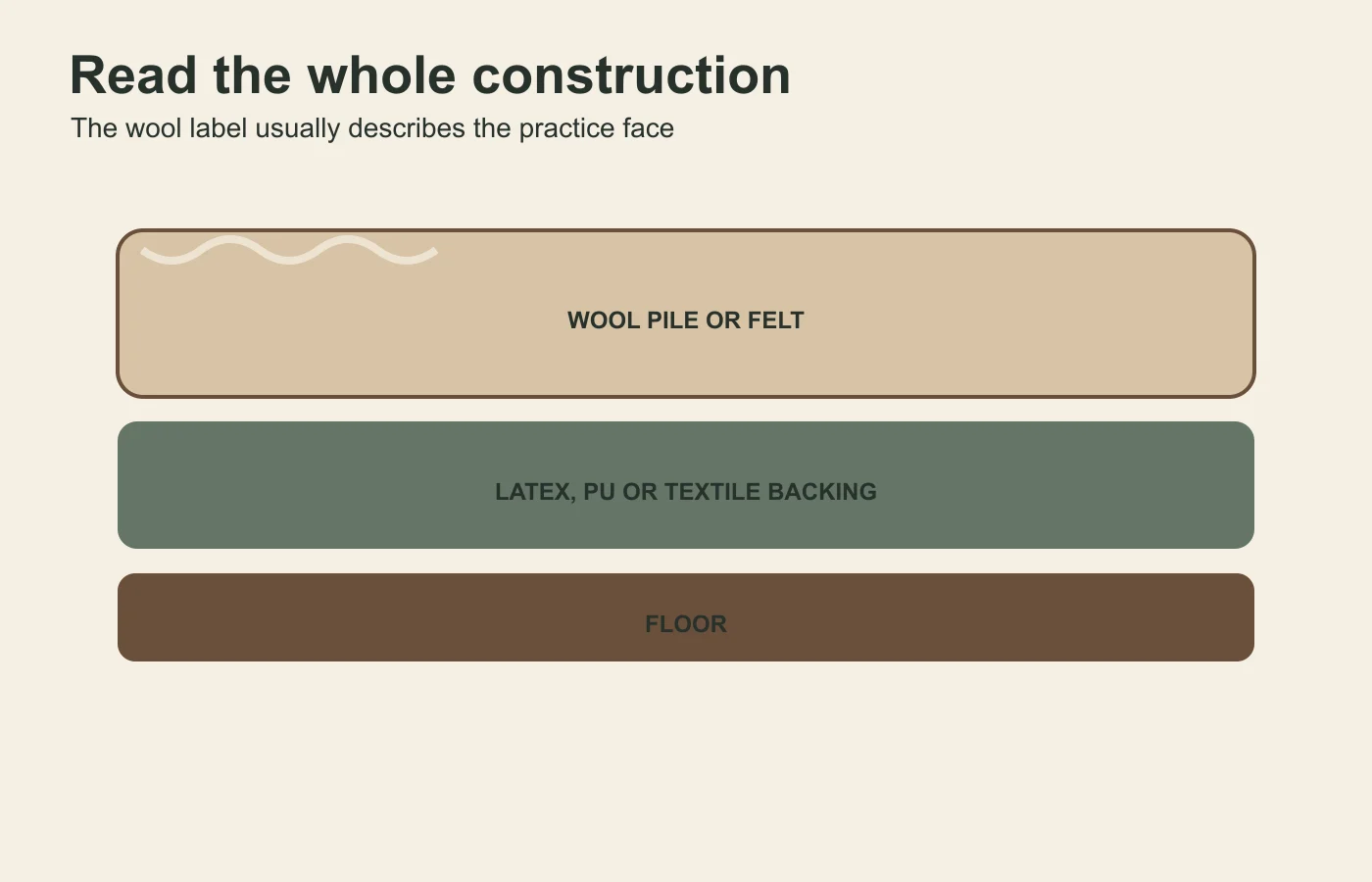
Use this three-line reading method on any product page:
- Practice face: virgin wool, merino, recycled wool, blend, pile or woven cloth?
- Support layer: bonded latex, sprayed latex, PU composite, fabric, separate mat or nothing?
- Finishing: synthetic edging, adhesive, dyes, anti-slip coating and carry bag?
If only the first line is disclosed, the product is not fully specified. Ask the seller before buying, especially when latex avoidance or low-synthetic construction is a hard requirement.
Where a wool mat fits—and where it does not
Wool changes the job of the surface. A conventional PVC, rubber, cork or PU mat is usually designed around hand-and-foot traction during standing movement. A wool face prioritizes soft contact and separation from a cold floor. That can be useful when much of the session is seated or reclined, but the pile can move under hands and feet rather than create tack.
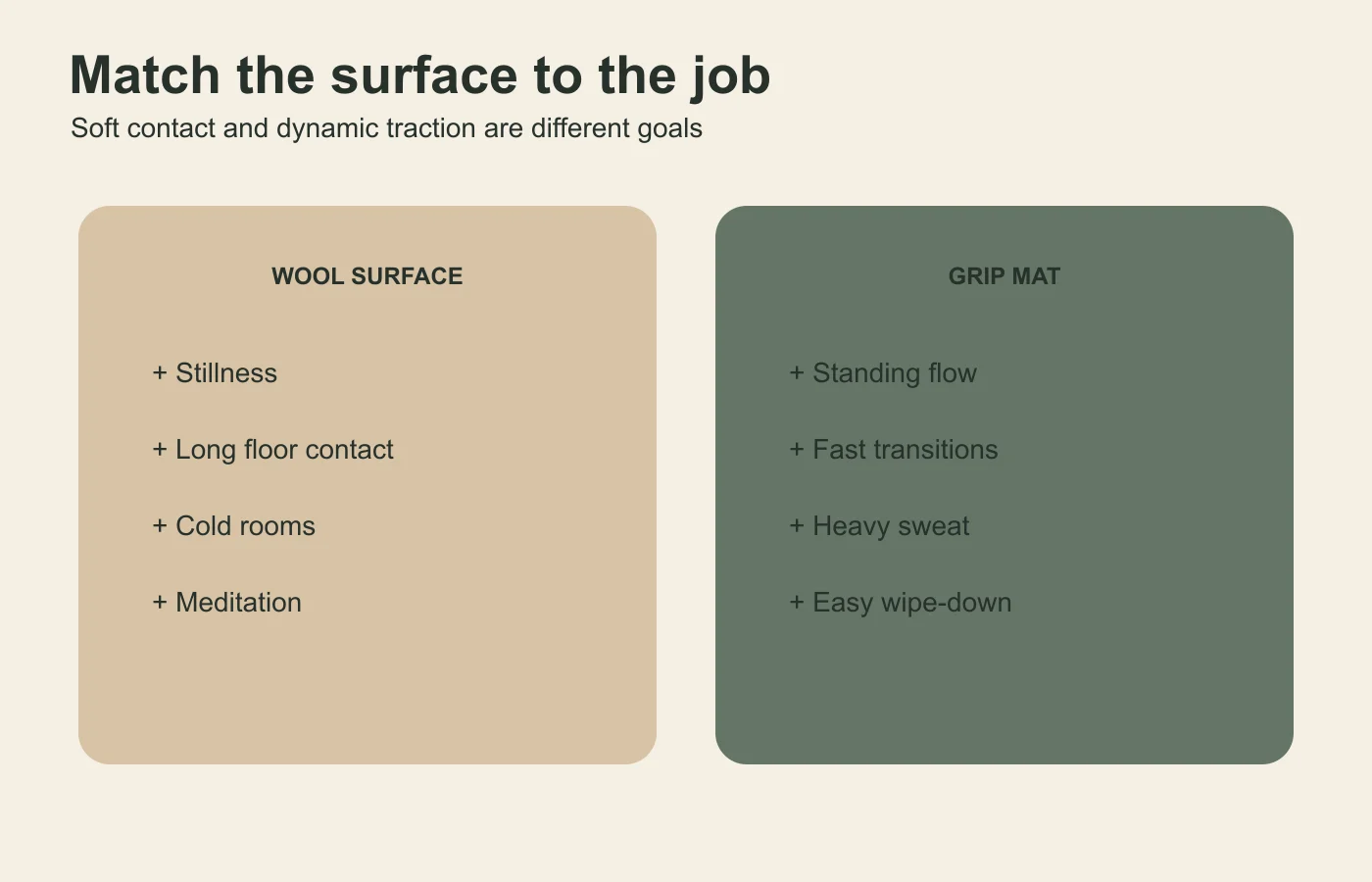
Wool is a sensible candidate when
- most of your time is seated, kneeling or reclined;
- a cold studio or hard home floor makes a bare grip mat uninviting;
- you want a wider textile area for meditation or quiet rest;
- you accept category-specific cleaning and storage; and
- animal-derived fiber aligns with your preferences.
Choose another surface when
- you need dependable traction for quick standing transitions;
- your practice produces heavy sweat;
- you require a wipe-clean closed surface;
- wool texture irritates your skin; or
- you follow a vegan material standard.
A cotton yoga rug is a closer comparison than a sticky mat because both are textile-led. A rug is often thinner and may be washable; wool is generally loftier and more insulating. Neither category guarantees traction without looking at weave, underside and floor pairing.
Four current construction examples
These examples illustrate the range rather than declare a universal winner. Availability and specifications can change, so recheck the linked manufacturer or retailer page.
| Example | Published face | Published backing | Size / care signal | What it demonstrates |
|---|---|---|---|---|
| Yogiraj Premium | 100% merino wool; Woolmark and OEKO-TEX claims | REACH-compliant base; exact composition not stated on category page | 75 or 90 x 200cm | Certifications do not replace backing composition |
| Yogisha Deluxe | 100% pure new merino wool; OEKO-TEX claim | 80% natural latex | 200 x 75 x 2cm; 2.6kg; hand wash to 30C | Thick, latex-backed specialist mat |
| Yoko Wool | 100% wool fleece | 80% PU, 20% polyester yarn | 70 x 200cm; about 1.4–1.5kg; wool cycle to 30C | Latex-free cannot be inferred, but synthetic backing is explicit |
| Yogistar Natural | Virgin-wool variants | Natural-latex underside | Several widths and lengths; maker lists wool-cycle washing | The same category can offer unusually wide formats |
The list deliberately avoids assigning “best” without standardized traction, compression and durability testing. Published dimensions and material disclosures are comparable; lifestyle adjectives are not.
The five checks that matter most
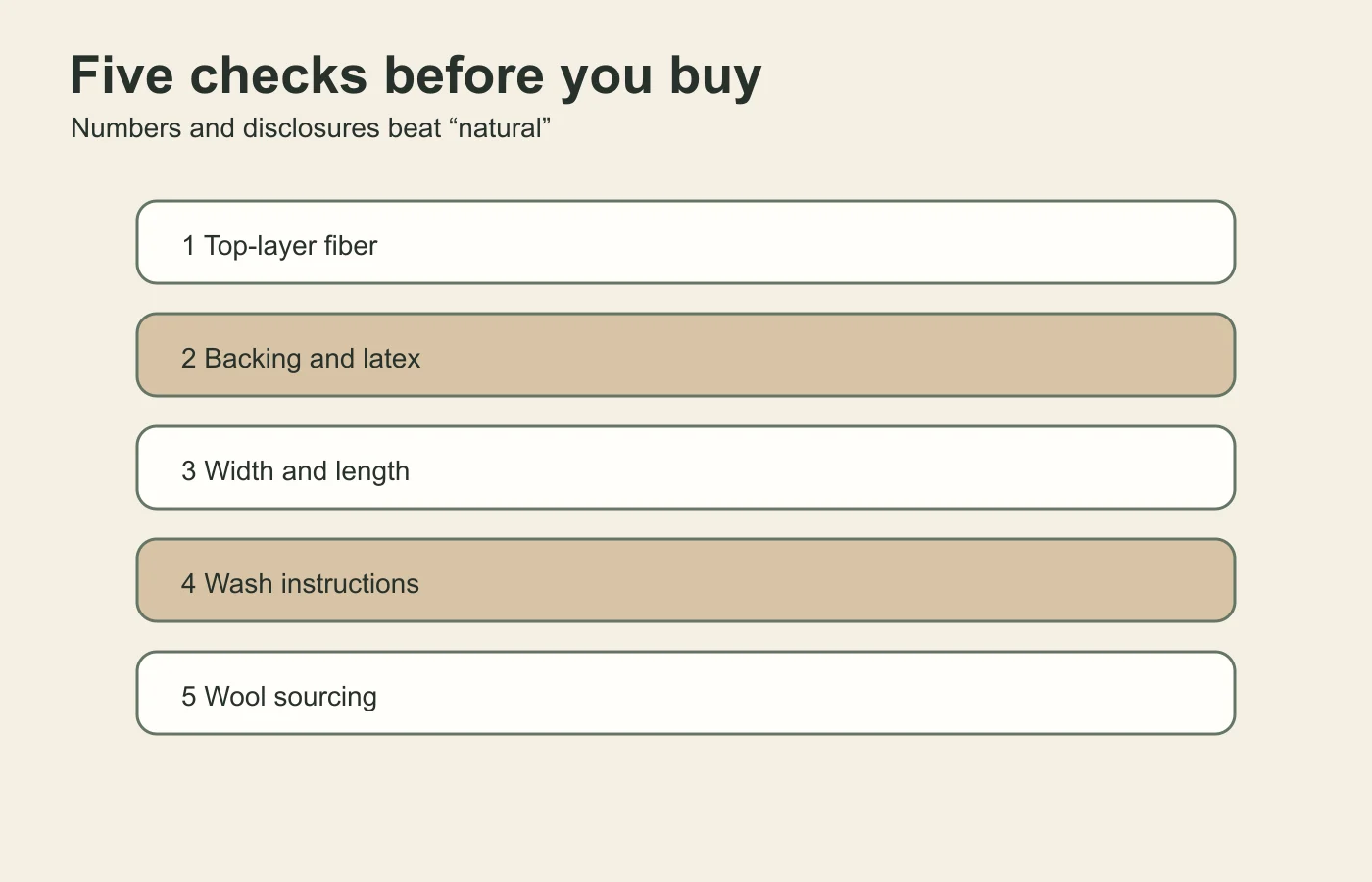
1. Identify the wool, not just the animal
“Virgin wool” means fiber used for the first time, while “merino” names a sheep breed associated with finer fiber. Neither term alone proves animal-welfare standards, chemical restrictions or a particular country of origin. Look for a named certification and verify what that scheme actually covers.
Woolmark identifies wool-content and quality specifications for licensed products. OEKO-TEX STANDARD 100 addresses tested harmful substances in a textile article; it is not a full lifecycle or animal-welfare certificate. “Mulesing-free” addresses one specific husbandry practice and should be traceable to the supplier rather than treated as a general ethical guarantee.
2. Resolve latex before choosing a color
Natural-latex backing is common because it helps a textile mat resist sliding on a smooth floor. That also makes the product latex-relevant. A wool top does not isolate you from the backing at edges, through handling or as the product wears.
If latex sensitivity matters, use the manufacturer’s complete composition and medical guidance appropriate to you; do not rely on the product category. A PU or textile-backed option may avoid natural latex, but that must be stated rather than assumed. The natural-rubber mat guide explains why rubber-tree material and latex need careful labeling.
3. Compare usable area and carry weight
Many wool mats are 200cm long and 70–100cm wide, which can exceed a standard 68 x 24-inch mat. Extra area is valuable for reclined use but also increases storage volume. Lofty wool rolls into a much larger cylinder than a thin travel mat.
Record length, width, thickness and mass. Yogisha’s current example is 2.6kg, while the Yoko listing is approximately 1.4–1.5kg. Those numbers are useful; “lightweight” is not. Check that a carry bag fits the rolled diameter, not merely the width.
4. Treat care instructions as construction-specific
Current directions vary. Yogisha says hand wash at no more than 30C and hang dry. Texelana allows a wool-cycle machine wash to 30C. Yogistar also lists machine washing for its current virgin-wool collection. A different adhesive, piping or backing can make one routine unsuitable for another mat.
5. Test both surfaces
On the practice face, check skin comfort and whether hands or feet shift during the movements you actually do. Underneath, press laterally at both ends on your real floor. A backing that holds on wood may behave differently on carpet, sealed concrete or a dusty studio floor. For soft flooring, see the dedicated yoga mat on carpet guide.
How to care for a wool yoga mat
Wool care should start with prevention: use clean feet, keep drinks away and air the mat fully after use. Do not accept “self-cleaning” as a reason to ignore sweat, spills or storage moisture. It is safer to distinguish routine airing from actual cleaning.
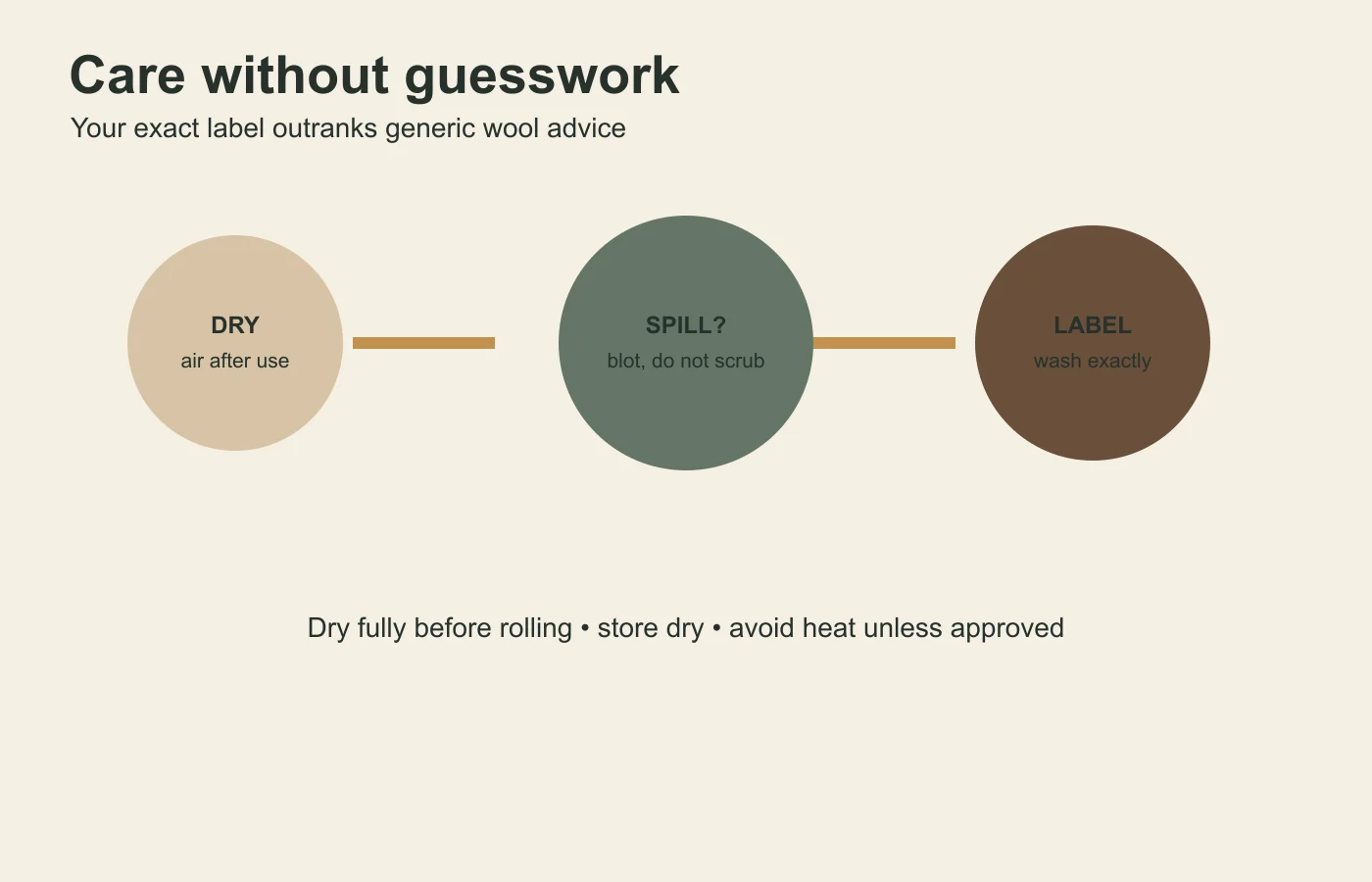
For routine care:
- Shake off loose debris outdoors without sharply folding the backing.
- Air the mat open after practice and let both faces dry.
- Blot a fresh spill with a clean absorbent cloth; avoid rubbing it deeper into the pile.
- Use only a wool-safe cleaner and wash method approved for the exact model.
- Dry completely before rolling, away from unapproved heat or intense sun.
- Store dry and inspect periodically for insects, odor, edge separation and backing deterioration.
Do not copy freeze-cleaning, steam-cleaning, essential-oil or tumble-drying advice from a different product. Those methods can affect dyes, wool finish, latex, adhesives or floor traction. The general yoga mat cleaning guide helps with cleaning frequency, but your wool mat’s label remains the final instruction.
Is wool automatically sustainable?
No single fiber makes a finished mat environmentally preferable. Wool is renewable and can be durable, but it is animal-derived and its impacts depend on land management, animal care, processing, dyes, transport and lifetime. A bonded PU, polyester or latex backing changes the material story and can make separation difficult at end of life.
Ask five bounded questions:
- Is the wool source and claimed standard named and verifiable?
- What percentage of the finished mat is wool by mass?
- What are the backing, adhesive, edging and dye materials?
- Is the product likely to stay useful for years under your care routine?
- Is there a real repair, take-back, reuse or disposal route where you live?
“Natural,” “chemical-free,” “hypoallergenic” and “biodegradable” are especially weak without scope and evidence. Every material is chemical matter; sensitivity is individual; and a composite may not biodegrade as one unit. Use the eco-friendly yoga mat checklist to compare full products rather than isolated fibers.
Wool yoga mat vs common alternatives
| Alternative | Choose wool when | Choose the alternative when |
|---|---|---|
| Cotton yoga rug | You want more loft and insulation | You want a thinner textile surface or simpler washing |
| Natural rubber mat | Soft contact in slow sessions matters most | Dry traction and standing stability matter most |
| Cork-topped mat | You prefer a textile feel and warmth | You want a firmer surface that is easier to wipe |
| PVC or TPE mat | Animal fiber and soft stillness fit your priorities | Low-maintenance versatility and compact rolling matter |
| Wool blanket over a mat | You want one integrated specialist surface | You want removable softness over an existing grip base |
The last option is often the most flexible trial: place a securely folded yoga blanket over a stable mat for quiet floor-based use, then remove it for standing work. Ensure the layers do not shift and follow your instructor’s setup where relevant. It tests the comfort concept without pretending a blanket and a purpose-built backed mat are identical.
The verdict
A wool yoga mat makes sense as a specialist comfort surface for quiet practice, meditation and long floor contact. It is not the default answer for dynamic flows, heavy sweat or shoppers who need simple wipe-down care.
Choose one only after the seller discloses the full layer stack, latex status, dimensions and exact wash method. Then evaluate sourcing claims separately from performance. The best wool mat is not the one with the softest marketing; it is the one whose construction fits your floor, skin, practice and maintenance tolerance.
Frequently asked questions
What is a wool yoga mat used for?
Its soft, insulating face is mainly suited to meditation and slower sessions with long floor contact. It is generally less suitable than a purpose-built grip mat for fast standing transitions or heavy sweat.
Are wool yoga mats non-slip?
The underside may resist floor movement with latex, PU or another backing, but the wool face is not equivalent to a tacky practice surface. Test body traction and floor grip separately.
Do wool yoga mats contain latex?
Many do; others use PU or textile constructions. Read the complete material list because “100% wool” may describe only the top layer.
Can you wash a wool yoga mat?
Only as the exact manufacturer permits. Current instructions range from hand washing to a wool-cycle machine wash. Backing, adhesive and edging determine what is safe.
Is a wool yoga mat eco-friendly?
Wool is renewable, but the full product may include latex, PU, polyester, dyes and adhesives. Judge sourcing, durability and end-of-life using the complete construction rather than the face fiber alone.
Frequently asked questions
What is a wool yoga mat used for?
Its soft, insulating practice face is primarily suited to meditation and slower sessions with long floor contact. It is generally less suitable than a purpose-built grip mat for fast standing transitions or heavy sweat.
Are wool yoga mats non-slip?
The underside can resist movement when it has a suitable latex, PU or other backing, but the wool practice face is not the same as a tacky grip surface. Floor grip and hand-and-foot traction are separate questions.
Do wool yoga mats contain latex?
Many current models use natural-latex backing, while others use PU or a textile construction. Read the complete material list; “100% wool” may describe only the top layer.
Can you wash a wool yoga mat?
Only as the exact manufacturer permits. Current instructions range from hand washing to a wool-cycle machine wash, while some products favor airing and spot cleaning. The backing and edge construction can change what is safe.
Is a wool yoga mat eco-friendly?
Wool is renewable, but the finished product may include latex, PU, polyester, dyes and adhesives. Check sourcing, certifications, durability, repairability and the full backing before making an environmental judgment.