

How this page has changed
July 26, 2026
Sources, internal links and safety or product context reviewed.
In this guide
The side of a yoga mat that goes up is the manufacturer-designated practice surface—unless the exact model is intentionally reversible. Do not rely on “rough side up, smooth side down.” Texture can serve either hand-and-foot grip or floor traction, and some high-grip top layers look almost smooth.
The fastest reliable check is the product page, packaging or care guide. If that is unavailable, identify the construction: a named PU, cork, microfiber or performance layer usually faces you; a rubber, foam or patterned stability base usually faces the floor. Use logos, alignment marks and texture only as supporting clues.
This guide covers equipment identification, not pose technique.
Quick decision table
| What you see | Most likely orientation | What confirms it |
|---|---|---|
| PU or performance coating over rubber | Coated face up; rubber base down | Maker names a top and base layer |
| Cork bonded to foam or rubber | Cork up; support layer down | Product construction and care guide |
| Microfiber or suede bonded to rubber | Fabric face up; rubber down | Product calls it a towel-like practice surface |
| Alignment lines on one face | Printed face usually up | Brand describes an alignment system |
| Dot, wave or tread pattern on one face | Pattern may be the floor side | Maker calls it a non-slip bottom |
| Identical material and finish on both faces | Possibly reversible | Explicit brand confirmation |
| Two different usable textures | Reversible with different purposes | Instructions explain Face A and Face B |
“Most likely” is deliberate. The exact model instructions outrank every visual shortcut.
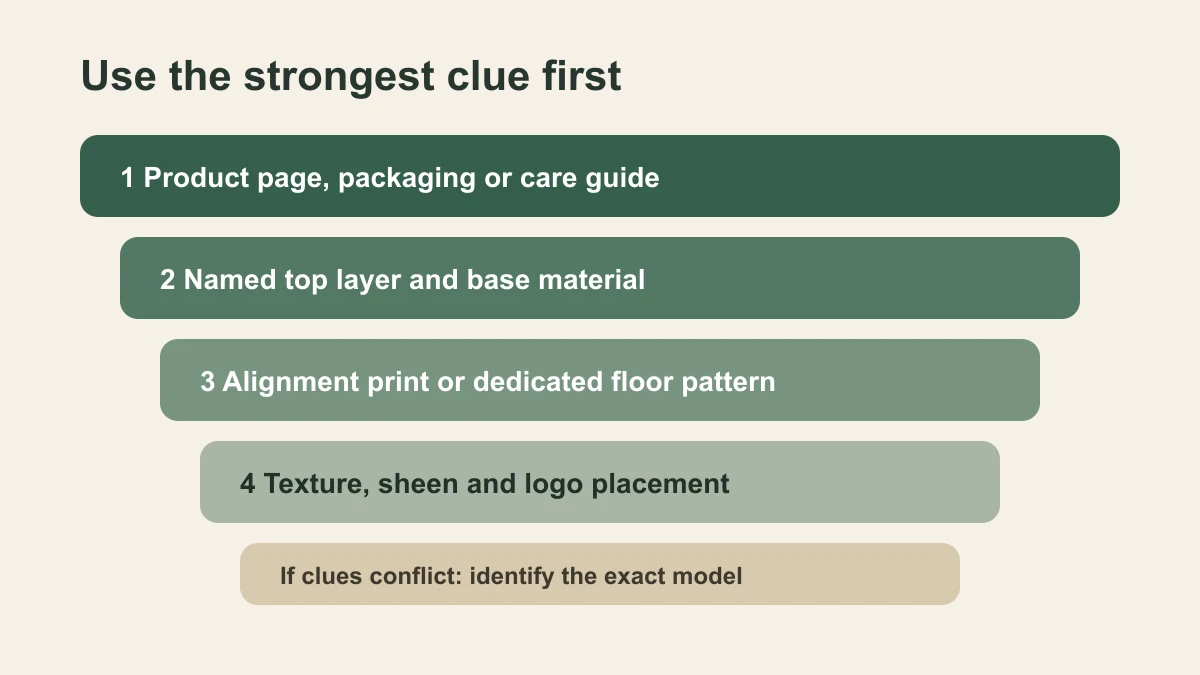
Six reliable clues, in order
1. Read the exact model instructions
Search the model name plus “top surface,” “base,” “use and care” or “reversible.” A family name is not always enough: one brand can sell both one-direction and two-sided mats.
Manduka illustrates the distinction clearly. Its PROlite description identifies a textured top layer and a dot-pattern bottom layer. Its eKO care instructions say to roll the mat with the textured top surface facing outward. Yet Manduka’s FAQ says the X Mat uses the same durable material on top and bottom and may be used on either side.
Those examples disprove any universal rule based on brand, texture or how a mat happens to arrive rolled.
2. Separate the practice layer from the base
Many current premium mats are layered systems. The upper layer manages contact, feel and moisture; the lower layer stabilizes the mat on the floor. Liforme, for example, identifies an absorbent top surface, a waterproof middle barrier and a natural-rubber base. The visual difference between those faces is structural, not decorative.
Look at the exposed edge. A thin colored or smooth coating bonded to a thicker rubber body is likely the practice layer. A treaded, foamy or raw-rubber face is likely the base. Do not peel, scratch or bend the layers sharply to investigate them.
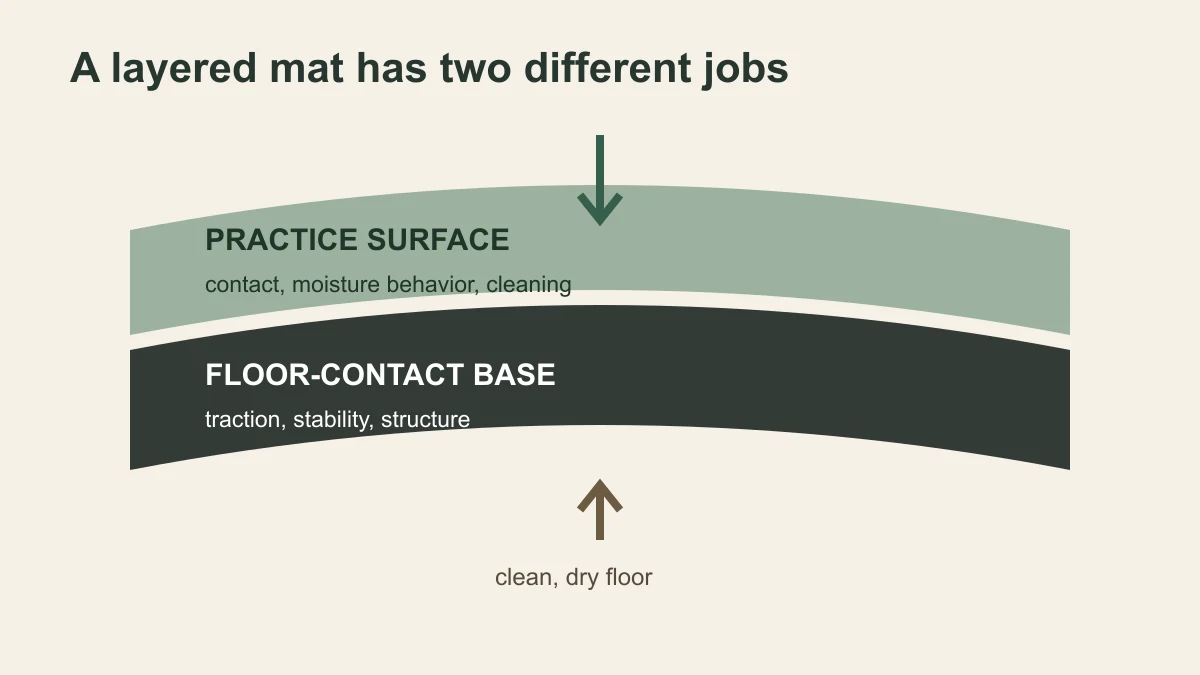
3. Identify unmistakable material pairs
Some pairings make orientation much easier:
- Cork composite: cork is normally the practice face; the bonded foam or rubber is the base. Yoloha’s Unity Air listing distinguishes its cork-and-rubber grip surface from the Plant Foam bottom.
- PU over natural rubber: the PU performance face goes up and rubber base goes down when the product describes that layered construction.
- Microfiber or suede over rubber: the textile face is designed for contact; the rubber layer anchors it.
- Printed alignment surface over rubber: the functional markings are intended to be visible during use.
Material names still need verification. “Rubber yoga mat” can mean a single-material mat, a rubber base under another surface or a blended construction. Our open-cell versus closed-cell guide explains moisture structure; it does not determine orientation by itself.
4. Look for an engineered floor pattern
A regular field of dots, waves, ribs or tire-like tread often signals a floor-contact face. The pattern aims to increase contact edges and resist movement on a hard surface. Manduka explicitly calls the PROlite dot pattern its bottom layer, making that pattern a strong model-specific clue.
But a top surface can also use ridges or texture for contact grip. Ask what the pattern is designed to grip: floor or user. A brand diagram or phrase such as “non-slip base” resolves the ambiguity; roughness alone does not.
5. Use alignment marks and logos cautiously
An alignment grid, center line or symmetrical position markers normally belongs on the visible practice face. Liforme’s marked surface is a clear example because the company names both the alignment system and the natural-rubber base.
A logo is weaker evidence. A logo that reads upright while the mat lies lengthwise often marks the intended top, but brands may print both faces or place a small manufacturing mark underneath. Consider it confirmation, not proof.
6. Compare the faces without performing a slip test
Place the mat flat on a clean, dry floor and inspect it at the edge. Does one face sit uniformly while the other clearly presents a finished contact layer? Does the product description name that finish? Does one orientation expose printed guidance correctly?
Avoid an improvised balance, jump or forceful sliding test. It cannot tell you what a material was engineered to do, and dust, floor finish, moisture and worn surfaces can distort the result. If the instructions remain unavailable and the faces differ materially, contact the maker with the model number and photographs.
Why “textured side up” is unreliable
“Textured” describes appearance, not function. A mat needs traction at two interfaces:
- between the practice surface and the user;
- between the bottom surface and the floor.
Manufacturers can texture either or both. A smooth-looking PU top may create substantial contact grip. A deeply patterned rubber underside may be engineered only for the floor. Conversely, a single-layer mat can use similar texture on both faces.
The same problem applies to “shiny side” and “sticky side.” Lighting changes perceived sheen, new-mat films can change feel, and wear can polish one area. Construction evidence is more dependable than adjectives.
What does reversible actually mean?
Reversible is not one standardized construction. It can describe identical usable faces, as Manduka states for the X Mat, or two different usable faces designed to offer different surface behavior. Lululemon markets The Reversible Mat as a two-sided product, for example.
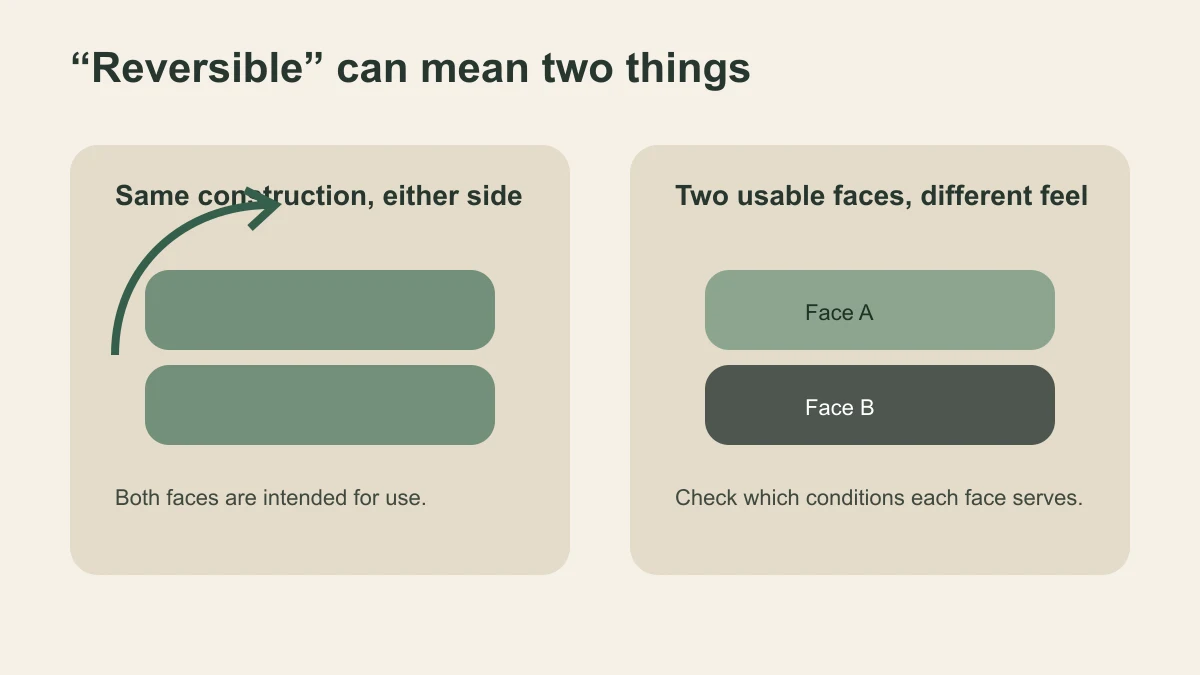
Before flipping a reversible model, check three details:
- whether both faces are approved for the floor in your setting;
- whether each face has different moisture or care instructions;
- whether floor dust on the previous underside must be cleaned before it becomes the practice face.
“Reversible” does not mean every mat can be flipped. A layered cork, PU or textile mat can expose its support base to wear and put the wrong material against skin or moisture when used upside down.
Orientation by common mat construction
Single-layer PVC, TPE or rubber
These are the hardest to identify visually. Some have a dedicated top texture and bottom tread; others are genuinely usable on both faces. Find the molded model code, packaging or archived product listing. Do not assume all TPE mats are reversible simply because both sides are foam.
PU and rubber mats
The finished PU surface normally faces up and the rubber base faces down when the maker specifies this stack. The top may appear smoother than expected, which is why the “rough side up” shortcut fails here. Follow the exact PU yoga mat care instructions because coated surfaces can have restrictions.
Cork mats
On a bonded cork mat, cork is the contact surface and the foam or rubber layer supports it from below. Confirm the construction because a loose yoga rug or cork accessory is a different product. See our cork yoga mat guide for material trade-offs.
Suede or microfiber mats
The fabric-like face goes up; its rubber or elastomer base goes down. These products often behave differently as moisture changes, but orientation does not change merely because the top feels less grippy when dry. Review the maker’s intended conditions and cleaning method.
Alignment mats
The alignment system generally faces up so it can be seen. Verify that the design is functional rather than a decorative underside print, then locate the named rubber or foam base.
If your mat still slips in the correct orientation
Correct orientation does not guarantee grip in every condition. Diagnose the interface that moves:
| What moves | Likely area to inspect | Next safe check |
|---|---|---|
| Entire mat shifts on floor | Bottom face or floor contamination | Clean both according to their instructions and dry fully |
| Contact slips on top | Practice surface, moisture or residue | Use maker-approved cleaning and check intended conditions |
| Corners curl | Storage direction or deformation | Follow model-specific rolling guidance and lay flat |
| Surface flakes or separates | Material wear or layer failure | Stop using the damaged area and ask the maker about warranty |
Do not apply salt, harsh solvent, abrasive powder or oil unless the manufacturer explicitly prescribes it for that exact material. A remedy intended to break in one PVC model can damage PU, cork, natural rubber or printed layers. Start with our material-aware yoga mat cleaning guide, then use the product care page.
For a mat chosen specifically around contact traction, compare construction and conditions in the best non-slip yoga mat guide. Orientation is only one part of grip.
Cleaning and storage after identifying the sides
Keep the roles consistent unless the mat is officially reversible. The practice surface receives skin contact and sweat; the underside collects dust and residue from floors. Mark the underside discreetly only if the manufacturer permits it—never use an ink or adhesive that could react with the material.
Roll direction is product-specific too. Manduka tells owners to store certain mats with the top surface facing outward so they lie flatter. That is useful evidence for those models, not a universal hygiene rule. Other constructions may require the practice face inward or loose storage to protect a coating.
For a reversible mat, clean the former floor side with an approved method and let it dry fully before using it as the practice face. This is a practical contamination boundary, not a reason to disinfect aggressively.
Final checklist
- Find the exact model, not only the brand.
- Read the product, packaging or care instructions first.
- Identify named top, middle and base layers.
- Treat cork, PU, suede and alignment surfaces as construction clues.
- Confirm whether a dot or tread pattern is called the bottom.
- Use texture, sheen, logo and rolling direction only as supporting evidence.
- Flip the mat only when the maker confirms it is reversible.
- Clean a former floor-contact face before using it on top.
- If evidence conflicts, ask the manufacturer rather than testing with movement.
The dependable answer is not “smooth” or “textured.” It is the face the exact construction was designed to place against you, while its designated base meets the floor.
Frequently asked questions
Which side of a yoga mat goes up?
Use the side the manufacturer identifies as the practice surface. On layered mats this may be a PU, cork, fabric or specially textured top over a rubber or foam base. Some single-layer mats can be used on either side, so material and model instructions are more reliable than appearance alone.
Does the textured side of a yoga mat go up or down?
Texture alone is not decisive. A texture can create hand-and-foot traction on top or floor traction underneath. Check the product guide, layer description, alignment print and bottom pattern before using texture as a tie-breaker.
Does the smooth side of a yoga mat go up?
Sometimes. Polyurethane practice surfaces can look smoother than their rubber bases, while other mats use a visibly textured top. A smooth appearance does not tell you which side is intended for the floor.
Can a yoga mat be used on both sides?
Only when the maker describes it as reversible or confirms that both sides are suitable. Manduka, for example, says its X Mat uses the same durable material on both sides, while its PRO and eKO products have identified top surfaces.
Is the logo always on the top of a yoga mat?
A correctly oriented logo is a useful clue, not a universal rule. Branding can appear on a corner, underside or reversible face. Give the product instructions and named layers more weight.