

Direct answer
Which should you choose?
Choose a yoga mat
If hand-and-foot grip and firm standing feedback are the priority.
Choose an exercise mat
If wider floor work or extra cushioning matters more than pose stability.
Biggest practical difference: The label is less useful than thickness, firmness, width, surface grip and the equipment you plan to use.
- Primary job
- Pose grip and stability
- General floor exercise
- Typical build
- Narrower and firmer
- Often wider and thicker
- Standing work
- Usually more stable
- May compress more
- Floor work
- Moderate cushioning
- Often more cushioning
- Shoe use
- Check the surface guidance
- More commonly intended for training
- Best for
- Yoga sequences
- Stretching and workouts
How this page has changed
July 26, 2026
Sources, internal links and safety or product context reviewed.
In this guide
- 01Quick comparison
- 02What defines a yoga mat?
- 03What defines an exercise or fitness mat?
- 04Thickness and firmness: related, not identical
- 05Grip has two interfaces
- 06Size and movement space
- 07Shoes, weights and equipment
- 08Choose by dominant demand
- 09Can a yoga mat be used for exercise?
- 10Can an exercise mat be used for yoga?
- 11Cleaning and storage differences
- 12Buying checklist
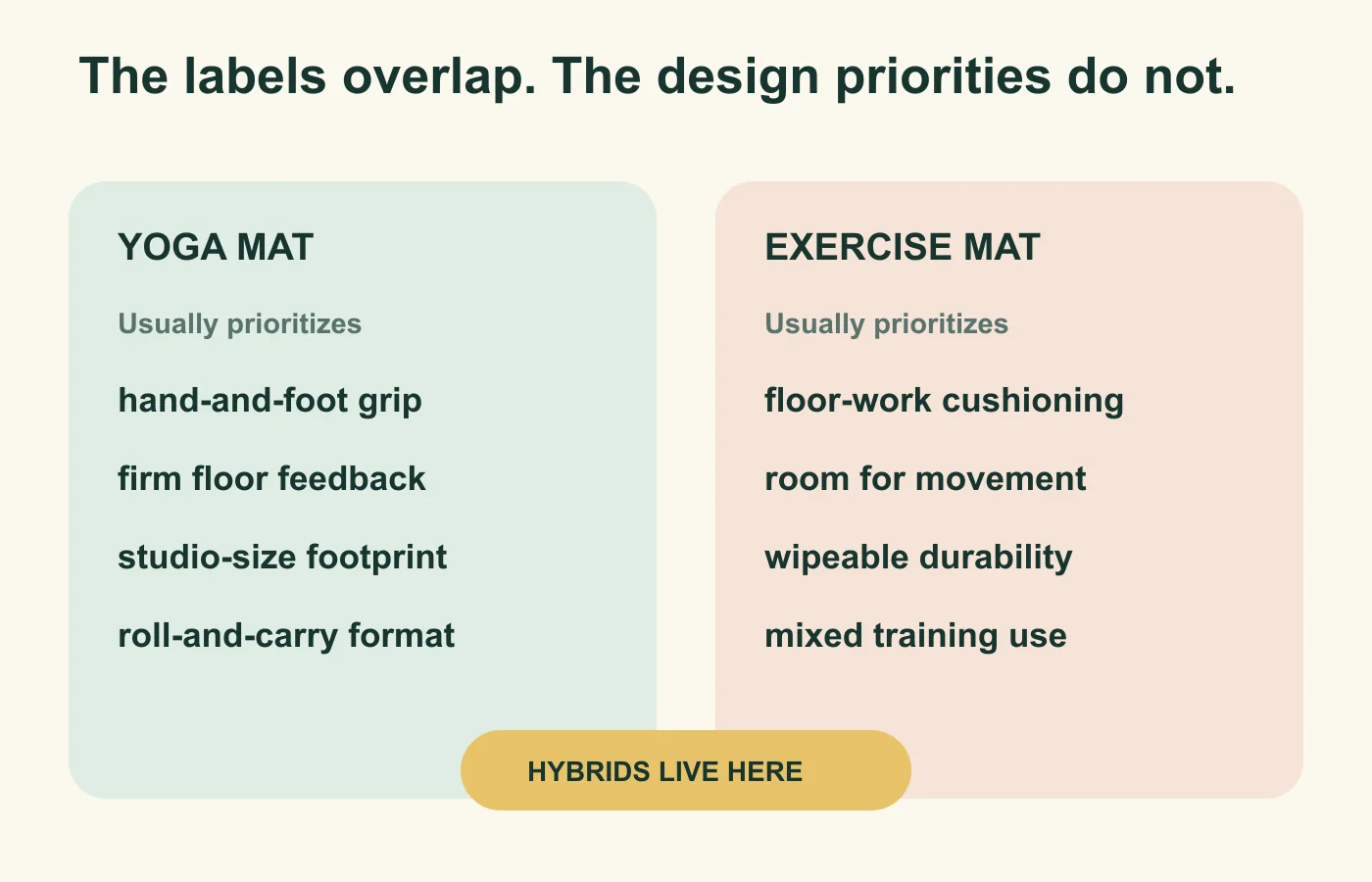
The practical yoga mat vs exercise mat difference is design priority, not a protected product definition. Yoga mats usually emphasize hand-and-foot grip, firm floor feedback and a studio-friendly roll. “Exercise mat” can describe anything from a soft 10mm floor-work mat to a wide, reinforced gym platform.
Choose from measurable properties: thickness, firmness, width, surface grip, base stability, shoe policy, cleaning method and permitted equipment. A 5mm hybrid may genuinely cover both jobs. A soft 10mm foam mat and a grippy 4mm yoga mat may look similar online yet behave very differently.
Quick comparison
| Feature | Yoga-first mat | General exercise mat | Hybrid training mat |
|---|---|---|---|
| Primary design signal | Grip and stable floor feedback | Cushion or room for floor training | Mixed movement and durability |
| Common current thickness | Roughly 3–6mm | Often 8–12mm for roll-up foam; specialized mats vary more | Often about 5–6mm |
| Typical footprint | Around 68–72 × 24 inches | Similar roll-up size or much wider, depending on category | Standard yoga size to oversized |
| Top surface | Bare-hand and bare-foot traction | Ridges, wipeable foam or training texture | Durable textured surface |
| Footwear | Often barefoot-only or maker-dependent | Product-dependent | More likely to allow mixed training; verify |
| Best starting use | Standing yoga, transitions, studio transport | Floor work where cushioning is the priority | Yoga plus compatible general training |
| Main compromise | Less cushion and lateral room | Can feel soft, stretchy or less grippy | Rarely best at both extremes |
These are market patterns, not standards. Gaiam currently labels a 72 × 23.6-inch, 10mm NBR product a fitness mat. Manduka calls its 71 × 24-inch, 5mm TPE model a hybrid fitness mat and explicitly positions it for training, recovery and movement. The overlap proves why the label alone is weak evidence.
What defines a yoga mat?
A yoga mat is a personal traction surface with enough cushioning to separate the user from the floor without turning the foundation into a deep pad. Its most useful characteristics are usually:
- top grip: resistance between the user and the mat;
- base stability: resistance between the mat and the floor;
- firm support: limited local compression under hands and feet;
- portable dimensions: narrow enough for studios and easy rolling;
- barefoot-compatible texture: no aggressive tread intended only for shoes.
The category is broad. A 1.5mm travel sheet, 4mm natural-rubber mat and dense 6mm PVC mat are all yoga mats, even though their weight and cushioning differ substantially. See the focused thickness guide before treating one millimeter figure as universally best.
Yoga-specific construction does not certify a mat for jumping, dropped weights, cardio machines or repeated shoe abrasion. Those uses can exceed the maker’s intended surface and warranty even if the material initially appears durable.
What defines an exercise or fitness mat?
“Exercise mat” is an umbrella term rather than one construction. It may mean:
- a rollable 8–12mm foam mat for stretching and floor work;
- a dense 5–6mm hybrid for mixed bodyweight training;
- a wide home-fitness surface for lateral movement;
- a folding panel or thick gym mat designed for a specific facility use;
- protective flooring made for equipment rather than direct body contact.
Those products should not be treated as interchangeable. A soft NBR roll provides a different foundation from a reinforced institutional mat. A machine mat protects flooring but may lack appropriate skin-contact texture. A folding gymnastics surface is not a better yoga mat merely because it is expensive and thick.
Read the complete use case and care instructions. Marketing phrases such as “multi-purpose,” “high density” and “non-slip” do not reveal compression, wet grip, permitted footwear or equipment compatibility.
Thickness and firmness: related, not identical
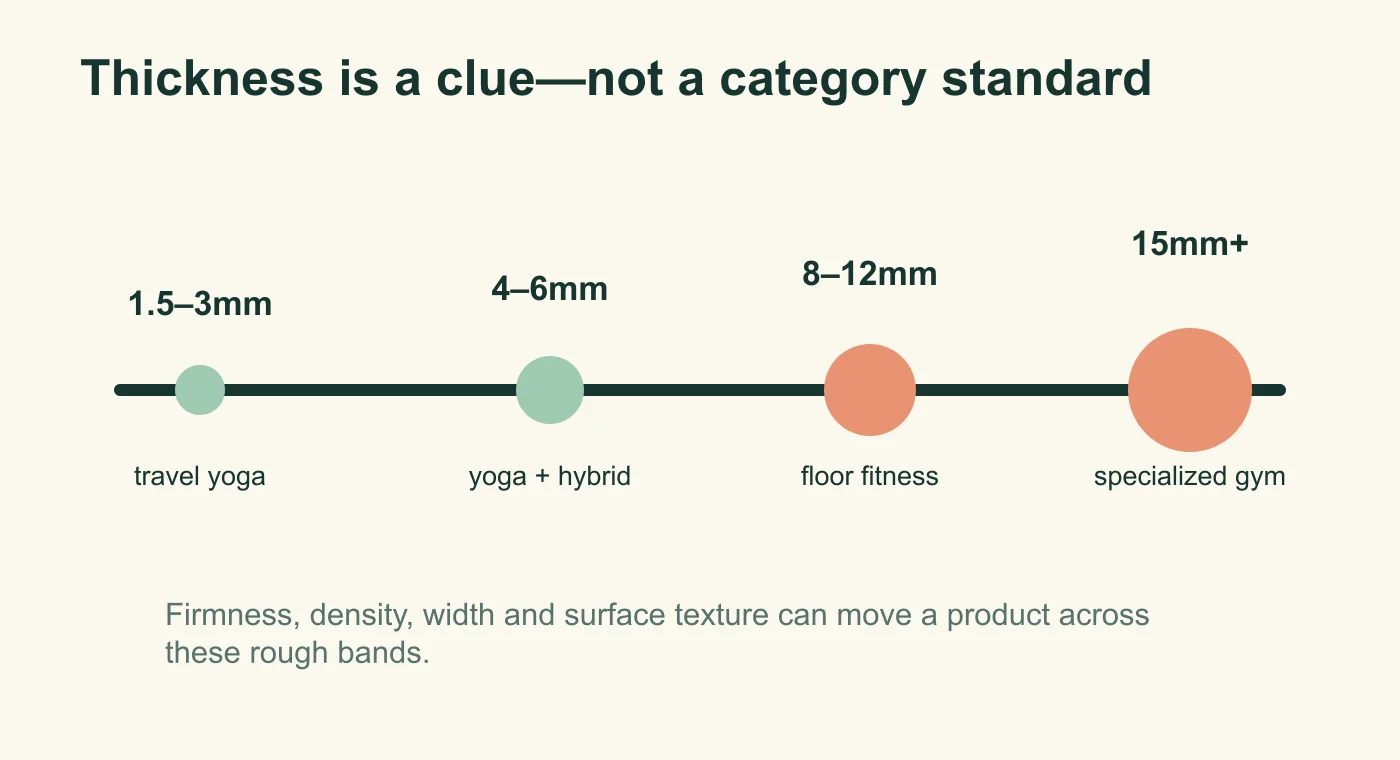
Thickness is visible in specifications, so comparisons often overuse it. It tells you the distance between surfaces, not how easily the material compresses. A dense 6mm mat can feel firmer than a soft 10mm foam mat.
Use thickness as an initial category signal:
- 1.5–3mm: travel or high floor-feedback yoga formats;
- 4–6mm: mainstream yoga and many hybrid mats;
- 8–12mm: common soft floor-fitness and Pilates-adjacent formats;
- 15mm and above: specialized exercise, folding or facility surfaces.
The current Gaiam 10mm NBR fitness mat illustrates the soft roll-up category. Manduka’s current 5mm X illustrates a crossover: yoga-size dimensions, high-density TPE, closed-cell cleaning and mixed-training positioning. Manduka’s facility page separately describes a 6mm, 79 × 30-inch P/ROX mat reinforced for footwear and high-intensity conditioning. These three products cannot be sorted usefully by “exercise mat” alone.
Density is also easily misused. A manufacturer may use “high density” without publishing mass per volume, and a foam’s apparent density does not fully describe recovery, surface firmness or reinforcement. Our high-density yoga mat guide explains what can and cannot be calculated from public specifications.
Grip has two interfaces
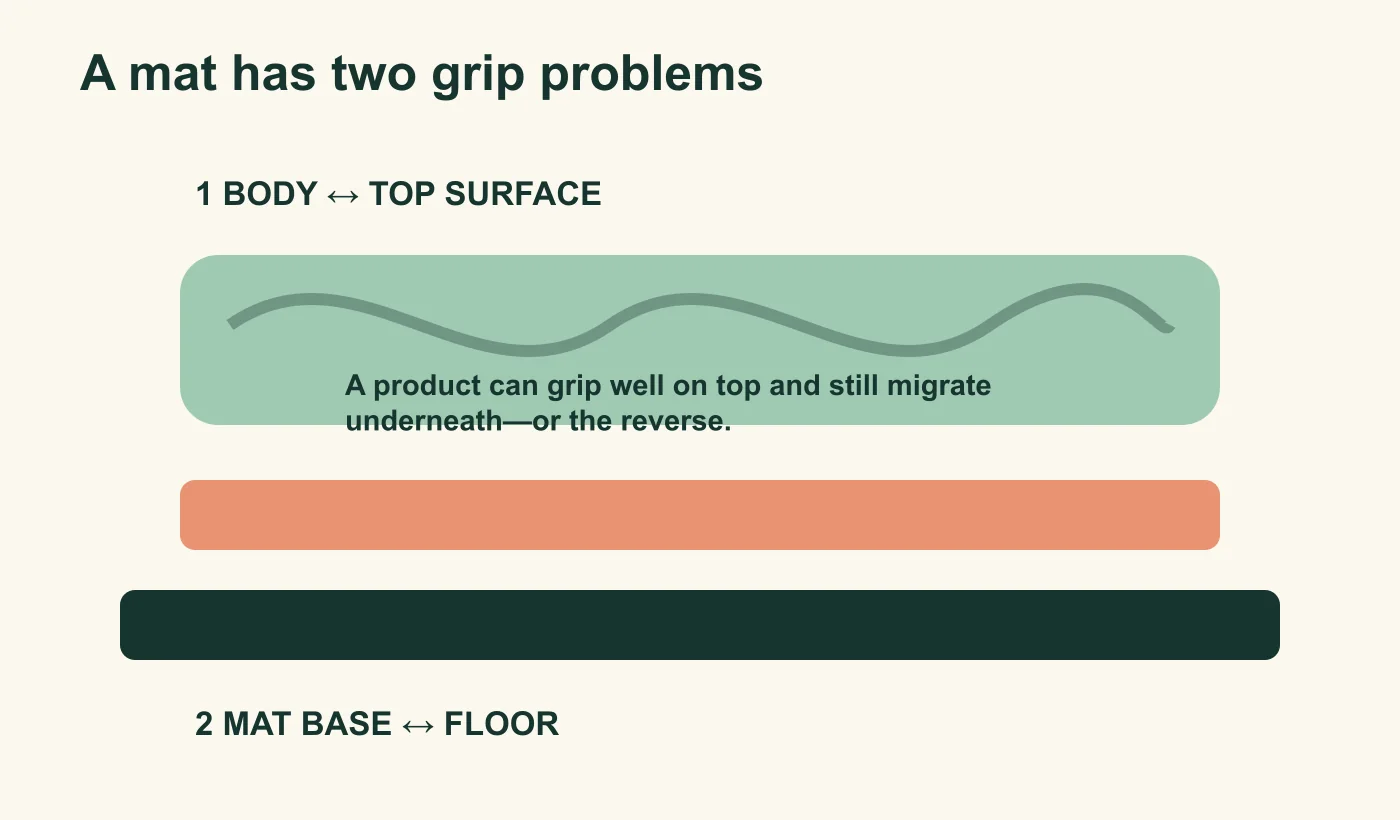
“Non-slip” is incomplete without an interface and test condition. A mat must manage:
- the body-to-top interface, affected by texture, material, moisture and residue;
- the base-to-floor interface, affected by backing, dust, floor finish and deformation.
Yoga generally places high value on sustained hand-and-foot contact. Some exercise mats instead use pronounced ridges, footwear-oriented texture or a wipeable skin. Neither description guarantees wet performance.
Do not add grip sprays, adhesives or hook tape unless the mat and floor makers allow them. They can alter materials, leave residue and create a stronger bond than the mat structure can tolerate. If the mat base moves on carpet, use the dedicated carpet setup guide; that problem involves pile and underlay as well as surface friction.
Size and movement space
A standard yoga footprint is deliberately narrow. It fits a studio row, rolls compactly and provides a consistent personal boundary. That same 24-inch width may be limiting for movement that travels sideways or uses a wider stance.
Exercise mats can be yoga-sized, moderately wider or room-sized. Bigger is not automatically safer: an oversized sheet can ripple, block walkways or sit partly on two floor surfaces. Record all dimensions and measure the clear floor area before buying.
Length still matters when the activity is mostly floor-based. Compare the person’s height and how much of the body should remain on the surface. The yoga mat size guide includes current product dimensions and separates length from width.
Shoes, weights and equipment
Footwear changes abrasion and local pressure. Many yoga mats are sold for barefoot practice and can show cuts, scuffs or accelerated wear under shoe tread. A hybrid mat may explicitly permit gym or outdoor training, but that permission belongs to the exact product—not every TPE or closed-cell mat.
Free weights create another category issue. A personal exercise mat designed for body contact is not automatically rated for dropped dumbbells, benches or cardio machines. Equipment can dent, tear or trap heat against foam. Use facility flooring or equipment protection specified for the load rather than assuming a thicker personal mat will protect the floor.
This comparison does not recommend impact activities or teach movements. It helps match published equipment limits to the intended environment.
Choose by dominant demand
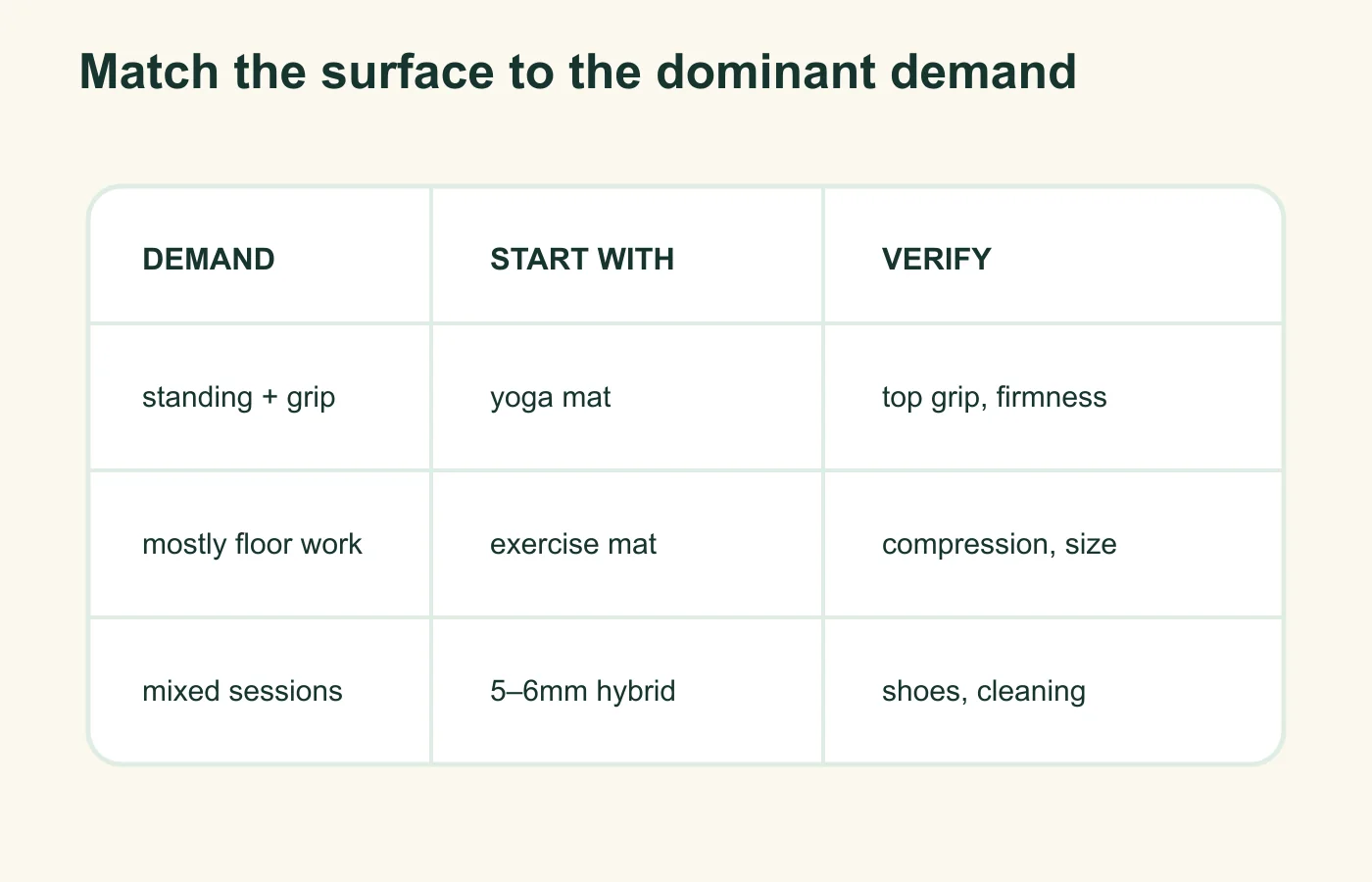
Choose a yoga-first mat when
- bare-hand and bare-foot grip is the main requirement;
- standing stability and firm feedback matter more than deep cushion;
- the mat travels to a studio or class;
- movement fits a conventional narrow footprint;
- shoes and equipment are not part of the use case.
Choose an exercise mat when
- most contact is seated, kneeling or lying floor work;
- a wider movement area is genuinely needed;
- the product explicitly permits the intended footwear and training type;
- cleaning after mixed users or heavy sweat is a major requirement;
- standing yoga grip is secondary.
Choose a hybrid when
- one mat must cover yoga and compatible low-impact training;
- 5–6mm firm support provides an acceptable compromise;
- the top and base both suit the actual floor and contact conditions;
- the maker explicitly describes mixed movement rather than relying on a retailer tag.
Keep two mats when
- one surface is reserved for clean barefoot use and the other sees shoes;
- the fitness session needs substantially more width or cushion;
- care instructions conflict;
- outdoor grit or rough flooring would damage the yoga mat;
- one activity requires a specialized rated surface.
Owning two mediocre mats is not automatically better than one well-matched hybrid. The use cases must be materially different enough to justify storage, cost and maintenance.
Can a yoga mat be used for exercise?
Yes, when the activity fits its footprint and the manufacturer permits the surface, footwear and cleaning load. A yoga mat can be a practical base for quiet floor work or bodyweight training that does not require impact absorption or equipment protection.
Stop treating it as interchangeable when the session involves repeated shoes, abrasive outdoor ground, lateral travel beyond the mat, equipment loads or a need for a crash surface. A thin grippy sheet does not become impact-rated because it is labeled durable.
Inspect the mat after changed use. Cuts, permanent dents, delamination, stretched areas and a base that migrates are functional warnings, not merely cosmetic wear. The mat lifespan guide uses performance rather than a fixed calendar replacement rule.
Can an exercise mat be used for yoga?
Sometimes. Check whether it lies flat, remains dimensionally stable and supplies appropriate top grip. A 5mm hybrid may perform much like a firm yoga mat. A soft 10mm NBR roll may compress more and emphasize floor comfort over standing feedback.
Do not infer that every exercise mat lacks grip or that every yoga mat is stable. Compare the actual surfaces. Also verify length: some general fitness mats use a shorter or wider geometry than yoga products.
If a mat visibly ripples, stretches, bunches or slides during an empty setup inspection, a different label will not fix it. Clean and store it only according to its material instructions.
Cleaning and storage differences
Closed-cell hybrid mats often emphasize wipe-down care because they are positioned for sweat, grit and mixed training. Open-cell yoga surfaces can have stricter limits on soaking, soap and drying. Thick foam rolls may trap moisture between layers if stored before fully dry.
Follow the exact care page, not a universal cleaning recipe. Avoid machine washing, disinfectant, essential oils, bleach, heat or pressure washing unless explicitly approved. Our yoga mat cleaning guide organizes methods by material and manufacturer direction.
Storage also changes with size. Wide mats may be designed to stay flat; thick rolls can develop curl; folding panels need dry, supported storage. Measure the stored format as well as the open footprint.
Buying checklist
Before choosing either category, record:
- exact length, width, thickness and weight;
- material and whether the construction is open- or closed-cell;
- top texture and base texture as separate features;
- published intended activities;
- barefoot, shoe and outdoor-use guidance;
- whether equipment may rest on the surface;
- approved cleaning and drying method;
- rolled, folded or flat storage dimensions;
- warranty exclusions and return terms;
- whether one hybrid replaces two genuinely different mats.
The best answer to fitness mat vs yoga mat is rarely a category winner. Choose the least complicated surface whose documented construction matches the dominant job. If grip and firm feedback lead, begin with a yoga mat. If floor cushioning or extra movement space leads, compare exercise mats. If the requirements overlap in the middle, a verified hybrid is the rational one-mat solution.
Frequently asked questions
What is the difference between a yoga mat and an exercise mat?
A yoga mat usually prioritizes a firm, grippy surface in a compact rollable format. Exercise mat is a broader label that can include thicker floor-work mats, wider training mats and reinforced gym surfaces. Labels are not standardized, so compare specifications rather than names.
Can you use a yoga mat as an exercise mat?
Often, for low-impact floor work or bodyweight training that fits its footprint and follows the mat maker’s use guidance. Check whether shoes, outdoor use, equipment and intensive cleaning are permitted. A standard yoga mat is not a crash mat or equipment-protection floor.
Can you use an exercise mat for yoga?
Sometimes. It needs sufficient top grip, a base that stays put, firm support and enough length. Thick soft foam may compress or stretch more than a yoga-first mat, while a 5–6mm hybrid can serve both categories.
Is an exercise mat thicker than a yoga mat?
Frequently, but not by definition. Current yoga mats commonly sit around 3–6mm, while many general floor-fitness mats use 8–12mm foam. Hybrid training mats can be about 5–6mm, and specialized gym mats can be much thicker.
Do you need separate yoga and exercise mats?
Not always. One firm, grippy hybrid can cover yoga and mixed low-impact training. Separate mats make more sense when one activity needs a clean barefoot surface and another uses shoes, more lateral room, heavy sweat or substantially more cushioning.