

How this page has changed
July 26, 2026
Sources, internal links and safety or product context reviewed.
In this guide
- 01Best meditation cushions at a glance
- 02Start with shape, not color
- 03Four source-checked picks
- 04Buckwheat, kapok, cotton or foam?
- 05Choose usable height and footprint
- 06Cover construction and care
- 07Meditation cushion versus yoga bolster
- 08Claims to ignore
- 09Buying checklist
- 10The verdict
- 11Frequently asked questions
The best meditation cushion is not one universal winner. It is the format whose compressed height, footprint, fill and care routine fit your normal seated setup. For most first-time buyers, an adjustable buckwheat zafu is the most adaptable starting point. A rectangular cushion offers a broad, predictable platform; a crescent leaves more open space in front; a lightweight kapok cushion is easier to carry; and a zabuton is a floor pad rather than a raised seat.
This guide compares publicly documented construction and current manufacturer specifications. It does not claim hands-on testing, diagnose discomfort or prescribe a meditation position. Measurements below are catalog dimensions, which can differ slightly after filling and compression.
Best meditation cushions at a glance
| Best for | Source-checked example | Published size | Fill and weight | Important trade-off |
|---|---|---|---|---|
| Adjustable classic zafu | Hugger Mugger Zafu | 15 × 15 × 5 in | Organic buckwheat hulls; 6.75 lb | Heavy for frequent travel |
| Firm, taller round seat | DharmaCrafts Studio Buckwheat Zafu | 15 in diameter × 5.5 in loft | Buckwheat hulls; about 4.5 lb | Higher catalog loft will not suit everyone |
| Lightweight travel | Hugger Mugger Zafuko | 14 × 7 × 5 in | Organic kapok; 1.1 lb | Spot-clean only; fixed-fill feel |
| Low broad support | DharmaCrafts Classic Square Support | 14 × 14 × 2 in | Recycled cotton batting | Less lift than a conventional zafu |
These are format representatives, not a ranking based on physical trials. Availability, color and construction can change, so verify the linked maker page before ordering.
Start with shape, not color
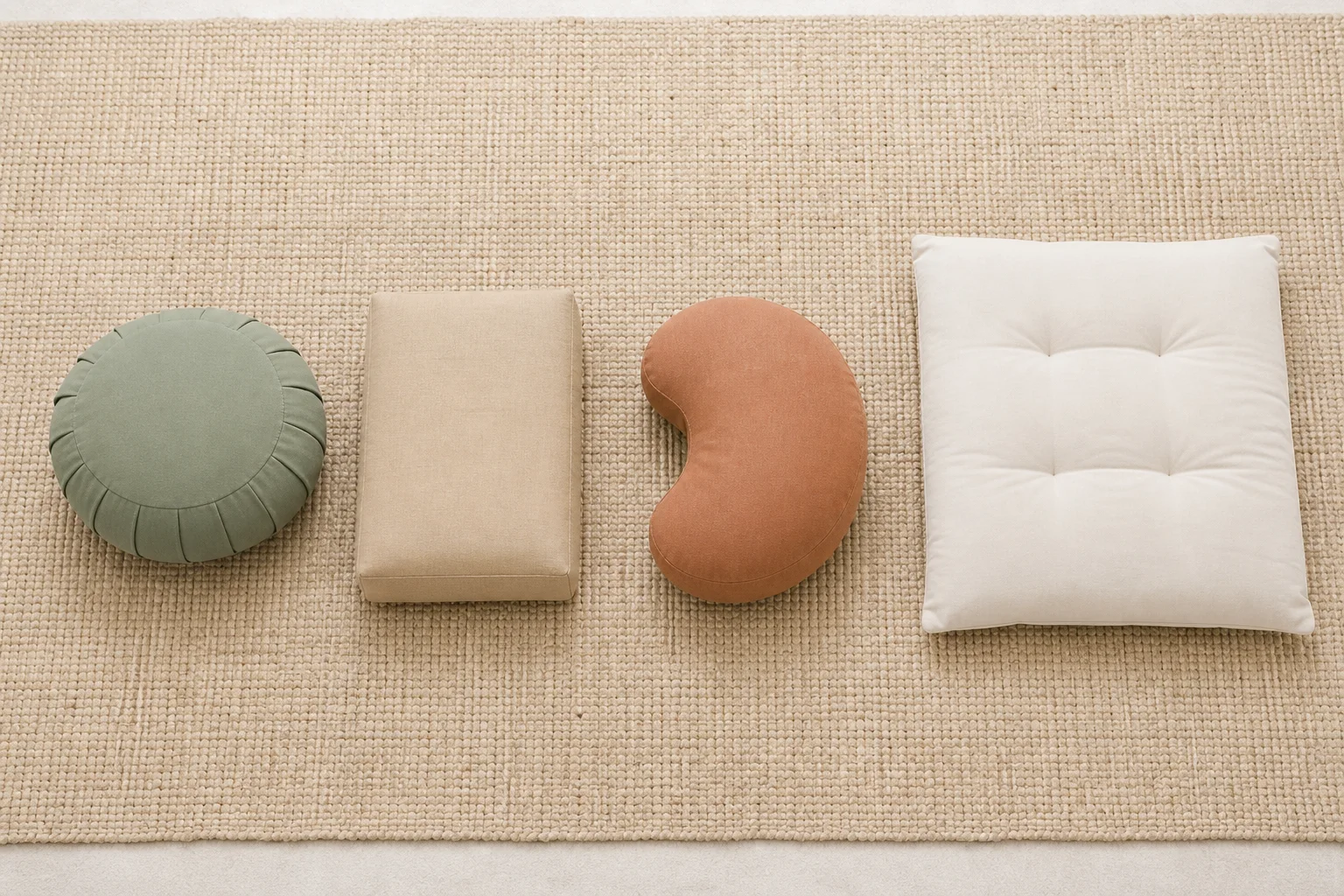
Product pages often group very different objects under “meditation cushion.” Shape determines where the support sits, how much room your legs have and how the cushion stores.
Round zafu
A traditional round zafu concentrates lift beneath a relatively compact area. Pleated sidewalls allow a stuffed cover to expand without becoming a perfectly rigid cylinder. Buckwheat versions can feel moldable because the hulls shift and settle; batting-filled versions tend to behave more like a single padded mass.
Round is the safest online-shopping default when you are unsure which direction the cushion will face. The drawback is its bulk: a 15-inch circle does not slide into a narrow backpack, and hull-filled models can weigh several pounds.
Rectangular cushion
A rectangular seat provides a clear front-to-back orientation and a broad straight edge. It can also stack neatly and fit against a wall. Hugger Mugger’s comparison guide lists its Zen cushion at 11 × 15 × 5 inches and 6.5 pounds, illustrating that a compact rectangle can be almost as heavy as a hull-filled zafu.
Do not confuse a firm rectangular meditation seat with a soft household pillow. Published dimensions, fill and a stable cover matter more than the familiar shape.
Crescent or V-shaped cushion
A crescent curves around the seated area and leaves the front more open. A V-shaped design extends farther toward the thighs. These forms can provide a different distribution of contact than a circle, but the names are not standardized. Compare the outline and dimensions rather than assuming every “crescent” behaves alike.
Hugger Mugger currently lists its V-shaped cushion at 6 × 24 × 17 inches and 7 pounds. That wide footprint is useful information for storage and floor planning, independent of any fit claim.
Zabuton and low square supports
A zabuton is a wide, relatively flat floor cushion usually placed under a raised seat. Hugger Mugger publishes 24 × 34 × 3 inches and 9.5 pounds for its zabuton. It covers much more floor than a zafu and can outweigh the seat above it.
If you are comparing both pieces as one purchase, use the meditation cushion set guide for zafu–zabuton proportions, combined weight, removable-cover architecture, storage and like-for-like bundle pricing. This page keeps ownership of individual seat formats.
If the broad floor layer itself is the purchase, use the meditation mat guide. It owns standalone zabuton, wool, layered and long-folding formats by footprint, loft, fill, tufting and care.
A low square support occupies a middle ground. DharmaCrafts’ Classic Square Support is 14 × 14 × 2 inches with recycled cotton batting. It adds modest separation without the five-inch catalog loft common in round seats. Neither is automatically necessary: measure your storage area and test a folded blanket before buying a second layer.
Four source-checked picks
Best adjustable classic: Hugger Mugger Zafu
The Hugger Mugger Zafu is the strongest all-purpose reference because its listing answers the practical questions many competitors omit. It measures 15 × 15 × 5 inches, weighs 6.75 pounds, uses a 100% cotton cover and is filled with organic buckwheat hulls. A zipper gives access to the fill, and a handle supports short carries.
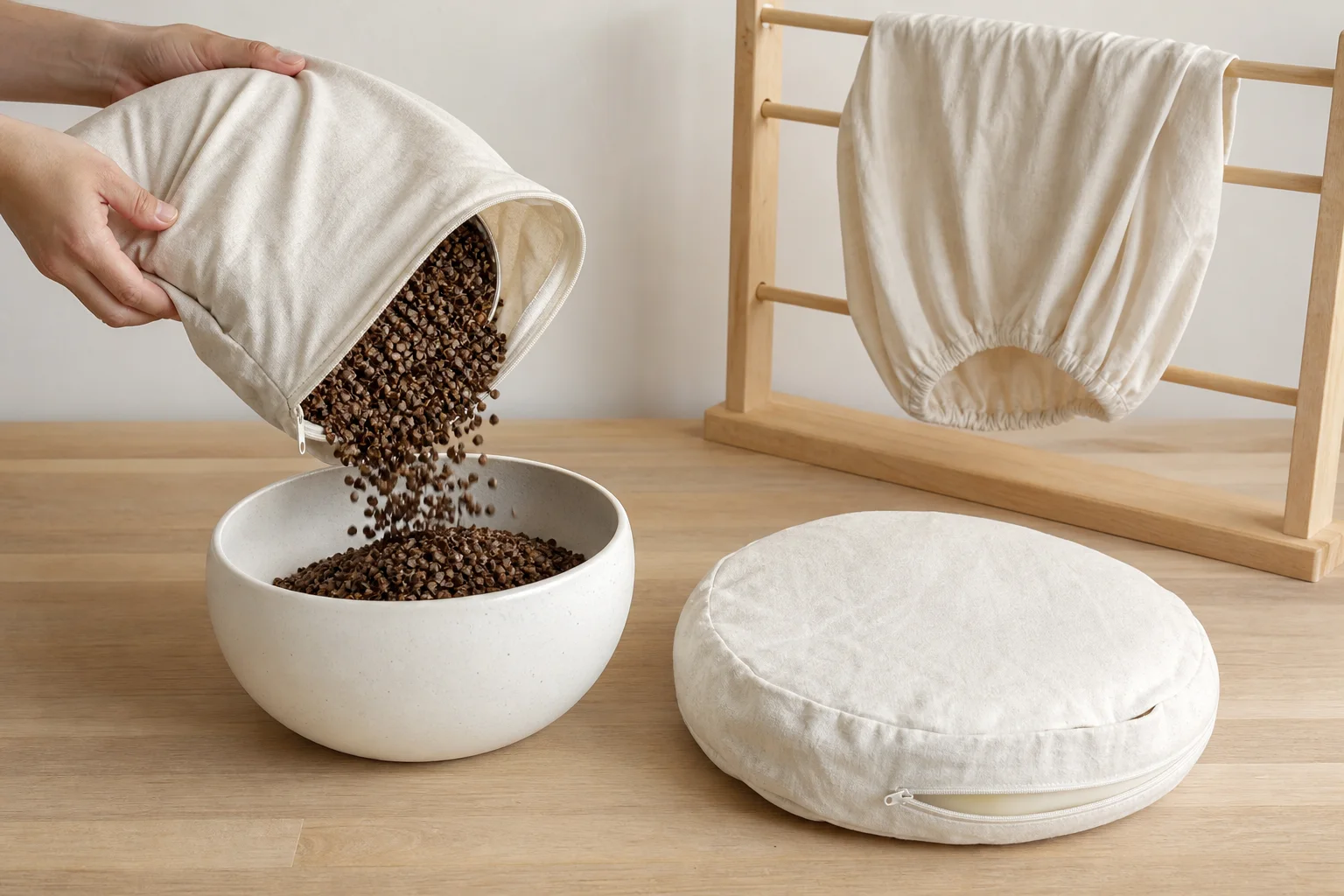
That access is the decisive feature. Removing some hulls changes uncompressed loft and how readily the contents redistribute. Keep removed hulls dry in a sealed, labeled container so they can be restored later. Adjustable does not mean infinitely tunable: the cover still defines maximum volume and shape.
The trade-offs are weight and a more involved wash routine. Hugger Mugger says to empty the hulls, hand wash the cover, hang it to dry and replace the fill only when the fabric is fully dry. This is a home-use cushion, not the easiest item to commute with daily.
Best taller documented zafu: DharmaCrafts Studio Buckwheat Zafu
DharmaCrafts publishes a 15-inch diameter, 5.5-inch loft and approximately 4.5 pounds of buckwheat hull fill for its Studio model. The outer cover is 10-ounce 100% cotton duck, removable and washable, while the cushion is handmade in the United States.
Its half-inch higher catalog loft distinguishes it from the five-inch reference above, but catalog height is not usable height. Hull quantity, cover tension and the sitter’s load all affect compression. Treat 5.5 inches as a comparison input, not a promised final position.
The removable outer cover simplifies routine surface care because the fill can remain contained in the inner cushion. Still follow the current care label for the exact color and model; “washable cover” does not mean the filled insert belongs in a machine.
Best for low carry weight: Hugger Mugger Zafuko
At 14 × 7 × 5 inches and 1.1 pounds, the Zafuko is dramatically lighter than the hull-filled examples. Its polyester cover and organic kapok filling create a compact multipurpose cushion that is made in Thailand. The published care method is spot cleaning.
Choose it when carried weight and fast packing matter more than removable-cover laundering or granular fill adjustment. Kapok is a light plant fiber, but “natural fill” alone does not establish allergy safety, antimicrobial performance or a medical benefit. We would disregard those broad claims unless independently substantiated.
Best low platform: DharmaCrafts Classic Square Support
The 14 × 14 × 2-inch Classic Square Support is useful for buyers who want a low, broad surface rather than a conventional five-inch seat. Its recycled cotton batting and cotton cover make it structurally different from a loose-hull zafu. The filling will not flow around the body in the same way.
This is also a practical reminder that “best” may mean less elevation, not more. A low support can be paired with a suitable floor surface, while someone wanting a broad layer beneath knees and feet should compare a full zabuton instead.
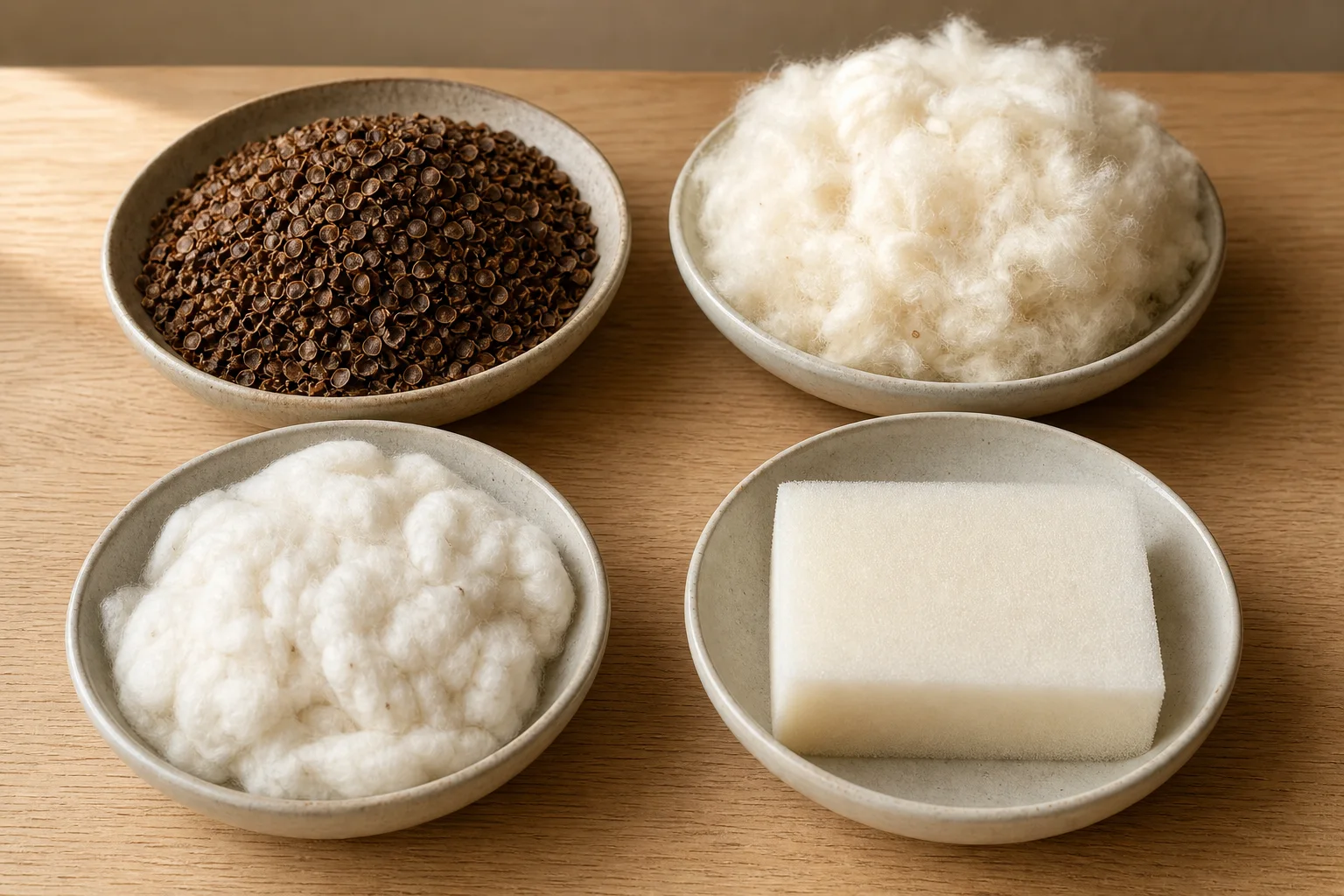
Buckwheat, kapok, cotton or foam?
Fill changes weight, sound, shape retention and cleaning logistics. It does not turn a product into medical equipment.
| Fill | Typical behavior | Main advantage | Main limitation |
|---|---|---|---|
| Buckwheat hulls | Loose pieces shift and settle | Moldable; often adjustable | Heavy; fill must stay dry |
| Kapok | Light, springy fiber mass | Very portable | Often fixed-fill; spot-clean care |
| Cotton batting | Layered or stuffed fiber | Broad, quiet padding | Can compress with use |
| Foam | Continuous resilient core | Predictable manufactured shape | Density and composition vary widely |
Buckwheat listings should disclose whether there is an inner liner and fill-access zipper. Without both, adjustment or cover washing may become messy. Kapok and batting cushions need clear care directions because loose plant fiber should not be assumed washable. Foam requires density and material disclosure; “memory” or “supportive” is not enough to compare two cores.
Natural does not automatically mean organic, low-emission, biodegradable or suitable for every person. Ask whether a certification covers the fill, cover or complete finished product.
Choose usable height and footprint
Most listings give height when the cushion is unloaded. The useful comparison is how much height remains under normal use, but few brands publish compression curves. You can still reduce uncertainty.

First, recreate several heights with firmly folded blankets or towels on a non-slip floor. Measure the stack after settling, not before. Notice whether the footprint feels broad enough and whether an edge creates unwanted pressure. There is no need to hold a position that produces pain, tingling or numbness; change the setup and seek qualified advice for persistent symptoms.
Then compare five product numbers:
- Unloaded height or loft gives a starting point.
- Seat diameter or width describes the contact platform.
- Overall footprint determines leg room and storage space.
- Product weight determines portability.
- Fill access determines whether loft can be reduced later.
Body height alone cannot select a cushion. Leg position, relative segment lengths, floor softness, clothing and preferred session length all affect fit. For online purchases, adjustable fill and a workable return policy are more valuable than a chart promising one size for every body in a height range.
Cover construction and care
A good listing separates the outer cover, inner liner and loose fill. Look for two zippers when routine laundering matters: one to remove the decorative outer cover and another, protected opening for fill adjustment. A carry handle should be sewn into a structural seam, especially on a six-pound cushion.
Use the least aggressive care method the maker approves:
- vacuum or brush dry debris from fabric;
- spot clean when that is the only published method;
- remove the outer cover or empty hulls exactly as instructed;
- close zippers and wash at the stated temperature and cycle;
- air-dry fully before reassembly;
- never wash loose buckwheat hulls or pack them into a damp shell;
- inspect seams, handle and zipper before lifting.
Hugger Mugger specifically instructs owners of its standard buckwheat zafu to empty hulls before hand washing and hang drying the cover. Its Zafuko is spot-clean only. Those two products from one brand demonstrate why a generic “meditation cushions are machine washable” rule is unreliable.
Meditation cushion versus yoga bolster
A meditation cushion is generally designed as a compact seated platform. A yoga bolster is longer and intended to support a larger body area in varied floor setups. Some products can do both jobs, but dimensions reveal the compromise: a travel cushion may be too small for broad support, while a full bolster can be awkward as a compact seat.
A folded blanket is the lowest-cost way to test height and may already be enough. A chair is a legitimate alternative when floor sitting is unsuitable. Equipment should adapt to the person and setting; purchasing a traditional shape is not a requirement for meditation.
Claims to ignore
Be cautious when a product promises to “correct alignment,” eliminate pain, improve circulation, cure numbness or transform meditation quality. A cushion changes geometry and contact. It cannot guarantee a health outcome, and no catalog adjective replaces individual fit.
Also question:
- “ergonomic” without dimensions or design evidence;
- “organic” without named scope or certification;
- “antimicrobial” or “hypoallergenic” without relevant testing;
- “eco-friendly” without material, durability and end-of-life detail;
- “machine washable” when the listing never separates cover from fill;
- “one size fits all” on a fixed-height product.
The strongest listing is often the least dramatic one: exact measurements, material percentages, product weight, zipper construction, origin, care instructions and a clear return policy.
Buying checklist
Before ordering, confirm:
- Which shape and overall footprint fit the available floor space?
- What is the unloaded height, and can fill be removed?
- What are the cover, liner and fill made from?
- Is product weight realistic for how often it will travel?
- Does it have a removable washable cover, or is it spot-clean only?
- Are replacement hulls or covers available?
- Is the handle structurally attached?
- Can the cushion be returned after a brief indoor fit check?
- Does any sustainability or organic claim identify its exact scope?
If the seller cannot provide dimensions, fill and care instructions, you cannot make a meaningful comparison.
The verdict
An adjustable buckwheat zafu is the most versatile starting point because it combines a familiar compact shape with user-controlled fill. Choose a documented taller zafu only when you have trialed similar height; select lightweight kapok when carrying weight leads; choose a low square support when a broad two-inch platform better matches your setup. Add a zabuton only when its larger floor-contact area earns its considerable weight and storage space.
Buy the physical specification, not a wellness promise: shape, compressed fit, fill, weight, cover access and exact care method determine whether a meditation cushion will remain useful.
Frequently asked questions
What is the best meditation cushion for beginners?
There is no universal winner. An adjustable buckwheat zafu is a practical starting point because its loft can be reduced, while rectangular, crescent and low formats provide different contact areas.
How high should a meditation cushion be?
Choose by usable compressed height after testing folded layers. Body proportions, leg position and floor setup matter more than a generic height chart.
Is buckwheat or kapok better?
Buckwheat is heavier, moldable and often adjustable. Kapok is much lighter and springier but commonly fixed-fill. Choose between shape control and portability.
Do I need a zabuton under a zafu?
No. It adds a broad padded floor layer, but a suitable rug, blanket or floor may already provide enough separation.
Can meditation cushion covers be washed?
Only as the exact label directs. Some covers are removable, some require loose fill to be emptied, and some cushions are spot-clean only.
Frequently asked questions
What is the best meditation cushion for beginners?
There is no universal best shape. An adjustable buckwheat zafu is a practical starting point because fill can be removed to change loft, while a rectangular or crescent format may suit a different leg position or contact preference.
How high should a meditation cushion be?
Choose by usable compressed height, not the unweighted catalog number alone. Your leg position, body proportions and floor setup change how much lift feels workable, so favor adjustable fill or a returnable product when you cannot try it first.
Is buckwheat or kapok better for a meditation cushion?
Buckwheat hulls are heavier, moldable and often adjustable. Kapok is much lighter and springier but commonly has fixed loft. The better fill depends on whether shape control or portability matters more.
Do I need a zabuton under a zafu?
No. A zabuton adds a broad padded contact area under knees, ankles and feet, but it adds cost, storage volume and weight. A rug, folded blanket or suitable floor may already provide enough separation.
Can meditation cushion covers be washed?
Only follow the exact product instructions. Some buckwheat cushions require the hulls to be emptied before hand washing the cover, some have a removable outer cover, and some lightweight cushions are spot-clean only.