

How this page has changed
July 27, 2026
Sources, internal links and safety or product context reviewed.
In this guide
- 01Meditation mat formats at a glance
- 02Zabuton: the main search-result format
- 03Low cotton and wool mats
- 04Long and foldable meditation mats
- 05Meditation mat versus yoga mat
- 06Measure the finished mat
- 07Footprint and usable area
- 08Fill and internal architecture
- 09Cover architecture
- 10Care: separate cover from insert
- 11Storage and transport
- 12Delivery inspection
- 13Weight and carrying
- 14Compare current value
- 15Red flags
- 16A practical selection sequence
A meditation mat is usually a broad, filled textile pad placed on the floor. In Western product listings, it is often a zabuton: wider and lower than a zafu seat, with cotton batting, kapok, wool or another layered fill held in a square or rectangular cover. Some retailers also use “meditation mat” for long foldable padded mats or thin wool layers.
That naming overlap makes construction more reliable than the title. Decide whether you need a broad tufted floor cushion, a low layered mat or a long portable pad. Then compare length, width, maximum loft, fill, tufting, cover architecture, total mass and storage.
This page owns the single floor-layer decision. Our meditation cushion guide compares raised seats, and the meditation cushion-set guide owns coordinated zafu-plus-zabuton bundles. This is not meditation or posture instruction and does not claim that a mat treats pain or prevents injury.
Meditation mat formats at a glance
| Format | Typical construction | Shape | Main buying variable |
|---|---|---|---|
| Tufted zabuton | Loose or layered natural/synthetic fill held by tufts | Square or rectangle | Finished dimensions and fill distribution |
| Removable-cover zabuton | Separate filled insert inside zippered cover | Square or rectangle | Whether cover and insert are truly separate |
| Kapok floor mat | Loose kapok in chambers or tufted shell | Square, rectangle or long | Loft, shifting and exact care |
| Layered cotton mat | Batting layers inside a shell | Usually square/rectangle | Layer containment and compression |
| Wool meditation mat | Wool batting or felted layer | Square/rectangle | Fiber disclosure and cleaning restrictions |
| Long foldable mat | Segmented foam or batting panels | Long narrow rectangle | Folded envelope and panel seams |
| Tatami-style padded mat | Woven or textile surface over firm layers | Square or long rectangle | Core, edge binding and moisture care |
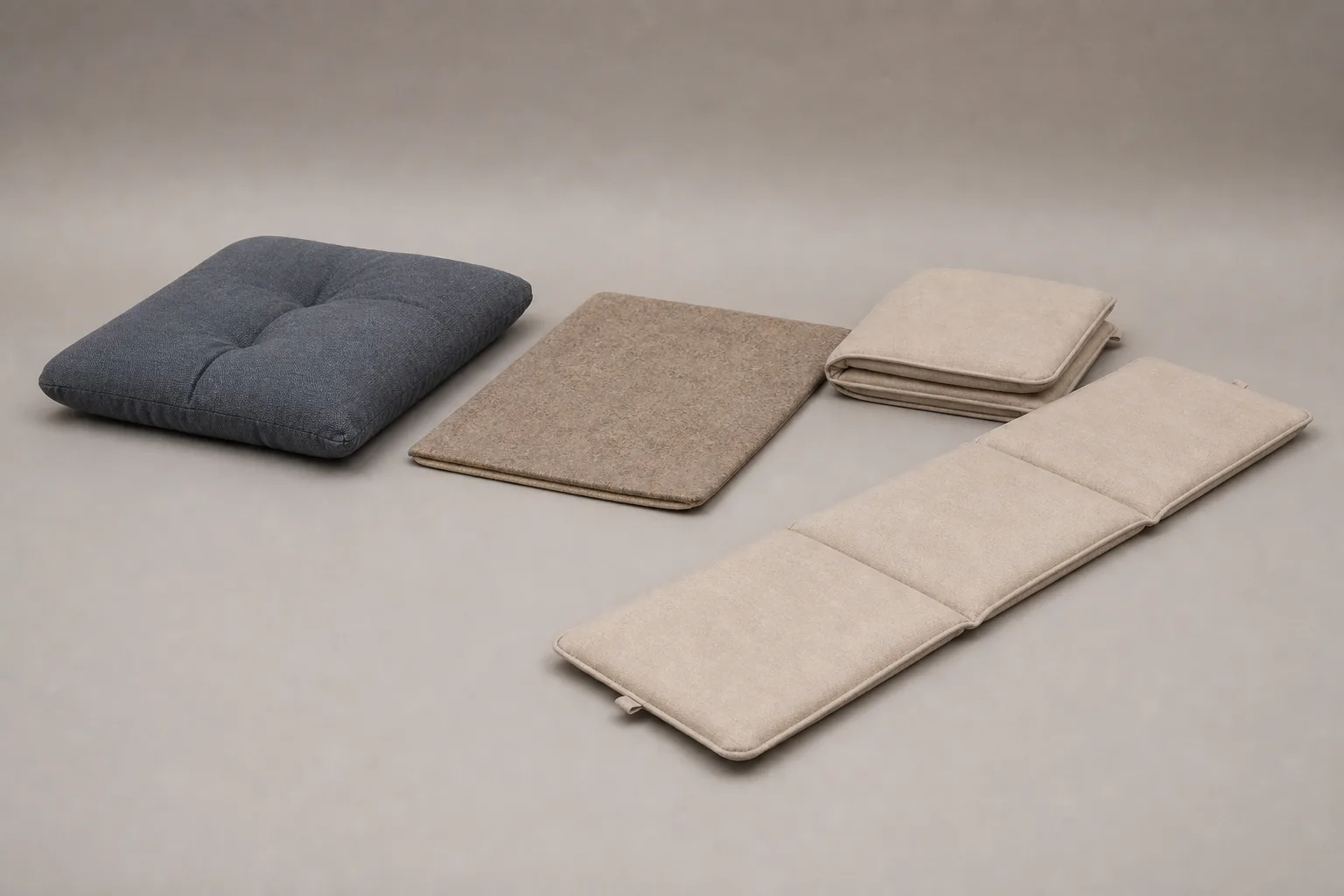
Zabuton: the main search-result format
A zabuton is a broad floor cushion. Sage Meditation currently publishes a rectangular 36 × 28 × 3-inch format with cotton batting. Still Sitting describes the category as a rectangular mat placed beneath a zafu or meditation bench. Boon Decor publishes 30 × 34-inch floor mats with kapok fill and sewn-in handles, although its stated six-inch height is much loftier than many conventional examples.
Those differences are large enough to change the product class in practice. Do not infer a standard zabuton size or thickness from one listing.
What tufting does
Tufting anchors the top and bottom textile layers through the fill. It reduces migration and creates visible low points. This means “three inches thick” may describe the fullest edge or chamber, not the compressed tuft location.
Check:
- number and placement of tufts;
- whether tufting passes through the removable cover;
- consistency across the mat;
- loose threads or pulled anchor points;
- edge loft compared with center loft; and
- whether the stated thickness is maximum or nominal.
A deeply tufted mat can look thicker in profile while providing a much lower surface at each anchor. Product photos should include both side and overhead views.
Low cotton and wool mats
Some meditation mats use layered batting rather than a lofty cushion structure. A 2025 Futon-Tatami catalogue distinguishes flat cotton/horsehair and virgin-wool zabuton constructions. That shows why “natural fill” is insufficient: wool, cotton batting, kapok and horsehair have different containment, cleaning and compression characteristics.
For any fiber-filled mat, verify:
- exact fill fiber or blend;
- whether the fill is loose, layered, felted or quilted;
- outer-cover fiber;
- inner liner or batting wrapper;
- certified-content claim and scope, if any;
- total product mass; and
- separate care instructions for every layer.
“Wool mat” can mean a filled pad, felted blanket-like layer or ordinary rug. Ask for a side profile and cross-section description. Likewise, “cotton mat” can refer to the cover while the interior is polyester fiber or foam.
Long and foldable meditation mats
Long pads may be marketed for meditation, floor seating, relaxation or portable use. They resemble segmented floor mattresses more than square zabutons. The extra length can suit a different room plan, but it also creates a larger stored object.
Compare:
| Field | Open state | Folded state |
|---|---|---|
| Length | Full end-to-end dimension | Longest folded edge |
| Width | Narrowest usable surface | Folded width including seams |
| Thickness | Maximum panel loft | Total stacked thickness |
| Mass | Same in both states | Determines carrying effort |
| Handle | Position under open load | Whether it safely carries the folded product |
| Closure | Usually irrelevant | Strap, buckle, tie or none |
“Foldable” does not guarantee suitcase portability. A four-panel mat may fold into a thick block whose longest edge remains wide. Verify the closed dimensions and a manufacturer-approved carry point.
Meditation mat versus yoga mat
A conventional yoga mat is a long thin exercise surface, usually compared by grip, density, thickness, material and movement area. A zabuton is a textile-filled floor cushion compared by footprint, loft, fill, tufting and cover care. They should not share one shortlist.
| Feature | Zabuton-style meditation mat | Conventional yoga mat |
|---|---|---|
| Core construction | Batting, kapok, wool or other fill | Foam, rubber, PVC, TPE, cork composites or textiles |
| Surface | Upholstery fabric | Grip-oriented exercise surface |
| Shape | Square or broad rectangle | Long narrow rectangle |
| Loft | Often measured in inches | Often measured in millimeters |
| Care | Cover and insert may differ | Material-specific surface cleaning |
| Storage | Usually flat; sometimes maker-approved fold | Usually rolled; some travel formats fold |
The phrase “yoga meditation mat” is ambiguous. Inspect the dimensions: a 28 × 36-inch filled cotton pad is not a 68 × 24-inch exercise mat even when both mention yoga.
Measure the finished mat
Use the live manufacturer specification to screen products, then measure the delivered mat after it has recovered from shipping. Filled textiles can expand after unpacking, and handmade edges may not be perfectly square.
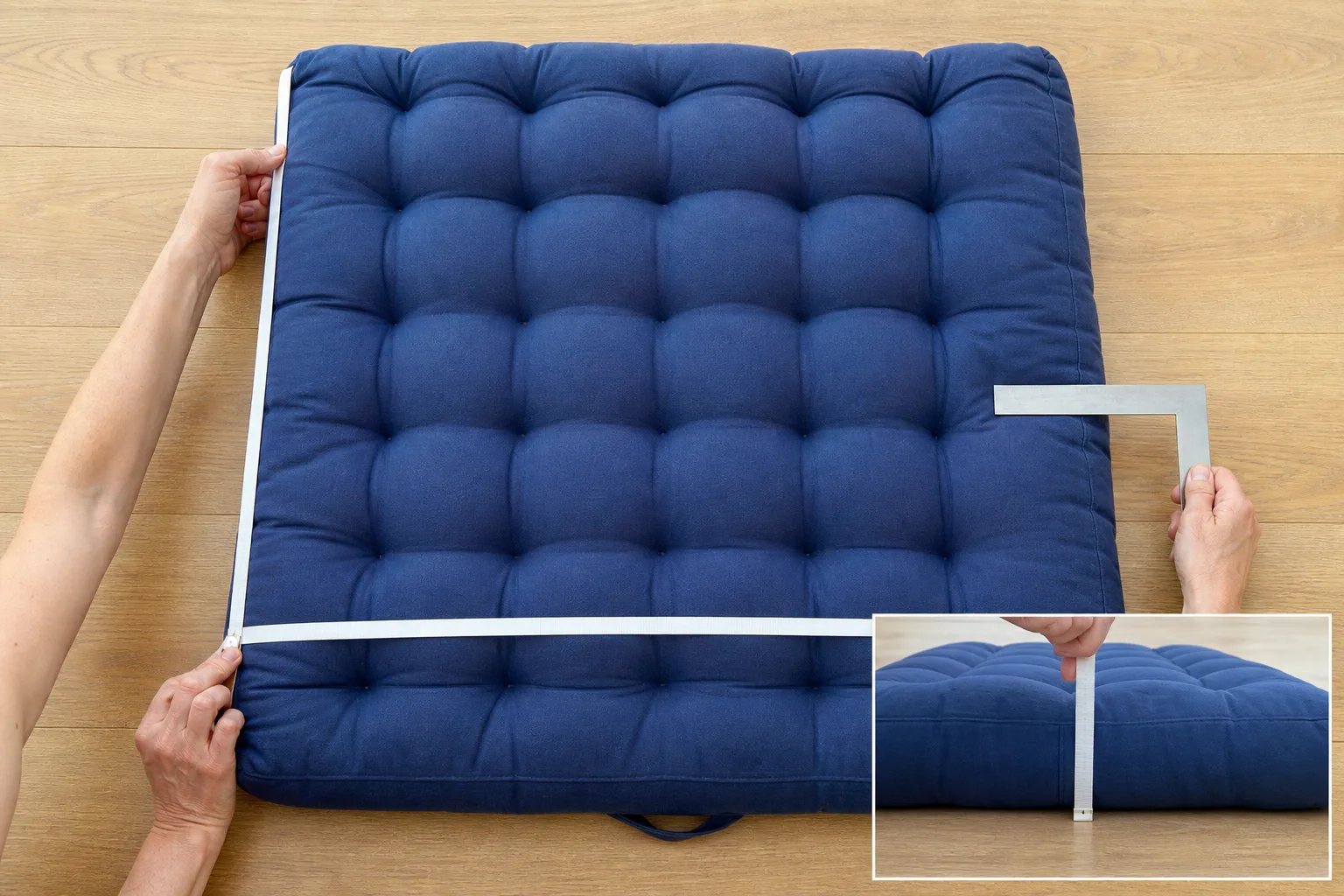
Measurement method
- Lay the mat on a clean, hard, level floor.
- Let it recover for the time stated by the maker.
- Measure maximum length across the finished edges.
- Measure maximum width perpendicular to it.
- Use a square or straightedge to record maximum loft without compressing.
- Repeat loft at the center, edge and a tuft.
- Weigh the entire dry product if carrying or shelving matters.
This is a product-fit exercise, not body-position guidance. To test room fit, outline the published rectangle with paper or floor-safe tape and include door swings, furniture and walking clearance.
Footprint and usable area
Piping, sloped edges and deep tufting reduce the uninterrupted surface. A nominal 30-inch square does not provide 900 square inches of uniformly flat, full-loft area.
For a companion cushion or bench, compare its complete floor-contact footprint with the mat’s inner usable rectangle. Do not let narrow bench feet sit partly on a thick edge roll and partly on a lower center. Follow the bench manufacturer’s surface requirements.
If the floor layer must fit inside a storage shelf, use the actual finished dimensions. A soft mat does not become safely smaller merely because it can be squeezed into a cubby.
Fill and internal architecture
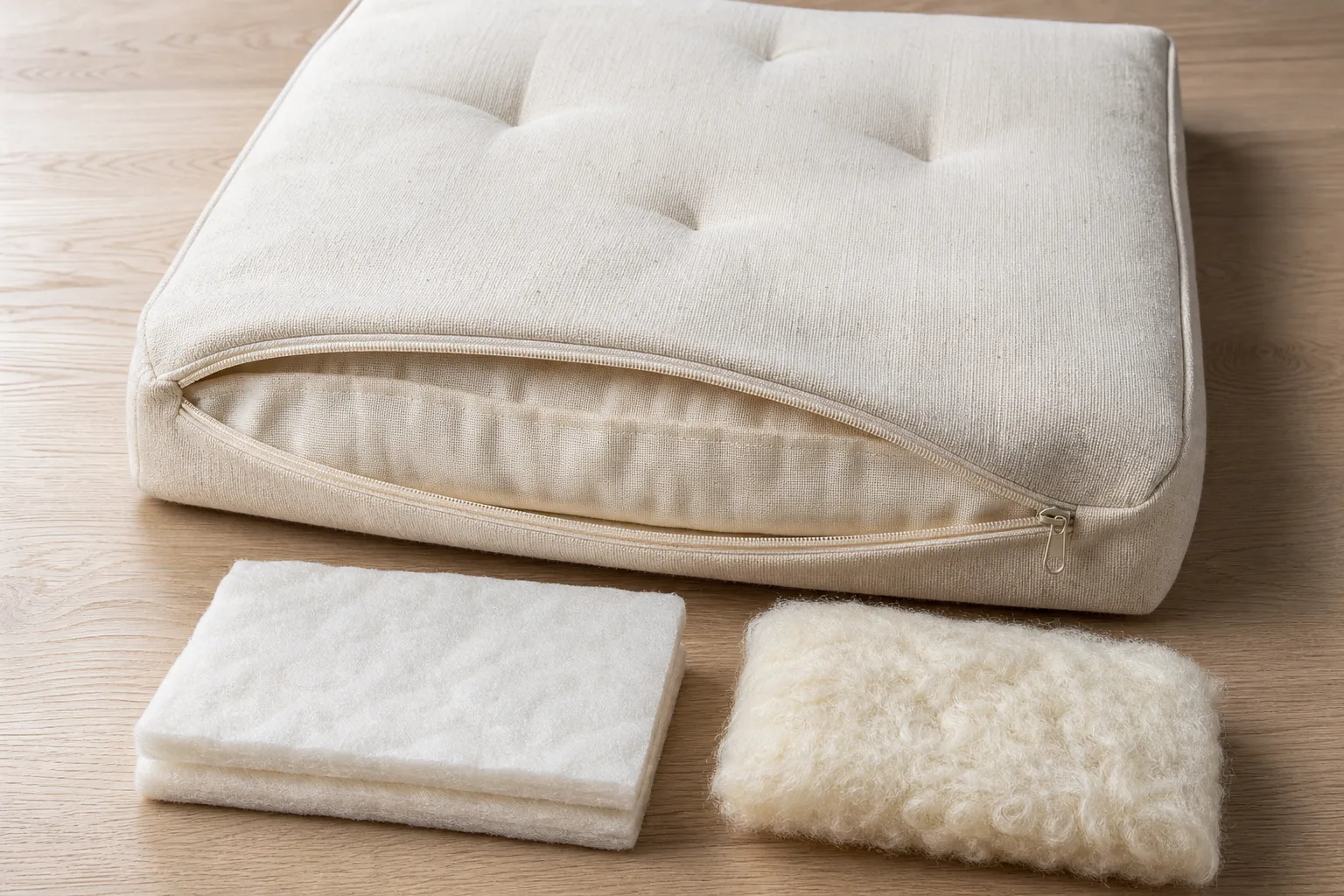
Cotton batting
Cotton batting is layered or distributed through the inner mat and often held by tufting. It can compress and may dry slowly if saturated. Confirm whether the batting is loose inside a shell, stitched into layers or permanently tufted through the outer cover.
Kapok
Kapok is a lightweight plant fiber often used loose inside chambers. Boon Decor identifies organic kapok in its floor mats. A kapok claim should be accompanied by fill containment, finished mass and care directions. Loose fiber can shift differently from batting.
Wool
Wool may be used as batting, felt or a blended fill. Verify the percentage and whether it applies to the fill or cover. Wool-care restrictions can include avoiding machine washing or heat; use the exact label rather than a generic wool routine.
Foam and synthetic batting
Long foldable mats may use foam panels or polyester batting. Ask for core material, panel count, density if published and whether the cover is removable. “Cotton mat” may describe the shell around a synthetic core.
Cover architecture
There are three common systems:
- Non-removable shell: tufting passes through the finished exterior; whole mat is usually spot-cleaned.
- Removable outer cover: a complete contained insert slides out through a zipper.
- Layered case: separate batting or panels sit inside a cover and may need careful reassembly.
A zipper alone does not prove a serviceable removable cover. The opening must be large enough to remove the insert without tearing, and the insert must remain intact. Inspect whether tuft strings connect the cover to internal layers.
Check zipper placement: a metal pull on the underside can contact the floor, while a side pull may catch during storage. A protective garage or fabric flap is useful when documented.
Care: separate cover from insert
Care claims often collapse two components into one sentence. Build a two-row care record:
| Component | Cleaning method | Water exposure | Drying method | Reassembly condition |
|---|---|---|---|---|
| Outer cover | Label-specific wash or spot clean | As permitted | Air or machine dry only if allowed | Fully dry, correct orientation |
| Filled insert | Often spot clean only | Avoid saturation unless permitted | Full airflow, no heat unless allowed | Completely dry and evenly distributed |
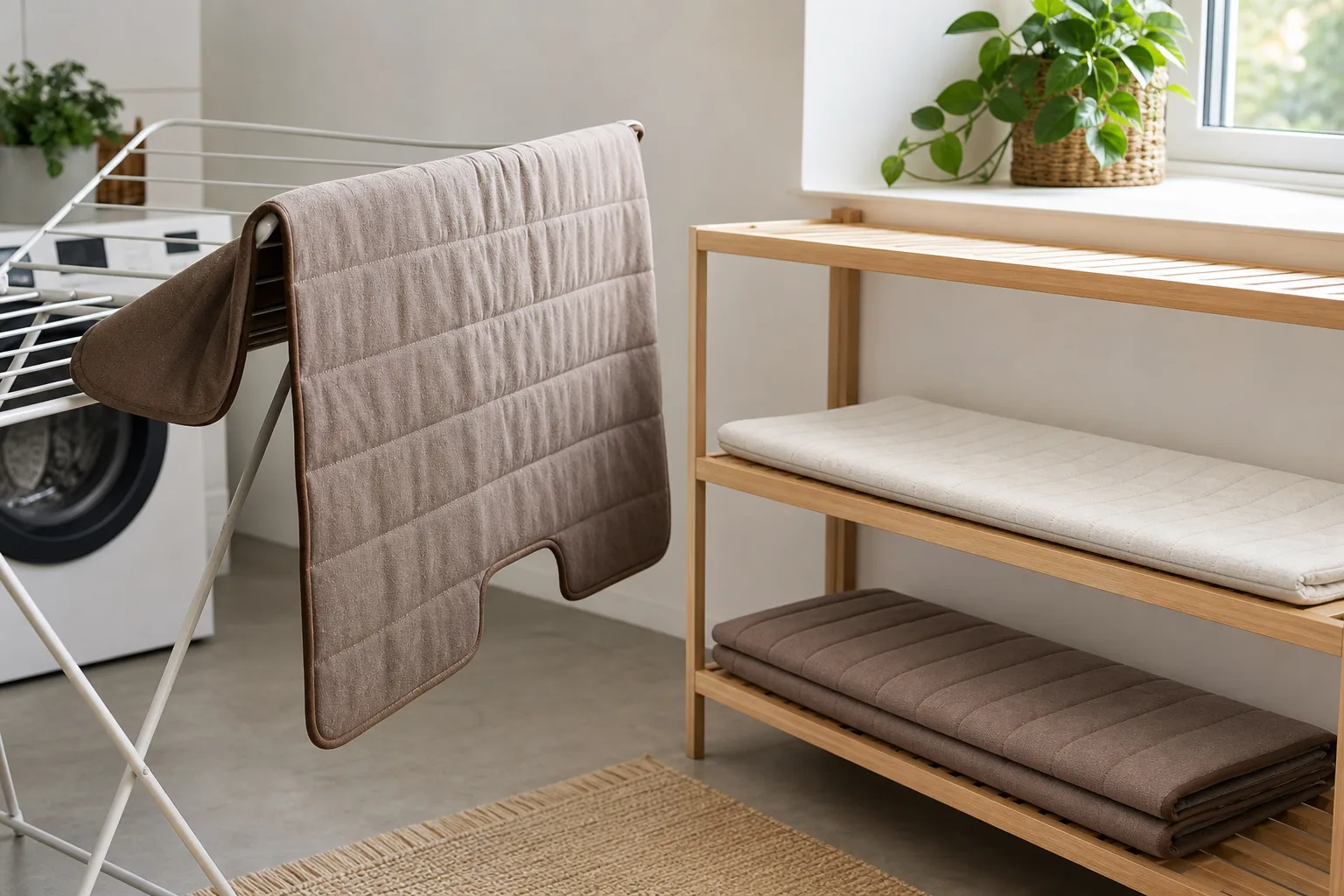
Vacuum loose surface debris using an upholstery attachment only when the maker permits it. Test any cleaning product on an inconspicuous area. Do not soak cotton, kapok or wool fill because the outer cover is washable.
If an insert becomes wet beyond the approved method, contact the maker. Drying only the surface can conceal moisture inside a thick core.
Storage and transport
A zabuton occupies a broad area even when not used. Still Sitting currently lists a folding zabuton category, which confirms that folding is a product-specific feature rather than a universal property.
Plan one approved storage orientation:
- flat on a ventilated shelf;
- upright only when supported without edge collapse;
- folded along manufactured seams; or
- inside a correctly sized breathable carry case.
Do not keep heavy books, blocks or bolsters on top of a filled mat. Avoid vacuum bags unless the maker approves compression. Keep the product clean, fully dry and away from persistent sunlight, heat, leaks and pests.
Sewn-in handles are useful only when reinforced for the full product mass. Inspect stitching before carrying. Do not suspend a mat permanently from a transport handle unless the manufacturer says it is a storage point.
Delivery inspection
Before accepting a new mat:
- confirm the model, size, fabric and fill on the order;
- inspect packaging for water or puncture damage;
- allow the stated recovery time;
- measure finished length, width and loft;
- compare tufting and fill distribution across the surface;
- inspect piping, seams, zipper and handle attachment;
- verify the care label and component boundaries;
- smell for persistent chemical or damp odor; and
- retain packaging until size and construction are accepted.
Handmade variation can be legitimate, but it should remain within the seller’s stated tolerance and not create open seams, exposed fill or an unstable surface.
Weight and carrying
Fill determines mass as much as dimensions. A large cotton-batting zabuton can be much heavier than a thin wool layer or kapok pad. The shipping weight may include packaging and should not replace the net product weight.
For transport, add the cushion or bench carried with it. A lightweight mat paired with a heavy zafu may still require a large bag. Our set guide compares combined bundle weight; this page keeps the standalone mat measurement.
Compare current value
Use current delivered cost rather than copying static prices:
Cost per usable square foot = delivered price ÷ measured usable area in square feet
This formula helps compare size, but it does not value fill, removable covers or workmanship. Add replacement-cover cost, return shipping, dry-cleaning restrictions and whether the insert can be serviced.
Compare like with like. A non-removable cotton-batting zabuton, a removable-cover kapok mat and a long folding foam pad solve different storage and care problems. A larger area is not automatically better when it blocks a door or cannot be stored flat.
Red flags
- “Meditation mat” with no length, width or thickness.
- One dimension reused for a clearly rectangular product.
- Cotton named without saying whether it is cover or fill.
- “Washable” without separating cover and insert.
- A zipper shown but no removable-insert description.
- Deep tufting hidden in side-profile photography.
- “Foldable” without closed dimensions or fold lines.
- A carry handle with no reinforcement or product mass.
- Therapeutic, pain or posture claims unsupported by suitable evidence.
- Yoga-mat grip language applied to a textile-filled zabuton.
- A bundle photograph used to sell a mat-only listing.
- Vacuum-compressed shipping with no recovery guidance.
A practical selection sequence
- Choose zabuton, low layered mat or long foldable format.
- Define the room footprint and storage envelope.
- Compare finished length, width, maximum loft and mass.
- Identify outer cover, inner containment, fill and tufting separately.
- Verify whether the cover truly removes and what each component’s care label permits.
- Check edge shape and usable flat area against any companion product.
- Inspect seams, tufts, zipper, handles and fill distribution on delivery.
- Store clean and fully dry without unapproved compression.
- Calculate live delivered value within the same construction class.
The best meditation mat is not simply the thickest or largest. It is the floor-layer format whose finished dimensions, fill architecture, care boundary, carrying method and storage requirements are fully documented and realistic for the room.
Frequently asked questions
What is a meditation mat?
In current product results, a meditation mat is usually a broad padded floor layer, often called a zabuton. It is generally square or rectangular and lower than a raised meditation cushion. Some sellers also use the term for long foldable padded mats, so verify the actual dimensions and construction.
Is a meditation mat the same as a yoga mat?
Usually not. A zabuton-style meditation mat is a filled textile pad with loft, tufting and often a removable cover. A yoga mat is normally a long, thin exercise surface designed around grip and movement. Retail wording overlaps, so compare construction rather than the word “mat.”
What size meditation mat should I buy?
Measure the intended floor zone and every item that will sit on the mat. Current zabuton examples vary substantially, including roughly 36 by 28 inches and other square or rectangular formats. Verify length, width and maximum loft, then add room clearance and storage space.
Can a meditation mat be washed?
Only according to the exact care label. A removable outer cover may be washable while the cotton-, kapok- or wool-filled insert remains spot-clean-only. Tufting can pass through the full mat and make the cover non-removable. Separate the instructions for cover and insert.
How should a meditation mat be stored?
Store it clean and fully dry, ideally flat or in the maker-approved folded orientation without heavy objects on top. Do not vacuum-compress a filled mat unless the manufacturer permits it. Plan for the real unpacked dimensions rather than the shipping carton.