

How this page has changed
July 26, 2026
Sources, internal links and safety or product context reviewed.
In this guide
- 01Meditation room accessories at a glance
- 02Build the room in the right order
- 03Choose seating accessories without duplicating them
- 04Lighting: design for control, not atmosphere alone
- 05Storage that makes the space repeatable
- 06Sound: reduce interruptions before buying a speaker
- 07Air, scent and plants
- 08Decorative objects: one is enough
- 09Three room plans
- 10What not to buy first
- 11Final room audit
- 12Bottom line
A timer is an operating tool rather than decor. The meditation timer guide compares browser, app and physical formats, including sound, screen-lock, offline use, power, privacy and accessibility.
The best meditation room accessories make a space easier to enter, use, reset and maintain. They do not need to make the room look mystical. Start with six functions: a dependable seat, a clear floor zone, controllable light, simple storage, optional sound control and acceptable air quality.
For a small corner, that may mean one cushion or chair, a compact rug, a dimmable lamp and a basket. For a dedicated room, the same functions can expand into layered lighting, closed storage, a washable floor textile and a place for a timer or speaker. Decorative objects come last.
This guide owns the room-level system, not meditation technique or posture. Our meditation cushion guide and meditation bench guide compare those products in depth.
If the room needs a low surface, the meditation table guide compares fixed, folding, narrow and stackable furniture by dimensions, construction, load rating and storage. This room guide only decides whether a surface belongs in the overall system.
For upholstered backrests and raised cross-legged furniture, the meditation chair guide separates fixed floor, folding floor and office-style formats by dimensions, frame, mechanisms and room footprint.
Meditation room accessories at a glance
| Function | Sensible starting item | What to verify | Usually essential? |
|---|---|---|---|
| Seating | Chair, cushion or bench | Stability, dimensions, access and care | Yes |
| Floor boundary | Small rug, mat or clear hard floor zone | Flatness, edges, grip and cleaning | Often |
| Lighting | Window control plus one warm adjustable lamp | Glare, placement, cord route and controls | Often |
| Storage | Basket, lidded box or low cabinet | Complete-kit capacity and clear access | Yes in shared rooms |
| Timing | Silent timer, watch or app | Audible/visual alerts and distraction level | Optional |
| Sound control | Door seal, soft textile, ear protection or speaker | Household communication and safe volume | Optional |
| Temperature | Washable blanket or room control | Fiber, dimensions and care | Optional |
| Focal object | One personally meaningful item | Stable placement and easy cleaning | Optional |
| Scent or flame | Preferably none; flameless alternative | Air sensitivity and fire safety | Never essential |
The Smiling Mind Spaces Toolkit includes floor or chair cushions, warm lighting and seated storage among possible furnishings. That is a useful functional list, not a requirement to buy every category.
Build the room in the right order
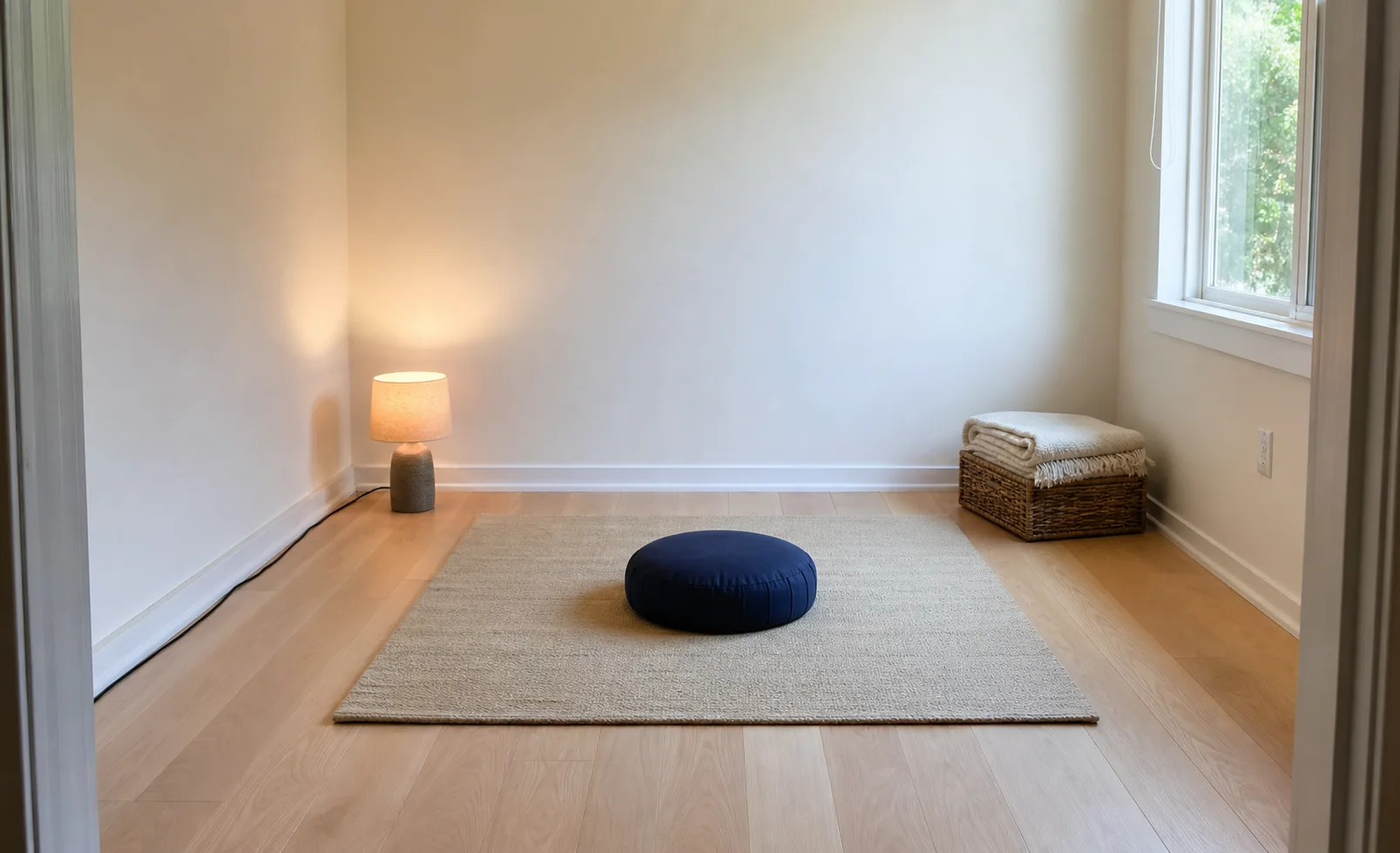
1. Choose the location before the objects
Test a candidate corner at the time you expect to use it. Notice real traffic, door swings, heating vents, direct sun, appliance noise and whether other people need the route. A beautiful corner beside a frequently used doorway will stay inconvenient.
Measure the clear floor rectangle, not the entire room. Include space needed to approach the chair or floor seat and to stand back up. Do not route lamp, charging or speaker cords through that access path.
2. Choose one primary seat
A room does not need a zafu, crescent cushion, zabuton, bench and chair. Choose the one format that belongs to the actual practice and store alternatives elsewhere.
For a coordinated two-piece purchase, the meditation cushion set guide compares zafu and zabuton dimensions, fills, covers, total weight and storage without prescribing posture.
A current Hugger Mugger buckwheat zafu illustrates the substantial end of portable floor seating: the maker publishes a 15 × 15 × 5-inch size and about 6.75-pound weight. A meditation bench is rigid and introduces leg geometry, hinges or removable connections. A dining or task chair occupies more floor space but may already meet the need.
This page does not prescribe a seated position. If floor transfer, prolonged sitting, pain, pregnancy, dizziness or another health factor changes what is appropriate, seek individual qualified guidance rather than decorating around the problem.
3. Define the floor boundary
A small rug or mat can make a temporary corner visually legible and protect a seat from the floor. It must lie flat and stay out of the walking path. Thick pile can make a rigid bench or chair less predictable; curling edges create a trip point.
If the existing floor is clean, comfortable and suitable, add nothing. A floor textile is not mandatory. Buy it for a specific function—boundary, insulation, cleanability or cushioning—not because every inspiration photo contains one.
4. Add controllable light
Use daylight when it suits the schedule, then add one controllable artificial source. Place the switch or dimmer where it can be reached without stepping over the seat. A shaded floor or table lamp usually creates less direct glare than an exposed point source, but every fitting must be used according to its rating and instructions.
5. Give the kit one storage home
The storage container should accept the full reset: cushion or bench if portable, blanket, timer, headphones and small personal object. If an item never fits, it will remain on the floor.
Closed storage reduces visible clutter and dust. Open baskets make soft items easier to access and ventilate. Choose based on what is stored, not on a styled photo.
Choose seating accessories without duplicating them
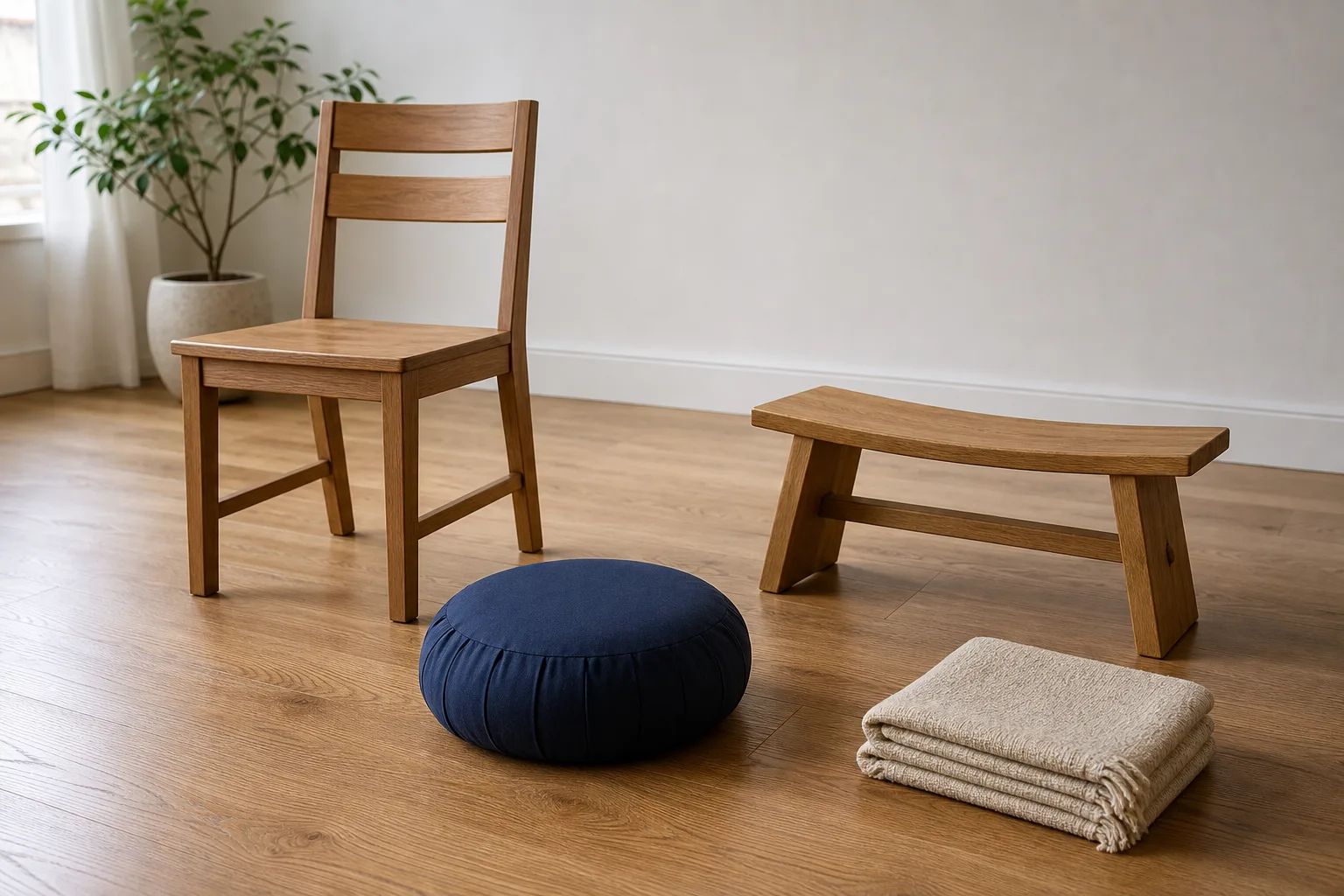
Floor cushion
Compare shape, uncompressed dimensions, fill, total weight, handle and cover care. Buckwheat hulls are heavy and moldable; batting and kapok behave differently. An adjustable inner fill opening is useful only when the liner and closure are secure.
A washable outer cover does not mean the whole cushion can enter the machine. Record the exact disassembly and drying process before purchase. A pale cover that requires spot cleaning may be a poor fit for a high-use shared room.
Meditation bench
Compare front and rear height separately, seat width, slope, fixed or folding legs, hardware and the maker’s setup instructions. Folding hardware improves storage but adds an inspection point. Do not put loose thick padding under bench feet or use a bench on a surface where it rocks.
The dedicated meditation bench guide compares current products and makes the rigid-seat intent explicit. The room decision here is simpler: does a bench fit the clear zone, storage system and access requirements?
Chair
A chair can be the complete seating system. Check that all feet contact the floor, the chair does not swivel or roll unexpectedly and the route around it remains clear. A cushion placed on a chair changes seat height and friction; it is not automatically an improvement.
Blanket or floor pad
A foldable blanket can add a thin layer, warmth or a larger floor boundary. Manduka’s current Essential Cotton Yoga Blanket is a deliberately large example at 68 × 82 inches and three pounds. Its handmade dimensions can vary, and the maker directs cold separate washing and hang drying.
That size can overwhelm a tiny corner. Measure the folded and open footprint. Our yoga blanket guide compares smaller woven formats and care routines.
Lighting: design for control, not atmosphere alone
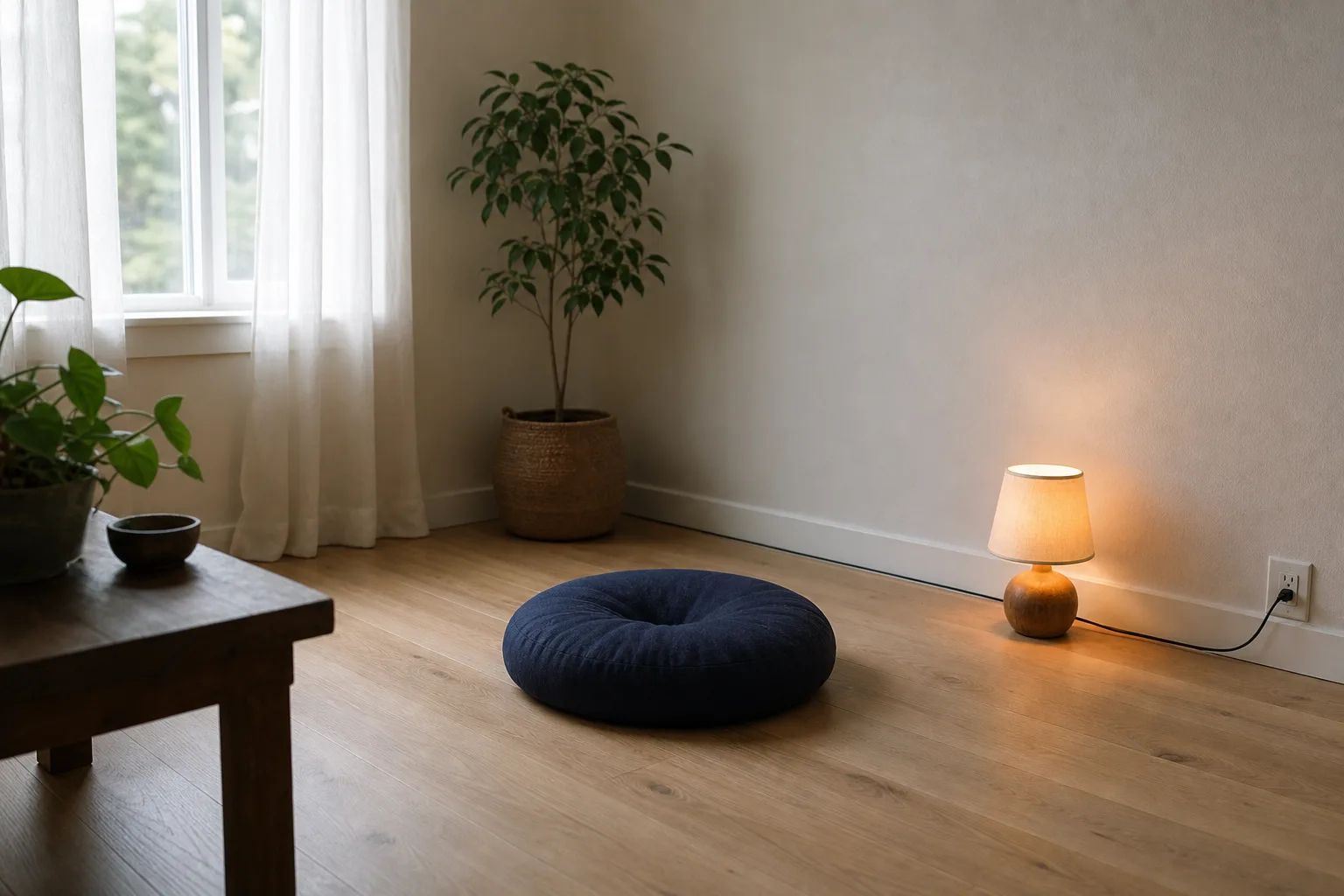
Daylight control
Sheer curtains diffuse light but do not block strong glare. A blind or lined curtain provides more control but can darken a shared room. Check whether the window treatment affects ventilation, radiators or required egress before installation.
Avoid placing delicate foam, textiles and printed materials in prolonged direct sun when the maker warns against it. Sunlight can also heat a floor zone unevenly during the expected session time.
Artificial light
Start with one lamp rather than a network of decorative lights. Compare these practical details:
- shaded or diffused output rather than an exposed bright source;
- switch reachable from the entry or seat;
- stable base outside the clear floor zone;
- cord length that reaches the outlet along the wall;
- bulb and dimmer compatibility;
- automatic shutoff only if its behavior will not interrupt use.
Warm light is a common design preference, including in the Smiling Mind toolkit, but a color-temperature number does not guarantee comfort. Shade material, brightness, wall color, daylight and placement change the result. Test the actual room.
Candles are not required lighting
An open flame adds surveillance, clearance and extinguishing requirements. The National Fire Protection Association says to keep candles at least 12 inches from anything that can burn, use stable holders and extinguish them before leaving the room or going to sleep. A meditation session is not an exception.
Flameless candles or a small shaded LED lamp reproduce the visual cue without combustion. If a candle is used, keep it away from blankets, curtains, plants, paper, shelves and floor-level movement. Never treat an altar, tray or glass vessel as automatic fire protection.
Storage that makes the space repeatable
The best meditation room storage reduces setup steps without turning practice equipment into permanent floor clutter.
| Storage format | Best for | Main check | Common failure |
|---|---|---|---|
| Open basket | Blanket, cover or small cushion | Ventilation, handles and cleanable base | Too small for the reset |
| Lidded box | Timer, headphones and personal items | Hinge/closure and interior dimensions | Becomes a general junk box |
| Low cabinet | Mixed room with several kits | Door swing and anchored stability where required | Blocks access route |
| Wall shelf | Light objects only | Appropriate installation and load disclosure | Heavy props stored overhead |
| Bench with storage | Shared-purpose room | Seat rating versus storage rating | Confusing furniture with meditation bench |
| Rolling cart | Flexible multi-use room | Locking behavior and clear parking place | Rolls into the floor zone |
Do not improvise wall installation from a generic decorating guide. Use hardware appropriate to the wall construction and the product instructions. Heavy cushions, weights, sandbags and benches should not be stored overhead without a system specifically designed and installed for the load.
Labeling can help in a shared room, but the simplest rule is one container per complete kit. Empty the container periodically. If décor, books and unrelated cables displace the cushion or blanket, storage has stopped serving the room.
Sound: reduce interruptions before buying a speaker
Sound accessories divide into three functions: reducing outside noise, playing guided audio and signaling time.
Reduce noise at the source
Close a door when safe, silence unnecessary notifications and choose a time with less household traffic. Soft furnishings can reduce some reflections inside a bare room, but a rug or curtain does not soundproof walls. Avoid exaggerated “acoustic” claims without test data.
Guided audio
A phone already provides audio, but it also provides notifications. Use focus settings or a dedicated player if interruptions are recurring. Place a speaker on a stable surface and route its charging cable outside the access zone.
Headphones reduce disturbance to others but also reduce awareness of doors, alarms and household communication. Use them only where that trade-off is acceptable. This guide does not prescribe volume or claim sound therapy.
Timer
Choose an alert you can hear without a startling maximum-volume signal. A simple watch, kitchen timer, phone app or dedicated visual timer may all work. Disable repeated alarms and confirm the device will not roll, vibrate off a shelf or light the room unexpectedly.
Singing bowls, chimes and bells are optional instruments, not necessary meditation equipment. Buy one only if the practice actually uses it and the household accepts the sound.
Air, scent and plants
Fragrance is optional
Incense, essential-oil diffusers, room sprays and scented candles add substances to indoor air. “Natural” does not establish that a fragrance is suitable for every person, pet, material or ventilation condition. The EPA notes that concentrations of many organic pollutants can be higher indoors and advises source control and ventilation as core approaches.
Avoid fragrance when a household member has sensitivity, when pets or children make access difficult, when the room lacks ventilation or when building rules prohibit it. Do not make respiratory, sleep or therapeutic claims for scent products.
If you use a diffuser, follow its water, cleaning, placement and oil instructions. Keep liquid away from electronics and porous textiles. Never assume an essential oil is safe around a particular pet; obtain relevant veterinary guidance.
Plants
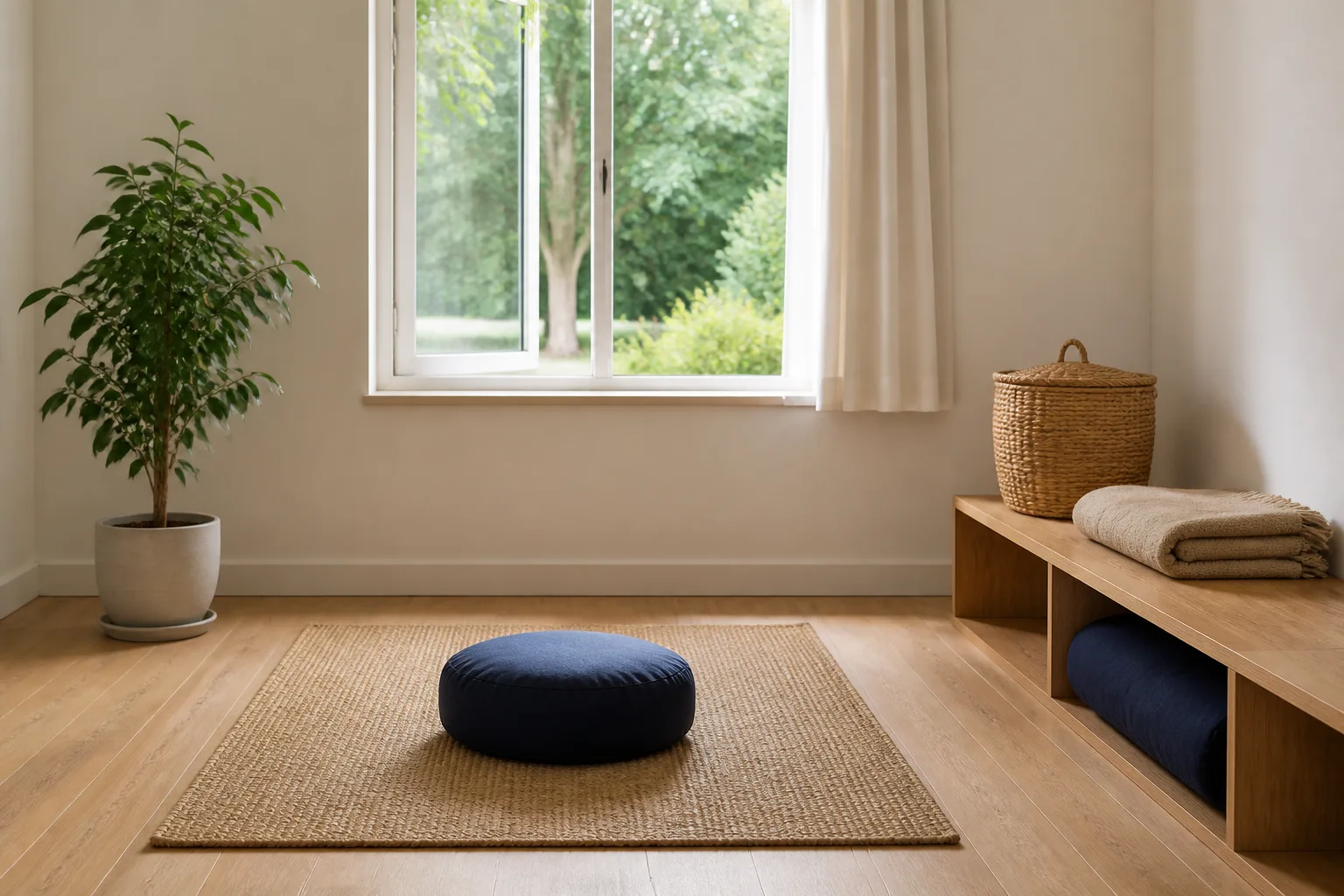
A plant can be a personally meaningful visual object, but it does not replace ventilation or air-quality management. Choose for the room’s light, watering schedule, household allergies and pet safety. Use a stable pot with a watertight saucer outside the walking zone.
Avoid placing trailing plants over the seat, hanging heavy planters above the floor zone or allowing damp soil and fallen leaves to accumulate near textiles.
Ventilation and temperature
An openable window may help when outdoor conditions are appropriate, but outside smoke, pollen, noise, heat or cold can make it unsuitable. Use the home’s existing ventilation and heating systems according to their instructions. Do not block supply or return vents with cushions, curtains or storage baskets.
A washable blanket is often a simpler temperature accessory than a dedicated heater. Portable heaters add clearance, tip-over, cord and shutoff considerations and should never be treated as décor. Follow all manufacturer and local fire-safety requirements.
Decorative objects: one is enough
A focal object can be a photograph, textile, stone, artwork, flower, book or faith-specific item chosen by the user. It does not need to imitate another culture’s sacred objects or create a generic “Zen” aesthetic.
Place it on a stable surface that does not require reaching over a flame, cord or water vessel. Keep heavy objects low, secure wall-mounted pieces appropriately and avoid glass at the edge of a low table. The object should be easy to dust and return, not another storage problem.
Mirrors can increase reflected light and visual activity. If a mirror is already in the room, test sightlines from the seat before buying another. Freestanding mirrors require suitable anti-tip measures; wall installation depends on the product and wall.
Three room plans
Small shared-room corner
| Item | Choice | Reset location |
|---|---|---|
| Seat | One portable cushion or stable chair already owned | Basket or permanent chair position |
| Boundary | Small flat rug or no added textile | Rolled beside basket if temporary |
| Light | Existing window plus one wall-side lamp | Permanent perimeter position |
| Storage | One basket sized for full kit | Against wall, outside route |
| Timer | Existing watch or focus-mode phone | Inside basket |
Skip dedicated décor until the corner works for several weeks.
Dedicated room
Use one primary seat and keep guest seating in closed storage. Add layered but simple lighting: daylight control, general room light and one low task/ambient lamp. A cabinet can separate textiles from electronics. Keep the center floor area open rather than filling every wall with accessories.
Multi-use yoga and meditation room
Separate the seated zone from the mat’s movement clearance. Blocks, straps and bolsters belong in low storage that can be fully closed or parked against the perimeter. The yoga props guide explains those equipment functions; do not scatter them through the meditation zone as decoration.
Use a lighting and storage reset that makes the active mode obvious. A single basket for meditation and a separate rack or cabinet for yoga gear reduces crossover.
What not to buy first
- A coordinated décor bundle before measuring the clear zone.
- Multiple cushions when one seat has not been chosen.
- A large floor rug with curling edges or uncertain grip.
- Open-flame accessories for unattended ambience.
- Incense or diffusers justified by health claims.
- A sound system before testing notifications, doors and scheduling.
- Heavy overhead shelves for props without appropriate design and installation.
- A mirror, fountain or plant that complicates access, cleaning or pet safety.
- Any object marketed as culturally “authentic” without understanding its origin and meaning.
The room should remain functional if every decorative object is removed. If it does not, the setup is relying on styling rather than access, seating, light and storage.
Final room audit
Before calling the space finished, verify:
- The approach, door swing and standing area are clear.
- The seat is stable and appropriate for its intended setup.
- Rug or mat edges lie flat.
- Lamp and charging cords follow the perimeter.
- Lighting controls are reachable without crossing the seat.
- Every accessory fits its storage home.
- Textiles have a documented care and drying method.
- Vents, radiators, exits and windows are not obstructed.
- Flames and smoke are absent—or managed under explicit safety guidance.
- The room can be reset in a few minutes.
Bottom line
The most useful meditation room accessories are ordinary and specific: one suitable seat, a clear boundary, controllable light and storage that fits the complete kit. Add sound, a blanket, a plant or one focal object only when it performs a real job for the people using the room.
Build from the floor plan outward. Keep cords, flame, smoke and clutter out of the access route. A calm meditation space is not the room with the most “calming” products—it is the one that remains simple to use, safe to leave and easy to reset.
Frequently asked questions
What should be in a meditation room?
Start with a dependable seat, a clear floor or chair zone, suitable light and one place to store the equipment. Add a timer, blanket or sound control only when it solves a recurring need. Decorative objects are optional and should not obstruct movement, ventilation or cleaning.
How do I make a meditation corner in a small room?
Use a portable seat, one compact floor boundary such as a small rug or mat, a nearby lamp and a basket or lidded box sized for the complete kit. Keep the access route clear and return every item to the same container after use.
Do I need a meditation cushion?
No. A stable chair, suitable bench or floor cushion can define the seat. Choose the format you can use consistently and safely access. This room guide does not prescribe posture; detailed cushion and bench construction are covered in separate buying guides.
Are candles and incense good meditation room accessories?
They are optional and introduce fire or indoor-air considerations. Flameless lighting provides visual ambience without an open flame. If you use candles, follow fire-safety guidance, keep them at least 12 inches from combustible objects and extinguish them before leaving. Avoid fragrance or smoke when it causes irritation or conflicts with household needs.
What color is best for a meditation room?
There is no evidence-based universal best color. Choose a finish that works with the room’s real daylight, artificial light and other uses. A restrained palette can make equipment easier to see and store, but function, clear access and controllable light matter more than a named “calming” color.