
How this page has changed
July 26, 2026
Sources, internal links and safety or product context reviewed.
In this guide
- 01Yoga props at a glance
- 02The best beginner kit is deliberately small
- 03Match the prop to the missing function
- 04Choose by practice style
- 05A practical prop-budget ladder
- 06How to evaluate a yoga prop set
- 07Specialist props: buy only for a named use
- 08Care and replacement checklist
- 09What to buy—and what to skip
- 10Bottom line
Yoga props are tools that change a practical variable: distance to the floor, available reach, contact area, cushioning, height, warmth or external support. A block is not a smaller bolster. A blanket is not merely a softer block. Each format behaves differently, and a good purchase begins with the function your class repeatedly asks for.
For most beginners, the sensible starting point is two full-size blocks and one non-elastic strap. A dense, foldable blanket is the next broadly useful addition. Buy a bolster when restorative, yin or another prop-heavy class is part of your real routine—not because a coordinated starter bundle looks complete.
This guide compares categories rather than ranking individual products. Our dedicated yoga block guide, yoga strap guide, bolster guide and yoga blanket guide own the detailed material and product decisions.
For dimensions specifically, the yoga block size guide compares 3-inch, 4-inch, lean, mini and oversized formats without duplicating the product rankings.
For a ready-made two-block bundle, the yoga block and strap set guide covers component counts, matched specifications, delivery inspection, storage and price comparison.
For a broader mat–block–strap package, the yoga starter kit guide audits advertised piece counts, component disclosure, replaceability, bag capacity and genuine bundle value. This page retains ownership of which prop categories to prioritize.
If a class or home setup calls for a fabric barrier at the feet, the yoga socks guide compares toe formats, sole-grip coverage, fit, materials and care without making pose or anti-slip claims.
This is a source-checked equipment guide, not pose instruction or medical advice. Follow the class sequence and prop placement taught by a qualified instructor.
Yoga props at a glance
| Prop | Variable it changes | Most useful buying detail | Usually first purchase? |
|---|---|---|---|
| Two blocks | Height, reach and firm contact area | Dimensions, material, density and edge shape | Yes |
| Strap | Reach and loop length | Total length, webbing stretch and closure | Yes |
| Blanket | Adjustable layers, padding and warmth | Foldability, dimensions, weight and care | Often |
| Bolster | Broad, firm external support | Shape, firmness, dimensions and cover care | Practice-dependent |
| Knee pad | Local cushioning | Thickness, firmness and floor grip | Only for recurring need |
| Wedge | Contact angle | Length, rise, width and material | Specialist |
| Sandbag | Deliberate external load | Filled weight, liner and closure | Specialist |
| Wheel | Curved, rolling surface | Diameter, width, padding and published load language | Specialist |
| Chair or bench | Elevated seat or rigid support | Stability, feet, hinges and intended use | Class-specific |
The mat is your practice surface, not usually counted as a prop in this guide. Clothing, towels, bags and cleaning products are accessories. That boundary matters because “yoga prop set” listings often mix functional props with unrelated extras to make a bundle appear larger.
The best beginner kit is deliberately small
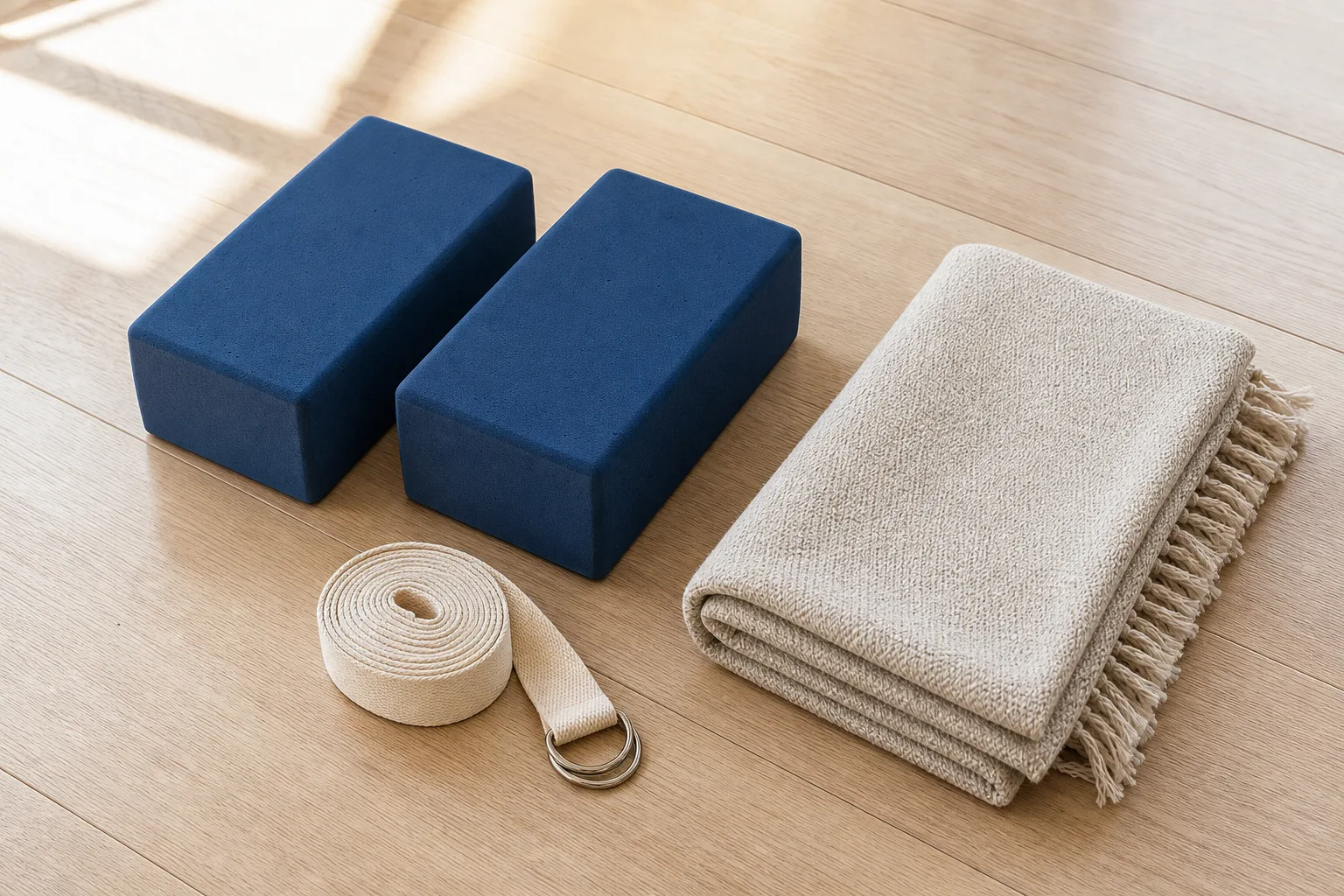
Start with what your class actually names. Many studios provide shared equipment, and online classes often publish a short prop list before the session. Borrowing or using studio gear for several classes teaches you more than guessing from a product bundle.
Priority 1: two matching blocks
Blocks are the most broadly reusable prop because each rectangular block offers three usable heights. A matched pair also gives both sides the same geometry. Manduka’s current recycled-foam example uses the familiar 9 × 6 × 4-inch format and weighs one pound. That is a useful reference size, not an industry guarantee.
Choose foam when low weight, softer contact and portability matter most. Choose cork when you prefer a firmer, heavier object and accept the extra carrying weight. Do not infer stability from material alone: density, surface finish, dimensions, wear and the floor beneath it all matter.
The existing foam-versus-cork block comparison handles that decision in depth. For a starter kit, matching dimensions are more important than matching colors.
Priority 2: one non-elastic strap
A yoga strap extends available reach and can form a controlled loop. It should not be confused with a stretchy resistance band or the carrying sling wrapped around a rolled mat. Manduka currently publishes 8-foot and 10-foot versions of its AligN cotton strap, both about 4.4 cm wide. The longer option creates more routing length but also leaves more loose webbing to manage.
Inspect the buckle, stitching, webbing edges and total usable length. A D-ring closure, cinch buckle and quick-release design do not operate identically. Buy the closure your teacher demonstrates or that you can adjust predictably. Our complete yoga strap buying guide compares length, buckle and material without taking over this page’s kit-level intent.
Priority 3: one dense, foldable blanket
A blanket can create thin, repeatable layers, a compact roll, a broader folded platform or warmth during a quiet finish. Those functions depend on a textile that holds a fold. A lofty bed throw may feel soft but collapse or spread; a tiny fleece blanket may not provide enough area.
Manduka’s current Essential Cotton Yoga Blanket is a large example at a published 68 × 82 inches and three pounds, using a recycled cotton-rich blend. Handmade dimensions can vary, and the maker warns that warm washing or tumble drying may cause shrinkage. This shows why fiber, size, mass and care belong in the purchase decision.
You do not need that exact blanket or that unusually generous size. Compare woven structure, usable dimensions after washing, edge finish and whether the folded stack remains even. See the source-checked yoga blanket comparison for current weaves and care instructions.
Priority 4: a bolster only when your practice calls for one
A bolster occupies more space and does a more specific job than a block or strap. It offers a wide, firm support surface for classes designed around sustained external support. A decorative bed pillow is usually softer, less predictable and more compressible.
Current bolsters vary substantially. Hugger Mugger’s Standard is a rectangular 11 × 25 × 6-inch, five-pound example with a foam core, cotton batting and 100% cotton cover. Other bolsters are cylindrical, narrower, lighter or filled with removable fiber. Shape and firmness affect how the object occupies space; they are not cosmetic details.
If a class says “bolster or firm pillows,” try the household option first. If a bolster appears in your weekly practice, choose its shape and construction using our yoga bolster guide. If you already own one and need a washable outer layer, use the separate replacement bolster cover guide.
Match the prop to the missing function
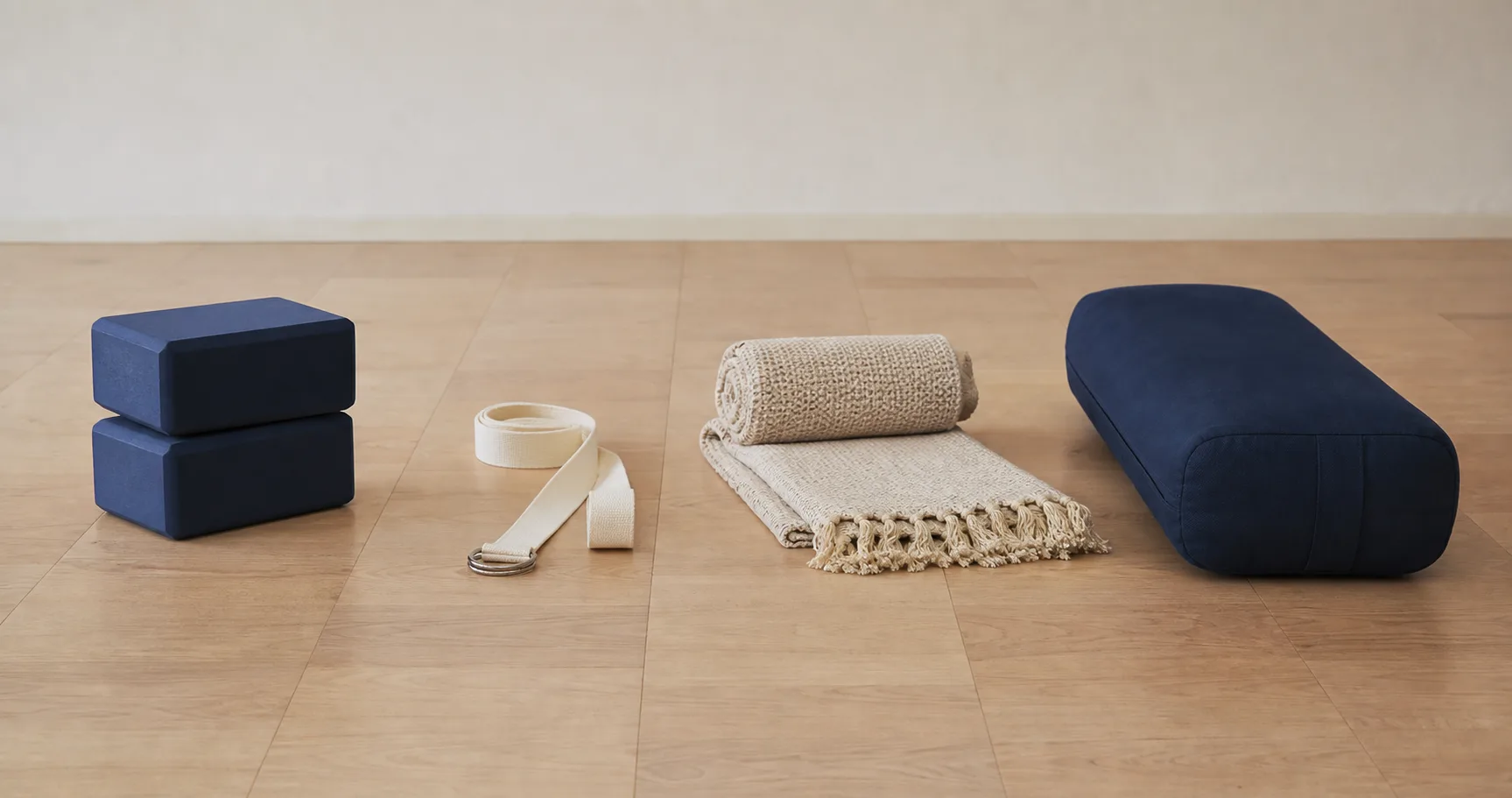
When an instructor names a prop, ask what physical property is required. That prevents poor substitutions and duplicate purchases.
| Needed property | Primary prop | Plausible temporary substitute | Poor substitute |
|---|---|---|---|
| Firm, level height | Matching blocks | Identical stable hardback books | Soft pillow or unstable box |
| Extra non-elastic reach | Yoga strap | Intact robe belt or fixed webbing belt | Resistance band or frayed scarf |
| Thin adjustable padding | Foldable yoga blanket | Dense folded bath blanket or towel | Puffy duvet |
| Broad firm support | Yoga bolster | Firmly packed cushions when teacher permits | Loose feather pillow |
| Small-area cushioning | Knee pad or folded mat edge | Folded towel when stable | Slippery loose fabric |
| Low continuous incline | Yoga wedge | Only a teacher-approved stable alternative | Block balanced at an angle |
| Controlled external weight | Purpose-built sandbag | No casual substitute | Loose household weights |
The substitute must reproduce the relevant property, not merely resemble the shape. Two books can be block-like only when they are flat, intact, equal in size and unable to slide apart. A belt can be strap-like only when it does not stretch and its hardware cannot damage the floor or skin.
Do not improvise specialist loading, inversion or rolling equipment. A household object is not a substitute for a yoga wheel’s tested structure, a headstand bench’s frame or a sandbag’s contained load. If the class depends on specialist equipment, use the specified product and instruction.
Choose by practice style
Different classes create different equipment lists. The style name is only a starting clue; the teacher’s published list is authoritative for that session.
General beginner, hatha or slower mixed class
Begin with two blocks and a strap. Add a blanket when the teacher regularly requests one. This compact set covers more functions than a large prop bought for a single occasional sequence.
Vinyasa or faster flow
Low-friction transitions and a clear practice area matter. Lightweight blocks are easier to move, but they still need adequate density and floor contact. Place unused props outside the movement path rather than surrounding the mat with every accessory you own.
Yin or restorative class
These formats often use a bolster, several blankets, blocks and a strap. The number can vary by sequence. Do not assume one generic “restorative kit” is complete: the teacher may specify a rectangular bolster, multiple firm blankets or two matched blocks.
REI’s prop overview distinguishes blocks, straps, bolsters and blankets by function, while NC State’s yoga fundamentals page shows the same core studio categories. That overlap explains why these four formats recur across beginner equipment lists even when individual class use differs.
Hot yoga
Check the class rules. Some heated formats use few props; others allow blocks and straps. Prioritize non-absorbent or maker-approved cleanable surfaces for shared or sweat-heavy use. A yoga mat towel manages surface moisture but is not a structural prop.
Meditation-focused practice
A meditation cushion or bench is seating equipment with a different search and buying problem. Compare seat height, packed size, slope and construction in the meditation cushion and meditation bench guides. Do not buy both before you know which format your practice uses.
A practical prop-budget ladder
Buying everything at once hides which item is useful. A staged budget creates feedback.
| Stage | Buy or borrow | What you learn before the next stage |
|---|---|---|
| First classes | Studio props or safe household stand-ins | Which props the teacher actually calls for |
| Core kit | Two blocks plus one strap | Preferred block firmness, size and strap length |
| Comfort layer | One appropriate blanket | Required fold thickness, area and wash frequency |
| Practice-specific | Bolster, knee pad or meditation seat | Whether the item appears often enough to justify storage |
| Specialist | Wedge, wheel, sandbag, bench or inversion equipment | Exact teacher-led setup and product requirements |
The cheapest set is not automatically economical. Compare each component against the item you would have bought separately. A narrow block, short strap and decorative blanket may all be usable products, yet collectively fail the class list.
Avoid exact price thresholds because prices and promotions move. Instead, compare the cost of the bundle with the sum of the components you genuinely need. Then check return terms: large bolsters and bundled textiles can be expensive to return, while opened personal-use products may face restrictions.
How to evaluate a yoga prop set
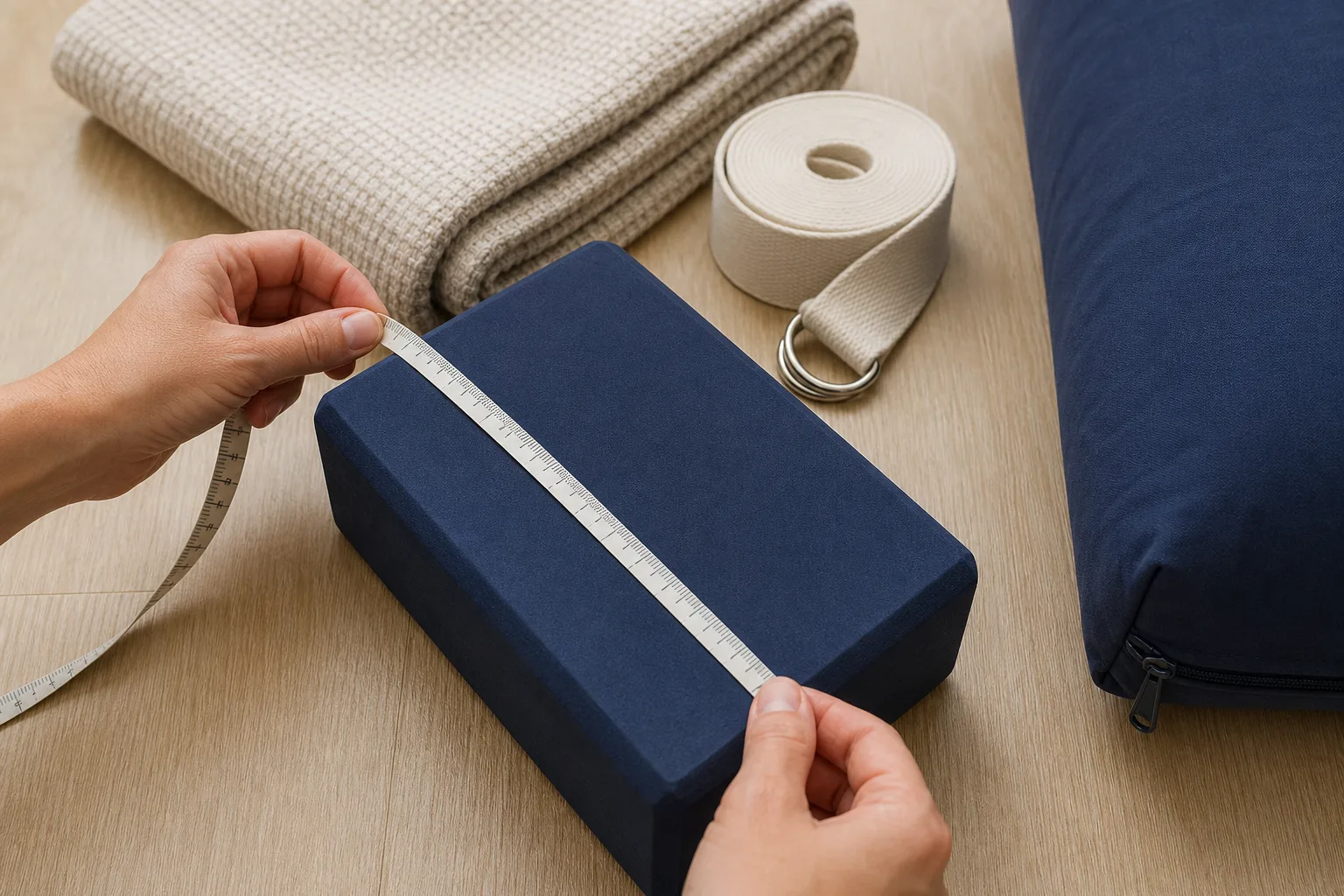
1. Read dimensions item by item
“Full size” and “standard” are marketing labels unless measurements accompany them. Record the three block dimensions, strap length and width, blanket length and width, and bolster length, width, height or diameter. Convert metric and imperial values before comparing.
2. Check materials as constructions, not virtues
EVA foam can be light or dense. Cork can vary in granulation and binder. Cotton webbing can differ in width and weave. A cotton bolster cover says nothing about the inner fill. Ask what each functional layer is made from.
Environmental language also needs evidence. “Natural,” “eco” and “sustainable” are not material specifications. Look for an exact recycled-content percentage, named certification, fiber composition, country of manufacture and realistic end-of-life information. Do not treat plant origin as proof of low impact.
3. Inspect closure and seams
On straps, check buckle edges, bar alignment and webbing stitching. On bolsters and sandbags, identify the outer closure and whether there is a separate inner liner. On blankets, inspect bound edges, fringe and loose yarn. A failure at the closure can change the function of the entire prop.
4. Check care before color
Shared or frequent-use props need a care method you will actually follow. Manduka directs users to wipe its closed-cell foam block rather than submerge or machine-wash it. Its current cotton-rich blanket requires cold separate washing and hang drying. Hugger Mugger specifies spot or dry cleaning for its Standard Bolster and does not recommend removing the tightly fitted cover.
A matching set can therefore contain four incompatible cleaning routines. Read every label before the first use and keep the instructions; a single “wipe all equipment with spray” rule may conflict with the maker’s guidance.
5. Calculate storage volume
Two blocks can stack. A strap coils into a drawer. A blanket folds but may still be bulky. A bolster retains almost all its volume. Measure the shelf, basket or wall system before ordering a large set.
Do not compress foam under heavy objects or store textiles damp. Keep props away from heat, prolonged direct sun and conditions the maker excludes. Our yoga mat rack guide covers wall and rack systems for mats; it does not imply that the same hardware safely stores heavy bolsters or blocks.
For a measured whole-collection plan, use the yoga equipment storage guide. It separates mat bays, rigid block shelves, textile airflow, bolster volume and small-item zones without duplicating the individual prop-buying guides.
Specialist props: buy only for a named use
Specialist does not mean advanced or superior. It means the tool changes a narrower variable.
Yoga wedge
A yoga wedge is a low ramp that changes contact angle. Compare rise and length together; a taller edge does not describe the slope by itself. Never balance a rectangular block diagonally to imitate a wedge.
Yoga sandbag
A yoga sandbag is a contained external load. Filled weight, inner liner, closure and handle matter. It is not interchangeable with loose plates, dumbbells or a bag of unsecured household material.
Yoga wheel
A yoga wheel creates a curved rolling contact surface. Check diameter, width, core, exterior padding, seam and the maker’s stated load language. It should enter practice through appropriate instruction, not because it looks like a larger block.
Knee pads and wedges
A small pad adds local cushioning; a wedge changes an angle. Neither automatically addresses pain, injury or a medical condition. Persistent, sharp, worsening or unexplained discomfort needs qualified assessment, not a shopping recommendation.
Inversion equipment
A headstand bench has a frame, opening, cushion and floor contacts. Product selection cannot teach inversion technique or establish that inversion is appropriate for a particular person. Treat it as specialist equipment and use qualified instruction.
Care and replacement checklist
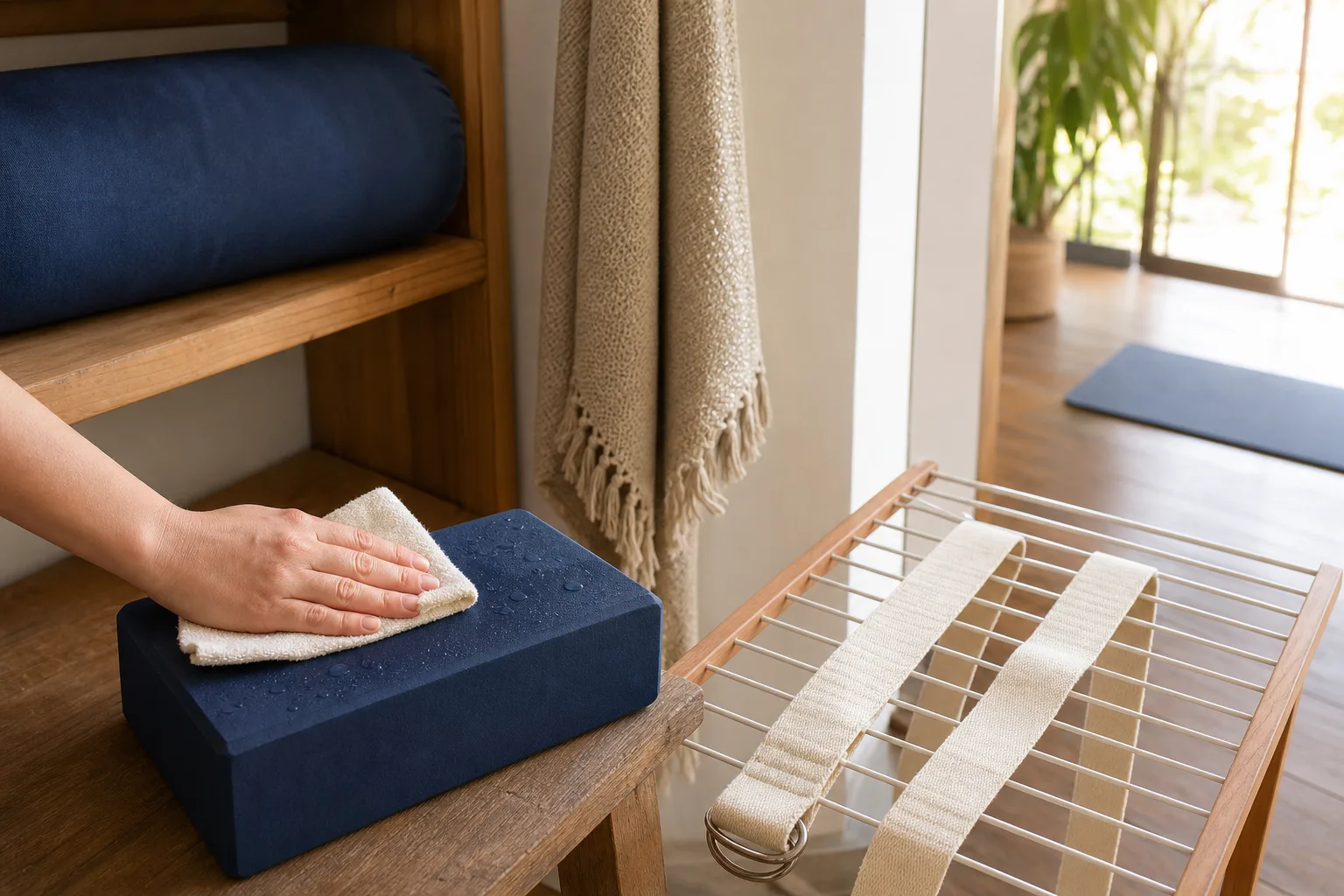
Inspect shared and personal props under good light. A cosmetic scuff is different from a structural defect.
- Blocks: look for deep compression, cracking, crumbling, warped faces or contamination that normal approved cleaning cannot remove.
- Straps: inspect the full webbing length, both edges, buckle, bar and every load-bearing stitch. Retire a strap with a damaged closure or significant fraying.
- Blankets: check seams, fringe, thin patches, odors and whether the blanket still holds an even fold after laundering.
- Bolsters: inspect cover seams, handles, zipper, liner and whether the insert has become markedly uneven or lost its intended shape.
- Wheels and benches: follow the maker’s inspection points for the frame, joints, fasteners, padding and floor contacts. Stop using equipment that cracks, loosens or deforms.
- Sandbags: check outer cover, liner and closure for leakage before moving the bag.
Never mix cleaning chemicals, saturate foam or machine-wash an item unless the product instructions allow it. Dry every component fully before enclosed storage. When a care label conflicts with a generic online guide, the item-specific maker instruction wins.
What to buy—and what to skip
Buy a prop when all four statements are true:
- A class, teacher or established personal routine repeatedly calls for its function.
- You know the dimensions and construction that fit that use.
- You have a safe storage and care plan.
- The prop adds a function your existing equipment does not already provide.
Skip or postpone it when the product is justified only by a wellness claim, the dimensions are missing, a household stand-in already works, or the object requires instruction you do not yet have.
For most beginners, that decision produces a modest kit: two matched blocks, one suitable strap and perhaps one foldable blanket. It leaves room to add a bolster or specialist tool after practice—not marketing—proves the need.
Bottom line
Yoga props are not trophies, shortcuts or a required collection. They are purpose-built ways to change height, reach, surface, cushioning, warmth or support. Choose the missing function first, then verify geometry, construction, care and storage.
Start small. Borrow when possible. Buy matched blocks and a dependable strap before specialist equipment, add a blanket when your class uses one, and choose a bolster only for a routine that benefits from broad firm support. The best yoga prop set is the one whose every component has a clear job.
Frequently asked questions
What are the essential yoga props for beginners?
For most beginners, two stable blocks and one non-elastic yoga strap form the most versatile starter set. Add a firm, foldable blanket if your class regularly calls for padding or adjustable height. A bolster is more relevant for restorative or yin practice and does not need to be the first purchase.
Do I need yoga props to start yoga?
Not necessarily. Many studios supply the props used in class, and a teacher may not call for any beyond a mat. Attend a few classes or preview the equipment list before buying. Props should answer a recurring need in your actual practice, not a generic checklist.
Is using yoga props cheating?
No. A prop changes distance, height, contact area, cushioning or feedback. It is equipment, not a measure of ability. The useful question is whether the prop creates the setup requested by your teacher and remains stable for that purpose.
Can household items replace yoga props?
Sometimes. A firm stack of identical hardback books may provide block-like height, a non-elastic belt can extend reach, and a dense folded blanket can provide padding. Household substitutes must be stable, intact and appropriately sized; soft pillows and stretch bands do not behave like firm bolsters and fixed-length straps.
Should I buy a yoga prop set?
Only if every included item matches your needs. Check block dimensions and material, strap length and buckle, blanket fiber and wash instructions, and bolster shape and firmness separately. A discounted bundle is poor value when one or more pieces are undersized, redundant or difficult to store.