

How this page has changed
July 26, 2026
Sources, internal links and safety or product context reviewed.
In this guide
- 01Current yoga mat racks compared
- 02Quick decision
- 03Three rack formats
- 04Eyelet compatibility
- 05Rolled-mat fit and capacity
- 06Projection and room clearance
- 07Wall type and mounting disclosure
- 08Capacity is more than a number
- 09Storage versus drying
- 10Inspection and retirement
- 11Materials and care
- 12Buying checklist
- 13How this guide was researched
A yoga mat rack can mean three different products: two posts for mats with eyelets, a bar for mats that hang open, or a cradle for rolled mats. Buying the wrong interface creates an unusable rack even when its advertised capacity looks generous.
Choose by mat format, dimensions, weight, rack projection, capacity definition, wall construction, hardware and inspection access. Do not punch eyelets into a conventional mat, overload a bar with thick rolls or assume included anchors suit every wall.
This is a source-checked product guide, not structural installation advice.
Need to coordinate mats with blocks, blankets, bolsters and straps? The yoga equipment storage guide owns whole-collection inventory, compartment planning, drying separation and mixed storage systems. This page retains the mat-rack interface, capacity and mounting decision.
Current yoga mat racks compared
| Current product | Rack format | Published size | Published capacity | Mounting disclosure |
|---|---|---|---|---|
| Manduka Wall Mat Rack | Two fixed posts for eyelet mats | 23 W × 8 H × 0.25 D in backplate; 8-in posts | Up to 10 compatible mats | Plaster or brick; installation hardware included |
| Life Fitness Adjustable Wall Mounted Mat Rack | Two adjustable posts for eyelet mats | 26 × 2.5 in | Up to 12 hanging mats | Mount to studs; hardware not included |
| Strencor Wall Mounted Rack | Two fixed hangers for eyelet mats | 24.5-in overall plate; 20-in hanger spacing | 10+ hangable mats | Two mounting screws included; wall substrate not detailed on page |
| Power Systems Wall-Mounted Mat Rack | Wide steel drape bar | 50 × 7 × 2 in listed by maker copy | Up to 60 thin mats | Mounting holes on 12-in centers; hardware not included |
| Iron American brackets | Paired upward-tilted wall brackets | Each bracket 1.5 W × 2 H × 6.6 D in | Up to eight 1.5-in-thick mats claimed | Screws, washers and anchors included; product references studs |
| Real Motion Solo rack | Steel wall cradle/channel | 500 × 250 × 196 mm | Mats and foam rollers; number not stated | Fixings included; maker recommends a solid structural wall |
These are published values, not our measurements or installation findings. Capacity language is not normalized. “Ten mats” on 8-inch posts, “60 thin mats” over a wide bar and “eight 1.5-inch mats” on brackets describe different orientations and assumptions.
Quick decision
| Your mat | Suitable rack type | Critical check |
|---|---|---|
| Flat mat with two factory eyelets | Fixed or adjustable two-post rack | Center spacing, eyelet diameter and post length |
| Mat intended to hang open | Drape bar | Bar width, bend radius and wet-load allowance |
| Conventional rolled yoga mat | Cradle or paired brackets | Roll diameter, support depth and side restraint |
| Thick exercise mat or foam roller | Deep cradle/channel | Maximum diameter, width and weight |
| Mixed studio inventory | Segregated rack system | Capacity by actual mat type, not total piece count |
If your current mat has no reinforced eyelets, eliminate post racks immediately. If it must stay unrolled after cleaning, eliminate a tight rolled-mat cradle. The interface decision is more useful than comparing finish colors.
Three rack formats
The live product SERP mixes visually different systems. Sorting by load interface prevents most buying mistakes.
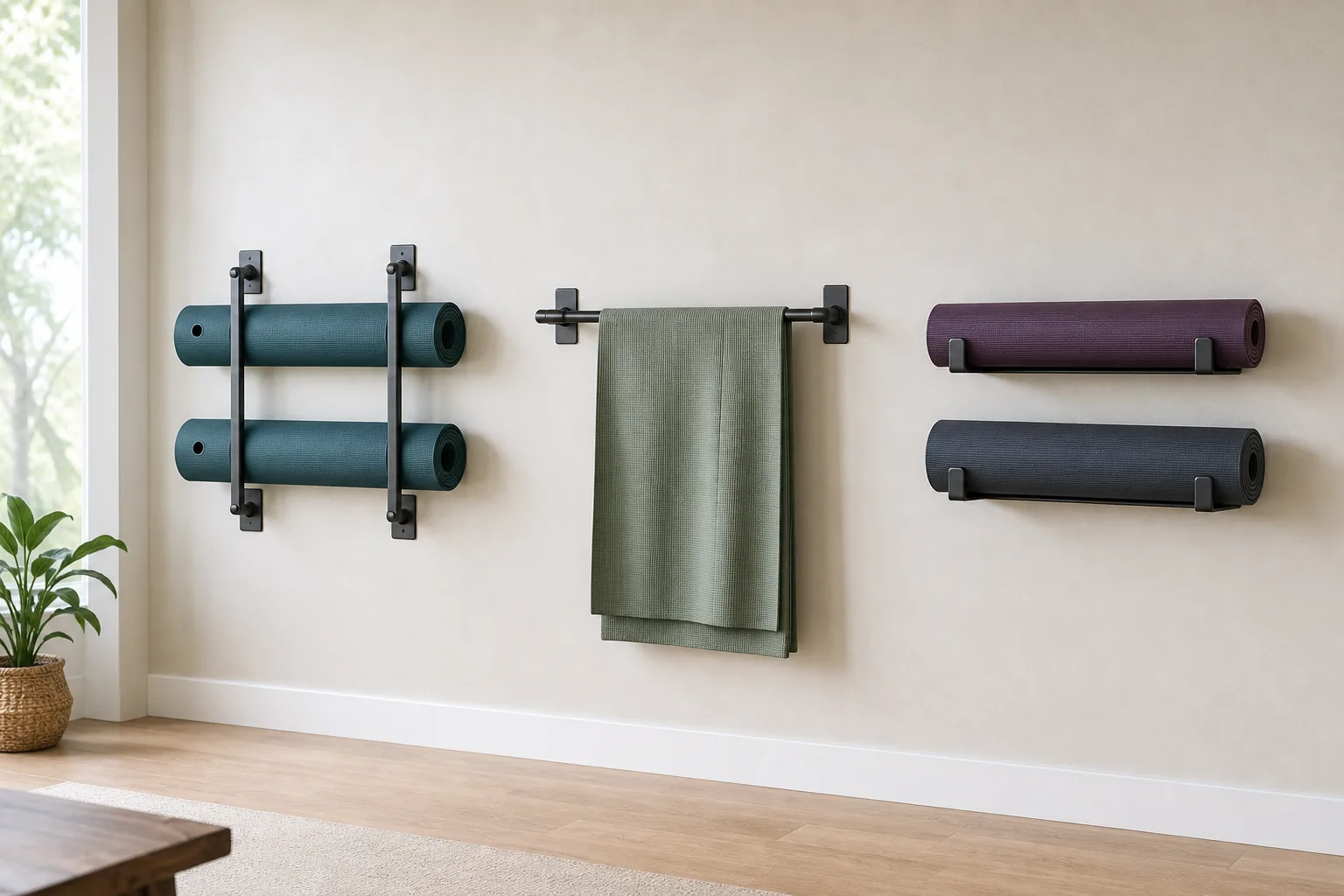
Eyelet-post racks
Manduka, Life Fitness and Strencor sell a backplate with two projecting posts or hangers. Mats slide over the posts through factory-installed grommets. This is common in studios because several flat mats can occupy little wall width.
The system is only compatible when both eyelets align. Manduka publishes 20 inches center-to-center, while Strencor also lists 20-inch hanger spacing. Life Fitness says its prongs adjust to mats with eyelets up to 23 inches wide. “Adjustable” does not mean unlimited; verify the usable center range and how the posts lock.
Post length sets a physical upper bound. Manduka’s posts extend 8 inches from the wall. Ten very thin mats may fit where fewer dense or padded mats do. The outermost mat must remain fully engaged with the post ends according to the manual.
Drape bars
Power Systems uses a broad 50-inch steel bar and claims capacity for up to 60 thin mats. Maker copy says the width allows two mats side by side. This is a commercial-scale arrangement, not evidence that 60 ordinary rolled yoga mats fit on one rail.
A drape bar supports each mat at a fold. Compare rail diameter and finish so the bend is not sharp or abrasive. Confirm whether the mat manufacturer permits hanging over a bar, especially for natural-rubber, cork-faced, multilayer or permanently creased materials.
Draping exposes more surface area than rolling, which can support drying. It is still not a drying claim unless the rack maker documents wet-load capacity, spacing and ventilation. Wet mats weigh more and can transfer moisture to the wall or adjacent mats.
Rolled-mat cradles and brackets
Iron American uses paired brackets with a stated 15-degree upward tilt. Real Motion’s Solo design is a steel channel made for mats or foam rollers up to an oversized format. Other home racks use wood hooks, shelves or vertical cubbies.
This format works with ordinary mats because it supports the roll rather than requiring eyelets. The important numbers are bracket projection, gap between supports, roll diameter, roll length, side restraint and total load.
A shallow bracket can let a large roll escape. A deep channel can store a thick mat but project far into the room. Measure the complete loaded envelope, not only the empty rack.
Eyelet compatibility
An eyelet system needs four compatible measurements: center spacing, inner eyelet diameter, post diameter and usable post length. Product pages often publish only one or two.
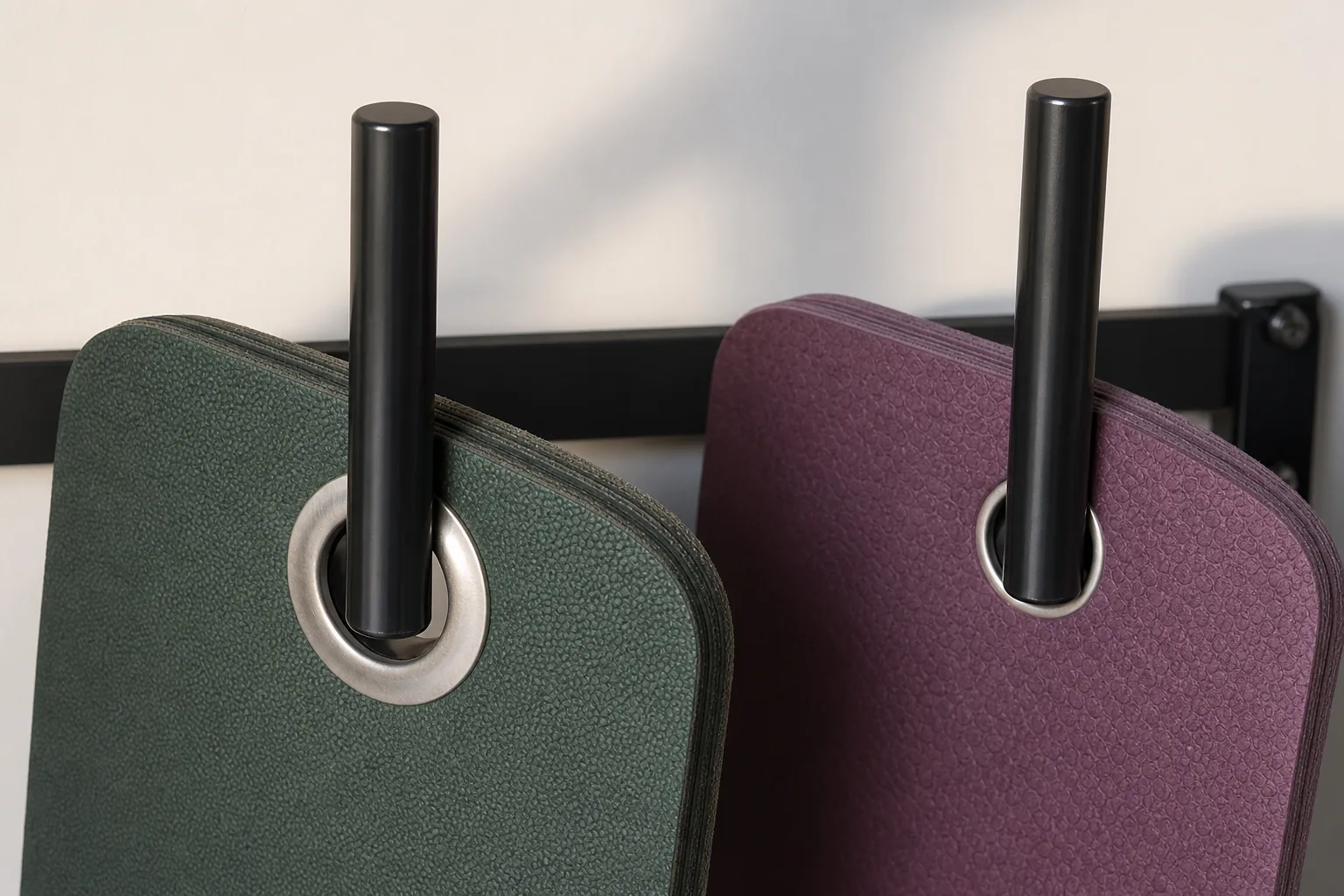
Center spacing
Measure from the center of one eyelet to the center of the other, not from inner edge to inner edge. Manduka’s 20-inch post spacing is explicitly center-to-center. A small error across two rigid posts can make the mat impossible to load or force the eyelets sideways.
Opening and post diameter
The post must pass through the eyelet with enough clearance for loading but not so much that the ring can catch behind a sharp shoulder. Look for a smooth, capped end and no exposed threads. If post diameter is missing, request it before ordering.
Eyelet construction
Factory eyelets should compress a reinforced area designed for hanging. Do not add hardware to a standard mat. A new hole removes material, creates a stress concentration and may expose layers or void the warranty.
Inspect eyelets for rotation, sharp burrs, corrosion, tearing and separation from the surrounding mat. Retire the hanging method when the reinforcement loosens; do not wait for the mat to drop.
Post length and stack depth
Capacity is a stack-depth problem. Ten mats at a compressed hanging thickness of 0.5 inch occupy about 5 inches; ten at 0.9 inch occupy 9 inches before any clearance. Published nominal mat thickness does not equal hanging thickness at an eyelet, where reinforcement adds layers.
Count only mats that sit fully on both posts without compressing against a wall, covering the retaining end or bowing the backplate. The manufacturer’s lower limit always overrides a calculation.
Rolled-mat fit and capacity
Rolled diameter depends on mat thickness, length, material stiffness, roll tightness and whether the mat has memory. Two 5 mm mats can form different cylinders.
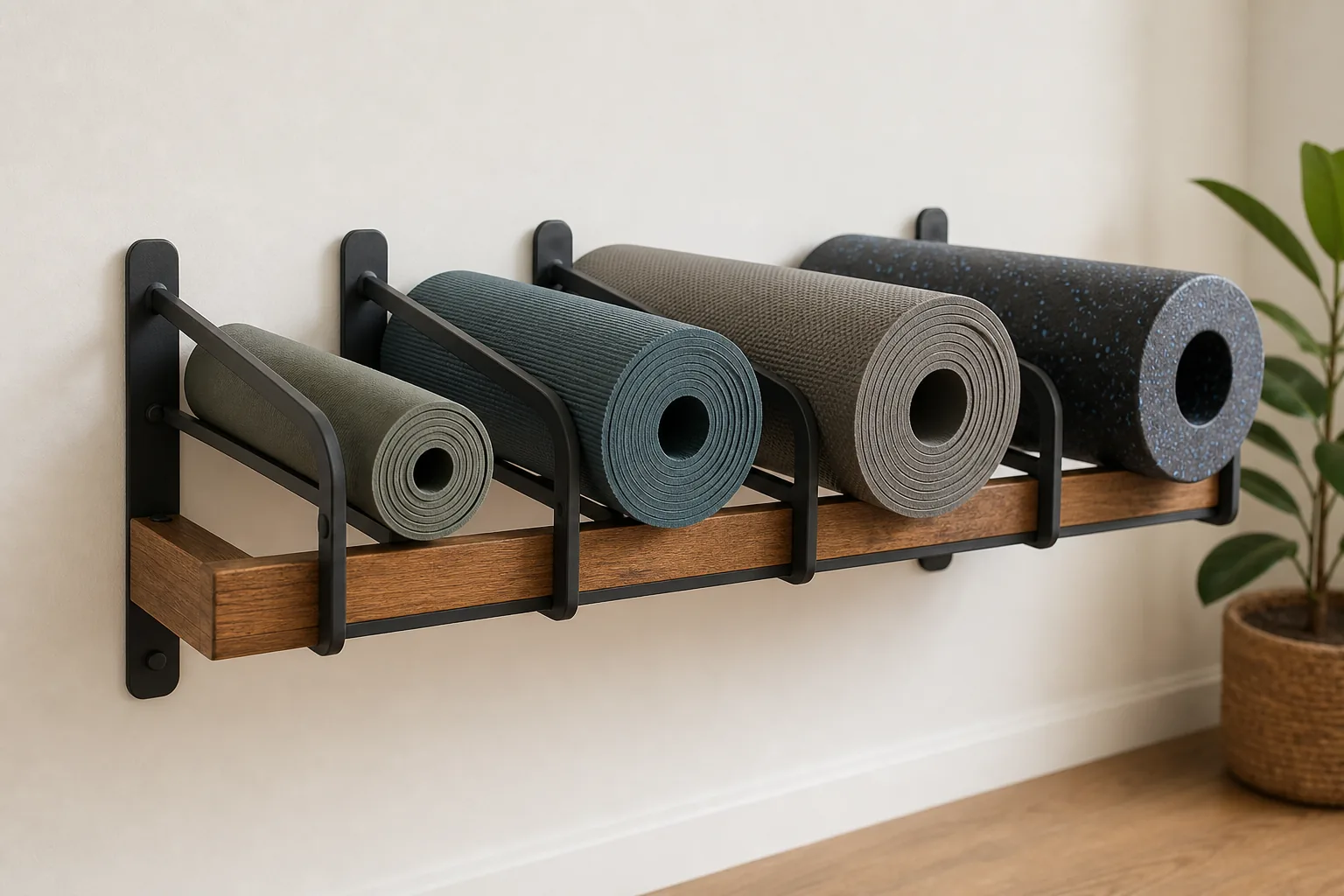
Measure your mat in its normal stored roll without forcing it tighter. Record:
- outside diameter at the widest point;
- total roll length, including any protruding strap;
- weight of the clean, dry mat;
- tendency to expand after the strap is removed;
- any maker restriction on rolled versus flat storage.
Iron American says its paired brackets can hold up to eight standard 1.5-inch-thick yoga mats, but “1.5-inch-thick” appears to describe stored equipment in its marketing and is ambiguous for conventional yoga-mat sheet thickness. Use the bracket’s published 6.6-inch depth and the actual product manual rather than extrapolating from that phrase.
Real Motion publishes a 196 mm channel dimension and says the Solo rack accommodates oversized mats and foam rollers. That still does not identify the maximum permitted roll diameter or item count. The clear internal dimension matters more than the overall metal size.
Do not stack a small roll behind a large one where removing the front mat can release the rear item. Each roll should be independently retained or follow the maker’s documented stacking arrangement.
Projection and room clearance
Wall storage saves floor area but moves equipment into the room. Manduka’s posts project 8 inches; Iron American’s brackets are 6.6 inches deep; the Real Motion rack is approximately 196 mm, or 7.7 inches, in its channel dimension. A loaded roll can extend farther.
Check:
- Empty rack projection from finished wall.
- Loaded projection of the largest mat or roller.
- Head and shoulder clearance along walking routes.
- Clearance from doors, curtains, switches, outlets and heaters.
- Removal path without striking ceiling, furniture or another mat.
- Minimum height needed to keep mats above dust, pets or moisture.
Avoid mounting projecting posts at face height in a circulation path. End caps and high-visibility placement reduce—but do not eliminate—impact risk. Commercial spaces may have accessibility, egress and local-code requirements that need professional review.
Wall type and mounting disclosure
The rack and its fasteners are one system. Product pages differ materially:
- Manduka says its rack is for secure mounting to plaster or brick and includes hardware.
- Life Fitness says to mount easily to studs and does not include hardware.
- Strencor includes two screws but does not identify the substrate in the short specification checked.
- Power Systems publishes 12-inch mounting-hole centers and excludes hardware.
- Real Motion includes fixings but recommends a solid structural wall and professional help when uncertain.
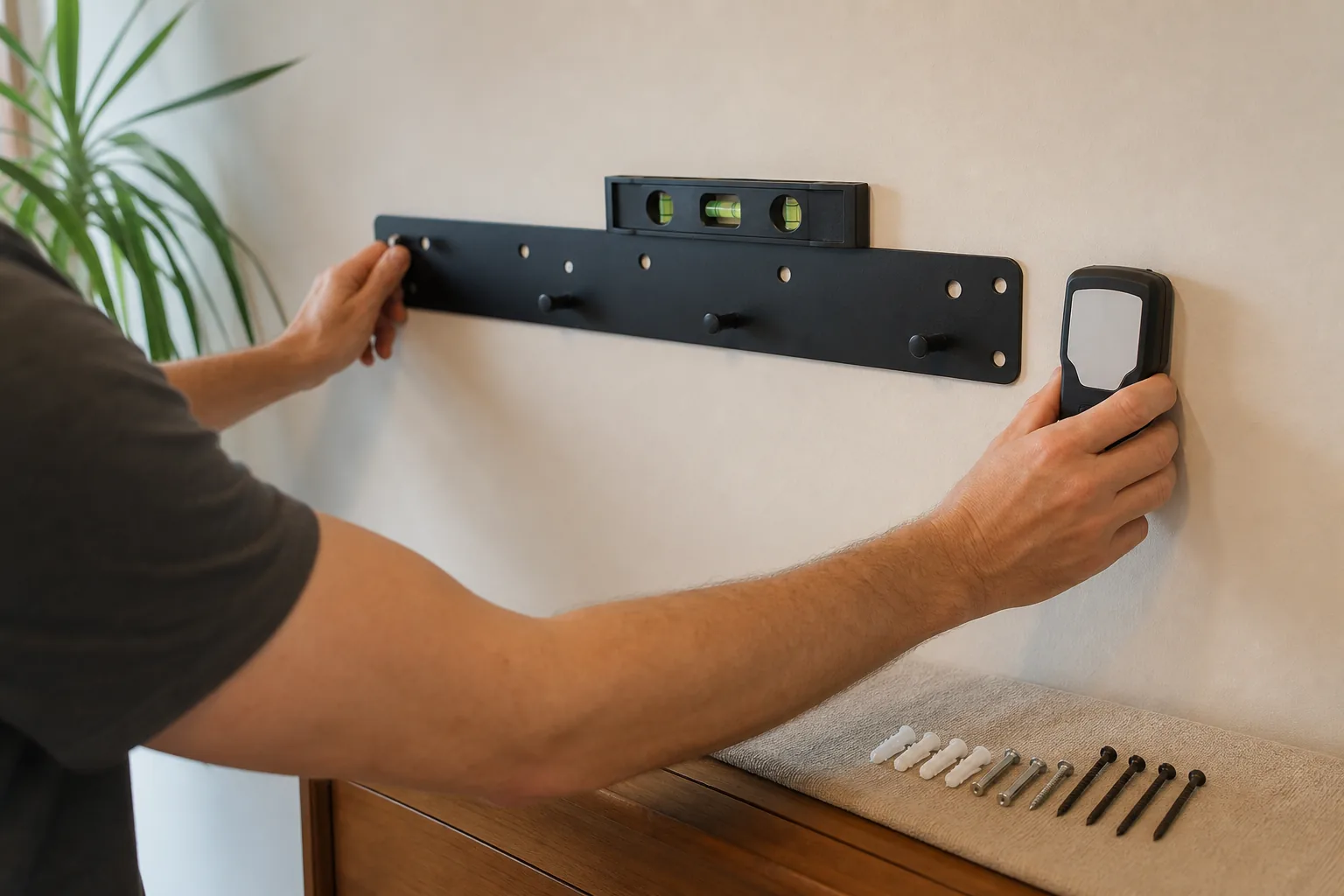
Drywall, plaster, brick, concrete, block, tile and framed walls require different assessments. Surface appearance can hide studs, furring, pipes and cables. Do not choose an anchor solely by the color or size shown in a product photograph.
Use a qualified installer when wall construction, services, load path or local requirements are uncertain. The installer should have the current rack manual, mat inventory and expected total load. A secure empty rack is not proof of a secure fully loaded rack.
Never mount into furniture, a door, trim, decorative panel or unknown partition unless the manufacturer and a qualified professional approve that structure. Do not combine random fasteners to “add strength”; mixed hardware can load the backplate unevenly.
Capacity is more than a number
Capacity claims use different units:
- number of compatible eyelet mats;
- number of “thin” draped mats;
- number of rolled mats at an assumed diameter;
- total weight capacity;
- linear inches of post or bar space.
Home Depot’s current Power Systems listing includes a 400 lb total weight field, while the maker copy emphasizes up to 60 thin mats. That database value should not be treated as permission to hang 400 lb without confirming the manufacturer’s current installation manual, wall requirements and model identity.
Build an inventory table before selecting a rack:
| Inventory field | Why record it |
|---|---|
| Mat model and material | Determines storage restrictions and surface sensitivity |
| Dry weight | Establishes base static load |
| Wet weight if hanging to dry | Can be materially higher |
| Eyelet spacing and diameter | Determines post compatibility |
| Rolled diameter and length | Determines cradle fit and projection |
| Quantity at peak use | Prevents capacity based on an average day |
Add only products the rack explicitly supports. Blocks, straps, dumbbells and towels can change leverage and fall behavior even when hooks appear available.
Storage versus drying
A rack can keep mats off the floor without making them dry. Rolled layers restrict airflow and can trap moisture. Closely stacked eyelet mats can touch. A draped mat exposes more surface but may place a persistent bend in one area.
After cleaning, follow the mat maker’s drying instructions first. Some mats should dry flat, some can hang, and some natural-rubber products should avoid direct sunlight or heat. The rack maker cannot override the mat’s material care.
For shared inventory, keep clean and used mats separated. Do not return a damp mat to a dense stack. Leave enough spacing for inspection, and clean the rack itself with a product approved for its metal, wood, coating and wall finish.
Our yoga mat storage guide owns the broader decision about rolling direction, environment and long-term mat care. This page owns the rack purchase: interface, measurements, wall load and capacity.
Inspection and retirement
Inspect a new rack after installation, after the first loaded period and at the schedule in its manual. Shared studios need more frequent checks because inventory and loading change.
Look for:
- a backplate lifting from the wall or a widening perimeter gap;
- loose fasteners, cracked plaster, crushed drywall or masonry dust;
- a bent post, bar or bracket;
- cracked welds, flaking coating, rust or sharp edges;
- loose end caps or retaining features;
- wood splits, delamination or a hook pulling from its base;
- eyelets tearing or deforming around the posts;
- mats contacting the wall, floor, heater or each other unexpectedly;
- capacity labels or model information that no longer match the inventory.
Unload the rack immediately if it moves, tilts, creaks, sheds wall material or shows a structural defect. Do not tighten an anchor repeatedly into a damaged hole and assume capacity is restored. A qualified installer should determine whether the wall, fastener or rack needs repair or replacement.
Retire bent components, cracked welds and deformed backplates unless the manufacturer supplies an approved replacement procedure. Do not drill extra holes or weld extensions; that changes the tested or intended structure.
Materials and care
Manduka uses anodized aluminum. Power Systems, Iron American and Real Motion specify steel, with black or powder-coated finishes. Wood cradles are common in the broader market but require product-specific species, finish and hardware disclosures.
Aluminum reduces rack weight and resists red rust, but can still scratch, bend or develop corrosion around incompatible metals. Powder-coated steel protects the surface only while the coating remains intact. Wood can split around fasteners or change with humidity.
Dust empty surfaces with a soft cloth. Use only a maker-approved cleaner and dry all contact areas. Avoid saturating wall seams, wooden brackets or anchor holes. Inspect coating damage before returning mats because rough metal can abrade a mat edge.
Keep essential oils, strong disinfectants and solvent away unless both rack and mat makers approve them. A residue safe for a metal bar may transfer to and damage a mat.
Buying checklist
Before ordering, verify:
- Rack format: eyelet posts, drape bar or rolled-mat cradle.
- Mat permission: the mat maker allows that storage orientation.
- Compatibility: post spacing and diameter, or maximum roll diameter.
- Capacity: defined for the actual mat type and quantity.
- Load: current manufacturer rating plus real dry or wet inventory weight.
- Projection: empty and loaded depth outside circulation routes.
- Wall: permitted substrate and known structural support.
- Hardware: included or installer-selected for the actual wall.
- Hole pattern: compatible with studs, masonry or specified anchors.
- Ends and edges: capped posts, smooth bars and nonabrasive cradles.
- Drying: documented airflow and wet-load use if required.
- Inspection: every fastener and mat interface remains visible.
- Replacement parts: caps, posts, brackets and hardware are obtainable.
- Installation: qualified professional when structure or services are uncertain.
For one or two conventional rolled mats, a shallow cradle with published internal depth is usually easier to match than an eyelet rack. For a studio inventory already built around factory-grommeted mats, a post system with matching center spacing provides compact storage. Choose a drape bar only when the mat material permits the bend and the wall system is rated for the complete hanging load.
How this guide was researched
We compared current specifications from Manduka, Life Fitness, Strencor, Power Systems, Iron American and Real Motion. We preserved incompatible capacity definitions and missing dimensions instead of inventing a universal rack standard. No rack was hands-on tested, and no installation or capacity claim was independently verified.
This URL owns yoga-mat-rack selection, compatibility, capacity and inspection. It excludes DIY structural instructions and keeps general mat-storage care on the existing storage page, preventing two URLs from competing for the same reader job.
Frequently asked questions
What type of yoga mat rack should I buy?
Choose the rack from the mat interface. Eyelet-post racks require mats with compatible reinforced holes. Drape bars hold mats open over a rail. Cradles or brackets support rolled mats by diameter. These formats are not interchangeable.
Can any yoga mat hang on a two-post rack?
No. A two-post rack requires two reinforced eyelets whose spacing, opening diameter and edge clearance match the posts. Do not punch holes into an ordinary mat; that changes the mat and can create tears.
How many mats can a wall rack hold?
Published examples range from three rolled mats to 60 thin draped mats. Capacity depends on mat thickness, roll diameter, eyelet construction, post length, bar width and the wall installation. Use the maker’s exact limit rather than counting photographs.
Can I mount a yoga mat rack on drywall?
Only when the rack maker permits that wall construction and a qualified installer selects fasteners for the actual substrate and expected load. Some products require studs or a solid structural wall; others specify plaster or brick. Universal anchors are not universal solutions.
Is a yoga mat drying rack the same as a storage rack?
Not necessarily. A storage cradle can trap moisture between rolled layers, while a drape bar can expose more surface area. A product should only be called a drying rack when the maker documents airflow, wet-load capacity and the permitted mat arrangement.