

How this page has changed
July 27, 2026
Sources, internal links and safety or product context reviewed.
In this guide
- 01Storage formats at a glance
- 02Inventory first, furniture second
- 03Measure usable space, not the room impression
- 04Mats: diameter, width and support
- 05Blocks: rigid shelves and predictable pairs
- 06Blankets and towels: volume plus airflow
- 07Bolsters: protect shape and cover access
- 08Straps and small accessories
- 09Open rack, cabinet or mixed system?
- 10Drying is separate from storage
- 11Floor stability and tip risk
- 12Wall-mounted storage
- 13Capacity calculations that stay useful
- 14Home versus studio requirements
- 15Delivery and assembly inspection
- 16Maintenance and periodic audit
- 17Compare cost without buying decoration twice
- 18Red flags
- 19A practical planning sequence
Yoga equipment storage is a capacity problem before it is a furniture problem. Rolled mats are tall cylinders, blocks are rigid rectangles, blankets need breathable shelf space, bolsters occupy large volumes, and straps disappear unless they have a small-item zone. One beautiful basket rarely handles all five well.
Build the storage plan from the equipment outward. Count every item, measure it in the orientation in which it will be stored, separate damp from dry gear, and leave enough hand clearance to remove one object without unloading everything else. Then choose open shelving, a floor rack, a cabinet, wall storage or a mixed system.
This page owns whole-collection planning. Our yoga mat rack guide compares dedicated mat racks and their capacity, while how to store a yoga mat covers mat condition, rolling and environment. This guide coordinates mats with blocks, blankets, bolsters, straps and smaller accessories. It does not provide construction drawings or replace a rack manufacturer’s installation instructions.
Storage formats at a glance
| Format | Handles best | Main constraint | Measure before buying |
|---|---|---|---|
| Open floor basket | A few rolled mats or foam rollers | Limited separation and side support | Internal diameter, height and opening |
| Freestanding open rack | Mixed mats, blocks and folded textiles | Floor footprint and tipping resistance | Overall size, bay dimensions and load ratings |
| Cubby shelf | Blocks, blankets and small bolsters | Fixed compartments waste irregular space | Clear internal width, height and depth |
| Closed cabinet | Clean, dry items and visual concealment | Airflow, door swing and interior depth | Usable interior—not external dimensions |
| Wall rail or shelf | Straps, light accessories and some mat formats | Wall structure, anchors and installation | Fastener spacing, projection and rated load |
| Modular system | Collection that may grow | Compatibility and proprietary components | Base footprint plus future modules |
| Mobile cart | Shared or multipurpose room | Wheel locks, thresholds and loaded stability | Loaded mass, wheel size and turning clearance |
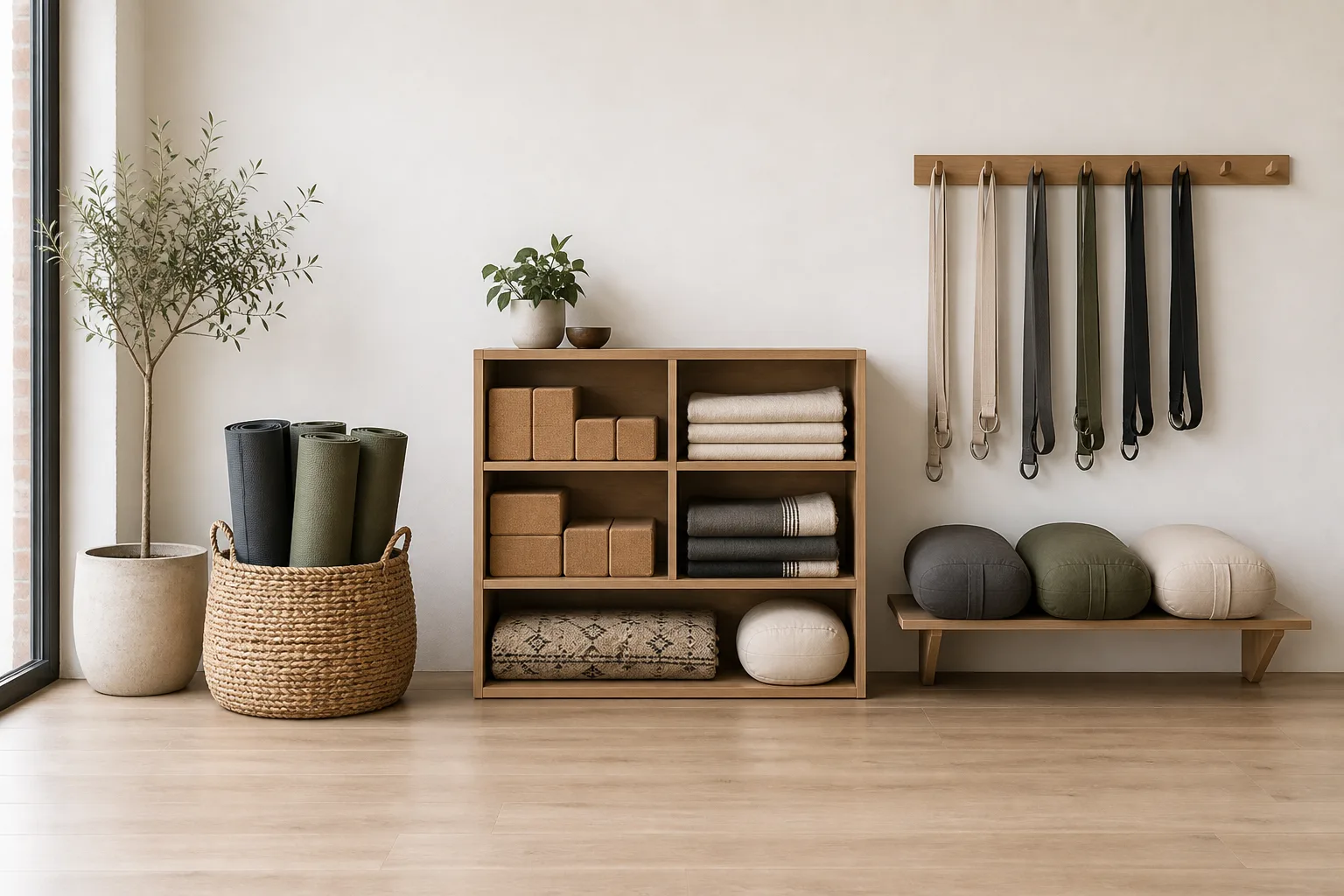
Inventory first, furniture second
Write down the collection you own now and what is likely to be added in the next year. Include items that migrate elsewhere after use: towels in the laundry, a mat left in the car, blocks borrowed by another room and straps inside a carry bag.
Use a simple inventory table:
| Item | Count | Stored orientation | Measurement set | Condition rule |
|---|---|---|---|---|
| Rolled mat | Each | Upright or horizontal | Roll diameter × mat width | Clean and fully dry |
| Block | Each or pair | Flat, stacked | Length × width × height | Dry, faces unobstructed |
| Blanket | Each | Loosely folded | Folded width × depth × height | Laundered and dry |
| Bolster | Each | Horizontal | Length × maximum diameter/height | Uncompressed, dry cover |
| Strap | Each | Coiled or hung | Coil diameter or hanging length | Buckle protected |
| Towel | Each | Folded after laundering | Folded volume | Never stored damp |
| Small accessories | Grouped | Tray or basket | Container footprint | Clean and identifiable |
Count pairs as separate physical objects. Two blocks need more shelf width when placed side by side than when stacked, and the preferred arrangement affects access. A product claiming “block storage” may hold one narrow block rather than a full-size pair.
Measure usable space, not the room impression
Storage listings emphasize overall dimensions because they are easy to publish. Those numbers do not reveal the usable space after frame rails, shelf thickness, doors, lips and dividers consume part of the volume.
Record these measurements for each candidate:
- clear bay width: the narrowest horizontal opening between structural parts;
- clear bay height: shelf surface to the obstruction above;
- usable depth: front edge to back panel after doors and stops;
- opening width: especially important for bins and cabinets;
- floor footprint: including feet that extend beyond the body;
- wall projection: the furthest loaded point from the wall;
- door or drawer sweep: space needed to open without moving a mat; and
- hand clearance: room to grip and lift the largest object.
Add tolerance rather than matching an object exactly. A 24-inch-wide mat does not belong in a precisely 24-inch bay: the roll may spread, caps or straps add width, and fingers need space. Treat nominal dimensions as a starting point and verify the actual equipment.
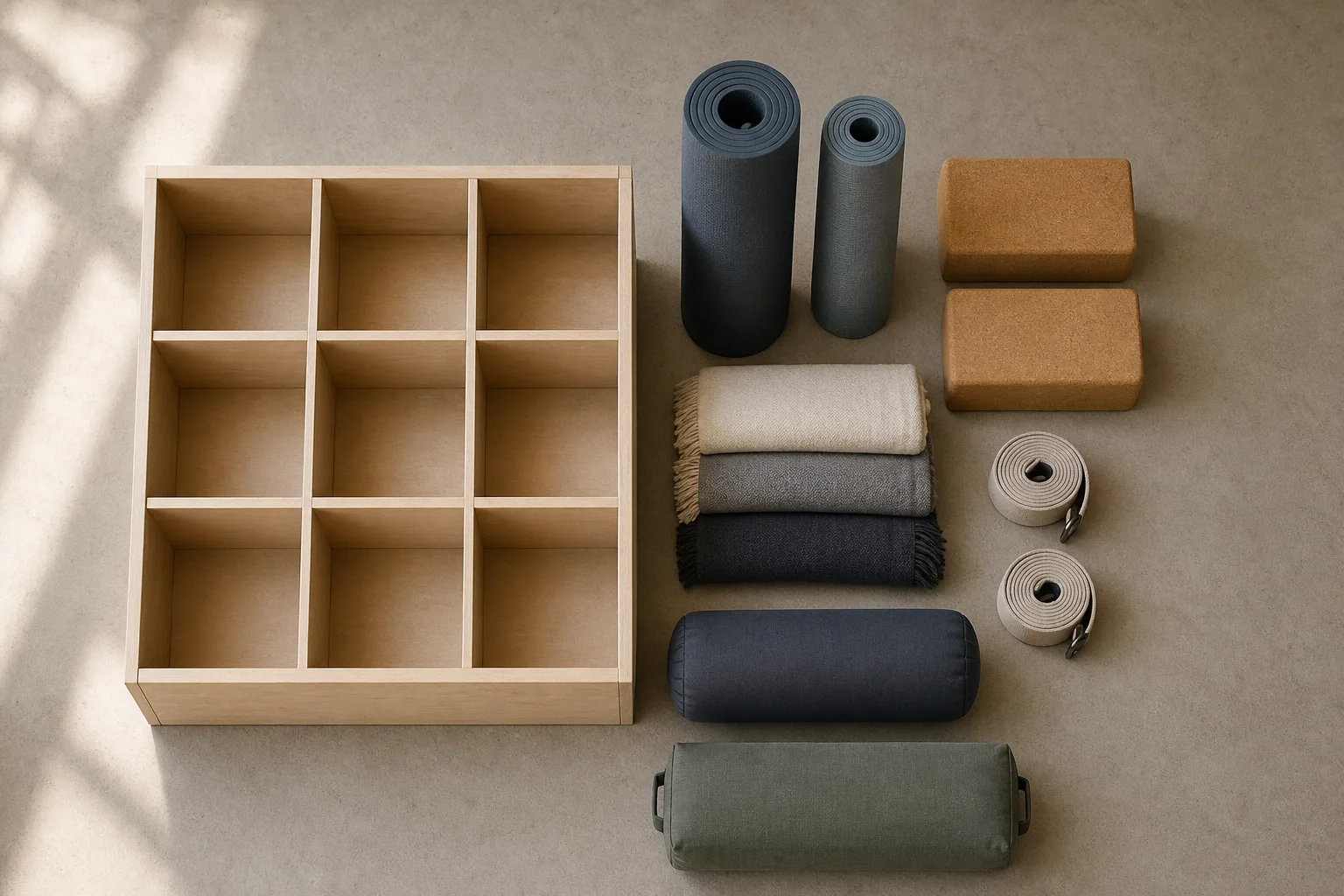
Mats: diameter, width and support
Rolled mat diameter changes dramatically with thickness, length, material stiffness and how tightly it is rolled. Never size a mat bay from a generic “standard mat” claim. Roll the mat as its maker directs, secure it without crushing, and measure the widest diameter.
For upright storage:
- support enough of the roll that it cannot lean into a sharp bend;
- keep the bottom off wet floors and cleaning residue;
- avoid squeezing several mats so tightly that removal scuffs edges;
- check that tall rolls cannot topple into a walkway; and
- leave the top visible so the correct mat can be selected.
For horizontal storage, support a rolled mat along more than one point so its weight does not concentrate on a narrow edge. A deep shelf may hide the back mat behind the front one; record whether the system is single-depth or double-depth.
Manduka’s current studio page notes that grommets can be added to certain mats for hanging storage. That is a manufacturer-specific construction choice, not permission to punch holes into any mat. Do not clamp, drill or hang a mat unless its maker supports that method.
Blocks: rigid shelves and predictable pairs
Blocks stack efficiently, but only when the shelf is flat, rigid and dry. Measure both the advertised block dimensions and the real pair. Cork, foam and wood blocks can have different weights even at similar sizes, so shelf capacity matters in larger collections.
Mache’s current block stand is designed as an add-on to a mat tube and is described as holding blocks, books and straps. Its modular approach demonstrates an important distinction: a block platform may depend on another base component. Confirm what is included, what is sold separately and whether the system stands independently.
Store frequently used pairs together. If two blocks are always retrieved at once, a single accessible shelf is more useful than scattering them across decorative cubbies. Avoid placing heavy wooden blocks above head height or on a shelf without an adequate front stop in a busy room.
Blankets and towels: volume plus airflow
Fold textiles only after they are clean and completely dry. A densely packed shelf may look efficient but reduces airflow and makes one blanket difficult to remove without disturbing the stack.
Choose one repeatable fold and measure the resulting rectangle. Consistent folding makes the capacity predictable and reveals when a shelf is being overfilled. Leave a small gap above the stack for fingers and circulation.
Separate clean yoga blankets from used towels awaiting laundry. A closed hamper may contain laundry temporarily if it is designed for that purpose, but the equipment cabinet should not become a damp holding zone. Persistent moisture and odor are signals to improve drying and laundry workflow, not to add fragrance inside the cabinet.
Bolsters: protect shape and cover access
Bolsters consume more storage volume than their simple product photos suggest. Record length and maximum diameter for cylindrical or round-ended formats; record length, width and height for rectangular formats. Include handles, piping and a slightly expanded cover.
Store a bolster horizontally on a shelf that supports its body. Do not wedge it under a low shelf or use other equipment to compress it. Compression can distort fill and makes cover seams harder to inspect. Keep the handle accessible if it is the intended retrieval point, but do not hang a heavy bolster from a handle unless the manufacturer explicitly permits it.
A removable cover needs its own workflow: the insert must have a clean temporary location while the cover is washed and dried. Our yoga bolster cover guide explains fit and laundering details.
Straps and small accessories
Straps can be hung, loosely coiled or placed in an open bin. Protect metal buckles from knocking into wood, painted surfaces or other props. Do not knot straps tightly for storage; repeated sharp folds make inspection difficult and can create permanent creases.
Use shallow, labeled-by-position zones even when there are no written labels. For example, one hook per strap or one compartment for eye pillows is easier to audit than a deep mixed basket. Small items should remain visible enough to count without emptying the container.
IKEA’s current sports-storage example combines a cabinet for towels and clothing with a pegboard for mats and resistance bands. The useful principle is separation by retrieval and ventilation—not the specific furniture brand.
Open rack, cabinet or mixed system?
Open racks
Open storage makes condition visible and allows more air movement. It is easier to see a damp mat, missing block or frayed strap. The trade-offs are dust, visual clutter and exposure to pets, sunlight and room traffic.
Namastand’s current product positions a freestanding unit for a mat, towel and exercise equipment. Yamazaki’s fitness rack targets mixed bulky items including mats and rollers. These products confirm the furniture-like commercial intent, but their marketing does not establish capacity for your exact prop set.
Closed cabinets
Cabinets hide visual clutter and can reduce dust. They also conceal leaks, odor and damp equipment. Choose a cabinet only after confirming that every item is routinely dried elsewhere. Look for ventilation gaps, removable shelves, cleanable surfaces and door clearance.
Do not store heavy loose objects where opening the door can release them. Keep denser items low and maintain a clear path to hinges and wall fixings.
Mixed systems
A mixed system is usually the most efficient: upright open bays for mats, rigid shelves for blocks and blankets, a broad shelf for bolsters, and hooks or a shallow basket for straps. Yoga Design Lab’s current Apis bundle combines a mat tube with optional block-storage hardware, illustrating how modular parts can divide functions.
Before buying a proprietary system, check whether replacement modules remain available, which components are included, and whether future pieces use the same connection standard.
Drying is separate from storage
Storage begins only after cleaning and drying. A rack is not automatically a drying rack, particularly when rolled mats touch one another or folded textiles sit against a back panel.
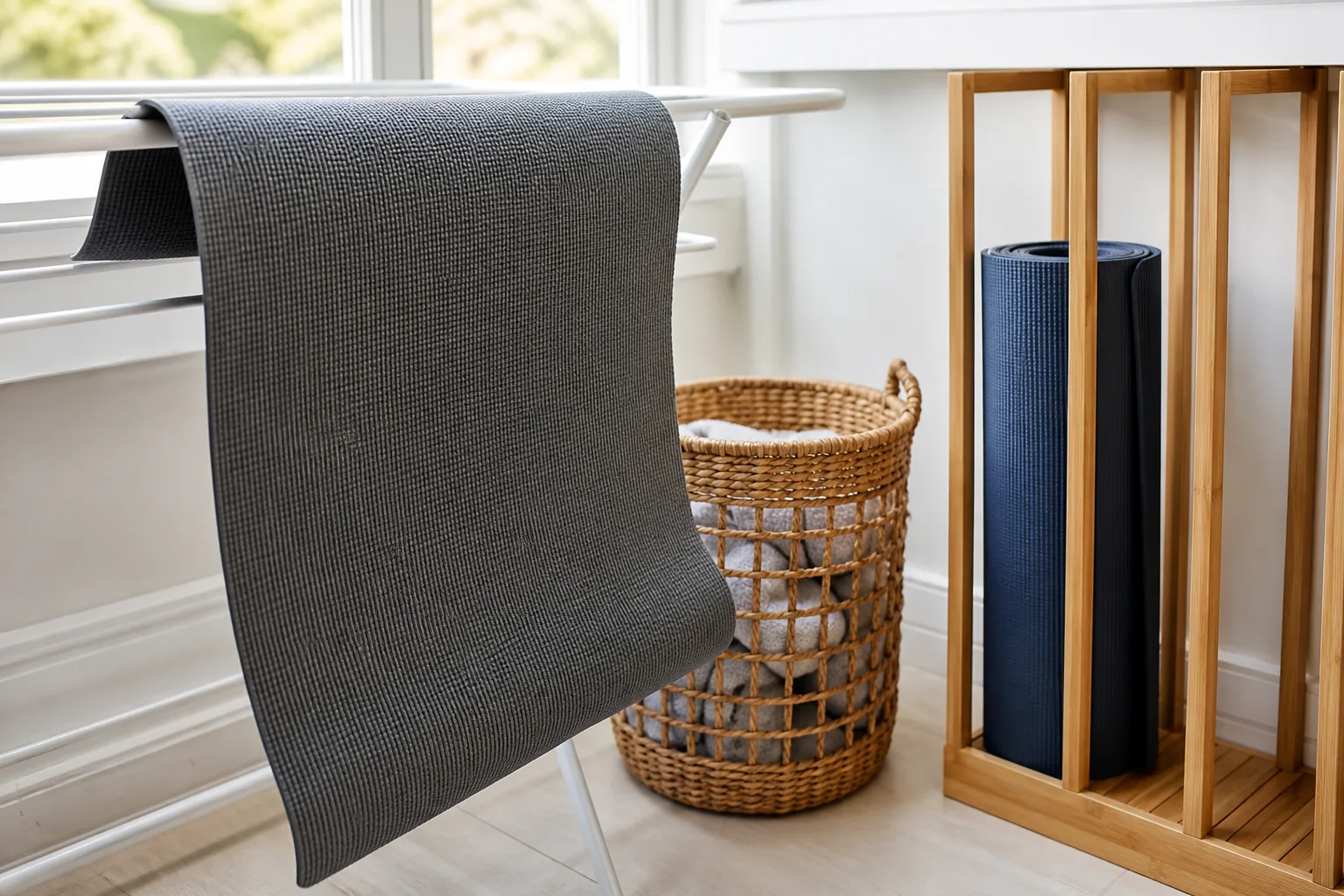
Use a two-stage flow:
- Return zone: equipment arrives from the room, studio or laundry and is inspected.
- Drying zone: damp items remain open with appropriate airflow according to their care instructions.
- Storage zone: only dry, accepted equipment returns to its assigned place.
Do not roll a damp towel inside a mat or place a wiped mat directly in a tube. Do not rely on a “breathable” basket to dry a densely rolled mat. Follow each manufacturer’s care guidance because natural rubber, cork, polyurethane, PVC, TPE and fabric-faced mats can require different methods.
Keep storage away from radiators, strong direct sun, persistent humidity and known leaks. A bright photograph beside a window is not a recommendation to expose natural rubber or dyed textiles to prolonged sunlight.
Floor stability and tip risk
Freestanding storage becomes less stable when tall items lean, heavy props sit high or drawers extend. Check the manufacturer’s anti-tip instructions and anchoring requirements. Do not improvise a wall tether or assume a heavy unit cannot tip.
Load dense items low:
- wooden or cork blocks on lower shelves;
- sandbags only on shelves rated for their full filled mass;
- light folded blankets above heavier objects;
- tall rolled mats retained so they cannot fall outward; and
- frequently retrieved items between knee and shoulder height when practical.
Keep feet, casters and floor contact visible for inspection. A woven basket can hide a damaged caster or uneven floor. Lock wheels before loading or unloading a mobile cart.
Storage must not narrow an exit, door swing or normal walking route. Include the largest removed object in the clearance plan: pulling out a long bolster needs more space than the cabinet footprint suggests.
Wall-mounted storage
Wall storage frees floor area but transfers every load into fasteners and the wall structure. Published rack capacity only applies when the specified fasteners and suitable wall construction are used.
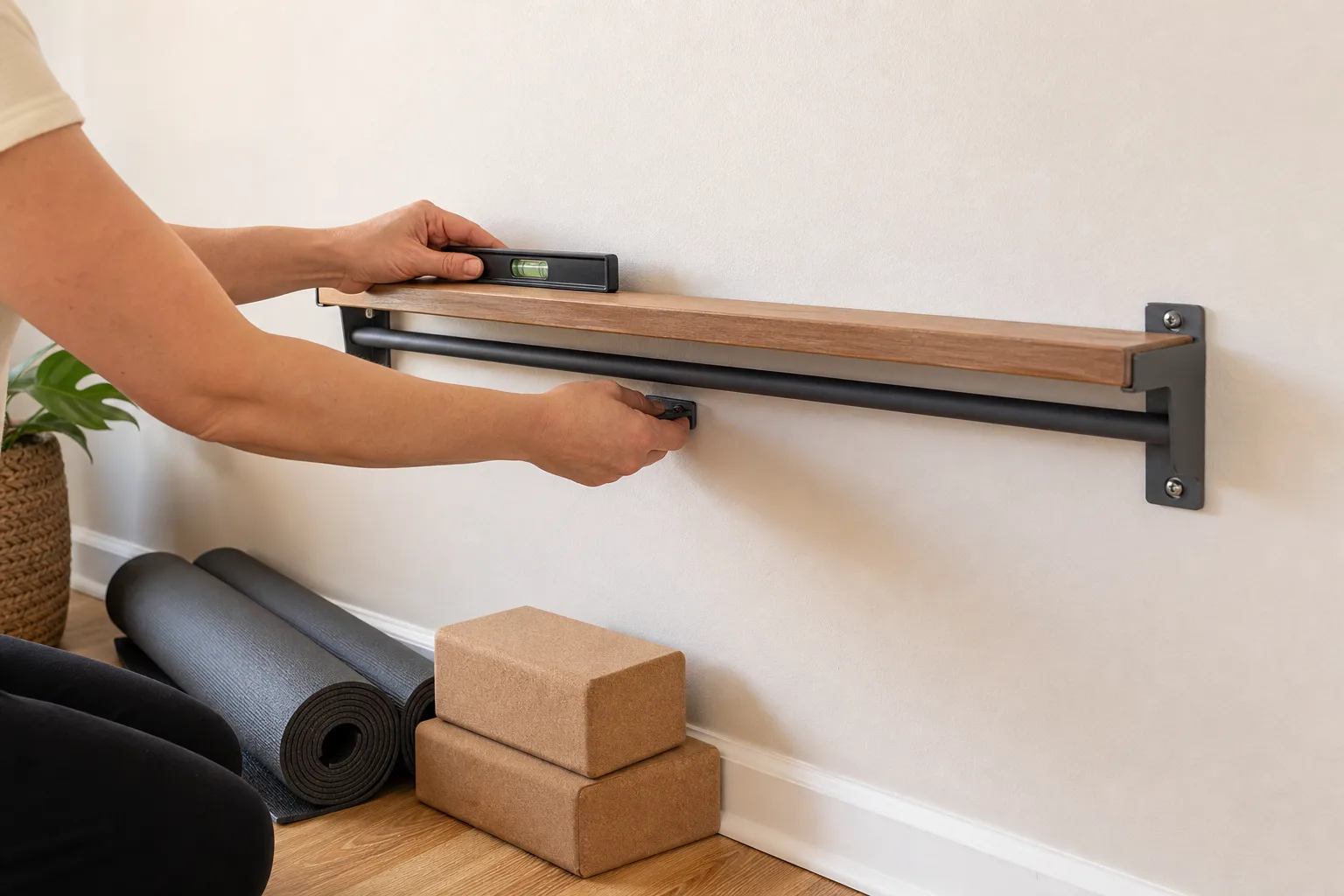
Before installation:
- identify the wall construction and potential utilities;
- read the complete mounting instructions;
- confirm all brackets and fasteners are present;
- compare the rated load with the total equipment mass;
- include the rack’s projection and leverage;
- mark the full loaded envelope, not just screw holes;
- keep equipment off the unit until installation is verified; and
- use a qualified installer when the substrate or load path is uncertain.
Do not copy fastener choices from a photograph. Masonry, wood framing, metal studs, hollow drywall and tile require different decisions. A generated image can explain inspection concepts but cannot identify the user’s wall.
Recheck fasteners, joints and level after initial loading and periodically thereafter. Stop using a unit if it moves, pulls away, cracks the surrounding wall or develops a bent bracket.
Capacity calculations that stay useful
Marketing counts are often based on unusually thin mats or tightly compressed textiles. Calculate from measured bays.
For a simple single-row mat bay:
Practical mat count = floor(clear bay width ÷ measured rolled diameter)
Then reduce the result if dividers, hand clearance or uneven roll sizes consume space. Do not treat the formula as structural capacity; the rack’s published load rating still controls.
For cubbies, compare all three internal dimensions. Volume alone is misleading: a bolster may have less cubic volume than a compartment but still be too long for the opening. For shelves, total the actual item masses and keep below the manufacturer’s distributed-load limit. A point load at the center or front edge may behave differently from an evenly distributed rating.
Plan modest spare capacity. An organizer filled to its mathematical maximum on day one has no room for drying separation, easier retrieval or a future pair of blocks.
Home versus studio requirements
A home system may serve one person and a small collection. A studio faces repeated retrieval, many similar items, cleaning workflows and higher cumulative loads.
| Requirement | Home | Shared studio |
|---|---|---|
| Identification | Visual position may be enough | Counts, zones and replacement tracking |
| Access frequency | Usually low | Repeated class changeovers |
| Cleaning | Individual schedule | Documented return/clean/dry flow |
| Capacity | Current set plus modest growth | Peak class inventory plus spares |
| Structure | Domestic furniture loads | Commercial-duty published ratings |
| Security | Usually unnecessary | Lockable staff or personal-item zones may matter |
| Inspection | Periodic | Routine documented check |
Manduka’s studio-equipment page distinguishes commercial mat storage, including hanging options for compatible mats. A domestic decorative rack should not be scaled into commercial service merely by buying several units. Verify duty rating, anchoring, fire/exit requirements and local obligations for the real venue.
Delivery and assembly inspection
Before loading a new system:
- compare every panel, bracket and fastener with the parts list;
- reject cracked boards, bent metal or damaged welds;
- confirm shelves seat fully and dividers are square;
- verify feet or casters are complete and level;
- follow the stated tightening order;
- confirm included anti-tip hardware and instructions;
- measure the assembled clear openings again; and
- retain instructions and model information.
Do not use yoga blocks, folded blankets or wedges to level furniture. Use only an approved leveling mechanism or correct the floor/installation as directed.
Maintenance and periodic audit
Once a month in a busy setup—or whenever damage is noticed—empty one zone at a time and inspect:
- shelf bowing, loose joints and corrosion;
- wall movement, cracked finishes and backing separation;
- sharp edges that can cut mats or textiles;
- basket splinters and broken handles;
- moisture, residue, odor or pests;
- labels or assigned positions that no longer match inventory; and
- whether the heaviest objects remain low.
Clean storage surfaces using the furniture maker’s method and let them dry before replacing props. Avoid transferring strong cleaning chemicals from a shelf onto a porous cork block, natural-rubber mat or fabric bolster cover.
Compare cost without buying decoration twice
Use current delivered price because furniture promotions and shipping charges vary. Normalize the system by usable zones, not marketing capacity:
Cost per usable zone = delivered system cost ÷ number of zones that fit your measured equipment
A mat tube plus separately priced block bracket may look like one product in photographs but require multiple purchases. Yoga Design Lab explicitly states that props are sold separately from its Apis storage bundle, and modular options vary. Reconstruct the exact included components before comparing.
Also consider installation hardware, professional mounting, replacement modules and the cost of unused compartments. A generic rigid shelf may outperform a yoga-branded organizer when its clear dimensions, load rating and cleanability are better documented.
Red flags
- “Fits all yoga gear” without internal dimensions.
- Mat capacity stated without assumed roll diameter.
- External dimensions presented as usable space.
- Wall-mount photos without fastener or wall-type guidance.
- No published load rating for shelves carrying dense props.
- Bolsters visibly compressed into undersized cubbies.
- Closed storage promoted for damp mats or towels.
- Heavy blocks shown above an unretained open edge.
- A modular photograph that does not identify separately sold parts.
- Decorative baskets with rough interiors touching mat surfaces.
- Casters without locks on a tall loaded rack.
- A narrow unit with no anti-tip instructions.
A practical planning sequence
- Inventory and count the entire prop collection.
- Clean, dry and measure each item in its stored orientation.
- Choose retrieval zones for mats, blocks, textiles, bolsters and small items.
- Measure clear openings, floor footprint, wall projection and removal paths.
- Compare open, closed, wall-mounted and mixed systems.
- Verify published loads, included components and assembly requirements.
- Create a separate return and drying flow.
- Install or assemble the unit unloaded and inspect it.
- Place dense items low and keep exits and walkways clear.
- Re-audit capacity, fasteners, moisture and damage periodically.
The best yoga equipment storage system is not the one that hides the most objects. It is the one whose measurable compartments fit the actual collection, keep damp gear out, make defects visible and let each item be removed and returned without creating a new hazard.
Frequently asked questions
What is the best way to store yoga equipment at home?
Inventory and measure the equipment first. A practical mixed system usually stores clean, dry mats upright in open bays, blocks on a rigid shelf, blankets loosely folded, bolsters horizontally without compression and straps on hooks or in a ventilated basket. The best format fits the actual collection and room rather than a generic prop count.
Can yoga mats be stored standing upright?
Yes, when each mat is clean, fully dry, loosely rolled and supported so it does not lean sharply or develop a flat edge. Measure the rolled diameter and mat width before choosing a bay. Follow the mat maker’s storage instructions when they are more specific.
Should yoga equipment be stored in a closed cabinet?
A cabinet can reduce visual clutter and dust, but it should only receive clean, fully dry equipment. Check internal depth, shelf loading, door clearance and airflow. Never use a closed cabinet as a drying space for a damp mat, towel or blanket.
How deep should yoga equipment storage be?
Depth depends on the largest item and its orientation. Measure bolster diameter or height, folded blanket depth, block length and the rolled mat diameter. Add hand clearance and space for doors or lips instead of matching the product dimension exactly.
Is a wall-mounted yoga storage rack safe?
Only when the rack, fasteners and wall construction are compatible and the published load limit covers the real equipment. Locate utilities and framing, follow the manufacturer’s installation instructions and use a qualified installer when the wall or load path is uncertain.