

How this page has changed
July 26, 2026
Sources, internal links and safety or product context reviewed.
In this guide
- 01Quick decision
- 02Current replacement covers compared
- 03Shape is the first fit test
- 04How to measure the insert
- 05Closure architecture
- 06Fit without compression or wrinkles
- 07Fabric selection
- 08Handles and load path
- 09Washing, drying and shrinkage
- 10Inspection and replacement
- 11Claims to question
- 12Buying checklist
- 13How this guide was researched
- 14Further reading
A yoga bolster cover is not a generic pillowcase. The insert may be rectangular, cylindrical, oval-ended or narrow pranayama-shaped, and two bolsters with similar advertised dimensions can have different corner radii, fill density and zipper requirements.
Choose a replacement by exact bolster model, uncovered insert measurements, shape, closure length, fabric, handle construction, shrinkage allowance and care label. “Standard size” is not a fit specification. Neither is a product photo of a smooth finished cushion.
This is an independent replacement-cover guide, not a bolster-use tutorial. Current product specifications and live commercial intent were checked July 26, 2026. Our separate yoga bolster guide owns complete-bolster selection, shape and fill.
Quick decision
| Your starting point | Best route | Verify before ordering |
|---|---|---|
| Branded bolster with model still sold | Model-specific original replacement cover | Model name, generation and complete-bolster dimensions |
| Rectangular insert without label | Made-to-measure or fully dimensioned rectangular cover | Length, width, height, corner radius and opening length |
| Cylindrical insert | Round/cylindrical cover | Length, diameter and end-panel construction |
| Studio fleet | Same-model spare covers | Dye lot, wash process, handle placement and identification system |
| Cover for wash-day rotation | Exact duplicate or approved spare | Preshrinking and whether washed/unwashed covers remain interchangeable |
| Cosmetic over-cover | Slip-on outer layer | Added bulk, drawstring position and whether original handle remains usable |
If the seller says a cover fits only its own bolster, treat that as the complete compatibility statement. Similar dimensions from another brand do not override it.
Current replacement covers compared
| Current cover | Intended shape and fit | Material and closure | Published care |
|---|---|---|---|
| Sunshine Yoga deluxe cover | Rectangular 24 × 12 × 6 in | 100% cotton, full-length zipper, handles at both ends | Machine wash cold; tumble dry low |
| Yoga Accessories round cover | Cylinder 28 in long × 10 in across | 100% cotton, full-length zipper, two handles | Cold gentle machine wash with mild detergent; line dry |
| Mount Adams slip-on cover | For its 24 × 12 × 6-in rectangular bolster; cover is 25 × 14 in | 95% cotton, 5% Lycra; open pillowcase format with end drawstring | Cold wash; tumble dry low |
| Sun and Moon replacement cover | Rectangular 27 × 12 × 7.5 in or cylindrical 27 × 10 in, selected separately | Closure and fiber not detailed on page checked | Care not detailed on page checked |
| Yogiraj outer case | Fits the maker’s 71 × 23-cm filled bolster | 100% cotton; side carrying strap | Machine wash at 30°C; no bleach/softener; hang or low tumble dry |
| Yoga Studio EU round cover | For Yoga Studio EU round bolster; 62 × 24 cm | 100% cotton, full-length zipper, end handle | Cold machine wash and hang dry; first wash separately advised |
These are current maker disclosures, not our measurements. Dimensions are not normalized: some describe the complete insert, some the flat cover and some the nominal finished bolster. Ask which object was measured before comparing numbers.
Shape is the first fit test
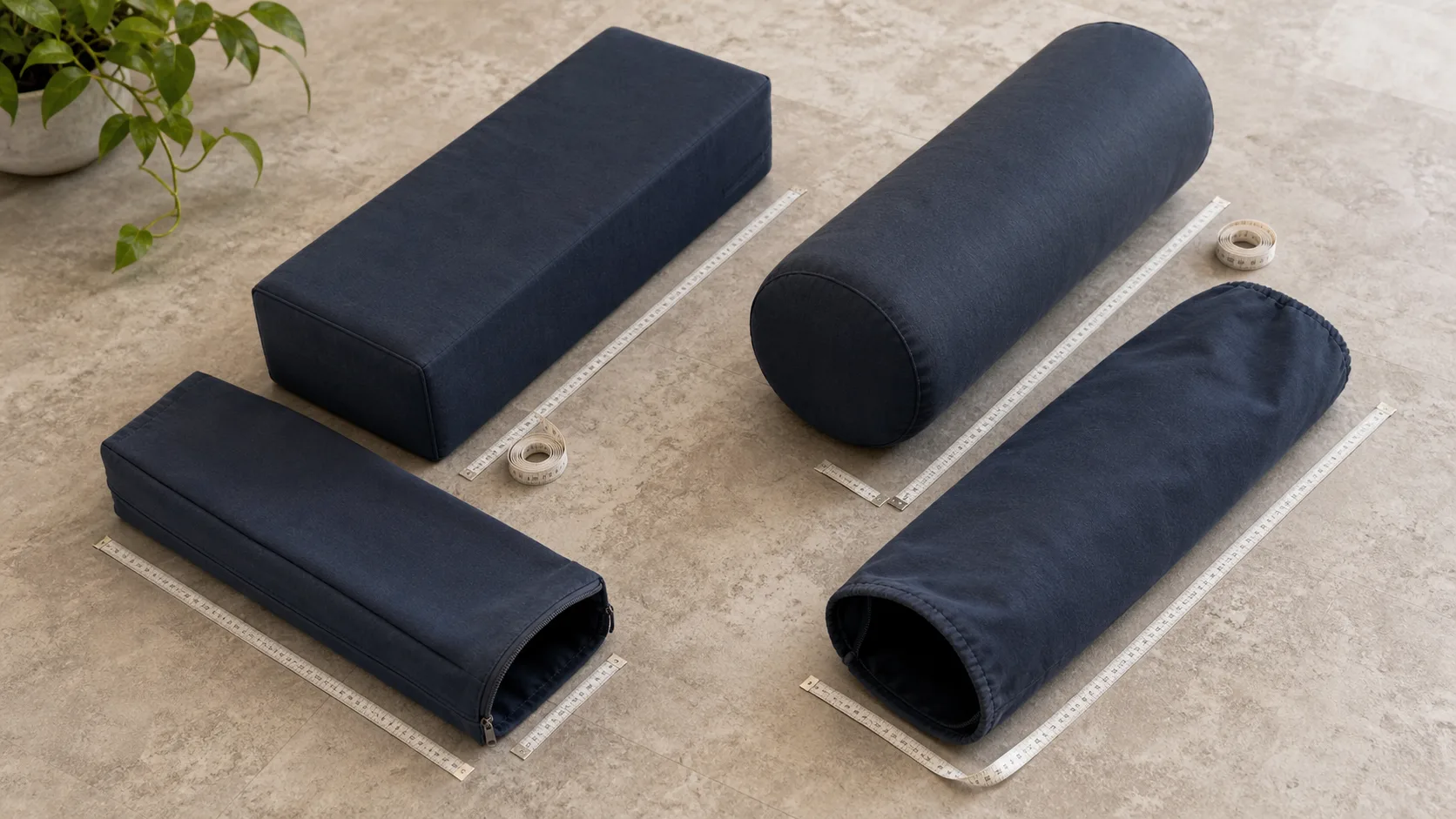
Rectangular covers
A rectangular bolster typically has six panel areas: top, bottom, two long sides and two ends. The sewn corners may be sharp, softly rounded or heavily radiused. A cover made for a boxy insert can wrinkle around a rounded insert even when length, width and height match.
Sunshine Yoga’s current cover is explicitly for its 24 × 12 × 6-inch Deluxe Firm Large Rectangular Bolster. Sun and Moon lists a larger regular rectangular size of 27 × 12 × 7.5 inches. Both can be called regular or standard in retail language, yet they are not dimensionally interchangeable.
Cylindrical covers
A cylinder needs length and diameter, plus end-panel geometry. Yoga Accessories publishes 28 inches long by 10 inches across. Sun and Moon publishes 27 by 10 inches. Yoga Studio Store lists 62 by 24 cm, approximately 24.4 by 9.4 inches, for its EU round model.
One inch of extra length is not automatically harmless. It can create loose end folds or let the insert shift between handles. A small diameter shortfall is more serious because circumference changes by roughly 3.14 times the diameter difference. A cover one inch too small in diameter needs about 3.14 inches less circumference than the insert.
Oval and rounded rectangular covers
Some bolsters look rectangular from above but have oval ends or a flattened top. Retailers may label these lean, flat, everyday or restorative shapes. Do not map them to a rectangular box using only maximum width and height.
Trace the uncovered end onto paper and compare it with the replacement maker’s end profile or request a pattern diagram. Maximum measurements can match while the perimeter shape does not.
Narrow and travel bolsters
Travel, mini and pranayama bolsters use narrower dimensions and may have denser or loose-fill inserts. Brow Farm, for example, sells a small/travel replacement cover around 52 × 18 cm with an underside zipper and end handle. It is a separate product class, not a smaller color variant of a standard cover.
How to measure the insert
Measure the uncovered inner insert when possible. Measuring over a padded, seamed or already loose outer cover adds uncertainty.
For a rectangular insert, record:
- seam-to-seam length along the centerline;
- maximum width without compressing the sides;
- maximum height at the center;
- end shape and approximate corner radius;
- location and direction of the inner liner seam or zipper;
- whether the insert is firm batting, foam or loose hull fill.
For a cylinder, record:
- end-to-end length through the center;
- maximum diameter at both ends and the middle;
- circumference as a cross-check;
- whether the end is flat, domed or gathered;
- the position of any inner handle or closure.
Use a soft tape and do not pull it into the cushion. Record measurements to at least the nearest quarter inch or 5 mm. Repeat after rotating the insert because used bolsters can become asymmetrical.
Finished bolster dimensions are not always insert dimensions
A complete product’s published 24 × 12 × 6-inch size may include the outer fabric and seam profile. The uncovered insert might be slightly different. Conversely, a flat slipcover measurement can be larger because it must wrap around depth and close at one end.
Mount Adams illustrates this distinction: it publishes the slip-on cover at 25 × 14 inches while saying it fits the maker’s 24 × 12 × 6-inch rectangular bolster. The flat cover width cannot be compared directly with a bolster’s three-dimensional width.
Closure architecture
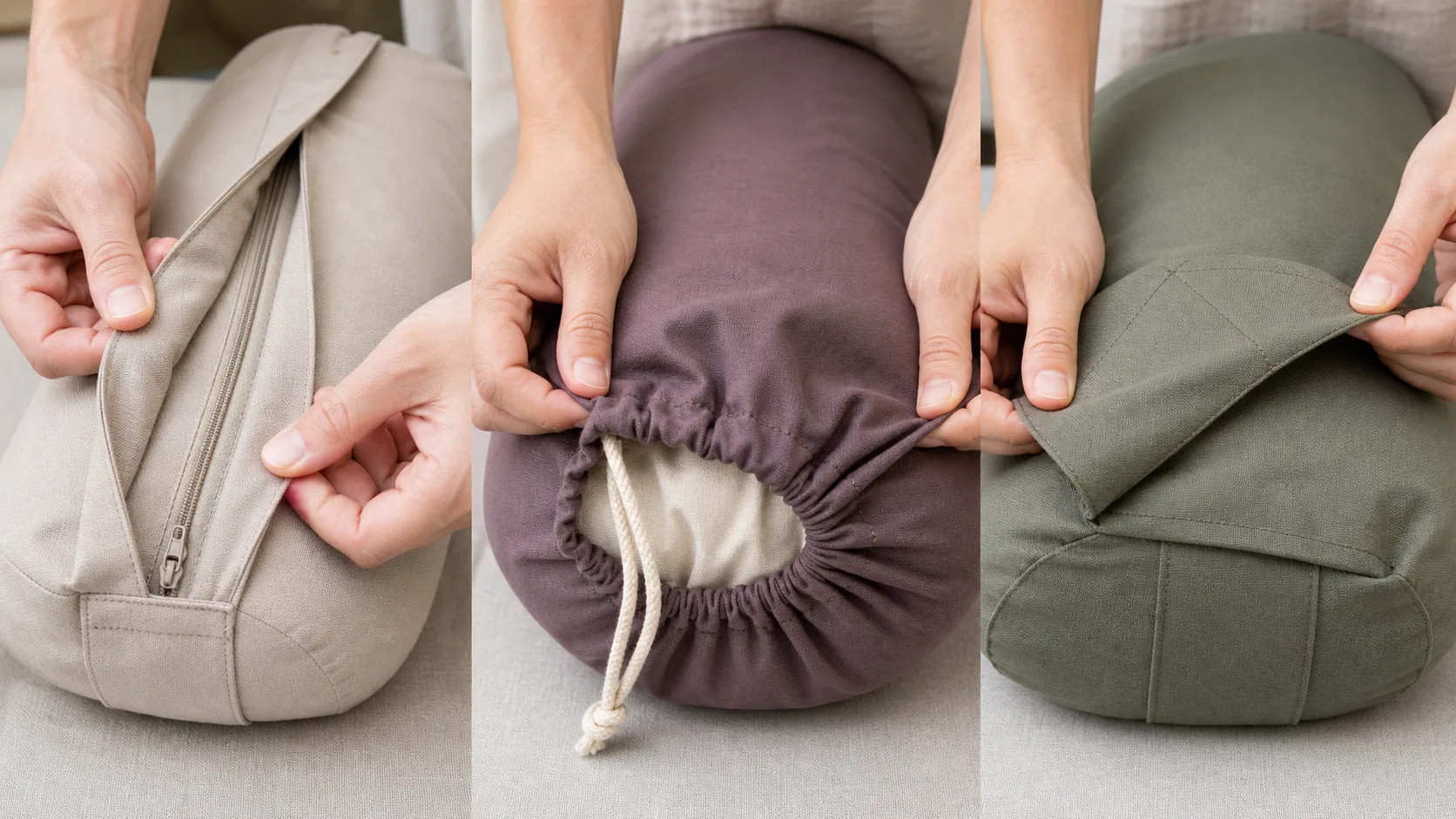
Full-length zipper
A long zipper gives the largest opening, reducing how much the insert must be compressed. Sunshine Yoga and Yoga Accessories both specify full-length zippers. Yoga Studio Store says the same for its round cover.
Check whether “full length” means nearly the entire underside or merely the longest available zipper on one panel. The opening should allow the thickest part of the insert through without dragging the zipper slider across fabric or filling.
A fabric flap over the zipper reduces direct contact with hardware and can keep the slider from catching. Inspect both end stops, stitching along the tape and the box-and-cross reinforcement where a nearby handle loads the same panel.
Short zipper
A short hidden zipper creates a clean surface but demands more compression and corner feeding. It works better with resilient foam or a structured inner liner than loose batting that can bunch near the opening.
Do not pull the zipper closed by forcing the slider against compressed fill. If the edges do not meet under light hand alignment, reassess cover size and insert position.
Drawstring slip-on cover
Mount Adams uses a pillowcase-style cover without a zipper, closed by a drawstring. Its cotton/Lycra blend adds stretch. This format can change quickly between users and avoids zipper hardware along the main body.
The trade-offs are a gathered end, loose cord and less tailored fit. Verify where the tied cord sits in use and whether it can tuck away. A drawstring over-cover may conceal the original handle or add fabric beneath the bolster.
Envelope or overlap closure
An overlapping fabric opening has no metal or cord but needs enough overlap to stay closed under movement. It is more common in simple dust covers and pillow-like cases. Check that the insert cannot become exposed when the bolster bends or the handle is lifted.
Fit without compression or wrinkles
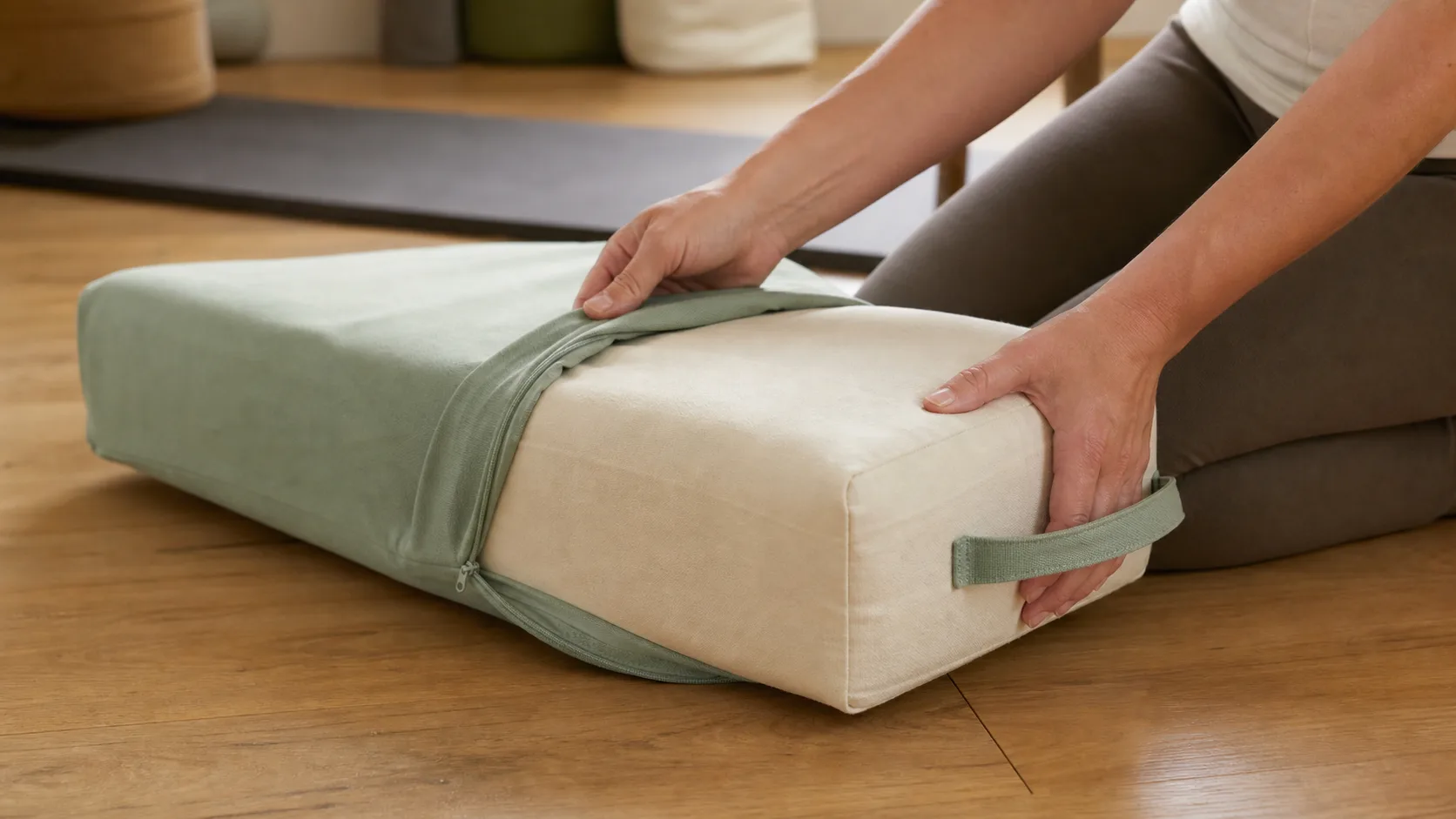
A fitted cover should follow the insert’s intended shape without changing its height or firmness. Slight surface tension is normal. Deep diagonal wrinkles, rounded-off corners, a bowed zipper and compressed ends indicate mismatch.
A conservative fitting sequence is:
- Confirm the cover is clean, completely dry and correct-side out or inside out as its instructions require.
- Open the closure fully and tuck the slider away from the insert path.
- Compress only enough to pass the opening; keep the inner liner closed.
- Feed one end, then work alternating corners rather than pulling from one seam.
- Align end panels, long seams and handle position.
- Smooth trapped fabric outward with flat hands.
- Bring zipper edges together without using the slider as a winch.
- Close slowly while keeping fabric and inner liner clear of the teeth.
- Check that the finished bolster remains symmetrical and the handle lifts evenly.
Stop when stitching strains, zipper teeth separate or the insert visibly deforms. A cover can appear to close yet be too small for repeated loading.
Too loose
Excess fabric forms folds that can rotate around a cylinder or bunch under a rectangular bolster. A loose cover may also let the insert move away from the carry handle, so the outer shell takes load unevenly.
Washing a large cover hot in hope of shrinking it is not a controlled alteration. Shrinkage can be uneven and can damage dye, zipper or stitching. Follow the label and exchange the size.
Too tight
An undersized cover can compress hull fill, round rectangular corners, reduce height or place constant force on the zipper ends. It may also make removal impractical after washing if the fabric shrinks.
If the model is correct but fit changes after laundering, compare the care process with the label and contact the maker. Do not trim the insert or remove filling unless the bolster manufacturer explicitly provides that procedure. Yoga Studio Store notes that a small amount of filling may need removal for its own round model; that advice is product-specific, not universal.
Fabric selection
Cotton canvas and plain weave
Most current replacement examples use 100% cotton. Cotton can feel breathable and provides friction against clothing, but fiber name alone does not reveal fabric weight, abrasion resistance, preshrinking or dye fastness.
Ask for weave and weight when the cover is intended for a studio fleet. A thin decorative cotton can wear through at corners faster than upholstery-weight canvas. A coarse weave can collect lint; a smooth dense weave may wipe more easily.
Cotton with stretch fiber
Mount Adams specifies 95% cotton and 5% Lycra for its slip-on cover. Stretch helps the flat case pass around a three-dimensional insert, but it does not make fit universal. Repeated high strain can distort openings and drawstring areas.
Vinyl and wipeable surfaces
Love My Mat sells a traditional bolster cover made from reclaimed/deadstock vinyl, sized 24 × 10 × 5 inches with two handles. It describes the surface as wipeable. A wipeable cover can suit certain shared environments, but ask about the approved cleaner, seam construction, plasticizer/material disclosure and what “reclaimed” means for consistency.
Do not infer machine washability from removability. Vinyl, coated fabric and faux leather often require surface cleaning.
Organic and environmental claims
An organic-cotton claim should identify the certification scope and current certificate, not merely use “organic” in the product name. Replacement can extend the functional life of a sound insert, but that does not automatically make every new cover low-impact.
Compare verified fiber certification, fabric durability, repairability, shipping distance, packaging and realistic wash life. The best environmental outcome is a cover that fits and lasts; an incompatible spare is waste regardless of fiber story.
Handles and load path
Some covers include one side or end handle; others use two. Sunshine Yoga and Yoga Accessories disclose handles at both ends, while Yogiraj lists a carrying strap on the side and Yoga Studio Store an end handle.
The handle belongs to the cover’s load path. Inspect:
- webbing or fabric continuing into a reinforced patch;
- box, bar-tack or cross stitching without broken threads;
- enough clearance for a hand without twisting the cover;
- no handle seam sharing a damaged zipper end;
- alignment with the insert’s center of mass;
- a maker statement that the handle is intended for carrying the filled product.
Do not lift a heavy bolster by a decorative loop. If the replacement cover has no handle but conceals the bolster’s original handle, carry the product with two hands unless the maker gives another method.
Washing, drying and shrinkage
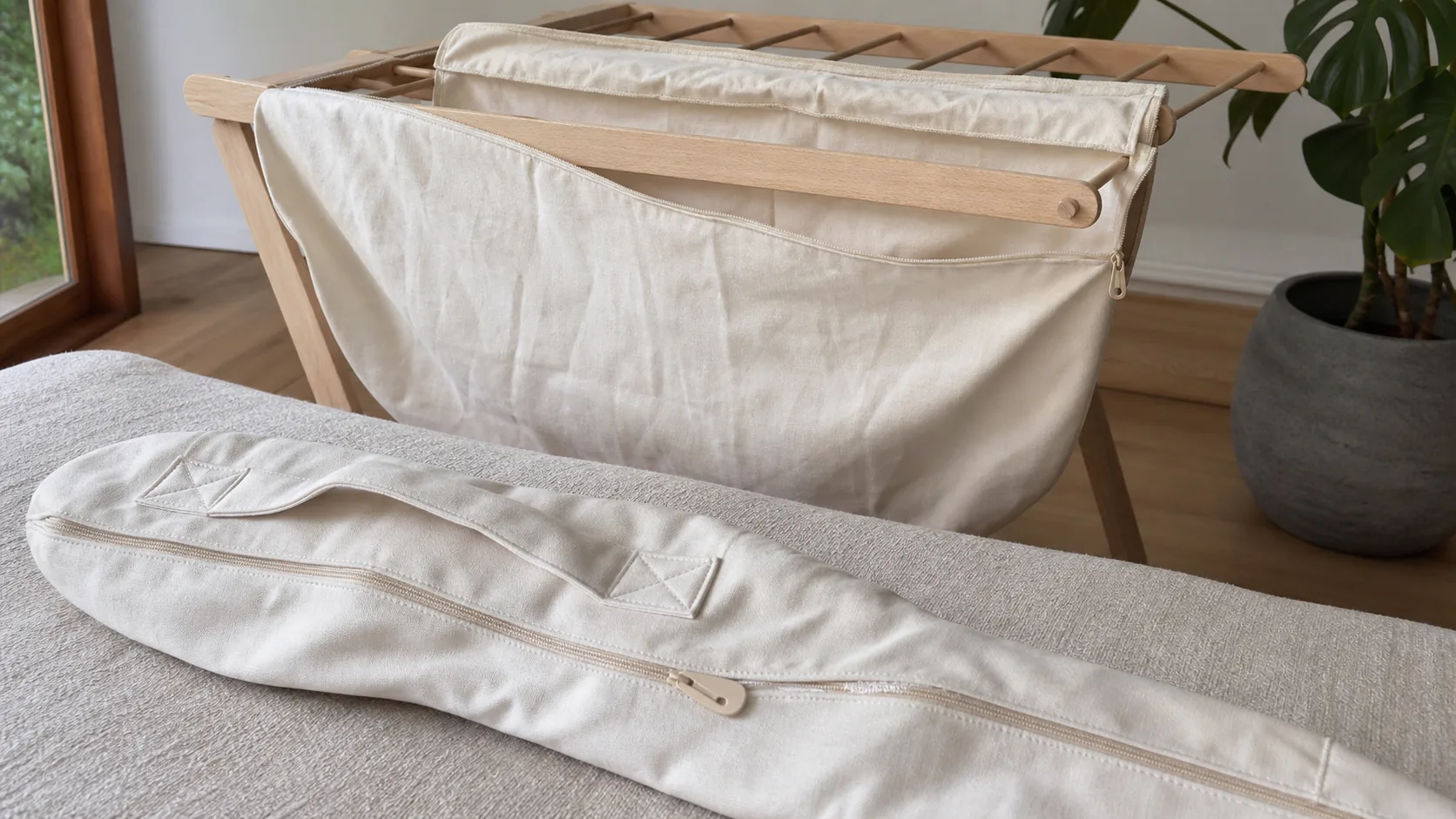
Current care instructions vary materially:
- Sunshine Yoga: cold machine wash, low tumble dry.
- Yoga Accessories: cold gentle cycle with mild detergent, line dry.
- Yogiraj: machine wash at 30°C, no bleach or softener, hang dry or low tumble.
- Yoga Studio Store: cold machine wash and hang dry; it warns dyes may not be fully colorfast and advises washing separately the first time.
- Brow Farm’s small/travel cover: machine wash at 40°C.
These are not interchangeable defaults. Water temperature, agitation and drying heat affect cotton shrinkage, dye and closure hardware. Use the sewn label for the exact color and production run when it differs from a web page.
Before washing, remove the insert fully, close or secure fasteners as directed and inspect for a loose thread that agitation could worsen. Wash separate colors when advised. Reshape seams while damp and dry the cover fully open with airflow.
Never reinstall a damp cover over cotton batting, foam or hull fill. Trapped moisture is harder to detect inside a dense bolster. Keep a second correctly fitted cover if the bolster must remain available during wash day.
Inspection and replacement
Inspect the empty cover under good light:
- thinning or shine at corners and the underside;
- pulled yarns, holes or seam slippage;
- broken zipper teeth or a slider that separates behind itself;
- loose end stops;
- frayed drawstring or a damaged cord channel;
- handle stitching pulling away from the body panel;
- coating cracks or delamination;
- permanent dye transfer;
- persistent odor after approved cleaning;
- dimensional change that now compresses the insert.
Repair a non-structural seam only when a competent textile repairer can match fabric, thread and load. Retire the cover from carrying when a handle anchor fails. Do not continue lifting by one remaining handle on a two-handle design.
Replacing the outer cover does not repair a degraded insert. If the inner liner tears, filling leaks, foam breaks down or the bolster no longer holds its intended shape, consult the complete product maker. Our yoga bolster buying guide covers the separate fill and shape decision.
Claims to question
Pause when a listing:
- says “universal” without a dimensional range and shape profile;
- calls both rectangular and cylindrical products standard size;
- shows complete bolsters but does not clearly say cover only;
- lists package dimensions instead of fitted-cover dimensions;
- omits closure length and location;
- says washable without temperature and drying instructions;
- claims preshrunk without a tolerance;
- calls cotton organic without identifiable certification;
- promises waterproof performance based only on a coated-looking surface;
- describes a handle without stating that it can carry the filled bolster;
- suggests a new cover fixes a collapsed or leaking insert.
A replacement cover is successful when it preserves the bolster’s original geometry and can survive its documented care cycle. Color is secondary.
Buying checklist
Before checkout, confirm all twelve:
- Is the listing cover only, or does it include liner, filling or complete bolster?
- What is the exact bolster brand and model?
- Is the insert rectangular, cylindrical, oval or another named shape?
- What are the uncovered insert dimensions in every axis?
- Are those numbers compatible with how the seller measured its cover?
- Does the end profile and corner radius match?
- Is the opening long enough for the insert’s least-compressible section?
- Will the closure and handle sit in the original intended positions?
- Are fiber, weave, coating and stretch content disclosed?
- Are washing and drying directions complete?
- Does the seller disclose shrinkage or dye-transfer precautions?
- Can you return the cover after a dry fit if the model match fails?
Dry-fit before washing when the return policy permits it. Laundering can make a cover non-returnable and can change its dimensions.
How this guide was researched
Product values are attributed specifications, not our measurements or laundering tests.
This URL owns replacement-cover compatibility, measured fit, closure, textile and care decisions. The existing best yoga bolster guide owns choosing a complete bolster by shape, firmness and fill. Keeping these reader jobs separate prevents a small replacement-accessory query from diluting the main bolster roundup.
Further reading
- Choose the complete prop with the yoga bolster guide.
- Compare washable textile props in the yoga blanket guide.
- Review small removable-cover construction in the yoga eye pillow guide.
- Read the fiber and certification context in the cotton yoga mat guide.
- See our affiliate disclosure for how commercial content is handled.
Have a current replacement-cover dimension or care label we should verify? Email hello@theyogasensei.com. Corrections are reflected in the review date.
Frequently asked questions
Are yoga bolster covers universal?
No. Rectangular, cylindrical, round and pranayama bolsters use different pattern geometry, and nominal dimensions do not guarantee the same corner radius, insert firmness or zipper opening. The safest replacement is made for the exact bolster model.
How do I measure a yoga bolster for a replacement cover?
Measure the uncovered insert without compressing it: seam-to-seam length, width and height for a rectangular insert, or length and maximum diameter for a cylinder. Also record corner shape, handle position and the opening needed to insert the cushion.
Should a bolster cover fit tightly?
It should sit smoothly enough to prevent folds and shifting without compressing the insert or distorting its shape. A cover that is too small can stress the zipper and seams; one that is too large can wrinkle and rotate.
Can I machine-wash a yoga bolster cover?
Only when the cover maker permits it. Current examples range from cold gentle machine washing and line drying to 30 or 40 degree cycles and low tumble drying. Follow the exact label because fiber, dye, zipper and preshrinking differ.
Does a replacement bolster cover include the inner cushion?
Usually not. Product pages commonly state cover only, case only or unfilled. Confirm whether the listing includes an outer cover, an inner liner, filling or a complete bolster before ordering.