

How this page has changed
July 26, 2026
Sources, internal links and safety or product context reviewed.
In this guide
- 01Yoga wedges at a glance
- 02Quick decision
- 03Understand wedge geometry
- 04Full-width wedge versus a pair
- 05EVA foam versus cork
- 06Floor and mat compatibility
- 07Quality inspection
- 08Yoga wedge versus yoga block
- 09Yoga wedge versus knee pad and bolster
- 10Care by exact product
- 11Claims to treat cautiously
- 12Buying checklist
- 13How this guide was researched
A yoga wedge is a low ramp-shaped prop: one flat base, one sloped contact surface and a thin-to-thick side profile. It does not do the same job as a rectangular block. A block adds a fixed height; a wedge changes an angle gradually. That geometry is the reason to buy one—and the first thing to compare.
For a general full-width format, current products from Gaiam, Hugger Mugger and Yoga-Mad cluster near 20 × 6 × 2 inches. That is a useful reference, not a universal standard. Other models are longer and shallower, compact enough to use as a pair, or much larger Pilates wedges that belong to a different equipment category.
Choose by footprint, rise, slope, material, base stability, edge finish and care. Do not buy from a therapeutic promise. This is a source-checked equipment guide, not hands-on testing, pose instruction or medical advice.
Yoga wedges at a glance
| Current product | Published dimensions | Weight | Material | Published care |
|---|---|---|---|---|
| Gaiam Yoga Wedge | 20 × 6 × 2 in | Not published | EVA foam | Spot clean with mild detergent; towel or air dry |
| Hugger Mugger Foam Yoga Wedge | 20 × 6 × 1.875 in | 0.5 lb | EVA foam | Warm wet cloth or maker’s gear wash; air-dry out of sun |
| Yoga-Mad Yoga Wedge | 50 × 15 × 5 cm | 400 g | EVA foam | Mild detergent, rinse, wipe and air-dry |
| Kakaos Foam Yoga Wedge | 24 × 3 × 1 in | Not published | EVA foam | Hand washable |
| Yoga Goods Japan EVA Wedge | 49 × 15 × 5 cm | 240 g | EVA foam | Product instructions apply |
| Balanced Body Large Foam Wedge | 15.75 × 16 × 3.75 in | Not published | Closed-cell EVA foam | Product instructions apply |
These are manufacturer values, not our measurements. The final row is intentionally included as a category boundary: it is a broad Pilates positioning wedge, not a narrow full-width yoga ramp. Search results can mix both shapes because retailers reuse the word “wedge.”
Quick decision
| Purchase question | What to compare | Why it matters |
|---|---|---|
| One continuous contact area or two independent points? | Full-width wedge versus matched pair | Determines placement freedom and symmetry |
| How much angle change? | Length and rise together | Rise alone does not describe slope |
| Will the whole contact area fit? | Usable width and length | A narrow wedge may not support the intended footprint |
| Soft or firm surface? | Material plus density | “EVA” covers many firmness levels |
| Home or travel? | Published weight and packed volume | A large foam wedge is light but bulky |
| Shared equipment? | Closed surface and maker-approved cleaning | Wipeability varies by construction |
If you cannot describe the needed footprint and angle, pause before buying. A qualified teacher can identify whether a wedge belongs in the setup; the product page cannot determine that from symptoms or flexibility labels.
Understand wedge geometry
A wedge is described by three basic dimensions:
- Length runs from the thin edge to the raised edge.
- Width runs across the platform.
- Rise is the height at the thick edge.
The slope depends on both length and rise. A 2-inch rise over 20 inches is much shallower than a 2-inch rise over 8 inches. Product listings sometimes publish only external dimensions and omit the actual angle. In that case, dimensions still let you estimate whether the ramp is shallow or abrupt, but rounded edges and molded transitions mean the mathematical angle is only approximate.
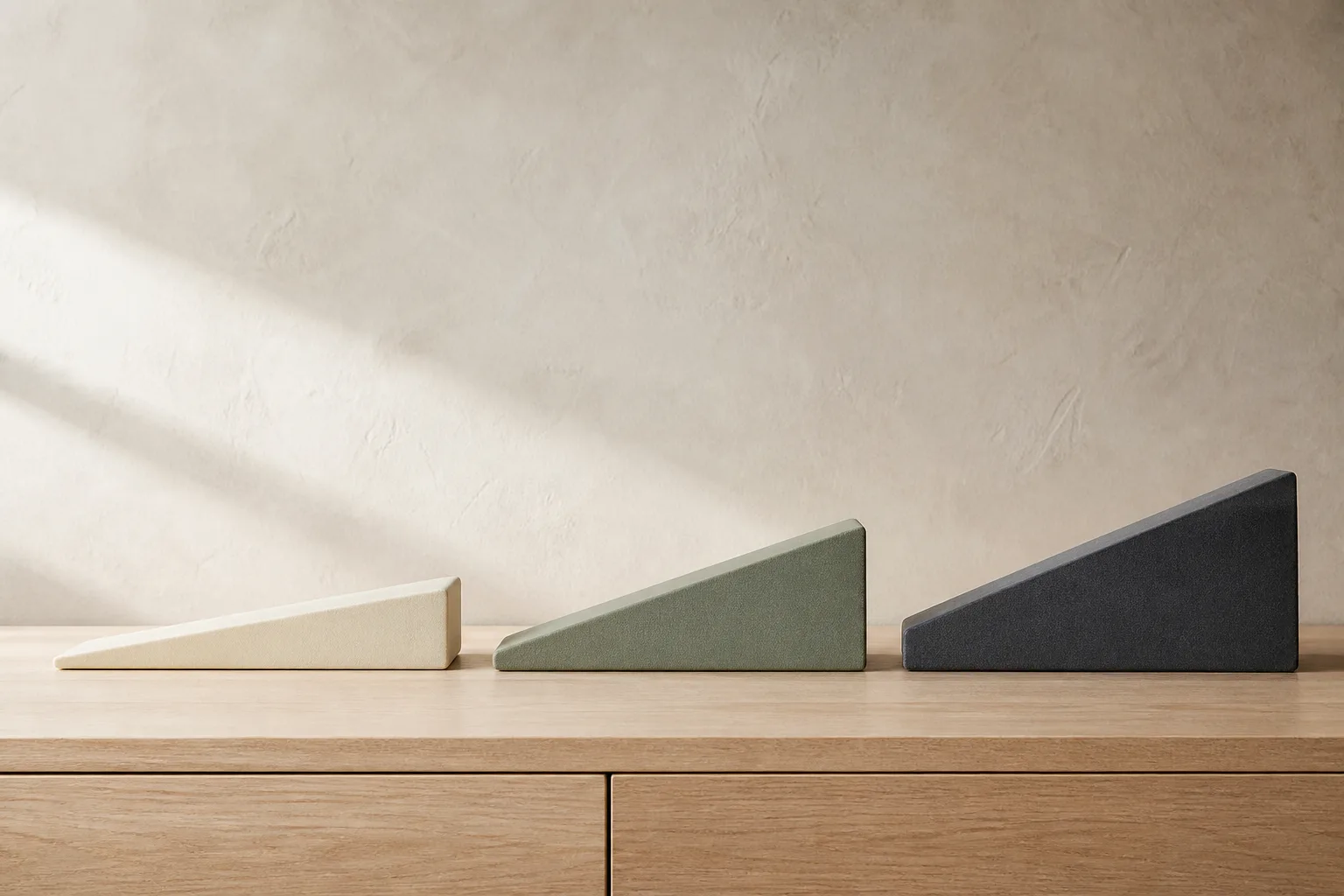
Current full-width geometry
Gaiam’s published 20 × 6 × 2-inch shape and Hugger Mugger’s 20 × 6 × 1.875-inch shape are close enough to define the familiar long yoga plank. Yoga-Mad’s 50 × 15 × 5 cm dimensions translate to roughly 19.7 × 5.9 × 2 inches. Those three products occupy essentially the same footprint class.
That agreement is useful because it distinguishes a yoga wedge from generic exercise ramps. The 24 × 3 × 1-inch Kakaos version is longer, half as wide and half as high. It supplies a shallower, narrower strip rather than a broad platform. Balanced Body’s 15.75 × 16 × 3.75-inch model is nearly square and much broader; it is sold for Pilates positioning.
No footprint is universally better. The correct one is wide enough for the taught contact area, long enough to create the intended transition and small enough to sit fully on a stable surface.
Slope estimates need honesty
If a product is a true right-angle wedge, the approximate slope angle is arctan(rise ÷ length). A nominal 2-inch rise over 20 inches is about 5.7 degrees. Yet one Japanese 49 × 15 × 5 cm listing publishes an angle of about 21 degrees, which likely reflects a different measurement convention or usable sloped section. That discrepancy is exactly why we do not invent a universal angle from catalog dimensions.
When angle matters, prefer a manufacturer that publishes an actual angle and a clear side drawing, or ask the seller how it was measured. Do not treat two “5 cm high” wedges as equivalent without comparing their sloped length.
Full-width wedge versus a pair
Most long models create one continuous platform across roughly 15 cm or 6 inches. Other products use two compact wedges that can move independently. These formats answer different placement problems.
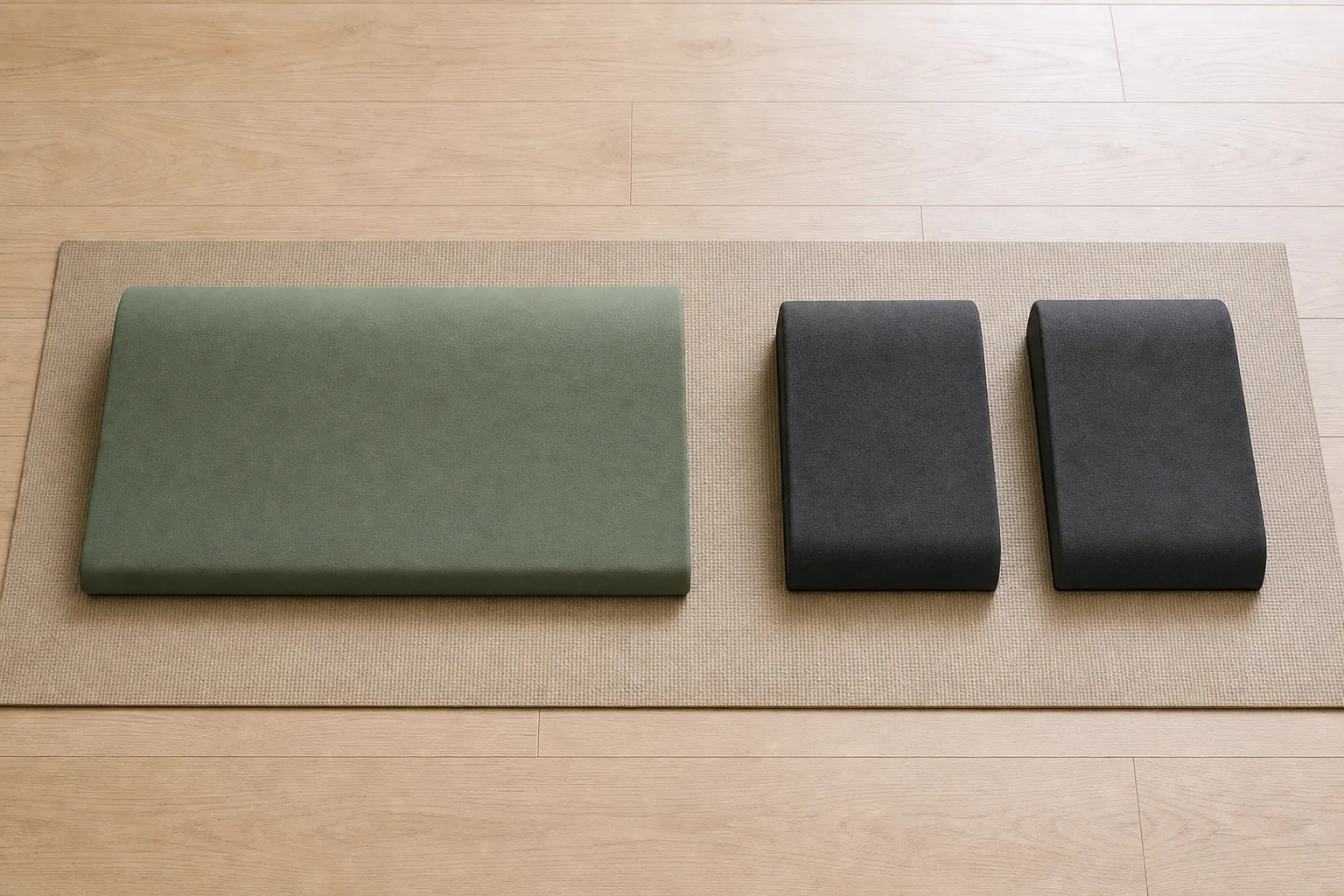
Choose one long wedge when
- the taught setup needs a continuous platform;
- keeping both sides on the same slope matters;
- you want one object to position and inspect;
- the 20 × 6-inch class fits the intended contact area.
A long wedge reduces the chance that two pieces drift to different angles. It is bulkier in a bag and cannot adapt its spacing.
Choose a matched pair when
- two contact points need independent spacing;
- compact storage matters;
- each piece is wide enough for its own contact area;
- the class or product instructions explicitly use paired wedges.
A pair should actually match in rise, slope, material and wear. Two unrelated doorstop-shaped pieces are not a reliable substitute. Position both on the same surface and check that neither rocks before loading them in any taught setup.
EVA foam versus cork
Current documented full-width products are dominated by EVA foam. Cork appears more often in compact wedge blocks and specialist pairs. Material changes mass, surface feel, moisture response and edge behavior, but it does not replace geometry.
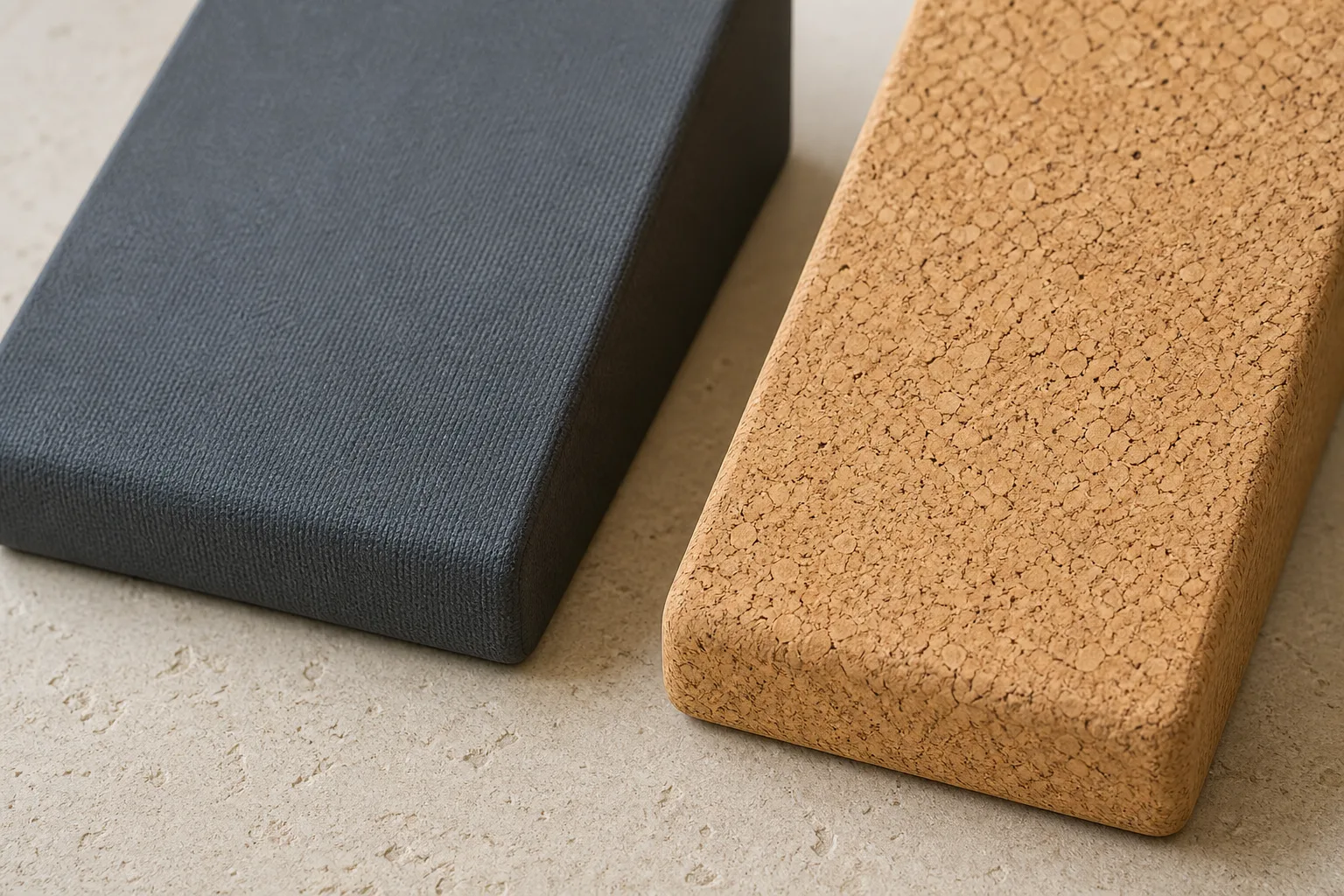
EVA foam
EVA makes a large wedge light enough to move easily. Hugger Mugger publishes 0.5 lb for its 20-inch model; Yoga Goods Japan lists 240 g for a similar footprint; Yoga-Mad lists 400 g. That wide spread within apparently similar dimensions is evidence that “EVA foam” does not identify one density.
Foam can also be molded with a closed or textured surface. Balanced Body explicitly describes closed-cell EVA, while several yoga-wedge pages say only EVA. Do not assume every foam surface has the same water resistance or cleanability. Use the exact maker’s care instruction.
The thin edge is the vulnerable part. Very soft foam can curl, crease or take a permanent dent; dense foam can feel abrupt or hard at the raised edge. Product photos should show the edge in profile, and a new wedge should sit flat without the tip lifting from the floor.
Cork
Cork is typically firmer and heavier for the same volume. Its granular surface can provide a distinct texture, and the material is often marketed as natural. Those properties do not prove grip in every direction or on every floor.
Check whether the wedge is solid agglomerated cork, cork-faced foam or another composite. A cork surface over a different core will not behave like a solid cork piece. Sustainability claims also need product-level evidence: fiber origin, binder, certification and manufacturing matter beyond the word “cork.”
Cork should generally be kept from soaking unless the manufacturer says otherwise. Inspect for crumbling corners, splits through the body and an uneven base.
Floor and mat compatibility
A wedge creates a force parallel to its slope as well as downward force. That makes the underside and support surface important. A wedge that sits flat on one mat may creep on polished wood, bunch a soft rug or rock across a raised texture.
Before use in any teacher-approved setup:
- Put the wedge fully on one clean, level surface.
- Press each corner lightly and check for rocking.
- Push the unloaded wedge gently along the slope direction.
- Check that the thin edge stays flat instead of curling.
- Confirm the mat beneath it does not wrinkle or lift.
This is an equipment check, not a pose instruction. Do not add a towel under a sliding wedge unless the manufacturer or teacher approves that surface combination; a loose layer can create a second slip plane.
If a wedge must bridge from mat to bare floor, reconsider the placement. Two surfaces can have different friction and height. Keeping the entire base on one stable plane is the clearer arrangement.
Quality inspection
A yoga wedge is simple enough that defects are visible. Inspect it when new, after cleaning and before any use where movement would matter.
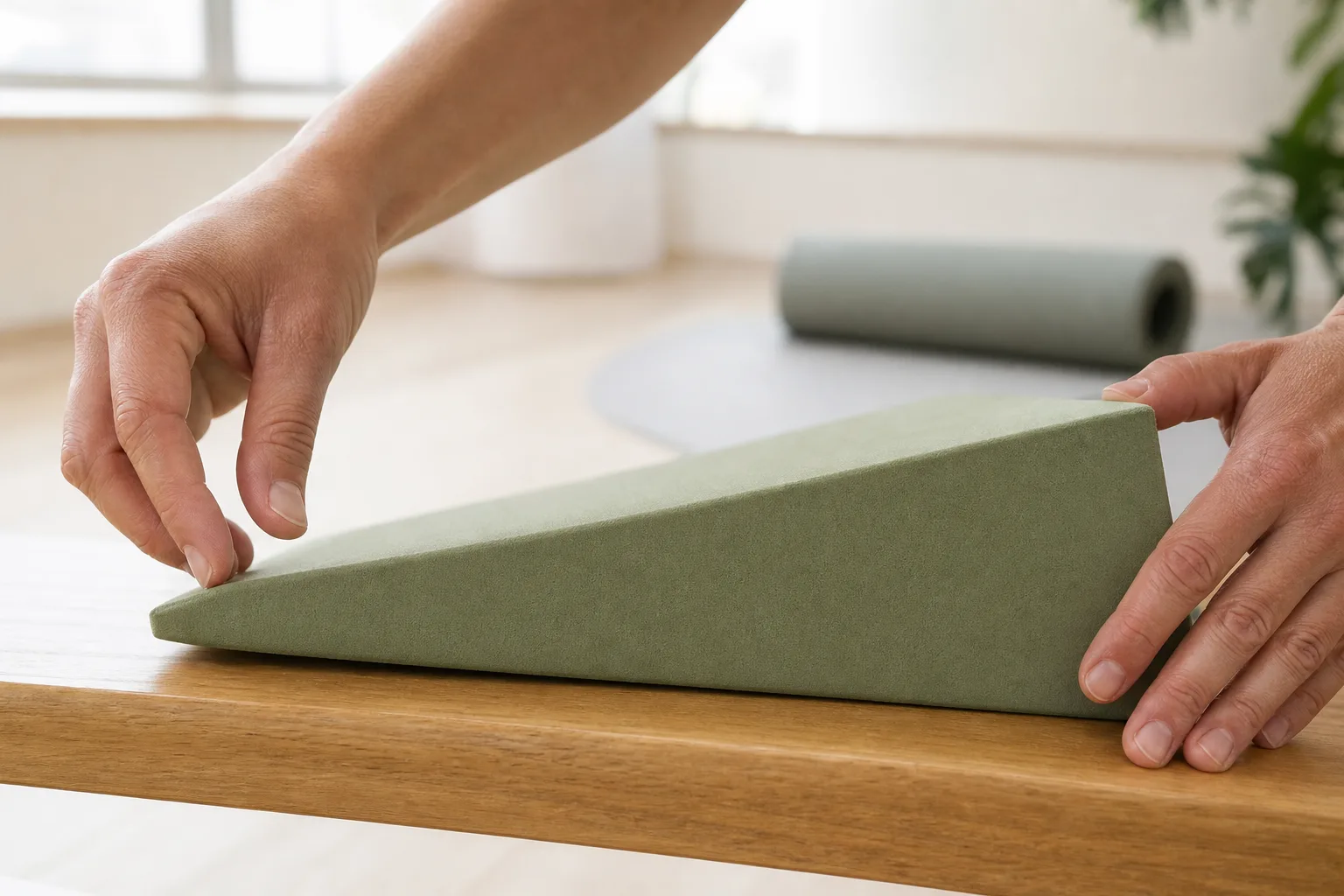
Look for:
- a base that lies flat with no diagonal rocking;
- a continuous slope without a depression or raised molding seam;
- a thin edge that is straight, not curled or torn;
- no deep dent, split, delamination or crumbling corner;
- even material density with no unusually soft pocket;
- a surface free from oil, cleaner residue or loose particles;
- dimensions and weight consistent across a matched pair.
Retire a wedge when it no longer returns to shape, the base warps, the thin edge tears into the usable area or a bonded layer separates. Do not glue a structural split and assume the original geometry or friction is restored.
Yoga wedge versus yoga block
| Yoga wedge | Yoga block |
|---|---|
| Continuous slope | Three discrete rectangular heights |
| Changes contact angle | Brings the floor closer or adds support height |
| Thin edge to raised edge | Similar thickness across each face |
| Often 20 × 6 × 2 in in full-width form | Often about 9 × 6 × 4 in |
| Usually one long piece or a compact pair | Commonly one or two bricks |
The words overlap in retail listings—“yoga wedge block” is a common query—but the shapes remain distinct. A rectangular yoga block placed at an angle is not automatically a wedge: it lacks a broad, continuous ramp and may not have a stable base in that orientation.
Likewise, stacking a wedge on a block changes both height and stability. Only use combinations explicitly taught for the setup and permitted by the product instructions.
Yoga wedge versus knee pad and bolster
A yoga knee pad adds localized cushioning without intentionally creating a long incline. A bolster provides a broad, compressible support volume. A wedge changes geometry with relatively little compressible height.
These products can all be marketed with the word “support,” but they are not substitutes. Start from the physical function:
- need a gradual angle change: wedge;
- need a fixed height: block;
- need localized cushioning: pad;
- need broad, yielding volume: bolster.
That function-first distinction also prevents buying a medical bed wedge or large Pilates ramp when the class asked for a narrow yoga plank.
Care by exact product
Official instructions vary even among EVA products:
- Gaiam says to spot clean with mild detergent and towel or air dry.
- Hugger Mugger permits a gear wash or warm wet cloth and specifies air-drying away from direct sunlight.
- Yoga-Mad says to wash with mild detergent, rinse with clean tap water, wipe and air-dry.
- Kakaos describes its foam wedge as hand washable.
Follow the sewn label or supplied sheet if it differs from the web page. Avoid soaking a product that only permits wiping. Do not use solvent, bleach, essential oil or disinfectant unless the maker approves it for that material; residues can alter the surface and concentrated oils can affect some foams.
Dry the wedge alone, flat and unweighted. Do not stand it on the thin edge while wet. Store it in a cool, dry place out of direct sun, with no heavy props stacked on the slope. A long foam wedge is light but occupies space; compressing it to solve storage can create the very warping that makes it unusable.
Claims to treat cautiously
Retail pages frequently connect yoga wedges with wrist pain, tight calves, lower-back strain or joint support. Those statements describe intended marketing use, not a diagnosis or guaranteed outcome. Changing an angle can redistribute load; it can also move load somewhere else.
A product cannot determine why something hurts. Stop and seek qualified assessment for sharp, persistent, worsening, traumatic or unexplained pain, numbness, swelling, weakness or loss of function. Do not use a wedge to continue through pain or to replace individual medical advice.
For ordinary classes, ask the qualified teacher which orientation and size the sequence expects. This page deliberately remains a buying and inspection guide because The Yoga Sensei does not have the qualified review required to publish indexable therapeutic or pose instruction around this prop.
Buying checklist
Before ordering, verify:
- Shape: a true wedge with flat base and continuous slope.
- Format: one full-width platform or a documented matched pair.
- Length: enough run for the intended gradual transition.
- Width: enough continuous contact area for the taught setup.
- Rise: measured at the thick edge, not confused with overall package height.
- Angle: published with a measurement convention, or treated as unknown.
- Material: actual EVA, cork or composite construction.
- Weight: published when portability or pair-matching matters.
- Base: flat, clean and compatible with one stable support surface.
- Care: specific cleaning, drying and storage instructions.
- Claims: no reliance on pain-treatment or injury-prevention promises.
- Return policy: enough time to inspect the footprint and geometry before use.
For a conventional full-width wedge, the 20 × 6 × approximately 2-inch EVA class is the best-documented starting reference. Choose a narrower, shallower, paired or cork design only because its measured geometry and material solve a defined equipment requirement.
How this guide was researched
We compared official specifications from Gaiam, Hugger Mugger, Yoga-Mad, Kakaos, Yoga Goods Japan and Balanced Body. We retained conflicting weights, care methods and angle information instead of smoothing them into a false standard. No product was hands-on tested, and no manufacturer claim was converted into our own finding.
The page owns yoga-wedge selection and care. It excludes pose sequences, therapeutic protocols and promises about pain. It also keeps the rectangular-block buying intent on the existing yoga-block page, preventing two URLs from competing for the same job.
Frequently asked questions
What is a yoga wedge?
A yoga wedge is a low, sloped prop with a flat base. Unlike a rectangular yoga block, it changes the contact angle gradually across its length. Full-width examples are commonly about 20 inches long and 6 inches wide, while compact wedges may be sold as a pair.
Is a yoga wedge the same as a yoga block?
No. A block provides discrete height on three faces. A wedge provides a continuous incline from a thin edge to a raised edge. Some listings say yoga wedge block, but the functional distinction is geometry rather than the product name.
What size yoga wedge should I buy?
Choose width and length from the contact area you need, then compare rise and slope. A full-width model around 20 by 6 inches creates one continuous platform. Paired compact wedges can be positioned independently but require symmetrical placement when that matters. Measure the intended footprint before ordering.
Is a foam or cork yoga wedge better?
EVA foam is lighter and usually more forgiving, while cork is typically firmer and heavier. Material alone does not prove traction or stability. Compare density, finished surface, base flatness, published weight and exact care instructions.
Can a yoga wedge treat wrist pain?
A wedge changes contact geometry; it does not diagnose or treat pain. Product pages often market wedges for wrist comfort, but persistent, sharp, worsening or unexplained pain needs assessment from a qualified clinician. Use the prop only in a setup taught or approved for you.